
Quick Answer
Overpronation in running happens when your foot rolls inward excessively after landing, allowing your arch to flatten more than usual. Some inward movement is normal and helps absorb impact. Excessive movement may contribute to discomfort in certain runners, but it doesn’t automatically cause injuries. The Cleveland Clinic’s overpronation guide explains this common movement pattern.
Five possible signs of overpronation
- Inward ankle movement: Your ankle appears to tilt inward during landing.
- Flattening arches: Your arches lower noticeably while supporting your body weight.
- Uneven shoe wear: The inner outsole may wear faster, although this alone isn’t a diagnosis.
- Recurring discomfort: You may notice arch, heel, ankle, or shin pain.
- Unstable landings: Your foot may feel less controlled during longer runs.
How to check
- Record your stride: Review a slow-motion video filmed from behind while running.
- Assess your comfort: Notice whether symptoms repeatedly appear during running.
- Get professional advice: A sports physical therapist or podiatrist can assess persistent problems.
If you’ve noticed your feet rolling inward while running, you might wonder whether that’s normal. The important distinction is how much your feet move and whether that movement causes problems.
I prefer looking at the complete running experience rather than judging feet by appearance alone. This guide explains overpronation, how to recognize it, and when supportive running shoes may help.
What Is Overpronation in Running?
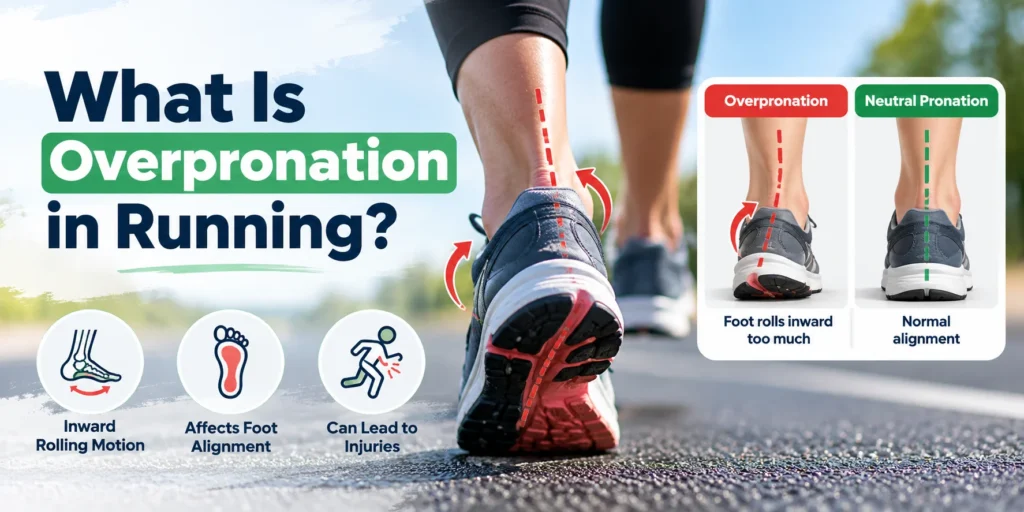
Overpronation is excessive inward rolling of the foot during the stance phase of running. It happens when the arch lowers and the foot moves inward beyond its usual motion pattern.
Pronation itself is completely normal. Your feet need some flexibility to adapt to the ground and transfer force through each stride.
How Does Normal Foot Pronation Work?
When you run, your foot moves through several connected phases. The motion helps your body handle repeated landings.
- Initial contact: Your foot touches the ground, often around the heel or midfoot.
- Loading: Your foot begins accepting body weight and normally rolls inward to some degree.
- Arch movement: The arch lowers as your foot adapts to the surface.
- Midstance: Your body passes over the supporting foot.
- Push-off: Your foot becomes more rigid as you move toward your next stride.
Overpronation describes greater-than-typical inward movement during this sequence. It doesn’t necessarily mean that something is damaged.
What Happens When Your Foot Overpronates?
With overpronation, the ankle and foot may move farther inward under load. The arch can also remain lowered for more of the stance phase.
This changes how muscles, tendons, and joints share forces during running. Whether that becomes uncomfortable depends on your individual strength, training, footwear, and movement pattern.
For a visual explanation, the American Academy of Orthopaedic Surgeons’ pronation animation illustrates different foot movements.
What Is the Difference Between Overpronation, Neutral Pronation, and Supination?
The main difference is how far your foot moves inward after landing. Neutral pronation involves a natural inward roll, while overpronation involves comparatively more inward movement.
Supination, sometimes called underpronation, describes comparatively little inward rolling. These classifications describe movement patterns, not automatic diagnoses.
| Feature | Neutral | Overpronation | Supination |
|---|---|---|---|
| Inward motion | Typical amount | Greater than typical | Less than typical |
| Arch behavior | Lowers naturally | May lower farther | Often remains relatively raised |
| Possible shoe wear | Mixed or even patterns | More inner-side wear | More outer-side wear |
| Possible shoe choice | Comfortable neutral shoe | Neutral or stability shoe, depending on needs | Comfortable neutral shoe |
Important: Outsole wear and arch shape aren’t reliable enough to classify your gait by themselves. A proper assessment considers your movement while walking or running.
What Are the Signs of Overpronation When Running?
The most noticeable sign is excessive inward motion during the supporting phase of a stride. Other clues may involve shoe wear, arch movement, or recurring discomfort.
1. Your Ankles Tilt Inward During Running
A rear-view running video may show your heel and ankle moving inward under load. Some motion is normal, so the amount and timing matter.
2. Your Arches Flatten Under Body Weight
Your arch may become noticeably lower when you stand or run. However, flexible arches naturally change shape when supporting weight.
3. Your Running Shoes Wear More on the Inside
Inner-side outsole wear can sometimes accompany overpronation. Running surface, shoe construction, and foot strike also affect wear patterns.
4. You Experience Recurring Foot or Leg Discomfort
Some runners experience arch fatigue, heel soreness, shin discomfort, or ankle pain. These symptoms have many possible causes and do not prove overpronation.
5. Your Feet Feel Unstable Late in Runs
Some runners notice less controlled landings as their legs become tired. Fatigue can influence movement, although it doesn’t establish a specific gait problem.
What Causes Overpronation in Runners?
Overpronation usually results from a combination of foot structure, movement habits, and individual biomechanics. There isn’t one universal cause.
- Foot structure: Some people naturally have more flexible feet or lower arches.
- Muscle function: Strength, endurance, and coordination influence how the feet handle load.
- Ankle mobility: Limited or altered ankle movement may change foot mechanics.
- Previous injuries: An injured runner may develop compensatory movement patterns.
- Training fatigue: Tired muscles may temporarily change how a runner controls each landing.
- Footwear interaction: Different shoe designs can influence comfort and movement without determining gait alone.
Your foot anatomy is only one part of the picture. Running technique, training demands, and lower-body strength also deserve attention.
Is Overpronation Bad for Running or Does It Cause Injuries?
Overpronation isn’t automatically harmful. Many runners pronate without pain, and research does not establish moderate pronation as a universal injury risk.
A prospective study of 927 novice runners found that ordinary pronated foot posture wasn’t associated with greater injury risk compared with neutral posture during the study.
The study couldn’t rule out risk among runners with highly pronated feet. Other research has found associations with particular injuries, so context matters.
Which Running Injuries May Be Associated With Overpronation?
Excessive or poorly tolerated foot movement may contribute to strain in certain runners. Clinicians may consider pronation when evaluating these conditions:
- Plantar heel pain: Discomfort around the heel or underside of the foot.
- Posterior tibial tendon problems: Pain along the inner ankle or arch.
- Medial tibial stress syndrome: Often called shin splints.
- Achilles tendon problems: Pain or stiffness around the back of the ankle.
- Some knee complaints: Symptoms potentially influenced by several movement and training factors.
These conditions aren’t unique to overpronators. Increasing running mileage too quickly, insufficient recovery, and other physical factors may also contribute.
Persistent pain deserves an individual assessment rather than an automatic switch to corrective shoes.
How Can You Tell If You Overpronate While Running?
A running gait assessment is more informative than simply inspecting your feet while standing. You can begin with a few observations before seeking professional advice.
Step 1: Record Your Running Stride
Place a phone behind you at approximately lower-leg height, using a safe location away from traffic. Record yourself running at a normal, comfortable pace.
Review the video slowly and look for inward heel movement and arch lowering. Foot motion can be difficult to interpret, so avoid diagnosing yourself from one recording.
Step 2: Examine Your Running Shoes
Place your used shoes on a flat surface and examine the heels and outsoles. Look for uneven wear or significant deformation.
Compare both shoes rather than focusing on one worn patch. Wear patterns provide clues, not proof.
Step 3: Check Your Arch Shape
Stand barefoot and observe how your arches change between sitting and standing. You can also compare how they look while rising onto your toes.
A wet-footprint test can offer a rough idea of arch shape. It cannot accurately measure dynamic pronation during running.
Step 4: Consider a Professional Gait Assessment
A sports physical therapist or podiatrist can examine foot movement alongside strength, mobility, and symptoms. A running-store video assessment may help with footwear selection but doesn’t replace medical evaluation.
Do Flat Feet Always Mean You Overpronate?
No. Flat feet and overpronation are related concepts, but they aren’t identical.
Flat feet describe foot shape, while overpronation describes movement. Someone with low arches may pronate normally, while a runner with higher arches can still display considerable inward movement.
Flat feet also don’t automatically require arch supports. Comfort, symptoms, and functional movement matter more than appearance alone.
Should Overpronators Wear Stability Running Shoes?
Some runners who overpronate feel more comfortable with stability shoes, but not everyone needs them. There is no rule requiring every overpronator to avoid neutral footwear.
Stability shoes use design features intended to guide or limit excessive movement. Modern models often rely on wide platforms, shaped foam, and supportive sidewalls instead of rigid corrective posts.
Neutral Running Shoes vs. Stability Running Shoes
- Neutral shoes: Primarily focus on cushioning, fit, and smooth transitions without pronounced corrective support.
- Stability shoes: Add features that guide movement or resist unwanted rolling.
- Supportive neutral shoes: May offer wide, steady platforms without being marketed as stability models.
I recommend comparing comfort and fit before choosing based on the stability label. A shoe should feel secure without forcing your feet into an uncomfortable position.
How Can You Manage Overpronation While Running?
You don’t necessarily need to eliminate inward foot movement. The practical goal is comfortable running with enough strength and control for your training demands.
1. Strengthen Your Feet and Lower Legs
Progressive strengthening can improve how your muscles tolerate running loads. Useful options may include:
- Calf raises: Begin with two-legged raises and progress as tolerated.
- Short-foot exercises: Practice gently lifting the arch without curling the toes.
- Single-leg balance: Develop coordination and control while standing on one foot.
- Resistance-band movements: Strengthen ankle muscles through controlled movement.
Start with comfortable efforts and progress gradually. The AAOS foot and ankle conditioning program provides exercise guidance.
2. Improve Calf and Ankle Mobility
Calf tightness or limited ankle mobility may affect your running mechanics. Gentle calf stretching and controlled ankle movements can support mobility where needed.
Avoid forcing painful stretches. Your mobility routine should reflect your individual limitations.
3. Increase Running Mileage Gradually
Sudden increases in distance or intensity can overload tissues regardless of pronation type. Build training gradually and allow recovery between demanding sessions.
Watch for discomfort that grows across multiple runs. Adjust training rather than repeatedly running through pain.
4. Consider Supportive Shoes or Orthotics
Supportive running shoes can improve comfort for some people. Orthotic inserts may also help manage certain symptoms when properly selected.
Neither option permanently changes your natural foot structure. If you need custom support or experience persistent symptoms, consult a qualified clinician.
How Do You Choose Running Shoes for Overpronation?
Choose shoes according to comfort, fit, running needs, and the amount of support you prefer. The strongest correction isn’t always the best solution.
- Secure heel fit: Your heel should stay comfortably in place without excessive slipping.
- Appropriate width: Your forefoot needs enough room to spread naturally.
- Comfortable support: Guidance features should feel natural rather than intrusive.
- Suitable cushioning: Consider your preferred softness and the distance you usually run.
- Familiar heel-to-toe drop: Large changes in shoe geometry may require adaptation.
- Trial running: Test shoes at your normal pace whenever possible.
My practical shopping rule is simple: prioritize a secure, comfortable running feel over marketing promises about correcting your gait.
How Do Popular Stability Running Shoes Compare in 2026?
These three current models offer different approaches to stability. Their advertised heel-to-toe drops are listed below.
| Shoe | Drop | Support Design | Best Starting Point |
|---|---|---|---|
| Brooks Adrenaline GTS 25 | 10 mm | GuideRails support | Structured daily support |
| ASICS GT-2000 15 | 8 mm | 3D Guidance System | Versatile guided daily running |
| Saucony Guide 19 | 6 mm | CenterPath platform and sidewalls | Broad-platform comfort |
Specifications are based on manufacturer information available in 2026. Actual fit and comfort vary by runner.
Three Stability Running Shoes Worth Considering in 2026
If you want to compare supportive running shoes, these are three useful starting points. They have different support designs, so try them on rather than treating any model as a guaranteed solution.
Affiliate disclosure: Some shopping links below may earn a commission at no additional cost to you. Displayed retailer ratings are snapshots, not independent product-testing scores.
🏆 Structured Daily Support
Brooks Adrenaline GTS 25
★★★★★ 4.6/5
REI customer rating, approximately 806 reviews when checked.
The Adrenaline GTS 25 uses Brooks GuideRails support, DNA LOFT v3 cushioning, and a 10 mm drop. I’d shortlist it for runners seeking a more structured feel during everyday road runs.
⚡ Versatile Guided Running
ASICS GT-2000 15
★★★★★ 5.0/5
Running Warehouse customer rating from one review; too small a sample for a reliable consensus.
This model combines FF BLAST MAX cushioning, an 8 mm drop, and ASICS’ 3D Guidance System. I’d compare it when looking for everyday support with a less overtly corrective design.
☁️ Broad-Platform Comfort
Saucony Guide 19
★★★★☆ 4.4/5
REI customer rating, approximately 67 men’s-shoe reviews when checked.
The Guide 19 uses PWRRUN foam, CenterPath technology, and a 6 mm drop. I’d consider it for runners who prefer support through a broad platform and raised sidewalls.
Frequently Asked Questions About Overpronation
Is overpronation normal when running?
Some inward foot rolling is a normal part of running. Overpronation refers to movement beyond the typical range, but it isn’t automatically a medical problem. If your running remains comfortable and injury-free, your natural movement pattern may not require correction.
Can you correct overpronation naturally?
Exercises may improve strength, mobility, and movement control, but they don’t guarantee a permanent change in foot structure or pronation. Strengthening, sensible training loads, and comfortable footwear can help manage symptoms. A physical therapist can identify which changes are appropriate for you.
Can you run with overpronation?
Yes. Many people run comfortably despite having pronated feet. What matters is whether your movement pattern is associated with pain or functional limitations. Choose comfortable footwear, progress training gradually, and seek professional assessment if symptoms repeatedly interrupt your running.
Do all overpronators need arch-support shoes?
No. Some runners benefit from stability shoes or inserts, while others remain comfortable in neutral models. Shoe selection should consider your symptoms, preferred support, fit, and running habits. Pronating more than average does not automatically mean you need strong corrective support.
Can overpronation cause knee or shin pain?
Overpronation may contribute to certain knee or shin complaints in some runners, but it isn’t the only possible cause. Training load, muscle strength, previous injuries, and other biomechanical factors can play roles. Recurrent pain should be assessed rather than automatically blamed on foot alignment.
Final Takeaway: Should You Worry About Overpronation?
Overpronation describes excessive inward foot movement during running. It can be relevant to discomfort or injury assessment, but it’s not automatically dangerous.
The most useful approach is to evaluate symptoms, training habits, strength, and footwear together. Choose running shoes that feel comfortable and supportive without unnecessarily restricting your stride.
Next step: Observe your running pattern, compare comfortable shoe options, and get professional advice if persistent pain affects your training. Your goal is comfortable, sustainable running—not forcing every foot into the same movement pattern.


Steven is a former sportsperson and now a full-time businessman and research writer. He is the mastermind of this site, and he created this site to help people who need specialized shoes for different activities. When he was a sportsperson, he was very passionate about different types of shoes for his sports purpose. The passion he had for shoes at that time now turned into his profession. Besides his shoe business, he loves sharing his knowledge and experience with people and helping them maintain healthy feet.
More Posts