
Quick Answer
High-stack running shoes place more material between your feet and the ground, often providing a more cushioned ride. Low-stack running shoes sit closer to the ground, typically offering greater ground feel and flexibility. Neither design is automatically better for injury prevention or performance, according to current running footwear research.
Key differences
- High stack: More underfoot material, often suited to cushioned daily training and long runs.
- Low stack: Less underfoot material, appealing to runners who prefer road feel and flexibility.
- Ground stability: Lower platforms can feel more connected, but base width and construction also matter.
- Muscle loading: Changing shoe geometry can redistribute stress across your feet and legs.
- Best overall: Choose the shoe that fits comfortably and supports your normal training.
My recommendation
- Prefer cushioning? Start with a stable high-stack daily trainer.
- Prefer ground feel? Try a flexible, lower-stack design.
- Unsure? Compare moderate-stack shoes before choosing either extreme.
Choosing between high stack vs low stack running shoes can feel confusing. Two shoes may look similar yet provide completely different running experiences.
I find it more useful to compare how shoes feel during running than to judge them by sole thickness alone. This guide explains the differences, trade-offs, and practical buying decisions for 2026.
What Does Stack Height Mean in Running Shoes?
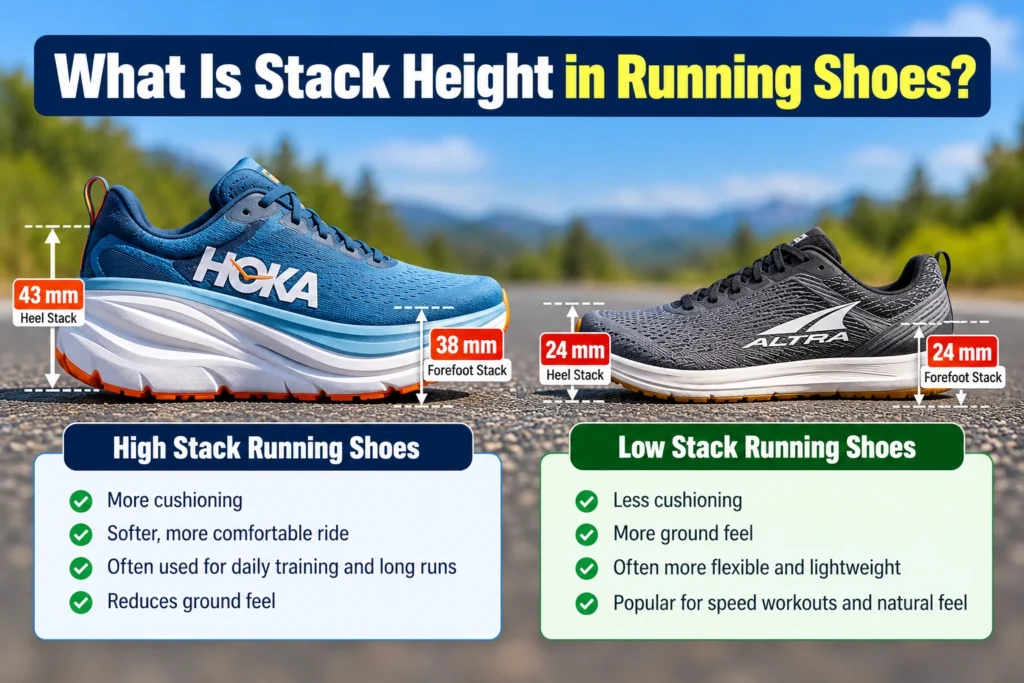
Stack height is the vertical thickness of the shoe’s construction beneath your foot. It is usually expressed in millimeters at the heel and forefoot.
A taller stack places more material between your foot and the ground. A shorter stack places your foot closer to the running surface.
How Is Stack Height Measured?
Shoe specifications commonly report heel stack height and forefoot stack height separately. These measurements describe the vertical dimensions at different positions beneath the foot.
- Heel stack: Thickness beneath the rear of your foot.
- Forefoot stack: Thickness beneath the front of your foot.
- Total construction: Depending on the measurement standard, stack figures account for different layers of the shoe.
- Measurement differences: Manufacturer specifications and independent laboratory results may not match exactly.
These differences matter when comparing brands. Use measurements from the same testing method whenever possible.
Is Stack Height the Same as Heel-to-Toe Drop?
No. Stack height describes how much material sits under your foot, while heel-to-toe drop describes the height difference between heel and forefoot.
For example, a shoe with a 36 mm heel and 28 mm forefoot has an 8 mm drop. A shoe with 24 mm under both areas has a zero-millimeter drop.
High-stack shoes can have low drops. Low-stack shoes can also have noticeable heel-to-toe drops.
This distinction is important because drop influences ankle positioning and loading independently of overall stack height.
What Is Considered High or Low Stack Height?
There is no universally accepted industry classification separating low, medium, and high stack heights. The boundaries also change as footwear designs evolve.
For everyday road-running comparisons in 2026, the following informal ranges offer a useful starting point.
- Low stack: Below approximately 30 mm at the heel.
- Moderate stack: Approximately 30–39 mm at the heel.
- High stack: Approximately 40 mm or more at the heel.
These ranges are shopping guidelines, not official technical standards. Some research considers shoes around 35 mm relatively high when compared with thinner designs.
Always check the forefoot height, too. Two shoes with identical heel stacks can feel different when their drops and foam constructions differ.
High Stack vs Low Stack Running Shoes: Comparison Chart
The biggest practical differences involve cushioning volume, ground feel, flexibility, and platform geometry. Neither category guarantees a particular level of comfort or stability.
| Feature | High Stack | Low Stack |
|---|---|---|
| Heel height | Often 40+ mm | Often below 30 mm |
| Cushioning volume | Usually greater | Usually less |
| Ground feel | Generally reduced | Generally greater |
| Flexibility | Depends on rocker, foam, and plates | Often more flexible |
| Platform stability | Depends heavily on base width | Lower center of mass may feel steadier |
| Typical preference | Plush daily or recovery runs | Flexible, connected running |
| Main trade-off | Less ground sensation | Less cushioning volume |
Important: These are tendencies rather than guarantees. Foam softness, outsole construction, shoe width, and rocker geometry can outweigh the stack-height difference.
Do High Stack Running Shoes Provide Better Cushioning?
High-stack shoes generally allow manufacturers to use more cushioning material. However, greater thickness does not necessarily mean softer landings or better comfort.
The foam formulation and shoe geometry influence how cushioning behaves under your weight. A thick, firm shoe may feel less plush than a thinner shoe made with softer foam.
How Does a High-Stack Midsole Feel?
A cushioned high-stack shoe may compress noticeably during landing and provide a rolling transition. Some models use rocker-shaped soles to guide movement from heel to toe.
The HOKA Bondi 9 illustrates this design approach with its thick supercritical EVA foam midsole. Its broad platform and rocker geometry help define its ride.
Does More Foam Mean Better Shock Absorption?
Not necessarily. A 2026 systematic review of shoe sole thickness examined 14 studies involving running biomechanics and economy.
Thicker soles generally showed lower loading rates, but peak vertical ground-reaction forces remained largely unchanged. The researchers rated the overall certainty of evidence as low to very low.
That means extra foam can change impact characteristics without proving better injury protection. Comfort remains an important consideration.
Are Low Stack Running Shoes More Stable?
Low-stack shoes often feel more stable because the foot sits closer to the ground. However, stack height alone cannot determine a shoe’s stability.
A wider high-stack shoe may feel steadier than a narrow low-stack model. Sidewalls, outsole shape, and foam firmness also influence balance.
What Does the Research Say?
A 2025 running biomechanics study compared shoes with approximately 27 mm, 35 mm, and 50 mm stacks. Seventeen experienced runners completed treadmill trials at two speeds.
The highest-stack condition produced changes in running mechanics, including indicators of reduced dynamic stability. However, the study did not establish that high-stack shoes cause more injuries.
My practical advice is to test stability while moving rather than standing still. A shoe can feel secure in a store yet behave differently around corners.
Which Stack Height Is Better for Long-Distance Running?
For long-distance training, the better stack height is the one that remains comfortable throughout your intended mileage. Many runners prefer generous cushioning, but some prefer a firmer, more connected ride.
High Stack for Long Runs
A well-designed high-stack shoe can offer considerable cushioning across repetitive training miles. That makes these models attractive for easy runs, recovery sessions, and prolonged road running.
However, extra height is not useful if the shoe feels unstable or disrupts your natural stride.
Low Stack for Long Runs
Experienced runners who prefer ground feel may find low-stack shoes comfortable over long distances. Their lighter and more flexible constructions can feel less bulky.
The drawback is reduced cushioning volume. Lower-stack running also requires adequate tolerance for the demands placed on your feet and lower legs.
Practical tip: Test a prospective long-run shoe during shorter sessions before extending the distance. Comfort during the first mile does not guarantee comfort after several more.
Are High Stack or Low Stack Shoes Better for Running Speed?
Neither stack category automatically makes a runner faster. Running economy depends on multiple shoe properties, including weight, foam response, stiffness, and geometry.
Modern high-stack racing shoes often combine lightweight, resilient foam with specialized plates. Their performance characteristics should not be attributed to stack height alone.
Low-stack designs can also feel responsive, particularly during short workouts. Their appeal often comes from flexibility, lower bulk, and more immediate ground feedback.
- Easy pace: Prioritize comfortable cushioning and smooth transitions.
- Tempo running: Look for an efficient, responsive ride.
- Speed workouts: Consider secure fit, weight, and stability.
- Racing: Evaluate the complete shoe design rather than stack height alone.
For performance comparisons, similar weights and intended uses make comparisons more meaningful. Comparing a maximal daily trainer with a lightweight racing flat can be misleading.
Can Stack Height Affect Running Injuries?
Stack height changes how the shoe interacts with your feet and legs. However, there is insufficient evidence to identify one stack-height category as universally safer.
Training volume, progression, previous injuries, and individual tolerance remain important risk considerations.
Can High Stack Shoes Cause Ankle Problems?
Taller soles can create stability challenges in certain designs and movements. This concern may be more noticeable on uneven ground or during sharp turns.
However, broad platforms and supportive geometry can improve the feeling of stability. Height alone is not proof of ankle injury risk.
Can Low Stack Shoes Increase Calf or Achilles Loading?
Lower-stack shoes are often paired with low heel-to-toe drops, but the features are separate. Changing to a lower-drop design can alter demands on the calves and Achilles tendon.
A systematic review of footwear construction identified increased ankle and forefoot loading with minimalist footwear. These findings support gradual adaptation rather than abrupt changes.
Runners experiencing persistent foot, calf, or Achilles pain should avoid forcing the transition. A qualified clinician can help assess recurring symptoms.
Who Should Choose High Stack Running Shoes?
High-stack shoes are worth considering when cushioning and underfoot protection are your main priorities. They are particularly appealing for runners who enjoy a substantial midsole.
High Stack May Suit You If:
- You enjoy a deeply cushioned ride during easy runs.
- You regularly complete longer road-running sessions.
- You prefer rocker-assisted heel-to-toe transitions.
- You want substantial cushioning for walking and running.
- You feel comfortable and secure on a taller platform.
Don’t assume the tallest shoe will always be the most comfortable. Try several cushioning densities before deciding.
Who Should Choose Low Stack Running Shoes?
Low-stack shoes may suit runners who prefer a more direct connection with the running surface. They can also appeal to people who dislike bulky midsoles.
Low Stack May Suit You If:
- You prefer a flexible shoe that bends with your foot.
- You value greater feedback from the ground.
- You enjoy lightweight, relatively simple running designs.
- You already tolerate lower-stack or lower-drop footwear.
- You want a shoe for shorter runs or controlled speed sessions.
Low stack does not automatically mean zero drop or barefoot-style construction. Check both measurements before buying.
Are High or Low Stack Shoes Better for Trail Running?
Trail-running preferences depend heavily on surface conditions. Smooth paths may suit either category, while technical ground creates additional stability and protection demands.
High Stack on Trails
More underfoot material may help isolate the foot from rocks and uneven surfaces. The trade-off can be reduced trail feedback.
Look for suitable outsole traction and a stable platform. A thick road shoe is not automatically a suitable trail shoe.
Low Stack on Trails
Lower platforms can provide a more direct sense of uneven terrain. Some runners appreciate that feedback when adjusting foot placement.
However, thinner protection may allow sharp rocks to feel more noticeable. Rock plates and outsole construction also matter.
What Are Real Examples of High, Moderate, and Low Stack Running Shoes?
The following manufacturer-reported specifications illustrate three different road-running designs available in 2026. These figures represent published designs, not independent laboratory measurements.
| Running Shoe | Heel Stack | Drop | Category |
|---|---|---|---|
| HOKA Bondi 9 | 43 mm | 5 mm | High stack |
| Saucony Ride 19 | 36 mm | 8 mm | Moderate stack |
| Altra Escalante 5 | 24 mm | 0 mm | Low stack |
HOKA reports the Bondi 9’s approximately 43 mm heel stack, while Saucony lists the Ride 19 at 36 mm and Altra lists the Escalante 5 at 24 mm. All figures are model-specific.
Notice how the drops differ independently of stack height. That is why comparing only heel thickness can hide important differences.
How Should You Transition Between High and Low Stack Shoes?
Switching footwear changes the experience of landing and pushing off. A gradual transition gives you time to assess how your body responds.
- Compare specifications: Review heel stack, forefoot stack, drop, and overall design.
- Start with short runs: Introduce the unfamiliar shoe during a brief, comfortable session.
- Keep your familiar pair: Alternate shoes instead of immediately replacing all your regular runs.
- Monitor discomfort: Pay attention to unusual calf, Achilles, foot, or ankle symptoms.
- Increase gradually: Extend time or mileage only when the new shoe feels consistently comfortable.
There is no universal transition schedule that works for everyone. Your starting footwear, training history, and symptoms affect the appropriate pace.
Safety note: Persistent or worsening pain is a reason to reduce loading and seek appropriate medical advice.
How Can Beginners Choose the Right Stack Height?
Beginners should prioritize comfortable fit and an appropriate running shoe over extreme stack-height specifications. A moderately cushioned daily trainer offers a useful starting comparison.
I recommend evaluating several practical details before committing to a particular model.
- Fit: Your toes should have space without excessive heel movement.
- Comfort: The shoe should feel natural during walking and light jogging.
- Cushioning: Choose a level that feels supportive without forcing your stride.
- Stability: Check how secure the shoe feels during turns and direction changes.
- Drop: Avoid major geometry changes without allowing adaptation.
- Purpose: Match the shoe to road running, treadmill sessions, or trail conditions.
A specialty running store can help you compare multiple options. Do not rely solely on online categories such as maximum cushioning or natural running.
What Mistakes Should You Avoid When Comparing Stack Heights?
The biggest purchasing mistake is treating stack height as a complete description of a shoe. It is only one part of the design.
- Assuming taller means softer: Foam materials and densities vary considerably.
- Confusing stack with drop: These measurements describe different characteristics.
- Ignoring platform width: Base geometry can strongly influence stability.
- Changing too quickly: Sudden footwear changes may create unfamiliar loading.
- Choosing by appearance: A thick sole does not guarantee better performance.
- Ignoring fit: Even an excellent shoe can be unsuitable for your foot shape.
My preferred approach is to shortlist shoes by intended use first. Then I compare the stack, drop, fit, and ride characteristics.
Do High Stack Running Shoes Meet Racing Rules?
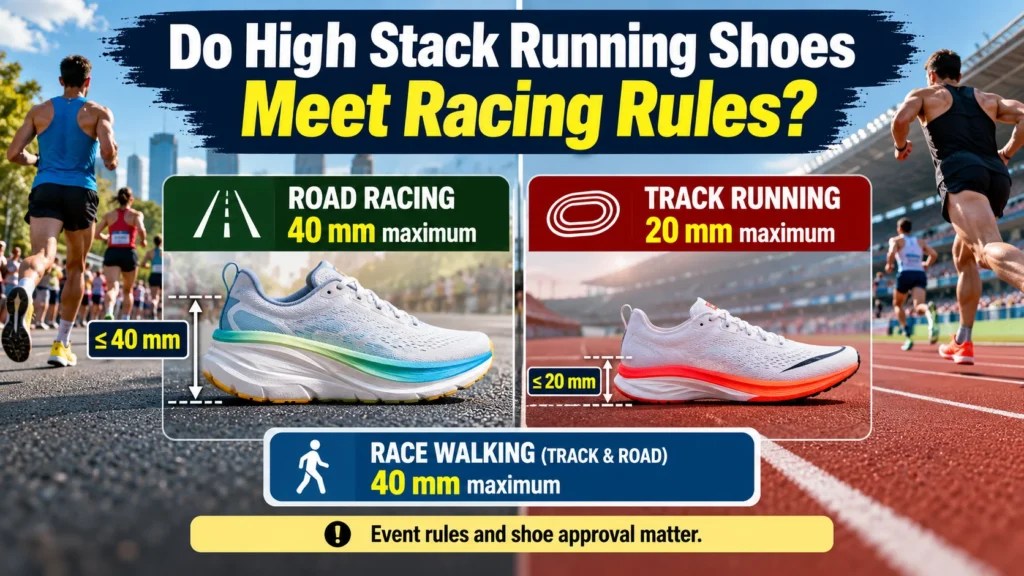
Not every high-stack shoe is eligible for regulated athletic competitions. Shoe legality depends on the event, construction, and applicable competition rules.
For example, World Athletics regulations impose sole-thickness limits for relevant competitive events. Consult the current World Athletics rulebook and approved footwear information before racing.
These restrictions do not prevent recreational runners from using thicker shoes during ordinary training. A shoe’s competition eligibility is separate from its comfort or training suitability.
Which High Stack and Low Stack Running Shoes Are Worth Considering in 2026?
If you’re ready to compare actual shoes, these three models represent different approaches to cushioning and ground feel. The scores are editorial assessments based on published design information, not customer ratings or firsthand wear-test results.
🏆 Best for Maximum Cushioning
HOKA Bondi 9
★★★★☆ 4.0/5
With a manufacturer-reported 43 mm heel stack and 5 mm drop, the Bondi 9 emphasizes substantial cushioning. Its supercritical EVA foam and rocker geometry make it my shortlist choice for runners prioritizing a plush daily-training experience. The taller platform and substantial build will not suit everyone.
⚖️ Best Balanced Alternative
Saucony Ride 19
★★★★☆ 4.0/5
The Ride 19 uses a 36 mm heel stack, 28 mm forefoot stack, and 8 mm drop. Its PWRRUN+ cushioning targets versatile daily training. I would shortlist it for runners who want comfortable cushioning without committing to a maximal platform.
👟 Best for Low-Stack Ground Feel
Altra Escalante 5
★★★½☆ 3.5/5
The Escalante 5 combines a 24 mm stack with a zero-drop platform. Its Altra EGO foam and spacious FootShape fit support a closer-to-ground running experience. I would primarily recommend considering it if you already enjoy low-drop shoes or can transition carefully.
Shopping reminder: Check model generation, width, sizing, and seller details before purchasing. Amazon search results may include different models or older releases.
Frequently Asked Questions
Are High Stack Running Shoes Better for Beginners?
Not automatically. Beginners may enjoy the cushioning of high-stack shoes, but comfort, fit, stability, and training suitability matter more than maximum thickness. A moderately cushioned daily trainer is often a sensible starting point because it allows runners to discover their preferences without choosing an extreme design.
Are Low Stack Running Shoes Better for Your Feet?
There is no strong evidence that low-stack running shoes are universally healthier for your feet. They may provide greater ground feedback and flexibility, but they can also change loading patterns. The right choice depends on previous footwear experience, running mechanics, training demands, and individual comfort.
Do High Stack Shoes Make You Run Slower?
No. High-stack shoes do not automatically make you slower. Some performance-focused racing shoes combine tall stacks with lightweight foams and specialized plates. However, thick daily trainers may feel bulky compared with lighter designs. Overall performance depends on the complete construction rather than stack height alone.
Can You Alternate Between High and Low Stack Running Shoes?
Yes, runners can alternate between high- and low-stack shoes when both designs feel comfortable. Different shoes may change underfoot sensations and loading patterns, so introduce unfamiliar footwear gradually. Alternating pairs does not guarantee injury prevention, but it can help runners choose footwear according to workout preferences.
What Is the Best Stack Height for Running Shoes?
There is no single best stack height for everyone. Lower stacks generally favor ground feel, while higher stacks provide more room for cushioning materials. For runners without a strong preference, a moderate-stack shoe is a reasonable starting point. Fit, comfort, drop, and stability should guide the final decision.
Final Verdict: Should You Choose High Stack or Low Stack Running Shoes?
High stack vs low stack running shoes is not a simple contest with one winner. Each design offers different advantages depending on the runner and intended use.
Choose high stack if you prefer substantial cushioning and feel stable in taller shoes. Consider low stack if you value ground feedback, flexibility, and already tolerate the associated loading demands.
For many runners, a moderately cushioned shoe offers a useful compromise. Whichever category you prefer, prioritize a comfortable fit and gradual training progression.
My final recommendation: Compare at least two stack heights before buying. The best running shoe is the one that feels secure, comfortable, and appropriate for your running routine.


Steven is a former sportsperson and now a full-time businessman and research writer. He is the mastermind of this site, and he created this site to help people who need specialized shoes for different activities. When he was a sportsperson, he was very passionate about different types of shoes for his sports purpose. The passion he had for shoes at that time now turned into his profession. Besides his shoe business, he loves sharing his knowledge and experience with people and helping them maintain healthy feet.
More Posts