
Quick Answer
Running shoe midsoles work by compressing under your body weight, cushioning the landing, and recovering their shape as you move forward. Their materials and geometry influence shock absorption, energy return, comfort, and stability. Some also provide motion guidance, as explained in our neutral vs stability running shoes guide.
How a Midsole Works During Each Step
- Foot contact: Your shoe meets the ground and begins supporting your body.
- Foam compression: Midsole materials deform under load and help cushion the landing.
- Energy storage: Some mechanical energy is temporarily stored in the compressed foam.
- Foam recovery: The material rebounds, returning part of its stored energy.
- Forward transition: Midsole shape, flexibility, and stiffness help determine how smoothly your foot rolls toward toe-off.
What Matters Most?
- Foam properties: Affect softness, resilience, and energy loss.
- Stack height: Determines how much material separates your foot from the ground.
- Midsole geometry: Influences stability and transitions.
- Personal comfort: Helps determine whether a particular design suits your running style.
Have you ever wondered why two running shoes can feel completely different, even with similar cushioning? The answer often lies in their midsoles.
I think understanding this hidden layer makes shoe shopping much easier. This guide explains how midsoles work, how different foams behave, and which features deserve your attention.
What Is a Running Shoe Midsole?
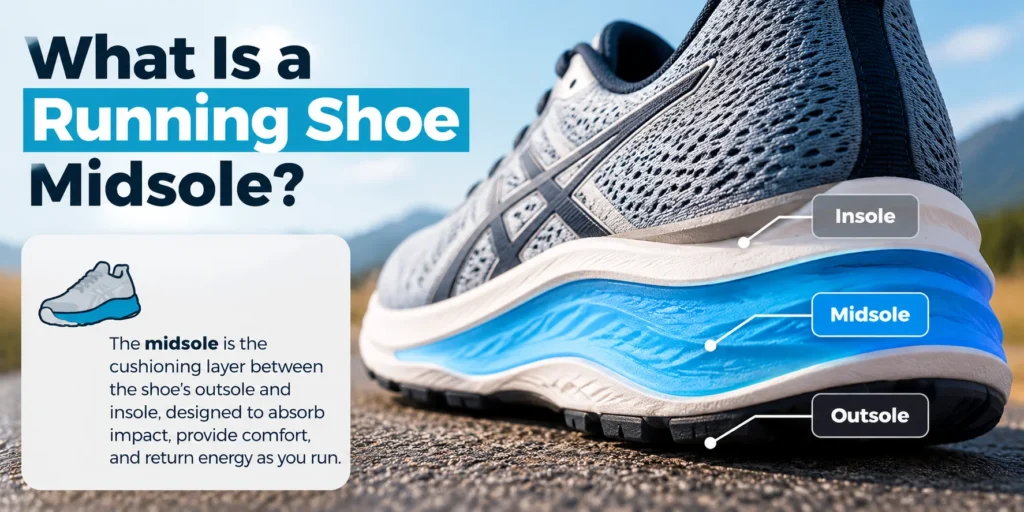
A running shoe midsole is the cushioning and structural layer positioned between the upper part of the shoe and its ground-contacting outsole. Its main functions include cushioning, managing deformation under load, and influencing foot movement.
Most modern running midsoles use engineered foam. Some also contain plates, air-filled units, or additional supporting structures.
Where Is the Midsole Located?
A typical running shoe has several important layers. Each performs a different job.
- Upper: Wraps your foot and helps provide a secure fit.
- Sockliner: Provides the removable or fixed layer directly beneath your foot.
- Midsole: Supplies most of the shoe’s cushioning and influences its ride characteristics.
- Outsole: Contacts the running surface and provides traction and wear resistance.
The midsole is often the thickest visible part of the sole. However, a thicker midsole does not automatically mean softer cushioning.
Why Is the Midsole Important?
The midsole changes how your foot interacts with the ground. It can influence the timing and distribution of forces during landing and push-off.
Its design also affects the shoe’s perceived comfort. A soft foam may feel pleasant while standing but less controlled during running.
- Landing comfort: Reduces the harsh sensation associated with ground contact.
- Energy management: Stores, dissipates, and returns mechanical energy.
- Stability: Influences how securely your foot moves over the platform.
- Transitions: Helps determine how naturally your foot rolls forward.
How Does Running Shoe Midsole Foam Work During Each Step?
Midsole foam works through repeated compression and recovery. Its response depends on the force applied, the speed of loading, and its material properties.
Running creates a repeating cycle of landing, support, and push-off. The foam changes shape throughout that cycle.
Step 1: Your Foot Lands
When your foot reaches the ground, the shoe begins experiencing increased loading. The magnitude and timing depend on your speed, landing pattern, and movement.
The midsole starts deforming as that load rises. Its shape and material influence how quickly deformation occurs.
Step 2: The Foam Compresses
As your weight moves onto the shoe, the foam compresses. This deformation provides cushioning and can extend the time over which some forces develop.
Different foams respond differently to the same load. Softer materials usually deform more easily under comparable testing conditions.
Step 3: Energy Is Stored and Lost
Compression temporarily stores mechanical energy inside the foam. However, some energy is dissipated as heat rather than returned.
This energy loss is part of a behavior called hysteresis. Materials with lower energy loss can offer greater mechanical energy return.
Step 4: The Midsole Rebounds
As the load decreases, the compressed foam moves toward its original shape. Some stored energy returns during this recovery.
This contributes to the responsive or springy sensation associated with certain shoes. The foam does not create extra energy by itself.
Step 5: Your Foot Moves Toward Toe-Off
During push-off, the midsole works with your foot, ankle, and lower-leg muscles. Its stiffness and geometry can change the way your body performs mechanical work.
A curved or rockered sole may encourage a smoother rolling movement. A flexible shoe may allow more bending around the forefoot.
What Is the Difference Between Cushioning, Shock Absorption, and Energy Return?
Cushioning, shock absorption, and energy return describe related but different midsole characteristics. Understanding them helps explain why softness alone cannot predict performance.
- Cushioning: The overall underfoot protection and feel created by the shoe’s materials and construction.
- Shock absorption: The ability of the shoe system to attenuate or manage mechanical loading during impact.
- Energy return: The proportion of stored mechanical energy that the material releases during recovery.
Consider two imaginary shoes with similarly thick midsoles. One uses a soft foam that loses considerable energy, while the other uses a more resilient foam.
The first may feel plush but somewhat dull. The second may offer a more energetic sensation despite having similar thickness.
Research published in Scientific Reports examines how footwear characteristics interact with running economy. It reinforces the importance of considering complete shoe designs rather than one feature.
What Materials Are Running Shoe Midsoles Made From?
Modern running shoe midsoles commonly use EVA, TPU, PEBA, or blends of different polymers. Each material family can be engineered into multiple cushioning characteristics.
Manufacturing methods also matter. Foam density, cell structure, additives, and processing can change the behavior of the finished midsole.
EVA Foam
Ethylene-vinyl acetate (EVA) is a widely used running shoe foam material. It offers versatile cushioning and can be manufactured at different firmness levels.
Traditional EVA formulations may have lower resilience than some premium performance foams. However, modern processed EVA blends can behave quite differently from older versions.
TPU Foam
Thermoplastic polyurethane (TPU) is another material used in running shoe cushioning systems. Depending on its formulation, it can offer good resilience and durability.
Expanded TPU materials are used in some responsive running shoes. Their finished weight and feel depend on the particular foam construction.
PEBA Foam
Polyether block amide (PEBA) appears in numerous performance-oriented midsoles. Certain PEBA formulations combine low weight with high resilience.
This makes PEBA attractive for responsive training and racing footwear. Nevertheless, PEBA alone does not guarantee improved running economy.
A 2024 study comparing EVA and PEBA footwear investigated running economy and biomechanics in trained runners. It also examined how the shoes performed after 450 kilometers of use.
EVA vs TPU vs PEBA: Midsole Material Comparison
| Characteristic | EVA | TPU | PEBA |
|---|---|---|---|
| Full name | Ethylene-vinyl acetate | Thermoplastic polyurethane | Polyether block amide |
| Common applications | Daily trainers and many other shoe categories | Responsive trainers and specialized cushioning | Performance trainers and racing shoes |
| Weight potential | Varies by formulation | Can be relatively dense | Can be very lightweight |
| Energy return | Formulation-dependent | Some versions are highly resilient | Some versions offer very high resilience |
| Typical design priority | Versatility and cost flexibility | Resilience and material durability | Low weight and responsiveness |
Important: These are general material tendencies, not guaranteed specifications. Two midsoles made from the same polymer can feel dramatically different.
Are Softer and Thicker Running Shoe Midsoles Better?
Not necessarily. More midsole material changes the shoe’s geometry, while softer foam changes how easily it compresses.
The best combination depends on your preferences and running conditions. More cushioning is not automatically more comfortable or safer.
What Does Stack Height Mean?
Stack height measures the amount of shoe material between your foot and the ground. Manufacturers usually report heel and forefoot measurements in millimeters.
For example, a shoe with 36 mm at the heel and 28 mm at the forefoot has an 8 mm heel-to-toe drop. Measurement methods can vary, so compare figures carefully.
- Lower stack: Often provides greater ground feel and a lower platform.
- Moderate stack: Can balance cushioning, weight, and ground connection.
- Higher stack: Provides more material beneath the foot but may require careful stability design.
Does Soft Foam Always Absorb More Impact?
No. Foam softness, impact attenuation, and resilience are separate properties.
A soft material may compress considerably without offering the best response under every loading condition. The overall shoe design influences how cushioning performs.
Can Too Much Cushioning Affect Stability?
It can. A tall, narrow, and highly compliant platform may feel less controlled during uneven landings.
However, a wide base, supportive sidewalls, and carefully tuned geometry can improve stability. High-stack shoes should not automatically be considered unstable.
How Do Midsole Shape, Heel Drop, and Plates Change Running Performance?
Foam is only part of the midsole system. Geometry and structural components also influence running mechanics.
Rocker Geometry
A rocker is a curved sole shape that influences how the shoe rolls forward. It may help guide transitions without requiring the shoe to bend as much at the forefoot.
Different rocker designs suit different running patterns. The most aggressive curve is not necessarily the most comfortable.
Heel-to-Toe Drop
Heel-to-toe drop is the difference between heel and forefoot stack heights. A shoe can have a tall midsole and still have a low drop.
Changing drop can alter how the ankle and lower leg work. Runners accustomed to higher-drop shoes may need time to adapt to lower-drop designs.
Carbon and Nylon Plates
Some performance shoes contain stiff plates embedded in the midsole. These plates change bending stiffness and interact with foam compression and sole geometry.
They do not independently generate propulsion. The performance effect comes from how the entire shoe interacts with a runner’s movement.
Midsole Stability Features
Running shoes can also use sidewalls, wider platforms, and selectively firmer areas to guide foot movement. Traditional stability shoes sometimes use firmer foam along the inner side.
These systems may influence inward rolling, also called pronation. Our guide explaining overpronation in running covers that movement in greater detail.
Can Running Shoe Midsoles Improve Running Economy?
Yes, certain midsole technologies can improve running economy for some runners. Running economy describes the energy required to maintain a particular running speed.
The benefit depends on the runner, shoe construction, and testing conditions. No foam material guarantees faster running.
What Does Research Show?
A 2026 controlled study tested 19 well-trained male runners using shoes that differed in midsole compliance. The more compliant shoe improved running economy by 3.90% under the study conditions.
The researchers also observed changes in knee mechanics and joint power. Read the published midsole compliance study for its methods and results.
These findings do not mean every softer shoe produces the same benefit. The experiment involved a specific shoe comparison and participant group.
Why Do Some Racing Shoes Feel More Efficient?
Advanced racing shoes often combine resilient foam, curved geometry, and increased bending stiffness. These components can work together to change muscular and mechanical demands.
- Resilient foam: Reduces some mechanical energy loss during compression.
- Structural stiffness: Influences how the foot and shoe bend.
- Rocker geometry: Changes the movement from landing toward toe-off.
- Lightweight construction: Helps limit the additional mass of cushioning and structural components.
A review of advanced footwear technology in endurance running discusses these interacting mechanisms. The evidence does not support treating any single feature as a universal performance solution.
Which Midsole Type Should You Choose for Your Running Style?
Choose a midsole based on your running needs, not the foam name alone. Comfort and a predictable ride are useful starting points.
For Beginners and Everyday Running
Consider balanced cushioning with a stable platform and comfortable fit. A neutral daily trainer can be a sensible starting point.
- Prioritize reliable comfort at an easy pace.
- Look for smooth transitions without an awkward rolling sensation.
- Avoid paying extra for racing technology you do not need.
For Long-Distance Running
Many distance runners appreciate substantial cushioning during longer sessions. However, the shoe must remain comfortable as fatigue develops.
- Look for consistent heel and forefoot cushioning.
- Check whether the foam feels stable during slower running.
- Consider weight, platform width, and overall fit.
For Faster Training and Racing
Responsive foam may suit runners seeking an energetic transition. Plated models can also be useful, but they are not essential for every speed session.
- Compare responsive foams rather than relying on marketing labels.
- Test shoes at your intended running pace.
- Make sure the geometry feels natural before racing.
For Runners Who Prefer Extra Support
Midsole shape and structural features may matter more than maximum softness. A broad platform can feel supportive even without a traditional medial post.
Arch shape alone does not determine your ideal midsole. Our guide on whether running shoes need arch support explains why comfort and individual movement matter.
How Can You Test a Running Shoe Midsole Before Buying?
You cannot judge the complete running experience by squeezing the foam with your fingers. A short movement test provides more useful information.
When I compare midsole designs, I prioritize the way the shoe behaves during movement over its initial softness. The following process is a practical way to make that comparison.
- Check the fit. Confirm that your toes have room and your heel stays secure.
- Walk naturally. Notice whether the shoe rolls forward smoothly.
- Jog briefly. Test the cushioning at your usual easy pace where permitted.
- Compare landing comfort. Look for cushioning that feels comfortable without excessive sinking.
- Check stability. Notice whether the platform feels predictable during gentle turns.
- Repeat the comparison. Try another model before deciding which feels better.
For example, compare a conventional daily trainer with a highly responsive model. Focus on the differences in control, transitions, and comfort rather than trying to identify which foam is technically superior.
Do not assume a five-minute shop test guarantees long-run comfort. It is only an initial screening method.
How Long Do Running Shoe Midsoles Last?
Running shoe midsoles gradually change through repeated loading, environmental exposure, and material aging. Their useful lifespan varies considerably by model and running conditions.
Foam degradation does not always produce obvious visible damage. The shoe may lose some of its original cushioning characteristics while its upper still looks acceptable.
Signs Your Midsole May Be Wearing Out
- Reduced cushioning: The shoe feels noticeably flatter than when it was new.
- Persistent compression: Certain areas remain visibly compressed.
- Uneven support: One side feels less stable than the other.
- Cracking or separation: The foam shows structural deterioration.
- Changed running feel: The shoe no longer provides the familiar, comfortable ride.
A shoe’s mileage alone cannot establish whether its midsole is finished. Compare its condition, fit, and behavior with a newer pair when possible.
What Mistakes Should You Avoid When Choosing Running Shoe Midsoles?
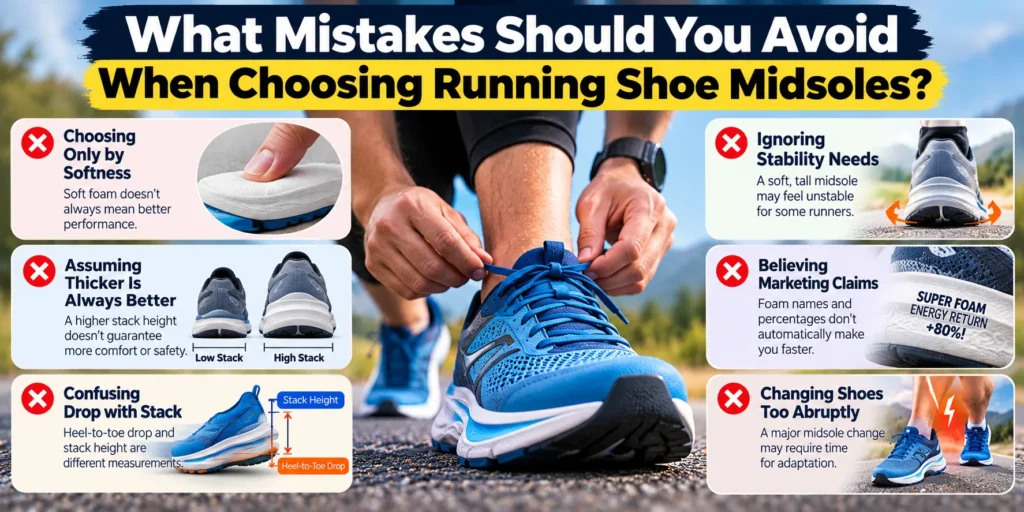
The biggest mistake is assuming one cushioning feature determines the entire shoe’s performance. Midsole materials work together with fit, geometry, and outsole construction.
- Choosing only by softness: Plush standing comfort does not guarantee comfortable running.
- Assuming thicker is better: High stack height does not automatically improve comfort or stability.
- Confusing drop with stack: These measurements describe different shoe properties.
- Believing energy-return percentages equal speed gains: Mechanical foam measurements cannot directly predict personal race results.
- Ignoring platform width: Cushioning feel and stability depend partly on sole geometry.
- Changing footwear abruptly: Major changes in drop, stiffness, or cushioning may require adaptation.
- Expecting shoes to prevent every injury: Footwear cannot replace appropriate training, recovery, and clinical assessment when needed.
Running on hard surfaces also makes overall comfort and outsole durability important. Explore our running shoes for concrete floors guide for related buying considerations.
Recommended Running Shoes for Different Midsole Experiences
These three established models illustrate different approaches to midsole construction. They are comparison examples based on manufacturer-listed features, not claims of hands-on testing.
The editorial scores below assess the models’ stated design and intended use. They are not customer ratings or laboratory performance measurements.
🏆 Balanced Daily Cushioning
Brooks Ghost 17
★★★★☆ 4.0/5
The Ghost 17 uses nitrogen-infused DNA LOFT v3 cushioning with a manufacturer-listed 10 mm drop. Its balanced design makes it a useful example of everyday cushioning without a performance racing plate.
I would shortlist it for runners seeking a traditional, predictable daily-training experience rather than maximum springiness.
⚡ Energetic Daily Cushioning
ASICS Novablast 5
★★★★½ 4.5/5
The Novablast 5 uses FF BLAST MAX cushioning and an 8 mm drop. Its foam and sole geometry are designed to create a soft, energetic daily-training experience.
I would consider it when comparing more responsive cushioning against a traditional daily trainer. Its energetic character may not suit everyone.
🚀 Responsive Speed Training
Saucony Endorphin Speed 5
★★★★☆ 4.0/5
The Endorphin Speed 5 combines responsive PWRRUN PB foam with a semi-rigid nylon plate. Its listed 36 mm heel and 28 mm forefoot measurements produce an 8 mm drop.
I would shortlist it for runners exploring how foam, plates, and rocker geometry work together during faster sessions. Its specialized design is not essential for easy jogging.
Affiliate disclosure: As an Amazon Associate, we may earn from qualifying purchases. Prices, stock, and available versions can change.
Frequently Asked Questions About Running Shoe Midsoles
Do Running Shoe Midsoles Absorb Shock?
Yes. Running shoe midsoles deform under load and help manage the forces associated with ground contact. The amount of impact attenuation depends on the foam, shoe construction, landing conditions, and runner.
Greater softness does not automatically mean better protection or a lower injury risk.
Does More Midsole Foam Mean More Energy Return?
No. Additional foam increases material thickness, but energy return depends on the material’s mechanical properties and how it deforms. A thick foam can lose substantial energy, while a thinner, more resilient design may recover a greater proportion.
Whole-shoe performance also depends on geometry, stiffness, and the runner.
Are PEBA Midsoles Better Than EVA Midsoles?
Some PEBA formulations offer excellent resilience at low weight, making them attractive for performance footwear. However, modern EVA formulations can also provide effective cushioning and responsiveness.
Compare the complete shoes rather than assuming one polymer always delivers better comfort, durability, or running economy.
Can a Midsole Help Prevent Running Injuries?
A midsole can change how forces are distributed during running, but no cushioning technology guarantees injury prevention. Comfort, training load, strength, recovery, and individual biomechanics all influence injury risk.
Recurring pain should be evaluated by a qualified healthcare professional rather than addressed through shoe cushioning alone.
Can You Replace a Worn-Out Running Shoe Midsole?
Most running shoe midsoles are permanently integrated into the sole assembly and are not designed for routine replacement. A removable sockliner can be changed, but doing so does not restore deteriorated midsole foam.
When cushioning has substantially degraded, replacing the running shoes is generally the more practical solution.
Final Takeaway: How Running Shoe Midsoles Work
Running shoe midsoles work by compressing, managing mechanical energy, and recovering during each stride. Their materials, shape, thickness, and stiffness combine to influence cushioning, comfort, stability, and running efficiency.
For most runners, the best midsole is not automatically the softest, thickest, or most expensive. It is the one that feels comfortable and predictable for their running needs.
My recommendation: Compare two or three different cushioning designs at your normal running pace before buying. Let comfort, fit, and intended use guide your decision more than foam marketing claims.


Steven is a former sportsperson and now a full-time businessman and research writer. He is the mastermind of this site, and he created this site to help people who need specialized shoes for different activities. When he was a sportsperson, he was very passionate about different types of shoes for his sports purpose. The passion he had for shoes at that time now turned into his profession. Besides his shoe business, he loves sharing his knowledge and experience with people and helping them maintain healthy feet.
More Posts