
Quick Answer
Running shoes should have approximately 10–15 mm (0.4–0.6 inches) of space between your longest toe and the inside front of the shoe. That’s roughly one thumb’s width, with half an inch (12.7 mm) being a useful starting point. Your toes should move freely while your heel stays secure. For more context, see this complete running shoe toe-room guide.
Five Quick Fit Checks
- Check the longest toe: Measure from whichever toe extends furthest, not automatically your big toe.
- Use the thumb test: Check for roughly a thumb’s width between your longest toe and the shoe’s front.
- Stand while measuring: Your feet change shape when supporting your body weight.
- Check toe movement: Your toes should spread without pressure or rubbing.
- Test heel security: Extra front space shouldn’t cause excessive slipping or sliding.
Before You Buy
- Wear running socks: Try shoes with the socks you’ll use during training.
- Test both feet: Choose a fit that accommodates your larger foot.
How much empty space should you feel beyond your toes when buying running shoes? It’s a small detail that can make a noticeable difference during a run.
I prefer checking actual toe clearance rather than trusting the shoe size printed on the box. This guide explains the measurements, fitting tests, and warning signs that help you avoid shoes that are too short or unnecessarily long.
What Does Toe Space Mean in Running Shoes?
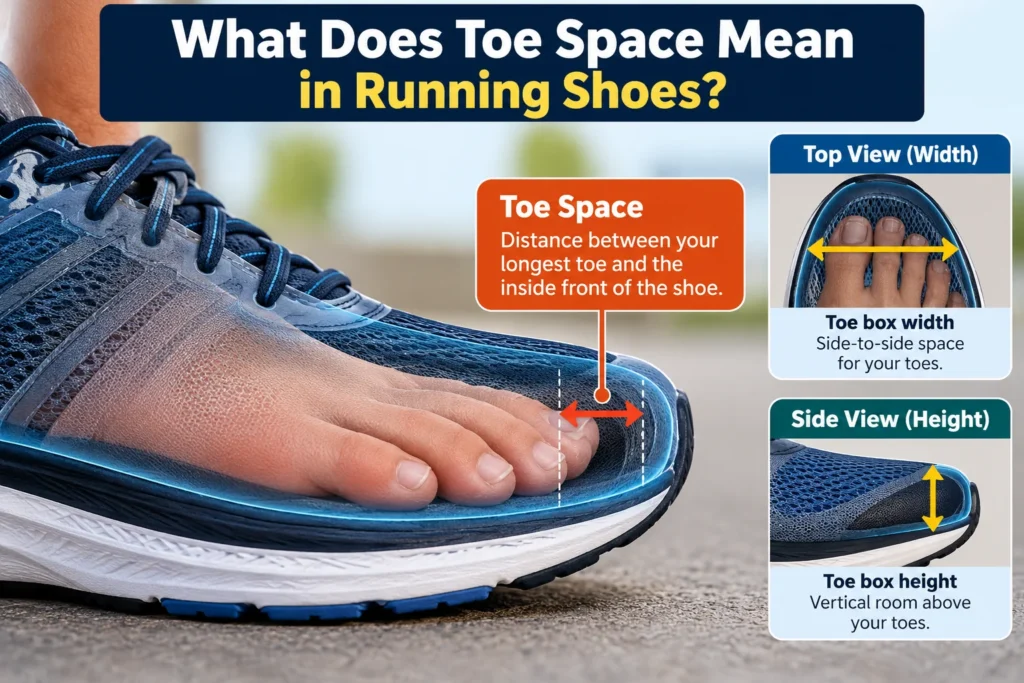
Toe space is the distance between the end of your longest toe and the inside front wall of your running shoe. It provides clearance when your foot moves and expands during running.
The front section of the shoe is called the toe box. Its length, width, height, and overall shape all affect comfort.
Toe Length Clearance vs. Toe Box Width
These measurements describe different parts of the fit. A shoe can provide enough length while still squeezing your toes together.
- Toe clearance: The empty space directly beyond your longest toe.
- Toe box width: The side-to-side space available for your toes.
- Toe box height: The vertical room above your toes and toenails.
- Forefoot volume: The overall space around the front of your foot.
For example, a runner with wide toes may experience rubbing even with 15 mm of front clearance. That runner may need a differently shaped toe box rather than a longer shoe.
How Much Space Should Be Between Your Longest Toe and the Shoe?
A practical starting range is approximately 10–15 mm (0.4–0.6 inches). Many fitting guides recommend about half an inch, or one thumb’s width.
The Harvard Health shoe-fitting guidance also recommends about half an inch beyond the longest toe. However, that measurement is a fitting guideline rather than a guarantee of comfort.
Running Shoe Toe Clearance Chart
Use the following measurements as a starting point while evaluating your shoes. Individual foot shape, upper construction, and heel security still matter.
| Front Clearance | Fit Assessment | Recommended Action |
|---|---|---|
| 0–5 mm | Usually too short | Try a longer size. |
| 6–9 mm | Less than commonly recommended | Compare with more toe clearance. |
| 10–15 mm | Typical starting range | Confirm width and heel security. |
| 16–20 mm | Roomier than average | Check movement and foot stability. |
| Over 20 mm | Potentially too long | Compare a shorter size if the shoe feels loose. |
Important: These ranges are practical screening guidelines, not medically established cutoffs. A shoe outside the preferred range isn’t automatically unsuitable if its overall fit remains secure and comfortable.
Does the Thumb-Width Rule Work for Everyone?
The thumb-width rule is useful, but thumb sizes vary between people. A ruler provides a more consistent measurement.
My preferred approach is to combine the thumb test with standing measurements and a short movement test. A numerical gap alone cannot reveal whether your toes are being squeezed.
How Do You Measure Toe Space in Running Shoes?
You can check toe clearance at home or in a shoe store without specialized equipment. Start with your running socks, then test the shoes while standing.
Step 1: Wear Your Normal Running Socks
Put on the socks you normally use for training. Sock thickness changes the available space inside your shoes.
Bring your usual orthotic inserts if you wear them. These can also change how your foot sits inside the shoe.
Step 2: Put On Both Shoes
Place your feet inside the shoes and settle your heels against the back. Lace them securely without squeezing the upper against your foot.
Always test the complete pair. Your left and right feet may require slightly different amounts of room.
Step 3: Stand With Your Weight on Both Feet
Stand naturally on a flat surface. Your feet generally become longer and wider under weight-bearing conditions.
Don’t measure clearance only while sitting. The resulting fit may feel different once you stand.
Step 4: Find Your Longest Toe
Locate the end of your longest toe through the shoe’s upper. For some runners, the second toe extends beyond the big toe.
Use that longest point when checking the gap. Measuring only the big toe can underestimate the length you need.
Step 5: Apply the Thumb Test
Press gently on the upper to locate your toe’s tip, then estimate the remaining distance to the shoe’s front. Look for roughly 10–15 mm of clearance.
Some stiff toe bumpers make this difficult. In that case, try the removable-insole method below.
Step 6: Try the Insole Test
Remove the insole if the shoe has a removable footbed. Stand on it with your heel aligned at the back.
Check the space beyond your longest toe and whether your forefoot extends past the sides. Remember that an insole is only an approximation of the shoe’s interior.
Step 7: Walk, Jog, and Change Direction
Walk briskly, jog briefly if permitted, and test a few changes of direction. Check whether your toes remain comfortable and your heel stays secure.
For a longer fitting checklist, the REI running shoe selection guide explains how toe room, width, and lacing work together.
- Pass: Your toes move freely without hitting the front.
- Pass: Your heel remains comfortably seated.
- Recheck: Your longest toe repeatedly presses against the bumper.
- Recheck: Your foot slides forward or sideways inside the shoe.
- Recheck: You develop pressure, tingling, or immediate rubbing.
Why Do Running Shoes Need Extra Space at the Toes?
Running involves repeated loading, forward movement, and changes in foot volume. A little extra front clearance helps accommodate these conditions.
The goal isn’t to wear oversized shoes. It’s to provide movement space without losing the secure fit around your heel and midfoot.
Your Feet Change Shape Under Load
When your foot supports your weight, its dimensions can change. The forefoot also spreads during movement.
A shoe that feels comfortable while sitting may become restrictive during exercise. That’s one reason standing fit checks matter.
Your Feet Can Swell During Longer Runs
Heat and extended activity may increase foot volume. Shoes that feel tight before running can become uncomfortable later.
The ASICS running shoe fit guide recommends additional toe space to accommodate this expansion. It also emphasizes checking the width of your shoes.
Your Feet May Move Forward
Forward movement can occur during running, particularly on descents. Poor heel security can increase that movement.
That’s why front clearance and heel fit must work together. Extra length alone won’t solve every toe-jamming problem.
How Can You Tell If Your Running Shoes Are Too Small?
Common warning signs include toe pressure, rubbing, numbness, and repeated contact with the shoe’s front. These symptoms can indicate problems with length, width, or toe-box height.
Don’t assume that every symptom requires a larger shoe. The location of the pressure often provides a better clue.
- Front-toe pressure: Your longest toe contacts the bumper while running.
- Bruised toenails: Repeated pressure may contribute to nail discoloration or tenderness.
- Toe-tip blisters: Friction develops near the front of the shoe.
- Numb toes: The shoe may be too short, narrow, shallow, or tightly laced.
- Curled toes: Your toes cannot lie comfortably flat.
- Side pressure: The toe box may be too narrow even when its length is adequate.
Persistent pain, numbness, or nail problems deserve professional assessment. Footwear fit is only one possible cause.
Can Running Shoes Have Too Much Toe Space?
Yes. Excessive shoe length can make it harder to control movement inside the shoe.
Some runners experience heel slipping, rubbing, or awkward flexing when shoes are too long. Others compensate by tightening their laces excessively.
- Your heel lifts noticeably during normal running.
- Your foot repeatedly slides forward when stopping.
- The shoe bends well ahead of your forefoot’s natural bending point.
- Your toes grip or curl to stabilize your foot.
- You need unusually tight lacing to prevent movement.
Try a shorter size or another shoe shape if these problems occur. Keep the front clearance test in mind before deciding.
Should You Buy Running Shoes Half a Size Bigger?
Going up half a size can help when your current shoes don’t provide enough toe clearance. However, it shouldn’t be an automatic rule for every runner.
Running shoe size labels vary between brands and models. A shoe’s shape can matter as much as the number printed on its tongue.
When Might Half a Size Up Help?
- Your longest toe touches the front while standing.
- You have less than the recommended clearance.
- Your toes repeatedly hit the bumper during short runs.
- Your current shoe becomes uncomfortable as your feet warm up.
- The larger size still holds your heel and midfoot securely.
The Brooks running shoe sizing guidance recommends approximately half an inch of front clearance. It also emphasizes choosing the appropriate shoe width.
When Should You Avoid Sizing Up?
Don’t increase length simply because your little toe feels squeezed. That often indicates insufficient width rather than insufficient length.
Likewise, a shoe that’s loose around your heel may become less stable in a larger size. Try a different shape or width instead.
Is Toe Room Different for Wide Feet or Different Running Styles?
The basic front-clearance guideline remains a useful starting point for most runners. However, foot shape, terrain, and shoe design influence how that space feels during movement.
Wide Feet and Foot-Shaped Toe Boxes
A wide forefoot may need more lateral room without additional length. Some shoes provide an anatomical toe box that follows the natural outline of your toes.
Other shoes provide width options throughout more of the shoe. Our running shoe width guide explains how these designs differ.
Long-Distance Running
Long-distance runners should pay particular attention to swelling and changing comfort. A shoe that passes a short standing test may still feel restrictive during extended exercise.
Try a representative training run before committing to a new pair for a marathon. Don’t intentionally choose excessive length without checking stability.
Trail Running and Downhill Running
Trail shoes need enough room to prevent toe jamming during descents. They also need a secure fit to limit unwanted foot movement.
Test the fit on a gentle downhill when possible. Repeated toe impacts can indicate poor length, heel security, or both.
Runners Using Orthotic Inserts
Orthotics can change interior shoe volume and foot position. Some inserts also affect how securely the heel sits inside the shoe.
Always bring your actual inserts when fitting running shoes. Don’t assume the size that works without them will provide the same comfort.
What Mistakes Should You Avoid When Checking Toe Space?
The most common mistake is treating shoe length as the only important measurement. A comfortable running shoe needs a balanced fit across the entire foot.
Seven Common Fitting Mistakes
- Measuring while sitting: Check the shoes while standing with your weight on both feet.
- Checking only the big toe: Use whichever toe extends furthest.
- Ignoring shoe width: Don’t buy a longer shoe solely to fix side pressure.
- Trying shoes without running socks: Sock thickness can change the fit.
- Expecting shoes to stretch longer: Don’t rely on break-in to create missing front clearance.
- Ignoring heel movement: Too much foot movement can cause problems even with adequate toe room.
- Trusting the size label alone: Check the actual fit of each model.
Another mistake is assuming every uncomfortable shoe needs stronger arch support. Pressure from poor sizing can feel different from an actual support problem.
If you’re unsure whether inserts will help, read our guide to whether running shoes need arch support before purchasing additional equipment.
How Do You Find the Right Running Shoe Size at Home?
Start by measuring both feet, then use each manufacturer’s chart to identify a trial size. The measurement is a starting point, not a final fit guarantee.
Simple Home Measuring Method
- Place a sheet of paper against a wall on a hard floor.
- Put on your usual running socks.
- Stand with your heel against the wall.
- Mark the position of your longest toe.
- Measure the distance from the wall to that mark.
- Repeat the process for your other foot.
- Use the larger measurement when comparing manufacturer size charts.
- Try the suggested size and verify the actual front clearance.
A professional shoe measuring device can provide additional information about foot length, width, and arch length. However, it cannot fully predict how every running shoe will fit.
The Brannock Device fitting instructions recommend checking both heel-to-toe and heel-to-ball measurements. The shoe should then be tested for comfort and proper movement.
What If One Foot Is Larger?
Choose shoes that provide enough space for the larger foot. It’s common for feet to differ slightly in their dimensions.
If the smaller foot feels loose, try adjusting the laces or considering another model. Don’t choose a shoe that compresses the longer foot.
Which Running Shoes and Measuring Tools Are Worth Considering?
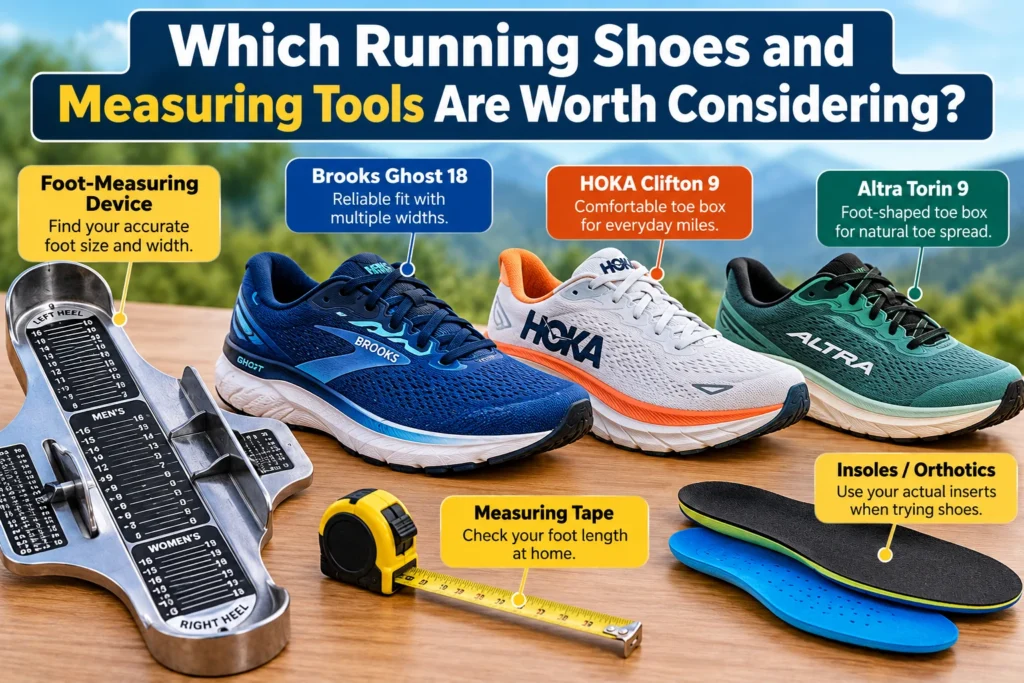
Good toe clearance starts with proper measurements and a shoe shape that matches your foot. The following options address three different fitting needs.
These are comparison starting points, not substitutes for trying shoes on. The star symbols below indicate editorial suitability for the stated use cases, not verified customer-review averages or hands-on test scores.
📏 Best for Measuring
Genuine Brannock Adult Foot-Measuring Device
★★★★☆ Editorial suitability
The Brannock Device measures heel-to-toe length, heel-to-ball length, and foot width. I’d consider it useful for repeat measurements, although trying on the actual running shoe remains essential.
👟 Best for Width Choices
Brooks Ghost 18 Running Shoe
★★★★☆ Editorial suitability
The Ghost 18 is a neutral road-running shoe offered in multiple widths, including narrow, standard, wide, and extra-wide options. I’d compare its available widths when the length feels right but the overall fit doesn’t.
🦶 Best for Toe Spreading
Altra Torin 9 Running Shoe
★★★★☆ Editorial suitability
The Torin 9 combines Altra’s foot-shaped toe box with a zero-drop platform and a 28 mm listed stack height. I’d compare it if conventional toe boxes feel tapered, while allowing time to adapt if switching from higher-drop shoes.
Affiliate disclosure: As an Amazon Associate, we earn from qualifying purchases. Product availability, sizes, and prices can change.
Frequently Asked Questions
Should Your Toes Touch the Front of Running Shoes?
Your toes should generally not press against the shoe’s front when standing or running. Aim for approximately 10–15 mm of clearance beyond your longest toe. Light contact with flexible upper material isn’t the same as repeated impact against the front bumper, but persistent pressure suggests the fit needs attention.
Is Half an Inch of Toe Room Too Much?
No. Half an inch, approximately 12.7 mm, falls within the commonly recommended running shoe fitting range. However, a shoe can still feel too large if your heel slips or your foot moves excessively. Check the shoe’s overall shape and fit before choosing a size.
Should Running Shoes Feel Loose Around the Toes?
Running shoes should feel comfortably spacious around your toes without allowing uncontrolled foot movement. Your toes should spread and wiggle naturally, while the heel and midfoot remain secure. A roomy toe box doesn’t mean the entire shoe needs to feel loose.
How Much Toe Room Do You Need for Marathon Running?
About 10–15 mm remains a useful starting point for marathon shoes. Long runs make it especially important to test for swelling, rubbing, and toe pressure. Choose shoes that remain comfortable during longer training sessions rather than assuming that marathon running always requires a full extra shoe size.
Can You Fix Running Shoes That Have Too Little Toe Space?
Lacing adjustments may improve pressure across the upper, but they cannot reliably create additional shoe length. If your longest toe touches the front, try a longer size or differently shaped model. If only the sides feel tight, a wider toe box may be the better solution.
Final Takeaway: How Much Toe Space Is Right?
Most runners should begin with approximately 10–15 mm of space beyond the longest toe. That’s about half an inch or one thumb’s width.
But the number isn’t the whole story. Comfortable running shoes also need enough toe width, adequate upper volume, and secure heel support.
Before buying your next pair, try the standing thumb test, check both feet, and take a short test walk or jog. Choose the shoe that stays comfortable while moving, not simply the one with the largest amount of empty space.


Steven is a former sportsperson and now a full-time businessman and research writer. He is the mastermind of this site, and he created this site to help people who need specialized shoes for different activities. When he was a sportsperson, he was very passionate about different types of shoes for his sports purpose. The passion he had for shoes at that time now turned into his profession. Besides his shoe business, he loves sharing his knowledge and experience with people and helping them maintain healthy feet.
More Posts