
⚡ Quick Answer
Running shoes should feel snug in the heel and midfoot while leaving 0.25 inches of extra width around the ball of your foot. Your toes must wiggle and splay flat without rubbing the upper mesh. If your foot hangs over the midsole edge, switch to a wide 2E or D size.
Key Running Shoe Width Rules
- Forefoot clearance: Leave 0.25 inches of space at your widest foot point.
- Standard codes: Men’s standard is D; women’s standard is B.
- Wide sizing: Wide adds 0.25 inches in girth and 0.13 inches to the sole.
Quick Shoe Fit Checks
-
✓
Step on the pulled-out insole to check for edge overhang. -
✓
Pinch a small fold of upper mesh over your forefoot. -
✓
Measure your feet at night when swelling peaks.
Your pinky toe burns at mile three. The tight mesh squeezes your forefoot with every step.
Buying the wrong shoe width ruins your run and causes painful blisters. As gear tester Steven Tyler, I see runners mistake tight toe boxes for short shoes daily.
You do not need to guess between a standard D width and a wide 2E fit. Below, you will learn the exact measurements and tests to lock in a pain-free fit.
📌 Key Takeaways
-
→
Forefoot expansion reaches up to 15% in width when your foot strikes the ground. -
→
Men’s wide 2E and women’s wide D add 0.25 inches of internal upper girth. -
→
The insole test proves a shoe is too narrow if your foot spills over the edges. -
→
Anatomical toe boxes give your toes room to splay without loosening the heel cup.
How Wide Should Running Shoes Feel on Your Feet?
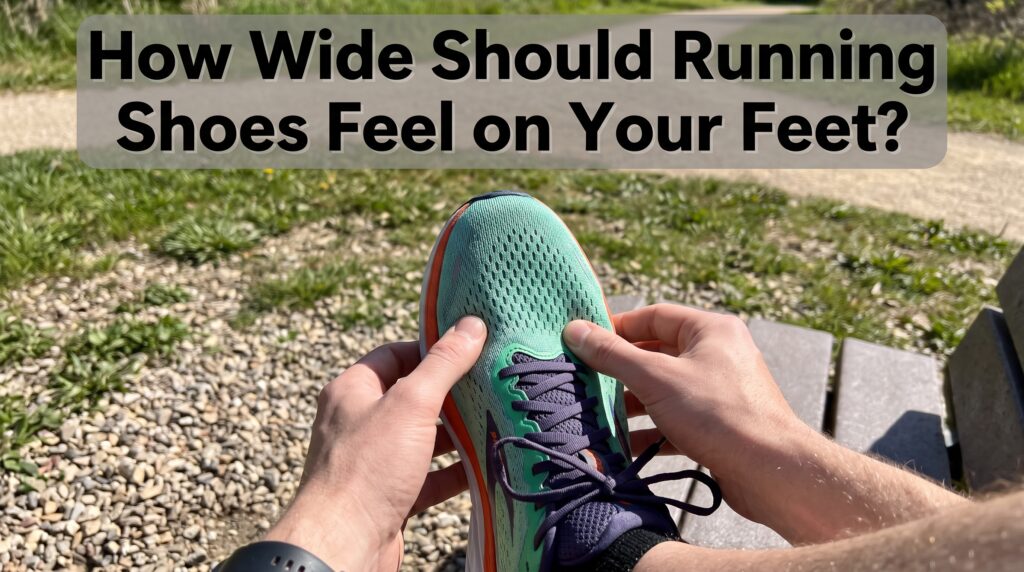
Your running shoes should feel locked down at the heel and snug across the arch, while leaving 0.25 inches of breathing room around the ball of your foot. Your toes must lie flat and spread out naturally on every landing without pressing against the side mesh. When you stand up and lace the shoe, you should be able to pinch a 0.25-inch fold of fabric over the widest part of your forefoot. At the same time, the outer edge of your pinky toe should never push past the foam midsole platform. If your toes overlap, go numb, or rub the side walls, the toe box is too narrow. A proper width lets your forefoot expand on impact while keeping your heel from slipping.
Most runners know they need a thumb’s width of space at the front of their toes. Yet many ignore side-to-side clearance until pain starts.
Here is why that matters. Your foot is not a rigid block of bone.
When you run, you land with a force equal to 2.5 to 3 times your body weight. That load flattens your arch and pushes your metatarsal bones outward.
0.25 in
Ideal forefoot width buffer
15%
Forefoot width expansion on impact
0.5 in
Required toe length clearance
Research shows your forefoot widens by up to 15% during mid-stance. Blood flow and heat also swell your feet by a half-size after 30 minutes of running.
So if you buy a shoe that feels skin-tight in the store, it will crush your foot at mile five. You need a three-zone fit to handle this swelling.
📋 The 3-Zone Running Shoe Fit Standard
-
Heel Cup (Locked): Zero vertical lift or side-to-side sliding when you push off the ground. -
Midfoot Saddle (Snug): Gently hugs your arch and instep like a firm handshake without pinching tendons. -
Forefoot & Toe Box (Roomy): Gives 0.25 inches of lateral wiggle room so toes splay flat.
You might be thinking a roomy forefoot will make your foot slide around on turns. Here’s why that will not happen: your midfoot laces and heel counter hold your foot in place, not your toes.
Now that you know how the fit should feel, how do you translate that into actual shoe sizes? Let’s decode the letters on the shoe box.
What Do Running Shoe Width Letters (B, D, 2E, 4E) Mean?
Running shoe width letters measure the horizontal base width and internal fabric volume of a shoe using the standard Brannock Device scale. For men, D is standard width, 2E is wide, and 4E is extra-wide. For women, B is standard width, D is wide, and 2E is extra-wide. Each step up in width adds 0.25 inches (6 millimeters) of total circumference around the ball of the foot and widens the midsole platform by 0.13 to 0.19 inches (3 to 5 millimeters). Because men’s standard width (D) equals women’s wide width (D), female runners with wide feet can easily wear standard men’s running shoes by subtracting 1.5 sizes from their normal women’s length. Knowing these letter codes stops you from buying longer shoes when you only need a wider platform.
Shoe brands print a letter next to your size number on the tongue tag. Most shoppers ignore this letter.
Here is what most runners do not realize. Moving from a standard D to a wide 2E changes more than just the flat insole width.
Brands build wide shoes on a higher-volume foot mold, called a last. A 2E last adds 6 millimeters of fabric girth over the top of your foot and widens the rubber outsole base.
Compare how running shoe width letters break down across men’s and women’s sizing scales:
Use this table to match your foot volume to the exact letter code on the shoe box.
Notice the overlap in the middle columns. A women’s wide (D) uses the exact same width scale as a men’s standard (D).
So if you are a woman who needs a wide D shoe and the store is sold out, buy a men’s standard D shoe 1.5 sizes smaller. For example, a women’s 9.5 Wide (D) equals a men’s 8.0 Standard (D).
Now let’s find out which letter matches your actual feet. You only need a piece of paper and a ruler.
How Do You Measure Your Foot Width for Running Shoes at Home?
You can measure your foot width at home in 5 minutes using blank paper, a pen, and a ruler. Measure your feet in the evening while wearing your normal running socks, because feet swell by up to 8% throughout the day. Stand on the paper with your full body weight, trace around both feet, and measure the straight-line distance across the widest part of your forefoot from the first metatarsal joint to the fifth metatarsal joint. Always use the measurements from your larger foot when picking a shoe size. Comparing your forefoot width against standard shoe sizing charts reveals whether you need a medium, wide, or extra-wide running shoe before you ever step into a store or place an online order.
Do not measure your feet while sitting down in the morning. A unweighted foot in the morning is at its smallest state of the day.
Wait until the evening or right after a 3-mile run. That guarantees you measure your foot at its true running width.
🔢 Step-by-Step: How to Measure Your Foot Width at Home
-
1
Stand on blank paper in running socks
Place equal weight on both feet during the evening when natural foot swelling peaks.
-
2
Trace both feet holding the pen straight
Keep the pen at a 90-degree angle so it does not tilt under your arch or heel.
-
3
Measure the widest forefoot points
Measure straight across from the base of your big toe joint to your pinky toe joint.
-
✓
Match your wider foot to the width chart
You now have your exact forefoot width in inches to select the right letter code.
Most people have one foot that is 0.1 to 0.2 inches wider than the other. Always fit your shoes to the wider foot.
What Width Measurements Count as Wide for Common Shoe Sizes?
Once you have your measurement in inches, compare it to your US shoe size below.
Check this reference chart to see if your forefoot measurement puts you in standard or wide shoes:
If your foot sits right on the border between two widths, always choose the wider category to allow for running swelling.
Paper tracing works well, but a real steel sizing tool removes all human tracing error. If you buy shoes online often, keeping an official Brannock Device at home saves you constant return shipping fees.
Recommended Product
Genuine Brannock Device – Men’s Professional Foot Measuring Tool
★★★★☆ Highly rated on Amazon
This official metal sizing gauge measures exact heel-to-toe length, arch length, and letter width from 3A to 3E in seconds.
As an Amazon Associate, we earn from qualifying purchases.
What if you already own a pair of running shoes and want to know if they are too narrow? You can test them right now without a ruler.
How Can You Tell If Your Running Shoes Are Too Narrow?
You can tell your running shoes are too narrow if the sides of your forefoot spill over the removable insole, your outer toes go numb after 2 miles, or blisters form between your fourth and fifth toes. To test your current shoes immediately, pull out the foam sockliner and stand on it with your full weight. If the ball of your foot or your pinky toe hangs over the outer edges of the insole, the shoe platform is too narrow for your anatomy. Other clear physical signs include red pressure marks along the outside of your foot, warped lacing eyelets that pull far apart over your instep, and upper mesh that bulges outward over the rubber midsole.
Most runners blame their socks when they get toe blisters. In reality, narrow shoe walls squeeze the toes together and trap friction.
Medical specialists at the American Academy of Orthopaedic Surgeons note that a proper athletic shoe must allow all your toes to wiggle freely under load. If your toes feel pinched together, your shoe fails the test.
Here is a surprising test used by specialty running shoe fitters. Pull the removable insole out of your shoe, put it on the floor, and stand on it.
Look straight down at your forefoot. If your fifth metatarsal bone or pinky toe hangs over the edge of that foam insert, your foot is sitting on the stitched seam of the shoe.
⚠️ Warning
Running in shoes that compress your metatarsals for months can cause Morton’s neuroma, a painful nerve thickening between your third and fourth toes.
According to the American Podiatric Medical Association, repetitive forefoot compression also speeds up bunion growth and ingrown toenails. Run through this quick physical audit to check your current pair.
✓ 5 Signs Your Running Shoes Are Too Narrow
-
✓
Your forefoot spills over the edges when standing on the removed sockliner. -
✓
Your pinky toe or fourth toe develops side blisters or hard corns. -
✓
The ball of your foot tingles, burns, or goes numb mid-run. -
✓
The upper mesh bulges out past the foam midsole under your pinky toe. -
✓
The lace throat spreads more than 2 inches wide across your instep.
If you checked even one box above, you need more forefoot room. But should you buy a wider shoe or just a shoe with a wider toe box?
Wide Toe Box vs Wide Width (2E/4E): Which One Do You Need?
A wide toe box running shoe flares out only around the toes while keeping a standard-width heel and midfoot, whereas a wide width (2E or 4E) shoe expands the entire shoe from heel to toe. Choose a wide toe box if you have a narrow or average heel and arch, a fan-shaped foot, or bunions that need extra toe splay room without heel slippage. Choose a true 2E or 4E wide shoe if you have a thick, high-volume instep, flat arches, or a wide heel and midfoot that feel squeezed across the laces. Mixing up these two designs causes runners with narrow heels to swim inside 2E shoes, and causes runners with thick midfeet to feel strangled inside anatomical toe box shoes.
Many runners think “wide toe box” and “wide width” mean the exact same thing. They solve two totally different foot shapes.
Look at your bare foot from above. Is it shaped like a triangle (narrow heel, wide toes) or a rectangle (wide heel, thick arch, wide toes)?
Brands like Altra and Topo Athletic build foot-shaped shoes for triangle feet. Brands like New Balance and Brooks build 2E and 4E lasts for rectangle feet.
Compare how an anatomical wide toe box differs from a true 2E/4E wide width shoe across every zone of the foot:
| Fit Zone / Feature | Anatomical Wide Toe Box (Altra / Topo) | True Wide 2E / 4E Shoe (New Balance / Brooks) ✓ Best for Full Volume |
|---|---|---|
| Toe Box Shape | Broad, rounded front for natural toe splay | ✓ Standard tapered curve with wider base |
| Midfoot & Instep Volume | Standard (snug hold over the arch) | ✓ Expanded (+6 mm to +12 mm extra girth) |
| Heel Cup Width | Standard to narrow (prevents heel slip) | ✓ Wider heel base and collar opening |
| Ideal Foot Type | Fan-shaped feet, bunions, narrow heels | ✓ High-instep, flat-arched, or broad feet |
Match your heel and arch thickness to the table above before ordering your next pair.
🎯 Which Option Is Right For You?
If you are…
Dealing with cramped toes or bunions, but your heel slips in wide shoes
→ Choose an Anatomical Wide Toe Box (Topo or Altra)
If you are…
Feeling squeezed across your arch, instep, and outer foot border
→ Choose a True Wide 2E (Men) or D (Women) Shoe
If you are…
Wearing thick custom orthotics with a very wide, flat foot
→ Choose an Extra-Wide 4E (Men) or 2E (Women) Shoe
Knowing the difference between toe box shape and full width saves you from heel blisters. Next, let’s look at why simply buying a longer shoe fails to fix width problems.
What Most People Get Wrong About Running Shoe Width
The biggest misconception about running shoe width is that sizing up a half-size or full size in length fixes a narrow shoe. Going up a half-size in length adds only 0.04 inches (1 millimeter) of width while adding 0.16 inches (4 millimeters) of unnecessary length. This shifts the flex grooves of the shoe past the ball of your foot, causing clumsy tripping, arch strain, and severe heel slippage. Two other common myths are assuming you can “break in” tight synthetic mesh and thinking that wearing excessively wide shoes provides extra comfort. In truth, modern engineered mesh does not stretch permanently, and wearing a 2E shoe on a standard-width foot lets your forefoot slide laterally on every step, causing black toenails and ankle instability.
Let’s break down the three myths that hurt runners most.
Myth 1: Sizing up in length replaces buying a wide width. When you go up a half-size in length, you get 4 millimeters of extra length but only 1 millimeter of extra width. By the time a narrow shoe feels wide enough, it is two sizes too long and bends in the wrong spot under your arch.
Myth 2: Tight running shoes will stretch and break in after 20 miles. Leather dress shoes stretch over time, but modern running shoes use heat-welded plastic overlays and synthetic yarns designed to hold their shape. As podiatrists at the American College of Foot and Ankle Surgeons point out, athletic shoes must fit comfortably from day one with zero break-in period.
Myth 3: Wearing wide shoes when you do not need them is harmless. Extra space sounds cozy, but a shoe that is too wide fails to hold your midfoot on corners or downhills. Your foot slides forward with every stride and slams your toes into the front bumper.
✅ Tip
If your shoe is only slightly tight across the ball of your foot, relace it using parallel window lacing (skipping the bottom crossover) to free up 2 to 3 millimeters of forefoot height.
Once you stop relying on length tricks, you just need to know which brands build the most generous platforms. Here is how top running brands compare.
Which Running Shoe Brands Fit Wide Feet Best in 2026?

New Balance, Brooks, Altra, and Topo Athletic fit wide feet best in 2026 because they build shoes on wider lasts and stock true 2E and 4E sizes across their core lineups. Altra (especially models built on the Original FootShape last like the Lone Peak) and Topo Athletic offer the widest anatomical toe boxes at around 4.4 inches in a standard men’s size 9, while New Balance and Brooks lead the industry in true full-volume 2E and 4E trainers like the Fresh Foam X 1080 and Ghost. On the other hand, Nike and standard-width Hoka models use narrower, tapered lasts that average 3.8 to 3.9 inches in forefoot width, making them a poor match for broad feet unless you specifically order their 2E versions.
Every shoe brand uses its own signature foot mold. A standard D width in Nike feels noticeably tighter than a standard D width in Brooks.
Knowing a brand’s baseline cut saves you hours of frustration.
Altra and Topo give you up to 15 millimeters more toe room out of the box than narrow-cut brands like Nike.
Your running shoe width matters more than cushion thickness or carbon plates. Keep a 0.25-inch buffer around your forefoot so your toes can splay on every impact. Pull the insoles out of your current running shoes right now and stand on them—if the sides of your feet hang over the foam edges, order your next pair in a wide 2E (men) or D (women) width.
Frequently Asked Questions
Should running shoes feel loose or snug?
Running shoes should feel snug in the heel and midfoot, but roomy in the toe box. Your heel and arch must stay locked down so your foot never slides forward. Meanwhile, your toes need 0.25 inches of side clearance and 0.5 inches of front length to spread flat.
Should I size up for wide feet in running shoes?
No, you should buy a dedicated wide width (2E for men, D for women) rather than sizing up in length. Going up a half-size in length adds only 1 millimeter of width while making the shoe 4 millimeters longer, which causes heel slipping and misaligned arch support.
How much wider is a 2E running shoe than a D?
A 2E running shoe gives you 0.25 inches (6 millimeters) more total internal girth around the ball of your foot than a standard D shoe. It also widens the physical foam outsole platform by 0.13 to 0.19 inches (3 to 5 millimeters) to stop side overhang.
Is it bad to wear wide running shoes if you have normal feet?
Yes, wearing wide shoes on standard-width feet causes your foot to slide side to side and forward inside the shoe. This extra movement creates friction blisters, black toenails on downhills, and unstable ankle roll when turning corners. Only wear wide sizes if your foot measurement requires them.
Can Women Wear Men’s Standard Running Shoes for a Wider Fit?
Yes, women who need a wide fit can wear men’s standard running shoes because both use the exact same D-width scale. Simply subtract 1.5 from your women’s shoe size to find your men’s size. For example, a women’s 9 Wide (D) equals a men’s 7.5 Standard (D).
Why do my toes go numb when I run?
Your toes go numb while running because a narrow toe box or tight lacing squeezes your metatarsal bones and pinches the nerves between them. As your feet swell by up to 15% on impact, the tight upper cuts off blood flow. Switching to a wider width fixes the numbness.
Do running shoes stretch in width over time?
No, modern running shoes do not stretch in width over time because they use synthetic engineered mesh and heat-welded plastic overlays designed to resist stretching. While the foam insole compresses slightly underfoot, a narrow toe box will stay tight and cause blisters until you buy the right width.


Steven is a former sportsperson and now a full-time businessman and research writer. He is the mastermind of this site, and he created this site to help people who need specialized shoes for different activities. When he was a sportsperson, he was very passionate about different types of shoes for his sports purpose. The passion he had for shoes at that time now turned into his profession. Besides his shoe business, he loves sharing his knowledge and experience with people and helping them maintain healthy feet.
More Posts