
Quick Answer
To choose running shoes, start with the surfaces you run on, then find a comfortable fit with adequate toe room. Compare cushioning and support based on how each shoe feels while moving. A secure heel, comfortable midfoot, and unrestricted toes matter more than brand popularity. See our running shoe toe room guide for additional sizing advice.
Six steps to choosing running shoes
- Choose your terrain: Match road, trail, or treadmill shoes to your usual running surface.
- Measure both feet: Check length and width while standing, preferably later in the day.
- Check toe clearance: Leave approximately one thumb-width ahead of your longest toe.
- Compare cushioning: Choose an underfoot feel that stays comfortable during running.
- Assess support: Try neutral and stability models when additional guidance may help.
- Test before buying: Walk, jog, and check for rubbing, slipping, or pressure.
Buying tip: Choose the shoe that fits comfortably now. Don’t depend on a break-in period to fix a poor fit.
Learning how to choose running shoes can feel complicated when every brand promises better cushioning, speed, or support. Yet the right decision usually starts with a few practical questions about your feet and running habits.
I recommend evaluating fit before comparing technology or appearance. This guide explains what matters, how to test shoes, and which features deserve your money in 2026.
What Should You Look for When Choosing Running Shoes?
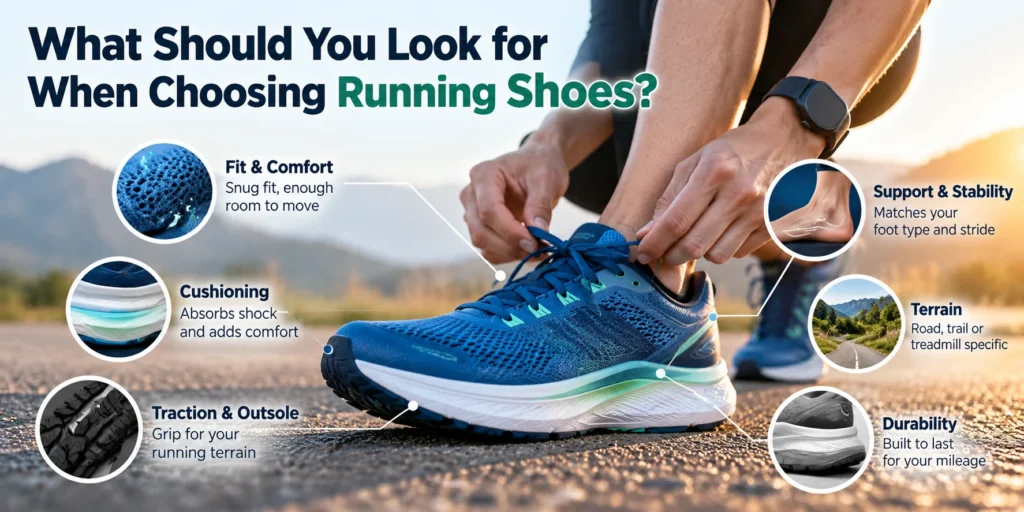
Good running shoes should match your running surface, fit your feet, and feel comfortable during movement. They should also provide the traction and cushioning appropriate for your training.
Running shoes are athletic shoes designed for repeated forward movement, with specialized midsoles, outsoles, and uppers. Different designs balance cushioning, weight, flexibility, and support.
The following factors deserve attention before you compare brands.
- Fit: Enough length and width without excessive movement inside the shoe.
- Terrain: An outsole suited to pavement, trails, or your regular training environment.
- Cushioning: A comfortable balance between softness and responsiveness.
- Support: A platform that feels controlled without forcing an uncomfortable stride.
- Breathability: An upper appropriate for your climate and running conditions.
- Durability: Construction suited to your expected mileage and use.
- Budget: A realistic price for a shoe you can wear consistently.
I would rank fit above every other factor. An expensive shoe cannot compensate for cramped toes or an uncomfortable heel.
How Do You Choose Running Shoes for Different Surfaces?
Choose road-running shoes for pavement, trail-running shoes for uneven off-road routes, and comfortable road trainers for most treadmill workouts. The main differences involve traction, protection, and outsole construction.
Road Running Shoes
Road shoes are designed for relatively predictable surfaces such as sidewalks, asphalt, and paved paths. Most use cushioned midsoles and outsoles intended for hard, even ground.
- Best use: Road runs, sidewalks, and regular pavement training.
- Outsole: Rubber or rubberized foam with relatively shallow tread.
- Cushioning: Available in firm, moderate, and plush designs.
- Practical priority: Comfort, traction, and reliable fit.
Trail Running Shoes
Trail shoes provide additional grip for dirt, gravel, roots, and uneven terrain. Many models also include protective toe caps or firmer structures.
Look for deeper tread lugs when running on loose surfaces. For rocky terrain, consider durable uppers and underfoot protection.
The REI trail-running shoe guide explains how terrain influences traction and protection.
Treadmill Running Shoes
Most runners can use comfortable road-running shoes on a treadmill. Specialized trail traction is generally unnecessary on a standard indoor running belt.
Focus on fit, a predictable transition through each step, and cushioning that feels suitable at your preferred speed.
Road vs. Trail vs. Treadmill Shoes
| Feature | Road | Trail | Treadmill |
|---|---|---|---|
| Best surface | Pavement | Dirt and uneven ground | Indoor running belt |
| Traction | Road-focused tread | Deeper lugs | Standard road tread usually works |
| Protection | Moderate | Often reinforced | Standard road construction |
| Main priority | Comfort and durability | Grip and stability on terrain | Fit and running comfort |
How Should Running Shoes Fit Your Feet?
Running shoes should feel secure around your heel and midfoot, with enough space for your toes to move. They should never cause pinching, numbness, or repeated rubbing.
Start with your actual foot measurements rather than your usual casual shoe size. Sizes and shapes can vary across running shoe brands.
Check Your Running Shoe Length
Leave approximately one thumb-width of clearance between your longest toe and the shoe’s front. This provides space as your feet move and change volume during running.
Measure from whichever toe extends farthest. For some runners, that is the second toe rather than the big toe.
Check Your Running Shoe Width
Your forefoot should sit comfortably without spilling over the sides of the shoe’s platform. Your toes should spread naturally rather than being squeezed together.
A shoe can have the correct length and still be too narrow. Try a wider width instead of automatically buying a longer shoe.
Common US adult width labels include these options:
- Women’s B: Typically standard width.
- Women’s D: Common wide-width designation.
- Men’s D: Typically standard width.
- Men’s 2E: Common wide-width designation.
- Men’s 4E: Common extra-wide designation.
Width labels are not perfectly consistent across brands. Always compare how the actual shoe fits.
Check the Heel and Midfoot
Your heel should remain reasonably secure as you walk or jog. Excessive slipping can produce rubbing and blisters.
The midfoot should feel held without pressure from the upper or laces. Tightening laces aggressively should not be necessary to make a poor-fitting shoe work.
Try This Five-Minute Running Shoe Fit Test
- Wear running socks: Use the socks you normally wear during training.
- Try both shoes: Fit the larger foot if your feet differ in size.
- Stand and check: Confirm toe clearance and comfortable width.
- Walk around: Notice any slipping, pressure, or unusual stiffness.
- Jog if allowed: Test the shoes at a comfortable pace.
- Recheck your feet: Look for pressure points before deciding.
The REI running shoe fit guide also recommends checking toe space, heel security, and fit later in the day.
How Much Cushioning Do You Need in Running Shoes?
Choose cushioning according to your comfort, running goals, and preferred underfoot feel. More cushioning is not automatically better for every runner.
The midsole is the layer between the footbed and the outsole. It commonly uses foam materials designed to influence impact feel, flexibility, and responsiveness.
Minimal or Low Cushioning
Low-cushion shoes place less material between your foot and the ground. They can provide a more direct surface feel.
However, they may require adaptation if you normally wear heavily cushioned shoes. Avoid making sudden changes to minimalist footwear during demanding training.
Moderate Cushioning
Moderately cushioned running shoes offer a balance between underfoot protection and ground feel. Many everyday trainers fit this description.
This is a sensible category for beginners to compare first. You can then adjust toward softer or firmer options.
Maximum Cushioning
Maximum-cushion shoes use thicker midsoles to create a substantial layer beneath your feet. Their ride can feel plush, firm, bouncy, or stable depending on the design.
A high stack height does not guarantee softness. Try the shoe rather than relying on appearance.
| Cushioning | Typical Feel | Consider If |
|---|---|---|
| Low | More ground contact sensation | You prefer a direct running feel |
| Moderate | Balanced underfoot feel | You want a versatile daily trainer |
| Maximum | Thicker platform with varying softness | You enjoy substantial underfoot cushioning |
Should You Choose Neutral or Stability Running Shoes?
Neutral shoes generally allow natural foot movement without dedicated corrective guidance. Stability shoes add design features intended to influence foot motion.
Neither category is universally better. Comfort, mechanics, and personal preference should guide the choice.
What Are Neutral Running Shoes?
Neutral running shoes typically provide cushioning without a prominent motion-control system. They are available with different levels of cushioning and inherent stability.
A neutral label does not mean the shoe lacks support. Broad platforms and supportive uppers can make neutral models feel secure.
What Are Stability Running Shoes?
Stability running shoes include features such as support geometry, sidewalls, or guidance systems. These aim to help manage foot movement through the stride.
Some runners prefer the additional structure. Others feel more comfortable in neutral models.
What Is Pronation?
Pronation is the natural inward rolling motion of the foot after landing. It helps the foot adapt to the ground and manage loading.
- Neutral pronation: A relatively typical amount of inward rolling.
- Overpronation: More inward movement than is typical during part of the stride.
- Underpronation: Relatively little inward rolling, sometimes called supination.
Foot arch shape and outsole wear can provide clues, but neither diagnoses your running mechanics alone. Consider professional guidance if you have persistent pain or unusual movement concerns.
Our neutral vs. stability running shoes comparison explores these differences in greater detail.
Does Arch Support Matter When Choosing Running Shoes?
Arch support matters when it improves comfort or helps meet an individual need. However, your arch height does not automatically determine the best running shoe category.
Some runners with flat feet enjoy neutral shoes. Others prefer a stability model or a particular insole.
The American Podiatric Medical Association provides foot-type-based guidance for selecting supportive running shoes.
I suggest comparing shoes under actual running conditions before choosing solely from an arch chart. Comfort is an important part of the decision.
For additional explanations, read our running shoe arch support guide.
What Is Heel-to-Toe Drop in Running Shoes?
Heel-to-toe drop is the height difference between the heel and forefoot of a running shoe. Manufacturers usually measure this difference in millimeters.
A shoe with a 30 mm heel stack and a 22 mm forefoot stack has an 8 mm drop. This measurement is different from the shoe’s overall cushioning thickness.
- Zero drop: The listed heel and forefoot heights are equal.
- Low drop: Commonly around 1–4 mm.
- Moderate drop: Often around 5–8 mm.
- Higher drop: Frequently above 8 mm.
Drop can influence how running loads are distributed through your legs. A large change from your familiar shoe may feel unusual.
For example, moving directly from a 10 mm drop to zero drop can increase demands on the calf and Achilles region. Make significant footwear transitions gradually.
How Do You Choose Running Shoes for Your Running Goals?
Your typical training matters more than choosing a shoe based on an ambitious future goal. Start with the runs you already do consistently.
For Beginners
Begin with a comfortable daily trainer intended for your regular running surface. Moderate cushioning and a secure fit make a practical starting combination.
Compare several models rather than buying the most expensive one immediately.
For Daily Running
Daily trainers should handle repeated use and varied easy-paced workouts. Look for a dependable outsole, comfortable upper, and predictable midsole.
Try the shoe at your normal running speed. A model that feels exciting while standing might feel different after several kilometers.
For Long-Distance Running
Long-distance comfort depends on fit, fatigue, and individual preferences. Pay particular attention to forefoot space and whether your heel remains secure.
Test potential long-run shoes gradually. Avoid debuting unfamiliar footwear on race day.
For Faster Workouts and Racing
Speed-focused shoes may use lighter construction, responsive foam, or specialized plates. These features can improve running feel for some athletes but involve tradeoffs.
Beginners rarely need a dedicated racing shoe for all training. A comfortable daily trainer is usually more versatile.
How Much Should You Spend on Running Shoes in 2026?
Set a budget based on fit, durability, and how often you run. A more expensive model is not automatically more appropriate.
These broad US-dollar price ranges are shopping guidelines, not current retailer quotes.
| Budget Range | Typical Shopping Focus | Best Approach |
|---|---|---|
| Under $80 | Entry-level and discounted models | Prioritize fit and legitimate running-shoe construction |
| $80–$130 | Value-oriented daily trainers | Compare comfort and outsole durability |
| $130–$180 | Many established daily-training lines | Choose the fit and ride you prefer |
| Above $180 | Premium training and specialized shoes | Pay extra only for a useful feature or better fit |
Previous-season shoes can offer strong value when their sizes are available. Check the return policy before ordering.
How Can You Test Running Shoes Before Buying Them?
Test shoes using your normal running socks and movements. A good fit should feel comfortable immediately rather than improving only after several uncomfortable runs.
Use This Practical Buying Checklist
- Measure your feet: Confirm current length and width.
- Identify your terrain: Choose the appropriate outsole type.
- Shortlist three models: Compare different fits and cushioning styles.
- Check toe room: Allow approximately one thumb-width at the front.
- Test heel security: Your heel should not slip excessively.
- Move naturally: Walk and jog on an approved surface.
- Check pressure: Reject shoes that pinch or cause numbness.
- Compare value: Consider comfort, return policy, and cost.
For online purchases, compare each brand’s size chart with your foot measurements. Look for return terms that allow appropriate indoor fit testing.
If you’re between sizes, compare both options instead of assuming sizing up always works. Extra length does not necessarily solve width or heel-fit problems.
What Mistakes Should You Avoid When Choosing Running Shoes?
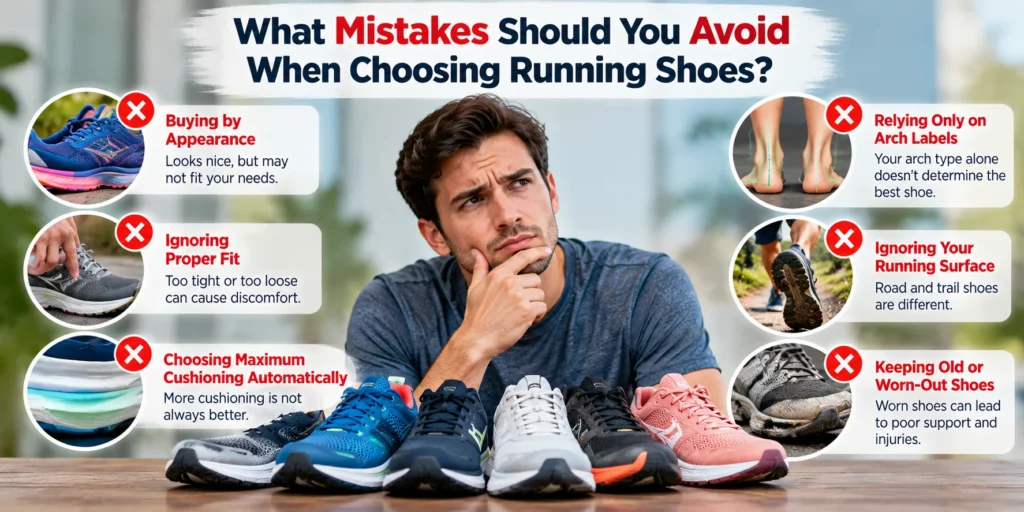
The most common buying mistakes involve ignoring fit and relying too heavily on marketing claims. A shoe needs to work for your feet, not just look impressive.
- Buying by appearance: Attractive colors do not guarantee an appropriate fit.
- Ignoring width: A correct length can still feel uncomfortable when the forefoot is cramped.
- Choosing maximum cushioning automatically: Thicker foam is not always more comfortable.
- Trusting arch labels alone: Static foot shape does not reveal every aspect of running movement.
- Skipping the movement test: Standing comfort may differ from running comfort.
- Expecting a break-in miracle: Significant pressure or numbness is a reason to reconsider the shoe.
- Changing shoe geometry abruptly: Unfamiliar drop or cushioning can require gradual adaptation.
- Ignoring running surface: Road and technical trail demands are different.
Another mistake is buying shoes based only on recommendations from friends. Their feet, training, and comfort preferences may differ from yours.
When Should You Replace Your Running Shoes?
Replace running shoes when wear begins affecting fit, comfort, traction, or structural integrity. Mileage provides a reference point, but no single distance guarantees replacement is necessary.
Many runners use approximately 300–500 miles as a general inspection range. Actual lifespan depends on construction, training conditions, and individual use.
- Uneven outsole wear: Traction or landing feel has changed noticeably.
- Midsole deterioration: The cushioning feels different or has visible damage.
- Upper damage: Tears or stretched materials reduce fit security.
- Persistent discomfort: Previously comfortable shoes now produce repeated irritation.
- Structural problems: The sole separates or the shoe no longer feels secure.
Replacement decisions should consider the shoe’s actual condition rather than mileage alone. Persistent pain also deserves appropriate medical assessment.
The APMA sports footwear guidance discusses choosing activity-specific shoes and the importance of suitable fit.
Which Running Shoes Are Worth Considering in 2026?
Three useful starting points are the Brooks Ghost 18, Brooks Adrenaline GTS 25, and ASICS GEL-KAYANO 33. They represent different approaches to everyday running comfort and support.
These are feature-based editorial shortlists, not personally tested rankings. The scores below describe suitability for their stated use cases rather than verified customer ratings.
Affiliate disclosure: As an Amazon Associate, we may earn from qualifying purchases. Prices, availability, and specifications can vary.
🏆 Best Neutral Daily Trainer
Brooks Ghost 18
★★★★☆ 4/5 editorial score
The Ghost 18 is a neutral road-running trainer with cushioned construction and a 10 mm heel-to-toe drop. I’d shortlist it for runners who prefer an everyday shoe without dedicated stability guidance.
🛡️ Best for Guided Support
Brooks Adrenaline GTS 25
★★★★½ 4.5/5 editorial score
The Adrenaline GTS 25 uses Brooks GuideRails support technology and a 10 mm drop. I’d compare it with a neutral model when additional movement guidance feels more comfortable.
☁️ Best Plush Stability Option
ASICS GEL-KAYANO 33
★★★★½ 4.5/5 editorial score
The GEL-KAYANO 33 combines substantial cushioning with adaptive stability features and an 8 mm drop. I’d consider it when a plush ride and structured support are both priorities.
Frequently Asked Questions About Choosing Running Shoes
How Do Beginners Choose Running Shoes?
Beginners should start by identifying their regular running surface and measuring both feet. Try comfortable daily trainers with adequate toe room, secure heels, and cushioning that feels natural while jogging.
There is no need to buy an advanced racing shoe immediately. Fit and consistent comfort are better starting priorities.
Should Running Shoes Be a Size Bigger?
Running shoes sometimes fit better in a larger size than everyday shoes, but sizing up is not a universal rule. Check the actual length and width instead.
Aim for about one thumb-width ahead of your longest toe. Make sure the heel remains secure.
Are Expensive Running Shoes Better?
Expensive running shoes can offer specialized materials or design features, but their price does not guarantee a better fit. Many reasonably priced daily trainers meet the needs of recreational runners.
Choose the shoe that feels comfortable and performs appropriately for your regular running.
Do Flat Feet Need Stability Running Shoes?
Not always. Some runners with flat feet prefer stability shoes, while others remain comfortable in neutral models.
Arch height alone cannot establish the best choice. Compare fit and support during running, and consult a qualified clinician when symptoms persist.
Can You Use the Same Running Shoes for Walking and Running?
Yes, many running shoes are suitable for both walking and running when they fit comfortably. Daily trainers can be versatile for recreational activity.
However, footwear designed for repeated forward motion may not provide ideal lateral support for court sports or activities involving rapid side-to-side movement.
Final Thoughts: How to Choose the Right Running Shoes
Choosing running shoes becomes easier when you prioritize fit, terrain, and comfort before brand names. Start with a suitable category, compare a few models, and test each pair through natural movement.
For most beginners, a comfortable daily trainer is the best place to begin. More specialized features become useful when your training needs justify them.
My final recommendation is simple: buy shoes that feel right on your feet today. The best running shoe is the one that suits your running habits and remains comfortable as you build consistency.


Steven is a former sportsperson and now a full-time businessman and research writer. He is the mastermind of this site, and he created this site to help people who need specialized shoes for different activities. When he was a sportsperson, he was very passionate about different types of shoes for his sports purpose. The passion he had for shoes at that time now turned into his profession. Besides his shoe business, he loves sharing his knowledge and experience with people and helping them maintain healthy feet.
More Posts