

Quick Answer
To choose your first running shoes, start with your running surface, find a comfortable fit, and select cushioning and support that feel natural. For most beginners running on roads or treadmills, a comfortable neutral daily trainer is a sensible starting point. Prioritize fit over brand, price, or appearance, following the basic principles in REI’s running shoe selection guide.
6 Steps to Choose Your First Pair
- Choose your surface: Select road shoes for pavement and treadmills, or trail shoes for uneven outdoor terrain.
- Identify support needs: Start with neutral shoes unless extra stability feels helpful or has been recommended.
- Measure both feet: Check foot length and width while standing, then fit the larger foot.
- Check toe space: Leave roughly one thumb’s width between your longest toe and the shoe’s front.
- Test the comfort: Walk and jog briefly, checking heel security, toe movement, and pressure points.
- Compare before buying: Try several models and confirm the retailer’s return policy.
My Beginner Rule
- Comfort comes first: A shoe should feel comfortable immediately, without relying on a break-in period.
Buying your first running shoes can feel confusing. Every brand promises comfort, cushioning, speed, and support, but beginners rarely need the most technical model.
I prefer a simpler approach: identify where you’ll run, check how the shoes fit, and compare their feel during a short jog. This 2026 guide explains exactly what to look for before spending your money.
What Should Beginners Look for in Running Shoes?
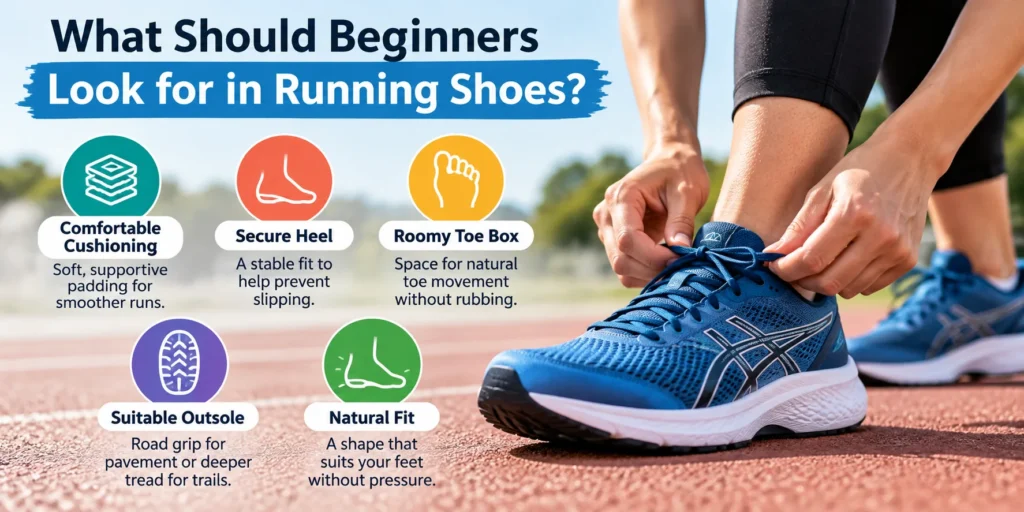
Beginners should look for running shoes that fit securely, provide comfortable cushioning, and match their intended running surface. The best first pair supports enjoyable, consistent running rather than promising performance improvements.
Beginner running shoes are typically everyday training shoes designed for regular running at comfortable paces. They usually prioritize cushioning, durability, predictable movement, and practical fit.
Unlike specialized racing shoes, daily trainers are designed to handle repeated training sessions. They also suit the walking breaks that many beginners include in their workouts.
Five Features That Matter Most
- Comfortable cushioning: Enough underfoot protection for your preferred running surface without making the shoe feel unstable.
- Secure heel: A heel counter and lacing system that help prevent excessive slipping.
- Roomy toe box: Space for your toes to move without rubbing against the shoe.
- Suitable outsole: Road-oriented grip for pavement or deeper tread for loose trails.
- Natural fit: A shape that suits your feet without squeezing or creating pressure.
My practical priority is the fit, followed by the underfoot feel. A shoe with impressive specifications still isn’t a good choice if it creates discomfort.
How Do You Choose Your First Running Shoes Step by Step?
Start by narrowing down your running needs before comparing individual models. This prevents you from paying for features that won’t improve your everyday runs.
Step 1: Decide Where You’ll Run Most Often
Your usual running surface determines which type of outsole you need. Most beginners can choose between road and trail running shoes.
- Road running: Choose regular road shoes for sidewalks, pavement, and paved park paths.
- Treadmill running: Choose comfortable road-running shoes with a secure fit.
- Trail running: Choose trail shoes for dirt, mud, rocks, and uneven terrain.
- Mixed surfaces: Consider road-to-trail shoes for pavement combined with maintained gravel paths.
Road shoes usually offer smoother outsoles than dedicated trail models. Trail shoes emphasize grip and protection for less predictable ground.
England Athletics’ shoe-selection guidance also recommends matching footwear to your running surface.
Step 2: Understand Neutral and Stability Shoes
Neutral and stability shoes differ mainly in how they support foot movement. Neither category is automatically better for every beginner.
Pronation is the natural inward rolling movement of the foot during walking or running. Some runners experience more inward motion, often described as overpronation.
- Neutral shoes: Typically offer cushioning without specialized motion-control features.
- Stability shoes: Include structural features intended to guide or limit certain movements.
- Motion-control shoes: Provide stronger support characteristics for selected needs.
You don’t need to diagnose your running style from your arch shape alone. Footwear comfort, movement, injury history, and professional advice can all affect your decision.
I wouldn’t choose a stability shoe solely because a wet footprint looks flat. I’d compare how neutral and supportive models feel while moving.
Step 3: Measure Your Feet Correctly
Your usual casual shoe size may not provide the right running fit. Running shoes differ in shape, internal length, and width across manufacturers.
- Measure both feet while standing with your weight evenly distributed.
- Measure from the heel to your longest toe, which isn’t always your big toe.
- Check the width across the widest part of each forefoot.
- Use the larger foot when selecting your starting size.
- Try the shoes with your normal running socks.
Shopping later in the day can help account for natural foot swelling. Don’t assume that you must buy exactly half a size larger than your everyday shoes.
Step 4: Find Your Preferred Cushioning
Cushioning affects how soft or firm a shoe feels during landing and push-off. Beginners should select a level that feels comfortable and stable.
- Moderate cushioning: A versatile starting point for everyday running.
- Plush cushioning: A softer feeling that some runners prefer for easy or longer runs.
- Firm cushioning: A more direct ground feel that may appeal to runners who dislike softness.
More foam doesn’t automatically mean better comfort or greater injury protection. The shoe’s geometry, foam properties, and fit also influence its ride.
Step 5: Test the Shoes Before Buying
A short in-store running test can reveal issues that standing still won’t show. Try the shoes on both feet with the laces adjusted normally.
- Walk for approximately one minute.
- Jog for 30–60 seconds if the store allows it.
- Notice whether your heels lift or slide.
- Check for pressure across the toes and midfoot.
- Compare at least two models before deciding.
My favorite comparison method is to focus on what I notice least. A shoe that stays comfortable without demanding attention is often a stronger candidate than one that initially feels dramatic.
Step 6: Check the Return Policy
Ask whether the retailer allows returns after indoor try-ons or limited outdoor running. Policies vary, and not every store offers a running trial.
Keep the packaging and receipt until you’re confident about the fit. Avoid taking shoes outdoors before checking the return conditions.
How Should Your First Running Shoes Fit?
Running shoes should fit securely around the heel and midfoot while providing enough space for the toes. You should be able to move your toes without feeling squeezed.
The American Academy of Orthopaedic Surgeons’ fitting guidance recommends approximately half an inch of space beyond your longest toe.
Running Shoe Fit Checklist
| Fit Area | Good Fit | Warning Sign |
|---|---|---|
| Toe length | About 12–13 mm of front clearance | Toes touching the front |
| Toe width | Natural toe movement | Pinching or rubbing |
| Midfoot | Secure but not tight | Pressure or numbness |
| Heel | Minimal slipping | Excessive lifting or rubbing |
| Overall comfort | Comfortable immediately | Pain that requires breaking in |
Toe room is especially important during downhill running, when your feet may move forward. Check that your toes don’t strike the front during your test.
What if You Have Wide Feet?
Look for models available in wide or extra-wide fittings. Going up in length isn’t always the best solution for a shoe that’s too narrow.
Try the correct length in a wider version first. Your toes should have space without your heel becoming loose.
Neutral vs. Stability vs. Trail Running Shoes: Which Is Best?
Neutral shoes are a sensible starting point for many beginners on roads. Stability shoes offer added support features, while trail shoes prioritize traction and protection outdoors.
| Feature | Neutral | Stability | Trail |
|---|---|---|---|
| Main purpose | Everyday cushioning | Added movement guidance | Off-road traction |
| Typical surface | Road/treadmill | Road/treadmill | Dirt/rock/gravel |
| Support design | General support | Additional guidance | Varies by model |
| Example model | Brooks Ghost 18 | Brooks Adrenaline GTS 25 | Saucony Peregrine 16 |
| Beginner consideration | Versatile road option | Try if support feels helpful | Choose for regular trail use |
These categories describe design priorities, not guaranteed performance outcomes. A shoe’s individual fit matters more than its category label.
How Much Cushioning and Heel Drop Do Beginners Need?
Most first-time runners can begin with comfortable, moderately cushioned shoes. There is no universal cushioning level or heel drop that suits everyone.
Heel-to-toe drop is the height difference between the heel and forefoot of a running shoe. Manufacturers usually report it in millimeters.
- High drop: Often above 8 mm, with a noticeably raised heel.
- Moderate drop: Roughly 5–8 mm, depending on the manufacturer’s classification.
- Low drop: Around 1–4 mm, with a smaller heel-to-forefoot difference.
- Zero drop: No designed height difference between heel and forefoot.
Lower-drop shoes can change the demands placed on your calves and Achilles tendon. Transition gradually if you’re switching from a noticeably higher-drop shoe.
For your first pair, I’d avoid treating any particular drop as a requirement. The more important question is whether the shoe feels natural during your normal running stride.
How Much Should You Spend on Your First Running Shoes?
You don’t need premium racing shoes to begin running. A reasonably priced daily trainer with the correct fit can serve a beginner well.
Many established daily running shoes have US list prices around $100–$160, although discounts and regional prices vary. More expensive shoes don’t automatically provide better individual comfort.
What Is Worth Paying For?
- Correct width: Choose a shape that doesn’t compress your feet.
- Comfortable midsole: Prioritize a ride you enjoy during easy running.
- Durable outsole: Select tread appropriate for your regular terrain.
- Useful return policy: A fitting-friendly retailer reduces purchasing risk.
Last-season daily trainers can also offer good value. Compare fit and condition rather than buying a particular model simply because it’s discounted.
What Are the Biggest Mistakes Beginners Make?
Most first-shoe mistakes come from prioritizing appearance or marketing over actual comfort. Avoid these common problems before making your purchase.
- Buying shoes that are too small: Limited toe space can cause rubbing, discomfort, or bruised toenails.
- Ignoring width: A longer shoe may still fit poorly if its shape is wrong.
- Choosing by appearance: Attractive colors cannot compensate for uncomfortable sizing.
- Assuming more cushioning is better: Excessively soft shoes can feel unstable to some runners.
- Automatically buying stability shoes: Extra support isn’t essential for every flat-footed runner.
- Skipping the running test: Walking comfort alone doesn’t always predict running comfort.
- Buying expensive racing shoes: Specialized designs may not suit regular beginner training.
Another mistake is assuming painful shoes will eventually become comfortable. Athletic footwear should fit well from the beginning.
The American Orthopaedic Foot & Ankle Society’s shoe-selection guidance recommends checking comfort immediately rather than depending on a break-in period.
How Do You Know if Your Running Shoes Are Right for You?
The right shoes should remain comfortable during easy runs without causing repeated rubbing, numbness, or excessive heel movement. Evaluate them over several appropriate trial sessions when the return policy permits.
Positive Signs
- Your toes can move freely without hitting the front.
- Your heels remain reasonably secure.
- The cushioning feels comfortable at your normal pace.
- You don’t notice persistent pressure against your arches or forefoot.
- The shoes feel predictable during turns and changes in pace.
Warning Signs
- Repeated blisters or painful rubbing
- Numbness or tingling in your toes
- Persistent arch pressure
- Excessive heel movement
- Toe impact against the front of the shoe
If you notice these problems, reassess sizing, width, and lacing before continuing. Persistent pain deserves evaluation by a qualified healthcare professional rather than repeated changes based on guesswork.
How Long Do Beginner Running Shoes Last?
Many everyday running shoes last approximately 300–500 miles (480–800 km), but replacement timing varies. Body weight, shoe construction, running surfaces, and individual wear patterns all affect durability.
According to Northwestern Medicine’s running shoe guidance, runners should monitor cushioning changes and wear rather than relying only on mileage.
Signs You May Need New Shoes
- Significant outsole wear
- Compressed or uneven cushioning
- Damaged uppers or heel counters
- Noticeably different comfort from when the shoes were new
- New discomfort associated with an aging pair
Keep a simple mileage record if you run regularly. Replace shoes based on their condition and feel, not just an arbitrary calendar date.
Which Running Shoes Should Beginners Consider in 2026?
If you’re ready to compare real models, these three shoes represent different beginner needs. They are examples to try, not universal recommendations.
Disclosure: This section contains affiliate links. Purchases through these links may earn a commission at no additional cost to you. The ratings below are editorial beginner-suitability assessments, not customer review averages or hands-on test scores.
🏆 Best Everyday Road Option
Brooks Ghost 18
★★★★★ (5/5)
A neutral daily trainer with nitrogen-infused DNA LOFT v3 cushioning and a 10 mm heel-to-toe drop. I’d put this near the top of a beginner’s road-running try-on list because it combines everyday cushioning with a familiar training-shoe design.
🛡️ Best for Added Support
Brooks Adrenaline GTS 25
★★★★☆ (4/5)
This road-running shoe combines soft cushioning, a 10 mm drop, and Brooks’ GuideRails support technology. I’d compare it with neutral options when a runner wants more structured guidance, provided the support feels comfortable.
🌲 Best for Trail Beginners
Saucony Peregrine 16
★★★★☆ (4/5)
A dedicated trail shoe with Vibram Megagrip traction, PWRRUN cushioning, and a protective upper. I’d shortlist it for beginners regularly running on dirt or rocky paths rather than choosing it for pavement-only training.
These models serve different purposes, so their ratings shouldn’t be compared as a universal ranking. Always verify available sizes, retailer listings, and your preferred fit before purchasing.
Frequently Asked Questions
Should Beginners Buy Neutral or Stability Running Shoes?
Many beginners can start by trying neutral running shoes, particularly for everyday road running. Stability shoes are worth comparing if additional support feels comfortable or has been recommended following a professional assessment. Neither category is automatically safer for every runner.
Should Running Shoes Be a Size Bigger?
Not necessarily. Running shoes need adequate toe clearance, but sizing differs across brands and models. Measure both feet, try shoes while standing, and aim for roughly a thumb’s width beyond your longest toe without allowing excessive heel movement.
Can I Start Running in Regular Sneakers?
Some comfortable athletic sneakers may be suitable for occasional short runs, but dedicated running shoes are generally a better option for regular training. They are designed specifically for repeated forward running movements, with cushioning, grip, and fit features intended for that activity.
Are Expensive Running Shoes Better for Beginners?
More expensive running shoes aren’t automatically better for beginners. Price can reflect premium foam, specialized materials, or racing features that aren’t necessary for easy training. A moderately priced daily trainer that fits well is often the more practical first purchase.
How Many Pairs of Running Shoes Does a Beginner Need?
One comfortable, properly fitted pair is enough for most new runners. A second pair can become useful when training frequently or alternating between different surfaces. There’s no need to buy multiple shoes before establishing a consistent running routine.
Final Thoughts: Choose Comfort Before Technology
Your first running shoes don’t need to be expensive, complicated, or designed for racing. They need to fit your feet, match your running surface, and feel comfortable as you build your routine.
Start by trying a few well-fitting daily trainers, then compare the cushioning and support during a short jog. Choose the pair that feels secure, natural, and comfortable rather than the one with the most impressive marketing claims.
Your next step: Measure your feet, identify your usual running surface, and try at least two suitable models before buying. A comfortable first pair makes it easier to focus on the running itself.


