

Quick Answer
Soft running shoes provide a plush, cushioned feeling that many runners enjoy during easy and long runs. Firm running shoes offer a more direct, controlled feeling underfoot, which some runners prefer for faster workouts. Neither is automatically better or safer. The best choice combines comfortable cushioning, secure fit, and appropriate support, as emphasized in orthopaedic footwear guidance.
Key Differences
- Soft cushioning: Compresses more easily and creates a plush landing sensation.
- Firm cushioning: Resists compression and provides a more direct connection with the ground.
- Long-run comfort: Many runners enjoy cushioning that reduces the sensation of hard landings.
- Running stability: Platform width and construction matter as much as foam firmness.
- Best everyday choice: A moderately cushioned shoe often offers a useful balance of comfort and control.
My Starting Recommendation
- Compare both: Try a soft and a moderately firm model at the same running pace before deciding.
Choosing between soft vs firm running shoes sounds simple until you try several pairs. One feels wonderfully cushioned, while another seems easier to control.
I prefer comparing how shoes behave during movement rather than judging their softness by hand. This guide explains cushioning, stability, injury research, and how to choose the right feel for your running.
What Does Soft vs Firm Running Shoes Mean?
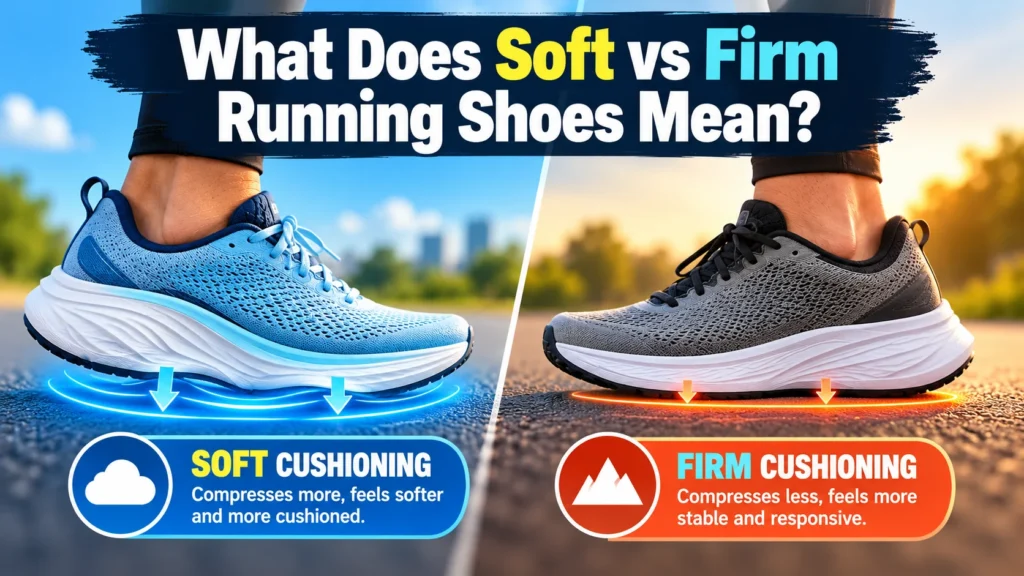
Soft versus firm running shoes describes how much the midsole compresses under load. The midsole is the cushioning layer between your foot and the outer rubber sole.
Soft foam generally compresses more easily, while firmer foam resists compression. However, midsole thickness, geometry, and materials also influence the experience.
What Are Soft Running Shoes?
Soft running shoes use cushioning that feels compliant when your foot lands. They often create a padded sensation during walking, jogging, and longer training sessions.
Some models use thick midsoles with specialized foams. Others achieve softness through flexible materials and well-designed cushioning systems.
- Plush landings: The foam compresses noticeably underfoot.
- Comfort-focused design: Many prioritize relaxed daily mileage.
- Variable responsiveness: Some soft foams rebound quickly, while others feel less energetic.
- Different stability levels: Wide platforms can make soft shoes feel surprisingly secure.
Examples include the Brooks Glycerin 23 and ASICS GEL-NIMBUS 28. Both emphasize comfortable, cushioned running experiences.
What Are Firm Running Shoes?
Firm running shoes have midsoles that resist compression more strongly. This creates a more direct feeling when your foot contacts the ground.
Firm does not mean uncomfortable or poorly cushioned. Many moderately firm shoes still provide substantial cushioning beneath your feet.
- More direct feedback: You may notice the ground beneath your feet more clearly.
- Less sinking: The midsole compresses less deeply during landing.
- Controlled transitions: Some runners appreciate the more immediate underfoot feel.
- Variable flexibility: A firm midsole can still be flexible through the forefoot.
The Saucony Kinvara 16 represents a firmer, lower-profile approach. It offers a different running experience from heavily cushioned daily trainers.
Soft vs Firm Running Shoes: What Are the Main Differences?
The biggest differences involve cushioning sensation, ground feedback, and how the shoes respond during movement. Neither category guarantees better performance.
| Feature | Soft Shoes | Firm Shoes |
|---|---|---|
| Foam compression | Easier to compress | Greater resistance |
| Landing sensation | Plush and padded | Direct and controlled |
| Ground feedback | Often reduced | Often increased |
| Stability | Depends on geometry | Depends on geometry |
| Energy return | Depends on foam technology | Depends on foam technology |
| Typical preference | Plush, relaxed running | More connected running |
These descriptions reflect common design tendencies, not fixed rules. A well-designed soft shoe can feel stable, while a firm shoe can still feel uncomfortable.
What Are the Benefits of Soft Running Shoes?
Soft running shoes appeal to runners who enjoy cushioned landings. Their main benefit is the comfortable sensation created when the foam compresses beneath the foot.
Why Do Soft Shoes Feel Comfortable?
A compliant midsole spreads cushioning through the landing phase. This may make repetitive impacts feel less harsh, especially during relaxed running.
However, feeling softer does not guarantee lower injury risk. Individual running mechanics and training habits also matter.
- Easy-run comfort: Plush cushioning may feel pleasant during recovery-paced training.
- Long-distance enjoyment: Some runners appreciate additional underfoot padding.
- Road-running feel: Softer midsoles may reduce the sensation of landing on hard pavement.
- Standing and walking: Comfort-focused designs can also suit everyday activities.
What Are the Disadvantages of Soft Shoes?
Extremely soft cushioning is not ideal for everyone. Some runners dislike the feeling of their feet sinking into the midsole.
- Unwanted compression: Excessive sinking can make transitions feel less predictable.
- Unstable sensation: A narrow, tall, soft platform may feel awkward during turns.
- Reduced feedback: Some runners prefer a stronger connection with the surface.
- Potential extra bulk: Highly cushioned designs can be heavier, although modern foams vary considerably.
My practical rule is simple: plush cushioning should feel comfortable without making each step harder to control. Softness alone is not enough.
What Are the Benefits of Firm Running Shoes?
Firm running shoes provide a more direct sensation underfoot. They can appeal to runners who dislike deeply compressing cushioning.
A firmer shoe may also feel predictable during changes in pace. Still, shoe geometry and weight influence this feeling.
When Can Firm Cushioning Work Well?
- Shorter workouts: Some runners enjoy a firmer sensation during brief sessions.
- Tempo training: Direct ground feedback may feel suitable at quicker paces.
- Controlled movement: Less foam compression can create a reassuring sensation.
- Lower-profile designs: Some firm models position the foot closer to the ground.
What Are the Drawbacks of Firm Shoes?
Firm cushioning can feel harsh when it does not match your preferences. This may become particularly noticeable during longer runs.
- Less plushness: Landings may feel more pronounced.
- Individual discomfort: Some runners dislike the harder sensation beneath their feet.
- Limited cushioning in certain models: Lower-profile shoes may provide less cushioning material.
- Adjustment period: Changing to a different shoe geometry can alter the load on your legs.
A firm shoe is not automatically faster or more supportive. Choose it because its overall construction works for your running.
Are Soft or Firm Running Shoes Better for Your Knees and Joints?
Neither cushioning category can guarantee protection against knee pain or running injuries. Research suggests that midsole properties influence loading, but individual responses vary.
A 2024 biomechanics study investigated midsole hardness and running-surface cushioning. Softer combinations reduced certain loading-rate measurements in the small group studied.
That finding does not prove that soft shoes prevent injuries. Biomechanical measurements and real-world injury outcomes are different.
What Does Research Say About Injury Risk?
A 2025 study of recreational runners found associations between perceived cushioning, shoe appreciation, and lower injury risk. However, these associations do not establish that choosing the softest shoe prevents injury.
- Comfort matters: Shoes should feel acceptable throughout your normal running movement.
- Training load matters: Sudden mileage increases can contribute to problems.
- Fit matters: Poor sizing may cause rubbing, pressure, or instability.
- Individual history matters: Previous injuries may change which designs feel suitable.
If you experience persistent knee, shin, heel, or foot pain, consider a qualified medical assessment. Do not rely on cushioning changes as a substitute for diagnosis.
Are Soft or Firm Running Shoes Better for Running Faster?
Neither soft nor firm automatically means faster. Running economy depends on several interacting shoe properties and the runner’s movement.
Modern performance shoes often use compliant, highly resilient foams. Resilience means the material returns energy after compression rather than simply absorbing it.
Why Is Energy Return Different From Softness?
A shoe can feel soft without producing a particularly energetic rebound. Likewise, a firmer shoe can feel responsive because of its foam composition and construction.
- Softness: Describes how easily the foam compresses.
- Energy return: Describes how much stored mechanical energy the material returns.
- Rocker geometry: Uses a curved sole shape to influence forward transitions.
- Longitudinal stiffness: Describes resistance to bending from heel to toe.
Advanced racing shoes may combine several of these features. Their performance cannot be explained by midsole firmness alone.
Does Cushion Thickness Matter More Than Firmness?
Cushion thickness and firmness describe different properties. A thick midsole can be soft or firm, while a thin midsole can also vary in hardness.
Understanding Stack Height and Heel Drop
Stack height measures the height of the shoe’s sole beneath the foot. Heel-to-toe drop measures the height difference between the heel and forefoot.
A shoe with a 36 mm heel and 28 mm forefoot has an 8 mm drop. These measurements do not directly reveal whether its foam feels soft.
- High stack: Provides room for more cushioning material but can change stability.
- Low stack: Often creates a more connected ground sensation.
- Higher drop: Changes the relationship between heel and forefoot height.
- Lower drop: May alter ankle movement and calf or Achilles loading.
Abrupt changes in drop or cushioning can feel unfamiliar. Introduce substantially different designs gradually rather than replacing every run immediately.
Which Is Better for Beginners, Long Runs, and Daily Training?
For many beginners, moderate cushioning provides a sensible starting point. The goal is comfortable movement, appropriate fit, and enough stability for repeated use.
| Running Situation | Starting Preference | Why |
|---|---|---|
| Beginner running | Moderate cushioning | Balanced starting point |
| Easy daily runs | Soft or moderate | Comfort-focused use |
| Long-distance training | Comfortable, stable cushioning | Sustained comfort |
| Faster workouts | Responsive cushioning | Efficient transitions |
| Uneven terrain | Stable, terrain-specific design | Traction and control |
These recommendations are starting points rather than universal rules. Your preferred cushioning may differ even when your running goals match another runner’s.
Does Body Weight or Foot Strike Change the Best Cushioning?
Body weight and foot-strike pattern can influence how a shoe compresses. However, neither characteristic determines one universally correct cushioning firmness.
A runner applying greater force may compress the same midsole differently. Shoe fit, mechanics, and personal comfort remain important.
- Heavier runners: Consider cushioning that feels supportive without excessive compression.
- Lighter runners: Compare whether firmer models compress enough to feel comfortable.
- Heel strikers: Pay attention to rearfoot cushioning and smooth transitions.
- Forefoot strikers: Evaluate forefoot protection, flexibility, and calf comfort.
- Overpronation concerns: Assess appropriate support features instead of relying on firmness alone.
Do not assume that flat feet automatically require firm shoes. Likewise, high arches do not automatically require the softest available foam.
How Can You Choose Between Soft and Firm Running Shoes?
Start with fit, then compare cushioning during actual movement. A structured trial reveals more than pressing the midsole with your thumb.
Step 1: Identify Your Main Running Activity
Think about your typical distance, pace, and surface. A shoe designed around relaxed daily mileage may feel different from one intended for quicker workouts.
Step 2: Compare Three Cushioning Levels
Try one plush shoe, one moderate shoe, and one firmer shoe. This makes differences easier to recognize.
Step 3: Check Length and Width
Your toes should move freely without touching the front of the shoe. The heel should stay secure without uncomfortable pressure.
Use proper running socks during fitting. Follow the American Orthopaedic Foot & Ankle Society’s shoe-selection guidance when assessing comfort and fit.
Step 4: Test Each Shoe at Your Normal Pace
Jog briefly if the store permits. Notice whether the cushioning feels natural during landing and push-off.
- Does your heel remain secure?
- Can your toes spread comfortably?
- Does the midsole feel too harsh or excessively soft?
- Do transitions feel smooth and controlled?
- Does either shoe cause rubbing or uncomfortable pressure?
Step 5: Compare Stability and Flexibility
Pay attention to unwanted side-to-side movement. A wide platform may feel stable even with soft cushioning.
Also check whether the shoe bends naturally during your stride. Foam firmness and bending stiffness are separate characteristics.
Step 6: Make the Change Gradually
Begin with shorter runs in a substantially different shoe. Increase use as your body becomes comfortable with its cushioning and geometry.
I would rather choose the shoe that consistently feels natural than chase the softest foam specification. That approach keeps attention on the complete running experience.
Can You Alternate Between Soft and Firm Running Shoes?

Yes, runners can alternate between differently cushioned shoes when both fit comfortably. This allows you to choose footwear based on the session.
- Soft daily trainer: Use for comfortable, relaxed mileage.
- Moderately cushioned trainer: Use for general everyday running.
- Firmer lightweight shoe: Consider for selected shorter or faster sessions.
Rotating footwear does not guarantee injury prevention. Maintain sensible training progression regardless of how many pairs you own.
What Mistakes Should You Avoid When Choosing Cushioning?
The most common mistake is choosing a shoe based on softness alone. Good running shoes must also fit and function comfortably.
- Assuming softer is always safer: Injury risk depends on more than cushioning.
- Confusing firmness with stability: Platform width and support construction also matter.
- Ignoring shoe width: A comfortable midsole cannot fix a cramped toe box.
- Choosing by appearance: Try the shoes before relying on their design or popularity.
- Changing footwear abruptly: Transition gradually when cushioning or drop changes considerably.
- Ignoring persistent pain: Seek professional advice instead of repeatedly changing shoes.
Which Soft, Balanced, and Firm Running Shoes Are Worth Considering in 2026?
The following models illustrate three different approaches to cushioning. These selections are based on published specifications and design characteristics, not personal laboratory testing.
The ratings are editorial assessments of each shoe’s suitability for its stated use. They are not Amazon customer ratings or measured performance scores.
🏆 Best for Plush Cushioning
Brooks Glycerin 23
★★★★½ 4.5/5
The Glycerin 23 features nitrogen-infused DNA TUNED cushioning, an 8 mm drop, and a broad platform. I would shortlist it for runners seeking plush landings on easy and long runs, although its substantial construction may not appeal to everyone.
⚖️ Best Balanced Daily Trainer
Saucony Ride 19
★★★★½ 4.5/5
The Ride 19 uses updated PWRRUN+ cushioning and an 8 mm drop, with 36 mm of heel stack and 28 mm under the forefoot. It is my specification-based starting pick for runners seeking an adaptable daily trainer rather than an extreme cushioning feel.
⚡ Best for a Firmer, Connected Feel
Saucony Kinvara 16
★★★★☆ 4.0/5
The Kinvara 16 combines PWRRUN cushioning with a low-profile design and a manufacturer-specified 4 mm drop. I would consider it for runners who prefer a firmer ground feel during shorter workouts, while recognizing that its lower drop and narrower fit may not suit everyone.
Frequently Asked Questions
Are Soft Running Shoes Better for Beginners?
Soft shoes can work well for beginners, but moderate cushioning is often a useful starting point. New runners should prioritize secure fit, comfortable movement, and stable construction rather than automatically choosing the softest available model.
Do Firm Running Shoes Cause More Injuries?
Firm running shoes do not automatically cause injuries. Research suggests that cushioning affects running mechanics and may influence injury risk, but training load, comfort, individual movement patterns, and previous injuries also contribute to outcomes.
Are Soft Running Shoes Better for Long Distances?
Many runners prefer softer cushioning during long-distance training because it feels comfortable over repeated steps. However, the best long-run shoe must also provide appropriate stability, fit, and reliable transitions throughout the entire session.
Can Soft Running Shoes Make Your Feet Hurt?
Yes, soft running shoes can feel uncomfortable when their cushioning, shape, or stability does not match your needs. Excessive movement, poor sizing, and unsuitable geometry may contribute to discomfort, so persistent pain deserves proper assessment.
Are Firm Running Shoes Better for Running Fast?
Not necessarily. Some runners enjoy firm, direct cushioning during faster workouts, but modern performance footwear can use very soft, responsive foams. Running speed and economy depend on several design properties rather than firmness alone.
Final Verdict: Should You Choose Soft or Firm Running Shoes?
Soft running shoes may be ideal when you prioritize plush cushioning and comfortable daily mileage. Firm running shoes may suit you better when you prefer direct ground feedback and less midsole compression.
For many runners, a balanced daily trainer is the easiest starting point. It avoids making extreme softness or firmness the deciding factor.
My recommendation is to compare comfort, stability, and fit during a real running movement. Choose the shoe that feels natural for your training rather than assuming one cushioning category is universally superior.
Ready to choose? Start by trying a soft, balanced, and firm running shoe side by side, then select the one that best supports your usual runs.


Steven is a former sportsperson and now a full-time businessman and research writer. He is the mastermind of this site, and he created this site to help people who need specialized shoes for different activities. When he was a sportsperson, he was very passionate about different types of shoes for his sports purpose. The passion he had for shoes at that time now turned into his profession. Besides his shoe business, he loves sharing his knowledge and experience with people and helping them maintain healthy feet.
More Posts
