

Quick Answer
It depends. The Saucony Kinvara 14 is an excellent lightweight option for neutral runners who enjoy short, quick sessions. Its 7 oz men’s weight and 4 mm drop help it feel nimble. However, the narrow forefoot, firm ride, limited wet grip, and modest support make it less convincing as an all-purpose trainer.
Should you choose the Kinvara 14?
- Best for neutral runners seeking a light, plate-free tempo shoe.
- Its rocker and PWRRUN foam favor smooth pace changes.
- Skip if you need a roomy toe box or reliable rain traction.
Overall*
Weight*
Value score
Stability*
Best for: Short-to-moderate road runs and faster workouts.
Not ideal for: Wide forefeet, wet pavement, or stability needs.
Price: Originally $120; check current Amazon listing.
Check Kinvara 14 Price on Amazon
*Overall and category ratings convert OutdoorGearLab’s independent scores to a five-point scale. Amazon link opens a specific men’s color/size listing; verify options before ordering.
Independent Category Scores — OutdoorGearLab
Scores belong to OutdoorGearLab, not FootwearHiker laboratory testing.
I’m Steven Tyler, the author behind FootwearHiker’s running-shoe coverage. Here, I compare published lab measurements with independent hands-on reviews rather than claim personal mileage I haven’t documented.
What Is the Saucony Kinvara 14 and Who Is It For?
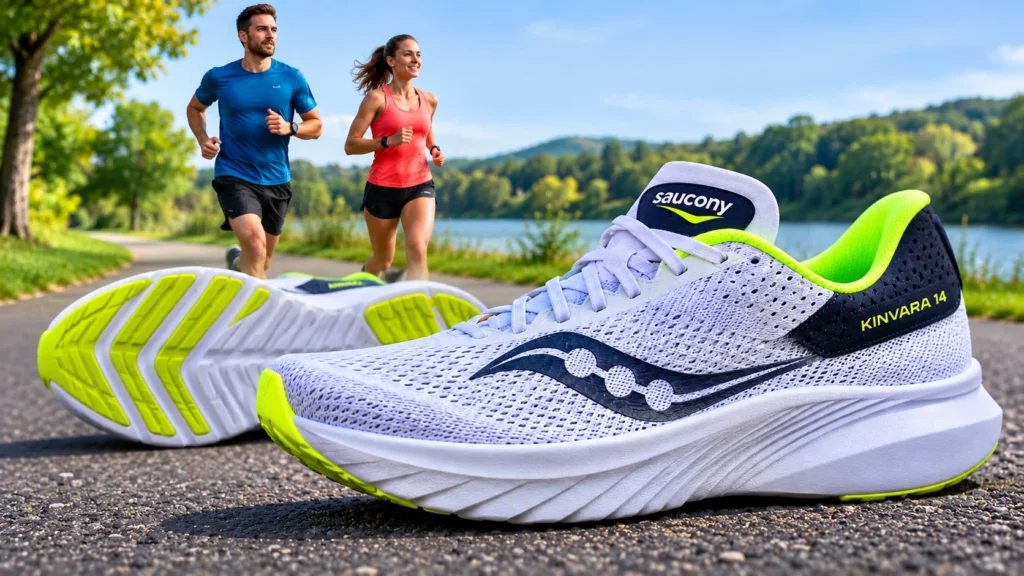
The Kinvara 14 is a neutral, low-drop road running shoe built for light, flexible training. It uses Saucony’s PWRRUN midsole and PWRRUN+ sockliner, without a propulsion plate.
It suits runners who have stable mechanics and enjoy a more direct road sensation. Several reviewers liked it for tempo runs, intervals, and shorter daily miles.
- Prefer neutral shoes with a low heel-to-toe drop.
- Run tempos or intervals mainly on dry roads.
- Want light footwear without a carbon plate.
- You need more forefoot space or structured support.
- You regularly run on slick, wet surfaces.
- You prioritize soft cushioning for longer outings.
Saucony Kinvara 14 Pros and Cons
The standout strength is weight; the standout weakness is its set of practical compromises. The same reduced rubber that saves mass also affects grip and wear protection.
- Around 7 oz in men’s standard reference size.
- Breathable upper scored 5/5 in RunRepeat’s lab.
- 4 mm drop suits runners who enjoy low-drop footwear.
- Rocker geometry helps maintain a smooth running rhythm.
- Narrow toe box caused discomfort in independent wear tests.
- Wet-road traction trails RunRepeat’s tested category average.
- Exposed midsole offers less outsole protection over time.
- Limited stability makes this unsuitable for support-dependent runners.
Which Kinvara 14 Features Matter Most?
Is the Kinvara 14 Light Enough for Speedwork?
Yes. Saucony lists 7 oz for a men’s size 9. RunRepeat measured a 6.8 oz sample, against its 9.2 oz shoe-category average.
Measured Weight: Lower Is Lighter
Kinvara 14 — 194 g
RunRepeat category average — 261 g
Bars compare actual measured weights, not invented performance scores.
Takeaway: Low mass is the Kinvara’s clearest measurable advantage.
That helps when turnover rises during repeats. It doesn’t guarantee greater energy return, which depends on foam behavior too.
Does the PWRRUN Foam Feel Soft and Bouncy?
No, not compared with modern plush trainers. The extra stack gives more underfoot protection, but the foam still feels relatively firm.
Takeaway: More foam does not automatically mean softer cushioning.
RunRepeat measured 56.1% heel energy return, compared with its 58.7% reference average. Expect a light ride rather than a springy superfoam feel.
Choose this model for quick turnover, not maximum bounce.
Does the Narrow Upper Affect Fit?
Yes, especially around the forefoot. Doctors of Running and Runner’s World both reported pressure or discomfort among some testers.
Takeaway: A true-to-size length does not guarantee comfortable toe width.
RunRepeat measured 74.0 mm in its older toe-box-width method, below its 78.6 mm comparison average. Check sizing and width before buying.
Can You Trust the Outsole on Wet Roads?
Not fully. The mostly exposed foam outsole saves weight but provides less consistent grip on slick pavement.
RunRepeat Forefoot Traction Test: Higher Is Better
Kinvara 14 — 0.40
Category reference — 0.52
Takeaway: Laboratory forefoot traction trails the category reference.
Use extra care on wet turns, painted road lines, and slick pavement.
Does the 4 mm Drop Change Your Stride?
Yes, it can change where your lower leg absorbs load. The low drop and rockered sole favor runners already comfortable with that geometry.
Takeaway: Ease into a low-drop shoe rather than switching every run overnight.
How Long Does the Kinvara 14 Last?
Durability depends on surface, gait, and mileage. Heavy exposed-foam coverage creates more wear risk than a thick rubber outsole.
Takeaway: Inspect the sole regularly instead of assuming a set lifespan.
Doctors of Running saw mild wear after 35 miles in one test pair. Another tester noted little concern after 25 miles, so experiences differ.
Rotate the Kinvara with a durable daily trainer if you run often.
How Does the Kinvara 14 Perform in Independent Tests?
Its strongest measurable result is low weight, while support scores lag. The cards below reproduce OutdoorGearLab’s five test categories.
Saucony Kinvara 14 Full Specifications
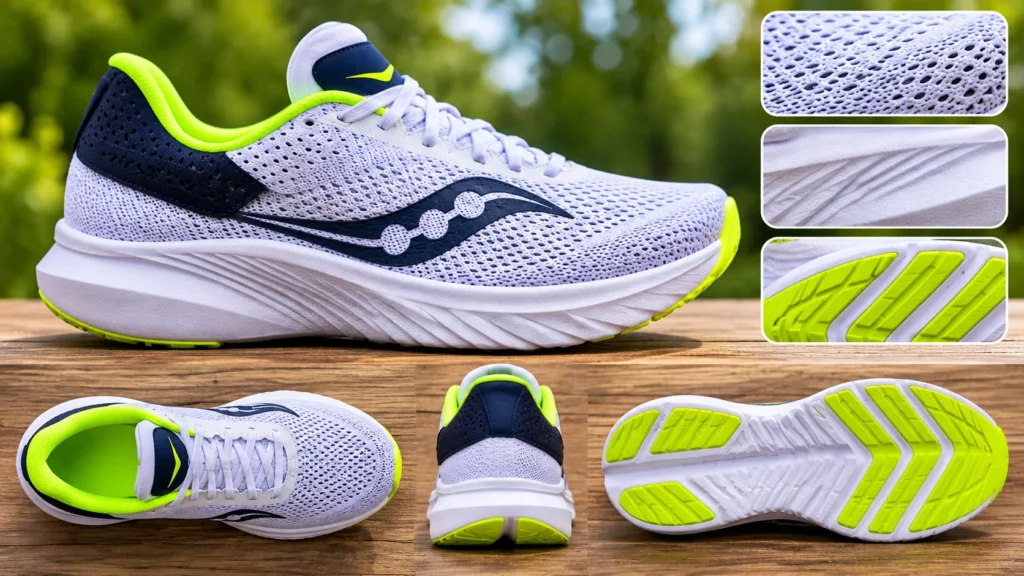
| Specification | Kinvara 14 |
|---|---|
| Type | Neutral road trainer |
| Midsole | PWRRUN foam |
| Sockliner | PWRRUN+ |
| Heel stack, brand | 31 mm |
| Forefoot stack, brand | 27 mm |
| Heel-to-toe drop | 4 mm |
| Men’s weight, brand | 7.0 oz / 200 g (US 9) |
| Women’s weight, brand | 6.2 oz / 175 g (US 8) |
| Independent weight | 6.8 oz / 194 g (RunRepeat) |
| Breathability test | 5/5 (RunRepeat) |
| Removable insole | ✓ Yes |
| Carbon plate | ✗ No |
| Original US list price | $120 |
The 4 mm drop and unusually low mass define the shoe more than its added stack height.
How Does the Kinvara 14 Compare to Competitors?
Kinvara 14 vs New Balance FuelCell Rebel v3
The Rebel v3 wins on a softer, springier feel; the Kinvara wins on lower weight and drop. Both are neutral shoes suited to pace changes.
Kinvara 14 vs Brooks Hyperion Tempo
The Hyperion Tempo offers a firmer, traditional speed-trainer platform with an 8 mm drop. The Kinvara is lighter and keeps the heel closer to the forefoot.
| Feature | Kinvara 14 | Rebel v3 | Hyperion Tempo |
|---|---|---|---|
| Original price | $120 | $130 | $150 |
| Men’s listed weight | 7.0 oz | 7.4 oz | 7.3 oz |
| Drop | 4 mm | 6 mm | 8 mm |
| Cushion feel | Firm / moderate | Soft / lively | Firm / responsive |
| Support type | Neutral | Neutral | Neutral |
| Best use | Light tempo runs | Bouncy fast runs | Traditional speedwork |
For bounce, try the Rebel. For lower-drop, plate-free speedwork, the Kinvara remains attractive.
Saucony Kinvara 14 Pricing — Is It Worth the Price?
Yes, at a meaningful discount. Its original $120 price now competes with clearance offers for newer training shoes.
A retailer price tracker showed a $48.95 offer when checked and a recent $34.95 low. Those are changing retailer quotes, not confirmed live Amazon prices.
Saucony Kinvara 14 Lightweight Neutral Road Running Shoe
Buy for fast, dry-road sessions if the fit suits you.
Who Should Buy the Saucony Kinvara 14?
Buy the Kinvara 14 if you’re a neutral runner who values light, fast footwear more than all-day plushness.
- Runners doing short intervals and tempo workouts on dry pavement.
- Experienced low-drop users who dislike heavy, built-up daily trainers.
- Buyers seeking an affordable alternative to plated racing footwear.
- Your toes feel cramped in tapered or narrow forefoot uppers.
- You need stable support or frequent wet-weather road traction.
Bottom line: Treat this as a specialist light trainer, not your only running shoe.
What Are Real Buyers Saying About the Kinvara 14?
Independent experts praise the low weight but disagree about fit and comfort.
A third-party tracker reported 8.6/10 from 1,319 ratings for one women’s listing. This is not a verified live Amazon count.
- Light construction receives praise across several independent editorial reviews.
- Narrow forefoot fit causes discomfort for some experienced running testers.
- Wet grip and reduced rubber coverage remain recurring concerns.
- Ride preferences vary between smooth-rocker fans and traditional Kinvara loyalists.
For test details, see OutdoorGearLab’s category scores, RunRepeat’s laboratory measurements, and Saucony’s official specifications.
Final Verdict — Is the Kinvara 14 Worth Buying?
Yes, for the right runner and the right price. The Kinvara 14 is light, breathable, and enjoyable for short road workouts. Yet it asks you to accept a narrow upper, modest support, firmer cushioning, and weaker wet traction. Independent reviewers don’t agree on every aspect, so fit matters more than any single rating. I would choose it as an extra speed-day shoe, not as a first running shoe or an all-weather workhorse. If you can try it on and find a deep discount, it remains worth considering.
Saucony Kinvara 14 Neutral Tempo Running Shoes
Light and quick, but check width and road grip before buying.
Frequently Asked Questions
Is the Saucony Kinvara 14 good for beginners?
It isn’t my first pick for most beginners. The neutral platform and low 4 mm drop require an adjustment if you’re used to more structured, higher-drop shoes. Start with a conventional daily trainer if you want more support and versatility.
Does the Kinvara 14 run true to size?
Reviewers found the length true to size, but the forefoot runs narrow. Doctors of Running noted toe-area discomfort in one test. Check both width and length.
Can I run long distances in Kinvara 14 shoes?
Some runners can. OutdoorGearLab found enough cushioning for longer miles but more fatigue than softer shoes. Narrow fit also limited distance for some Doctors of Running testers.
Is the Saucony Kinvara 14 waterproof?
No. Its airy mesh does not block rain. RunRepeat rated breathability 5/5. Choose a weather-resistant shoe if dry feet matter most.
Does the Kinvara 14 have a carbon plate?
No. It relies on a PWRRUN foam midsole, PWRRUN+ sockliner, and rockered shaping rather than a carbon plate. That keeps the ride flexible and simple, but it lacks the propulsive structure used by some dedicated racing shoes.
Is the Kinvara 14 slippery on wet pavement?
It can be. RunRepeat measured traction at 0.40 against a 0.52 reference. Slow down on painted lines and slick turns.