

Quick Answer
Yes, running shoes should feel comfortably snug around your heel and midfoot, but not tight across your entire foot. Your toes need space to spread, with roughly a thumb’s width beyond your longest toe. The best fit feels secure while moving, without pressure, numbness, or repeated slipping. For a deeper breakdown, see how tight running shoes should be.
Five signs of a comfortably snug fit
- Secure heel: Your heel stays seated without persistent lifting or rubbing.
- Gentle midfoot hold: The laces support your foot without squeezing its top.
- Free toes: You can wiggle and spread your toes comfortably.
- Enough length: Your longest toe has approximately 10–15 mm of front clearance.
- Comfort in motion: Walking and jogging create no pinching, tingling, or unwanted sliding.
One quick way to confirm
- Try both shoes standing: Wear running socks, check toe room, then walk and jog briefly indoors.
Running shoes should hug your feet, not squeeze them. When I evaluate fit, I look at heel security, midfoot pressure, and toe freedom separately because one shoe can get two areas right and the third wrong.
What Does a Snug Fit Mean in Running Shoes?
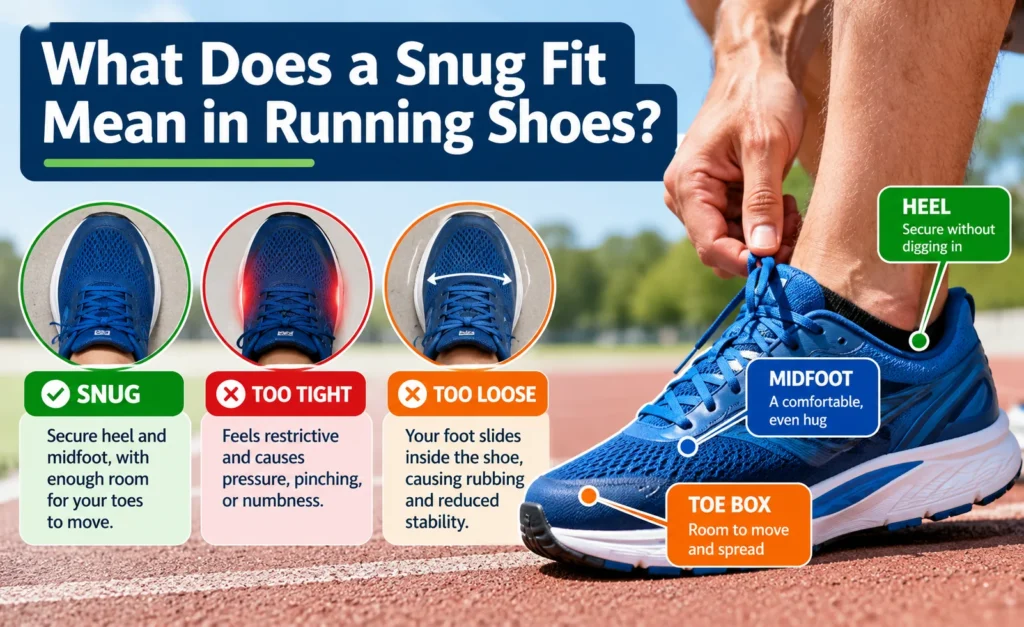
A snug running shoe fits closely enough to control unwanted movement without compressing your foot. Think of a gentle, secure hold rather than a tight wrap.
That difference matters because your feet change shape under load. A shoe that feels pleasantly close while sitting might become restrictive when you stand or run.
- Snug: You feel contact around your heel and midfoot, yet you can move naturally.
- Too tight: You feel concentrated pressure, pinching, tingling, or numbness.
- Too loose: Your heel repeatedly lifts or your foot slides inside the shoe.
The REI running shoe fit guide recommends a secure heel and midfoot alongside ample toe clearance. That combination is more useful than judging fit by how firmly the upper touches your foot.
Where Should Running Shoes Feel Snug?
Running shoes should feel most secure at the heel and midfoot. The forefoot should have enough width and length for comfortable toe movement.
Heel: Secure Without Digging In
The heel counter is the firmer structure surrounding the back of your heel. It should cradle that area without biting into your Achilles tendon or ankle.
A little movement may occur with some shoe designs. Repeated lifting, friction, or the sensation that your heel is escaping signals a problem worth correcting.
Midfoot: A Comfortable, Even Hug
The midfoot covers the arch and upper middle section of your foot. Laces should hold this region steadily without creating a sharp pressure point.
If loosening the laces immediately removes discomfort, tension may be the issue. If the shoe still squeezes at comfortable tension, its shape or volume may not suit you.
Toe Box: Room to Move and Spread
The toe box is the front compartment surrounding your toes. Unlike the heel, this area should not feel tightly wrapped.
Start with approximately 10–15 mm, or about a thumb’s width, beyond your longest toe while standing. See our guide to how much space to leave at the toe for a more detailed length check.
- Your longest toe should not press into the shoe’s front.
- Your smallest toe should not feel squeezed against the side.
- Your toes should spread without overlapping or curling.
- Downhill movement should not repeatedly drive your toenails into the upper.
Snug vs. Tight vs. Loose: What’s the Difference?
Comfortable snugness is about stability, not maximum compression. Use the table below to compare how each fit feels during a short walk or jog.
| Fit check | Comfortably snug | Too tight | Too loose |
|---|---|---|---|
| Heel | Mostly stays seated | Collar digs or rubs | Repeated lifting |
| Midfoot | Secure, even pressure | Pinching across instep | Sliding or bunching upper |
| Toe length | About 10–15 mm clearance | Toes touch front | Excess gap plus sliding |
| Toe width | Toes wiggle freely | Toes pressed together | Side-to-side shifting |
| During jogging | Stable and comfortable | Pain or numbness | Rubbing or foot movement |
Measurement note: Toe clearance is a starting guideline, not a universal prescription. Foot shape, shoe design, and personal comfort still determine the final fit.
How Can You Check Whether Your Running Shoes Fit Correctly?
You can complete a useful fit check at home in several minutes. Test both shoes under normal standing pressure, then confirm that comfort remains during movement.
- Wear your usual running socks. A thicker sock changes how much space remains inside the shoe.
- Settle your heels into place. Tap each heel gently against the floor before tying the laces.
- Lace to moderate tension. The shoe should hold your midfoot without painful pulling.
- Stand and check your longest toe. Aim for roughly a thumb’s width of front clearance.
- Spread your toes. Check that neither side of the forefoot feels pinched.
- Walk and jog briefly indoors. Look for slipping, rubbing, numbness, or a changing pressure point.
- Repeat later in the day. Feet can become larger after hours of standing or activity.
I favor this moving test over squeezing the upper with my fingers. A shoe can feel soft in your hands while still restricting your foot once your weight is on it.
If you’re unsure of your starting size, follow our step-by-step running shoe sizing guide. The American Academy of Orthopaedic Surgeons also advises trying both shoes with your activity socks and checking fit later in the day.
How Do You Know If Running Shoes Are Too Snug?
Running shoes are too snug when their close fit creates persistent pressure or limits normal foot movement. Discomfort that appears quickly is more important than the size printed on the box.
- Tingling or numb toes: The front or upper may be compressing your foot.
- Pinching near your little toe: The forefoot shape may be too narrow.
- Pressure over the laces: The instep may lack volume or the laces may be too tight.
- Toes hitting the front: The shoe may be too short, especially on descents.
- Repeated hot spots: Localized rubbing may indicate a fit, sock, or lacing mismatch.
- Relief when you remove the shoes: Persistent compression deserves a closer fit check.
Don’t plan to run through numbness until your shoes supposedly stretch. Some uppers soften, but a short toe box or poorly positioned heel cannot reliably break into the correct size.
If pain, numbness, or swelling persists even after changing footwear, speak with a qualified healthcare professional. Foot symptoms can have causes beyond shoe fit.
What If Your Running Shoes Feel Too Loose Instead?
A loose shoe allows unwanted movement even when your laces are tied normally. That movement can produce friction, especially around the heel and the ball of your foot.
Start by checking whether the problem is excessive length, excessive width, or a heel shape mismatch. Our guide to signs running shoes are too big explains these differences.
- Heel slips, toes fit: Try a runner’s loop or a different heel shape.
- Foot shifts sideways: Compare a narrower width or lower-volume model.
- Heel and forefoot both slide: Recheck the shoe’s length and overall volume.
- Laces need extreme tightening: Don’t hide an oversized shoe by crushing your instep.
The Fleet Feet fitting guide makes the same practical distinction: your heel should stay secure while your toes retain room. A loose heel doesn’t automatically mean you need a smaller shoe.
Should Running Shoes Feel Snug When You First Buy Them?
Yes, new running shoes should feel comfortably secure straight away. You shouldn’t need several painful runs before the shoes become wearable.
Modern uppers may soften with use, but stretching is not a dependable solution for inadequate length or width. Choose a comfortable fit on the first day.
Should You Go Half a Size Bigger?
Not automatically. A half-size increase can help when your toes lack clearance, but it may create heel slipping if the original length was right.
Measure both feet and judge the larger foot. Compare actual fit across brands rather than assuming your everyday shoe size must change by a fixed amount.
Should You Choose a Wide Running Shoe?
Choose more width when your forefoot feels squeezed despite adequate length. Buying a longer shoe rarely solves a width problem cleanly.
US width labels commonly include women’s B as standard and D as wide, with men’s D as standard and 2E as wide. For a closer comparison, read how wide running shoes should be.
Brooks explains that width options also change the upper’s volume, not just the amount of space beside the toes. Its shoe width guidance helps explain why the same length can feel different across widths.
Can Lacing Make Running Shoes Feel More Comfortably Snug?
Yes, lacing can fine-tune a shoe that already fits reasonably well. It cannot turn the wrong length or width into the right one.
For a Heel That Slips Slightly
- Lace normally, leaving the top extra eyelets available.
- Create a small loop on each side using its upper eyelet.
- Cross each lace through the opposite loop.
- Pull gently toward the heel and tie without painful pressure.
- Walk again to check for less heel movement.
This technique is often called heel-lock or runner’s-loop lacing. If your heel still lifts substantially, try another shoe shape instead of increasing tension endlessly.
For Pressure Across the Top of Your Foot
Loosen the affected section of the laces first. Window lacing, which skips crossing the laces directly over a sore spot, may also reduce localized pressure.
If the top of your foot remains compressed at a comfortable tension, the shoe may have insufficient instep volume. The answer may be a different model rather than a new knot.
What Fit Mistakes Should Runners Avoid in 2026?
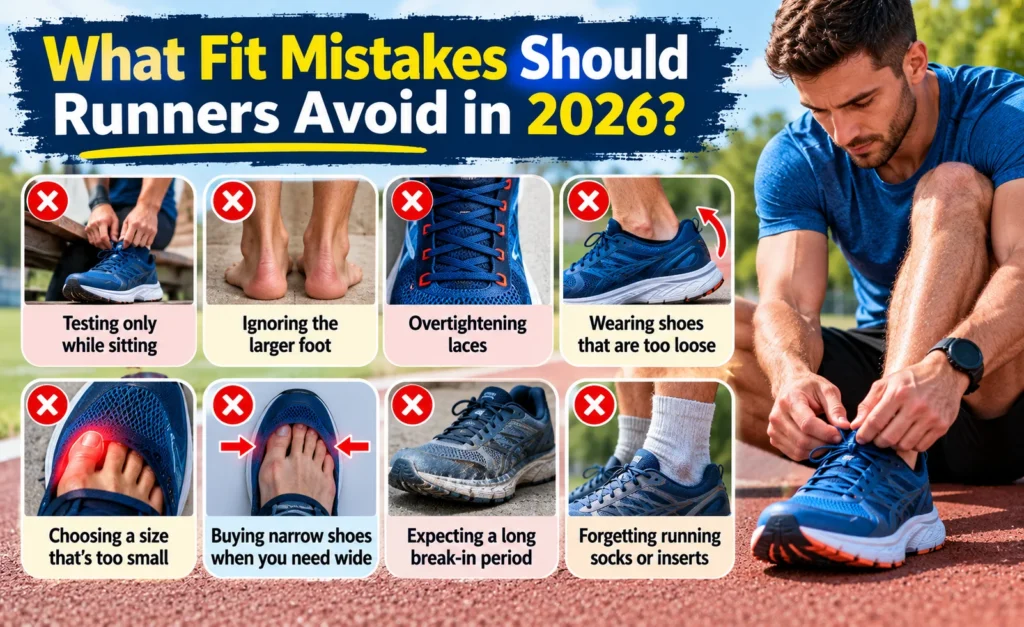
Most fit mistakes come from treating size as a single number. Length, width, upper volume, and heel shape all affect how snug a shoe feels.
- Testing only while sitting: Stand and move to see the true fit.
- Ignoring the longer foot: Buy for the foot that needs more space.
- Assuming tight means supportive: Compression and stability are different things.
- Buying longer to fix narrowness: Try a suitable width instead.
- Overtightening laces: Painful lacing can mask an oversized shoe.
- Expecting a long break-in: Comfortable running shoes should work from the start.
- Forgetting running socks or inserts: Both change the available volume.
One useful extra check is to remove the insole and stand on it. If your foot spills substantially over the edges, the shoe’s shape may be too narrow.
The Brannock Device fitting instructions also emphasize measuring arch length and width, not just heel-to-toe length. These measurements are a starting point, never a substitute for trying on the shoe.
Helpful Products for Fine-Tuning Running Shoe Fit
Start with the correct shoe size and shape before buying accessories. If your fit is already close, these tools may help you measure more accurately or improve everyday comfort.
Editorial fit-use ratings: The stars below reflect usefulness for each stated task, not customer-review averages or hands-on laboratory testing.
📏 Best for size measurement
Combination Brannock Device
★★★★☆ 4/5
This professional foot-measuring device checks length, arch length, and width, with men’s and women’s scales. I’d consider it for repeated home fittings; an in-store measurement is more economical for occasional shoe purchases.
🔒 Best for adjustable lacing
Lock Laces Original No-Tie Shoelaces
★★★★☆ 4/5
These 48-inch elastic replacement laces include a locking system for adjustable tension. I’d use them for convenient fine-tuning, not to compensate for a shoe that is substantially too long or wide.
🧦 Best for cushioned comfort
Balega Hidden Comfort No-Show Socks
★★★☆☆ 3/5
These running socks offer full-length plush cushioning and moisture-managing fabric. I’d consider them for reducing rubbing in a close-fitting shoe, but thicker socks should never be used to disguise a major sizing mistake.
Frequently Asked Questions
Should running shoes feel tight or loose?
Neither extreme is ideal. Running shoes should feel snug around your heel and midfoot, with enough toe room to wiggle freely. Persistent pressure suggests they are too tight, while repeated sliding suggests they are too loose. Check fit while standing and jogging, not just sitting.
Should running shoes feel snug across the top of your foot?
A light, even hold across the instep is normal. Sharp lace pressure, tingling, or numbness is not. Try easing the tension or changing the lacing pattern. If discomfort remains, consider a shoe with more upper volume rather than forcing the current pair to fit.
Is a little heel movement normal in running shoes?
Some minor heel movement can happen depending on the shoe design. However, repeated lifting, rubbing, or a feeling that your heel might escape means the hold needs attention. Try heel-lock lacing first, then consider a different heel shape if slipping continues.
Should running shoes feel snug with thick socks?
They should feel comfortably secure with the socks you actually use for running. Thick socks take up extra volume and may turn a good fit into a tight one. Always test shoes with your usual socks and never rely on unusually thick layers to repair major looseness.
Will snug running shoes loosen after a few runs?
Some materials soften slightly with wear, but meaningful changes in shoe length or width are unlikely. New running shoes should feel comfortable from the start. If your toes are cramped, your foot goes numb, or your instep hurts, choose a more suitable size or shape.
Final Takeaway: How Snug Should Your Running Shoes Be?
Your running shoes should hold your heel and midfoot comfortably while giving your toes room to move. The right fit feels stable, not restrictive, and stays comfortable when you start jogging.
Before keeping a new pair, check toe clearance, test both shoes in motion, and notice any pressure or slipping. Choose the shoe that fits your foot today—not one you hope will fit after breaking in.


Steven is a former sportsperson and now a full-time businessman and research writer. He is the mastermind of this site, and he created this site to help people who need specialized shoes for different activities. When he was a sportsperson, he was very passionate about different types of shoes for his sports purpose. The passion he had for shoes at that time now turned into his profession. Besides his shoe business, he loves sharing his knowledge and experience with people and helping them maintain healthy feet.
More Posts
