

Quick Answer
Yes, the Mizuno Wave Daichi 8 is a good trail shoe for mixed surfaces. Its Vibram Megagrip outsole, 4mm lugs and balanced cushioning offer strong everyday performance. However, its loose-fitting heel and limited mud traction make it less suitable for technical mountain trails.
What matters most before buying?
- Independent grip testing scored it 13 out of 15.
- The 6mm drop and rock plate support mixed-terrain running.
- Heel movement and shallow lugs are its main drawbacks.
| Best for | Road-to-trail runners and everyday trail training |
| Not ideal for | Deep mud, narrow heels and demanding technical trails |
| Price | $105 observed at Fleet Feet; Amazon price unverified |
Ratings are editorial calculations based on published test results, not verified Amazon star ratings.
Category Scores
Scores are normalized from an independent six-category test using a 15-point scale. They are not proprietary laboratory measurements.
Buying a trail shoe for mixed paths can be tricky. Aggressive lugs may feel harsh on roads, while road shoes can slip on wet roots. I’m Steven Tyler, and I reviewed independent field tests, manufacturer specifications and retailer listings for this Mizuno Wave Daichi 8 review. I have not personally worn this pair, so I won’t claim personal mileage or laboratory results. Instead, I compared several hands-on reports to identify its real strengths and weaknesses. The biggest finding is clear: grip is excellent, but heel security needs attention.
What Is the Mizuno Wave Daichi 8 and Who Is It For?
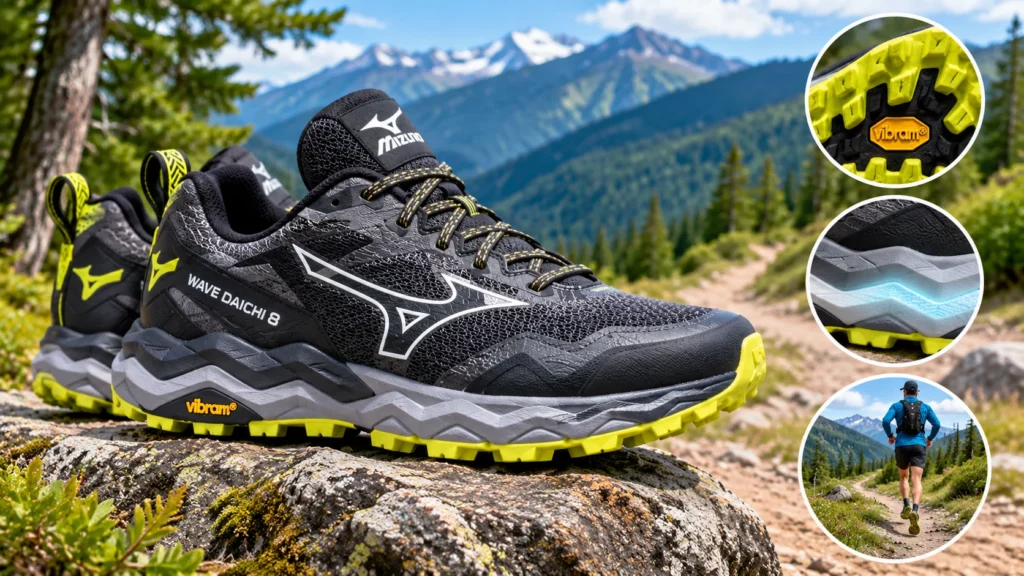
The Mizuno Wave Daichi 8 is a versatile trail-running shoe designed for mixed terrain. It combines road-friendly cushioning with a protective forefoot plate and a Vibram Megagrip outsole. The shoe suits runners who move between paved roads, gravel, forest paths and moderate trails.
Mizuno uses its MIZUNO ENERZY foam throughout the midsole. Its Foam Wave structure adds rearfoot stability without making the ride excessively soft. A hardened EVA rock plate protects the forefoot from sharp stones and uneven ground.
The biggest advantage is its versatility. You don’t need an aggressive mountain shoe for every woodland path. However, the Daichi 8 has only 4mm lugs, so deep mud remains a weakness.
It works best for neutral runners who want one shoe for regular trail training and occasional road sections. It also suits beginners who prefer moderate cushioning over an aggressive racing feel.
- Run regularly on gravel and forest trails.
- Want reliable grip on wet rocks.
- Prefer balanced cushioning and a 6mm drop.
- You regularly run through deep mud.
- You need a very secure heel lock.
- You want maximum cushioning for ultras.
Mizuno Wave Daichi 8 Pros and Cons
The biggest strength is its Vibram Megagrip outsole, which performs well across wet and dry surfaces. The biggest weakness is its heel fit, which several independent testers found less secure than expected.
- 4mm Vibram lugs provide dependable mixed-terrain traction.
- 6mm drop supports a balanced running position.
- 33.5mm heel stack offers useful everyday cushioning.
- Forefoot EVA plate helps protect against sharp rocks.
- Hidden lace pocket keeps loose ends out of the way.
- Roomy heel can allow unwanted movement on descents.
- 4mm lugs struggle in deep, sticky mud.
- Moderate cushioning may feel limited on very long runs.
- Side protection is modest on demanding mountain trails.
- Its roughly 300g listed weight isn’t ideal for racing.
Mizuno Wave Daichi 8 Key Features — What Do the Tests Show?
Does the Vibram Megagrip Outsole Provide Good Traction?
Yes, the Vibram Megagrip outsole is one of the Daichi 8’s strongest features. An independent XC-RUN test awarded its grip 13 out of 15 points. Reviewers also reported confident traction on wet roots, rocks and ordinary forest trails.
Takeaway: The rubber compound is a major reason to choose this shoe.
The 4mm lugs offer a useful balance between trail grip and road comfort. They don’t dig as deeply as aggressive mud lugs, but they work well on mixed paths.
For more information, see Vibram’s Megagrip technology.
Is the MIZUNO ENERZY Cushioning Comfortable Enough?
The cushioning feels balanced rather than extremely soft. Its 33.5mm heel and 27.5mm forefoot stack provide useful protection without creating an overly high platform.
Takeaway: Expect controlled comfort, not a plush ultra-running ride.
Runner’s World describes the ride as comfortable but not excessively soft. That makes sense for daily trail training, where runners need both ground feel and protection. Very long runs on hard surfaces may call for a softer shoe.
Does Foam Wave Technology Improve Stability?
Yes, the dual-density Foam Wave construction helps the Daichi 8 maintain a stable feel. Mizuno places this structure around the rearfoot and midfoot to balance cushioning and support.
Takeaway: The shoe favors stable transitions over maximum flexibility.
Independent testing found the platform reasonably stable during climbs and descents. However, stability cannot fully correct a loose heel. Runners who make sharp downhill turns should check the fit carefully.
Does the Heel Fit Securely During Trail Runs?
No, heel security is the main fit concern. XC-RUN awarded heel hold just 9 out of 15 points, and another tester also reported a wide, low-cut heel shape.
Takeaway: Try a runner’s loop or marathon lacing before buying.
The midfoot and forefoot generally fit well, with enough room for natural toe movement. The rearfoot is less consistent. A narrow heel may move during fast descents, even when the rest of the shoe feels comfortable.
Use a runner’s loop to tighten the top eyelets. Test downhill movement before committing to a long run.
Does the Rock Plate Protect Against Sharp Stones?
Yes, the hardened EVA plate adds useful protection under the forefoot. It helps reduce the impact of sharp rocks and roots during ordinary trail runs.
Takeaway: Forefoot protection is useful, but it isn’t full mountain armor.
The raised toe guard also helps shield the front of the shoe. However, independent testers noted limited side reinforcement. Runners who cross sharp, exposed rock fields should consider a more protective mountain shoe.
Can the Wave Daichi 8 Handle Road-to-Trail Running?
Yes, this is where the shoe makes the most sense. Its moderate cushioning, stable platform and relatively shallow 4mm lugs make it suitable for roads, gravel and forest paths.
Takeaway: It works best when your route changes surface often.
For example, you can start on pavement, continue along a gravel path and finish on a woodland trail. The shoe doesn’t feel as specialized as a rugged mountain model, but that is also its main advantage.
No standardized multi-model laboratory benchmark was available for these features. I have therefore used the published tester scores instead of inventing best-in-class, average and worst-in-class figures.
How Does the Mizuno Wave Daichi 8 Perform in Real Tests?
The available independent test scores show strong grip and build quality, with weaker heel security. The following figures convert one tester’s published 15-point ratings to a 10-point scale.
Measured Performance
The key finding is the difference between grip and fit. The outsole performs well, but the heel may need extra lacing work. That matters most on steep descents and routes with frequent turns.
Mizuno Wave Daichi 8 Full Specifications
These specifications combine manufacturer information with retailer listings and independent measurements. Weight can change with shoe size and testing sample.
The key specification is the combination of a 33.5mm heel stack and 4mm lugs. It provides useful cushioning without making the outsole too aggressive for ordinary road sections.
How Does the Mizuno Wave Daichi 8 Compare to Competitors?
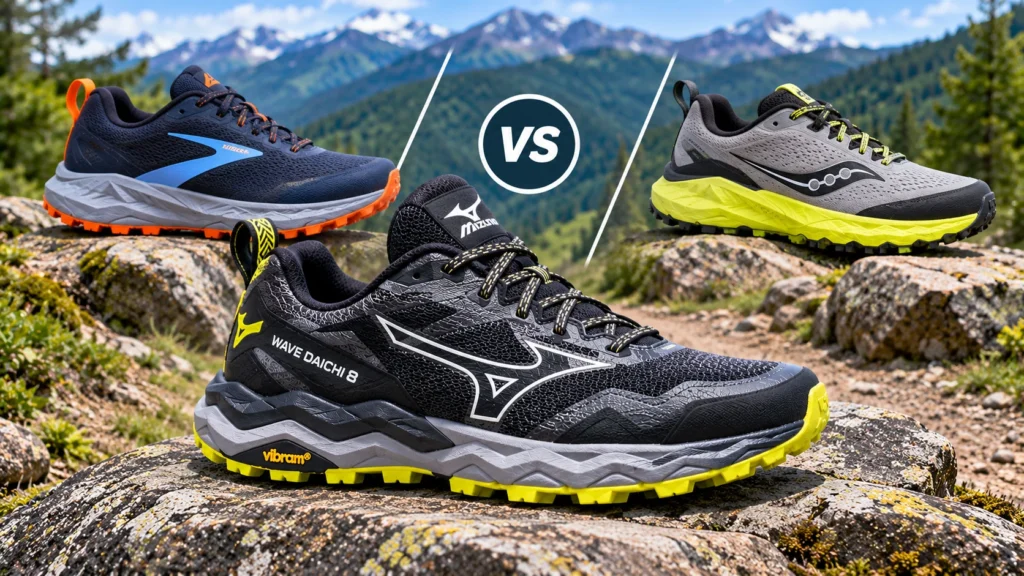
The Daichi 8 wins on wet-rock grip and road-to-trail balance, but other shoes suit different terrain. The Brooks Divide 5 offers better budget value, while the Saucony Peregrine 15 is more specialized for rugged trails.
Mizuno Wave Daichi 8 vs Brooks Divide 5
The Brooks Divide 5 is the better budget option for easy trails and gravel. Its listed weight is 10.2 oz, compared with the Daichi 8’s 10.6 oz. However, the Mizuno has a Vibram Megagrip outsole and a forefoot rock plate that make it more appealing for wet, uneven routes.
Mizuno Wave Daichi 8 vs Saucony Peregrine 15
The Saucony Peregrine 15 is the stronger choice for rugged trails. Its 5mm lugs, forefoot rock guard and 4mm drop suit rougher terrain. The Daichi 8 feels more versatile for mixed routes, especially when pavement and gravel are part of the same run.
Here is a side-by-side look at their published specifications and observed prices.
| Feature | Wave Daichi 8 | Divide 5 | Peregrine 15 |
|---|---|---|---|
| Observed price | $105 | $79.95 | $115.73 |
| Weight | 10.6 oz | 10.2 oz | 1 lb 3.4 oz per pair |
| Drop | 6mm | 8mm | 4mm |
| Lug depth | 4mm | Not available | 5mm |
| Rock plate | Yes | Not confirmed | Yes |
| Best for | Mixed surfaces | Light trails | Rugged trails |
| Price availability | Retailer listing | Listed out of stock | REI listing unavailable |
The prices are retailer observations, not guaranteed checkout prices. For a budget road-to-trail shoe, consider the Divide 5. For rougher terrain, the Peregrine 15 has more aggressive lugs.
Mizuno Wave Daichi 8 Pricing — Is It Worth the Price?
The Daichi 8 offers better value when discounted. Its US list price was $140, while Fleet Feet displayed a sale price of $105. That is a $35 saving, or 25% below the listed retail price.
Another retailer displayed $109.95. The lowest historical price across all retailers is not available, and I could not verify a current Amazon price. A dated Mizuno US pricing document also shows a later advertised price reduction, but it does not establish the shoe’s lowest-ever selling price.
At $105, the Daichi 8 is competitive with road-to-trail alternatives. At its original $140 price, I would compare the Peregrine and other rugged trail shoes before deciding.
Mizuno Wave Daichi 8 Trail Running Shoe
Worth considering when you want Vibram traction and balanced cushioning without paying full retail.
Who Should Buy the Mizuno Wave Daichi 8?
The Daichi 8 is best for neutral runners who want a dependable shoe for mixed paths. Its grip, moderate cushioning and stable platform suit everyday training better than highly technical racing.
- Road-to-trail runners covering mixed surfaces.
- Neutral runners who enjoy moderate cushioning.
- Trail beginners seeking dependable wet-ground grip.
- Your routes contain deep mud and loose slopes.
- Your heel needs a very tight lockdown.
Bottom line: Buy it for mixed-terrain versatility, not extreme mountain protection.
What Are Real Buyers and Testers Saying About the Mizuno Wave Daichi 8?
Independent testing is generally positive about grip, comfort and versatility. The most repeated criticism is heel security, followed by limited performance in deep mud and reduced protection on demanding technical trails.
A third-party product catalogue associated with ASIN B0DHWFV928 displays 4.3 out of 5 from 39 reviews. However, I could not verify that figure on a live Amazon page, and 39 ratings are not enough to establish a reliable Amazon-wide consensus.
What Independent Testers Found
- Strong Vibram grip across mixed surfaces.
- Balanced cushioning and a stable ride.
- Comfortable midfoot and forefoot fit.
- Heel movement during fast downhill running.
- Shallow lugs struggle in deep mud.
- Limited side protection on rough mountain terrain.
Bottom line: The test consensus favors the outsole and everyday comfort. The heel fit remains the main reason to try before buying.
Final Verdict — Is the Mizuno Wave Daichi 8 Worth Buying?
The Mizuno Wave Daichi 8 earns a research-based score of 7.6 out of 10. Its strongest feature is the Vibram Megagrip outsole, which performs well on wet rocks and mixed trails. Its biggest weakness is the rearfoot fit, which can feel too loose during fast descents. The 4mm lugs also limit its ability in deep mud. I would choose it for everyday trail training, gravel paths and road-to-trail routes. At around $105, it becomes a more attractive purchase than at its original $140 price.
My final recommendation is to prioritize fit over the outsole. If the heel stays secure during a downhill test, the Daichi 8 offers a useful balance of comfort and traction. If it slips, choose a shoe with a firmer heel lock.
Mizuno Wave Daichi 8 — Vibram Megagrip Trail Shoe
Choose it for versatile grip and everyday trails, provided the heel fits your foot securely.
👉 Find Mizuno Wave Daichi 8 on Amazon ↗
Compare Alternatives ↗
Frequently Asked Questions
Is the Mizuno Wave Daichi 8 good for road running?
Yes, the Mizuno Wave Daichi 8 handles short road sections well. Its 4mm lugs and balanced MIZUNO ENERZY cushioning make pavement-to-trail transitions comfortable. However, it is still a trail shoe, so dedicated road trainers are better for runners who spend most of their time on asphalt.
Does the Mizuno Wave Daichi 8 have good grip on wet rocks?
Yes, its Vibram Megagrip outsole provides dependable traction on wet and dry surfaces. An independent tester awarded its grip 13 out of 15 points. The 4mm lugs work well on rocky paths and wet roots, although deep mud remains a limitation.
Is the Mizuno Wave Daichi 8 waterproof?
No, the standard Mizuno Wave Daichi 8 does not have a waterproof membrane. Its woven upper offers breathability rather than full water protection. Mizuno also sells a separate GTX version with a waterproof membrane, which is a better option for consistently wet conditions.
Does the Mizuno Wave Daichi 8 run true to size?
Mizuno describes the fit as consistent and recommends normal running-shoe sizing. However, the rearfoot feels roomy to some independent testers. Try your normal running size first, then check heel movement and toe space before choosing a size.
Is the Mizuno Wave Daichi 8 suitable for muddy trails?
It can handle light mud, but it is not the best shoe for deep muddy routes. Its 4mm lugs provide useful traction on ordinary trails, while deeper mud needs more aggressive tread. Consider a shoe with 5mm lugs or deeper for regular muddy running.
Is the Mizuno Wave Daichi 8 good for long-distance running?
It can handle middle-distance trail runs and some longer outings, depending on your foot and running style. Its 33.5mm heel stack provides moderate cushioning. However, runners seeking maximum softness for very long ultras may prefer a more cushioned trail shoe.
Affiliate Disclosure: As an Amazon Associate, I earn from qualifying purchases. Links on this page may earn me a small commission at no extra cost to you.