
Quick Answer
To convert women’s running shoe sizes to men’s in US sizing, subtract 1.5 sizes for Nike, Brooks, and New Balance. For adidas, subtract 1 size instead. For example, a women’s US 9 equals a men’s US 7.5 in Nike but a men’s US 8 in adidas. Always check the brand’s official shoe size chart before buying.
Convert Your Size in Four Steps
- Step 1 — Check the system: Confirm both shoes use US sizing.
- Step 2 — Identify the brand: Find its men’s and women’s conversion difference.
- Step 3 — Convert the length: Subtract 1.5 sizes for most major brands or 1 for adidas.
- Step 4 — Check the width: Compare narrow, standard, and wide options before ordering.
Before You Buy
- Fit check: Allow approximately a thumb’s width of space beyond your longest toe, while keeping the heel secure.
Converting women’s running shoe sizes to men’s sounds simple until two brands give you different answers. A women’s size 9 doesn’t always translate to the same men’s size.
I’ll explain the conversion rules, show practical charts, and cover the width differences that numbers alone cannot solve. You’ll also learn how to check the fit before buying.
What Does Converting Women’s Running Shoe Sizes to Men’s Mean?
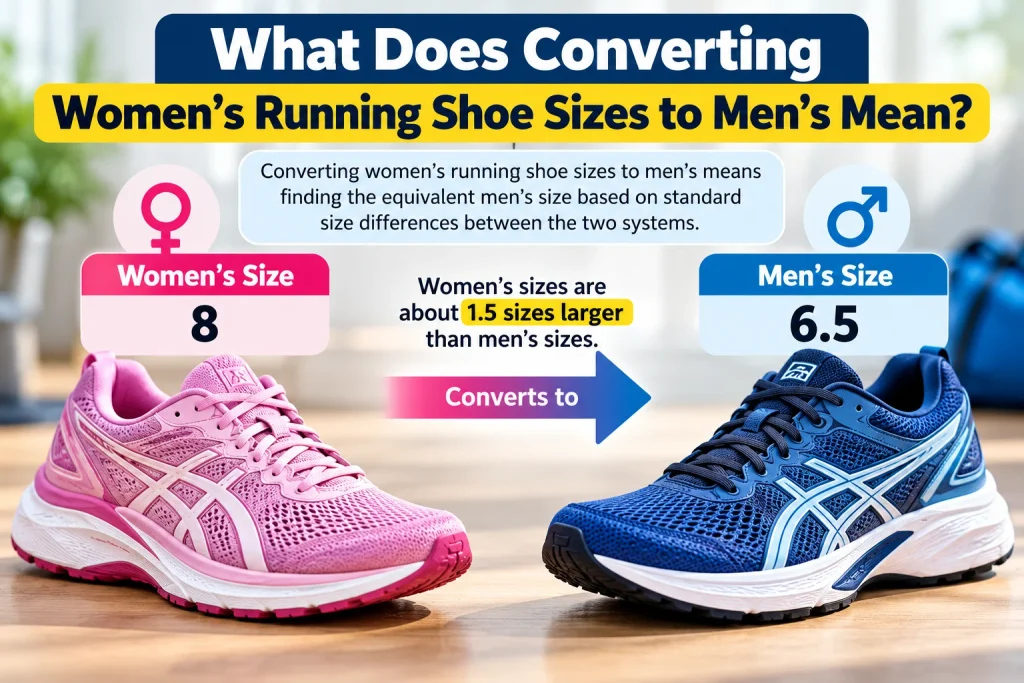
Women’s-to-men’s shoe size conversion means identifying the men’s shoe size intended for approximately the same foot length as a given women’s size. It does not guarantee identical width, shape, or comfort.
In US shoe sizing, women’s size numbers are usually higher than men’s numbers for a comparable foot length. However, individual brands apply different numbering conventions.
This distinction matters because running shoes must accommodate repeated foot movement. A shoe can have enough length while still feeling uncomfortable across the forefoot or heel.
- Length: Determines how much room your foot has from heel to toe.
- Width: Determines how the shoe accommodates the sides of your foot.
- Volume: Describes the space available around the top and middle of your foot.
- Shoe last: Refers to the foot-shaped form used to build a shoe.
My practical rule is to treat the converted size as a starting point, not a final answer. Length and width both deserve attention.
Women’s to Men’s Running Shoe Size Conversion Chart
The following chart compares common US size conversions for Nike, Brooks, New Balance, and adidas. It uses each brand’s published men’s-to-women’s size relationship.
| Women’s US | Nike Men’s | Brooks / New Balance Men’s | adidas Men’s |
|---|---|---|---|
| 5 | 3.5 | 3.5 | 4 |
| 5.5 | 4 | 4 | 4.5 |
| 6 | 4.5 | 4.5 | 5 |
| 6.5 | 5 | 5 | 5.5 |
| 7 | 5.5 | 5.5 | 6 |
| 7.5 | 6 | 6 | 6.5 |
| 8 | 6.5 | 6.5 | 7 |
| 8.5 | 7 | 7 | 7.5 |
| 9 | 7.5 | 7.5 | 8 |
| 9.5 | 8 | 8 | 8.5 |
| 10 | 8.5 | 8.5 | 9 |
| 10.5 | 9 | 9 | 9.5 |
| 11 | 9.5 | 9.5 | 10 |
| 11.5 | 10 | 10 | 10.5 |
| 12 | 10.5 | 10.5 | 11 |
Important: This chart compares US length-size labels, not identical shoe shapes. Not every men’s running shoe is available in every listed size.
For example, you might calculate a men’s size 5.5 correctly but find that a particular model starts at size 7. That is a product availability issue, not a conversion error.
How Do You Convert Women’s Running Shoe Sizes to Men’s Step by Step?
Start with your current women’s running shoe size, then apply the intended brand’s conversion. Follow these five steps to avoid a common ordering mistake.
- Find your current US size. Check the label inside a running shoe that already fits comfortably.
- Confirm the target brand. Identify whether it uses a 1.5-size or 1-size difference.
- Calculate the men’s size. Subtract the appropriate number from the women’s US size.
- Match the width category. Check whether the men’s model offers the same relative width fit.
- Test the complete fit. Confirm toe room, heel stability, and comfortable forefoot pressure.
Example: Converting a Women’s Size 9
Suppose you currently wear a women’s US 9 and want to buy a men’s Nike running shoe. Nike’s standard conversion gives you a men’s US 7.5.
If you choose adidas instead, the corresponding men’s US size is 8. The different result comes from the brand’s sizing chart.
- Nike: Women’s 9 – 1.5 = Men’s 7.5.
- Brooks: Women’s 9 – 1.5 = Men’s 7.5.
- New Balance: Women’s 9 – 1.5 = Men’s 7.5.
- adidas: Women’s 9 – 1 = Men’s 8.
These examples establish your initial length size. Your foot width and the individual shoe model still determine whether the fit works.
Do Nike, adidas, Brooks, and New Balance Use the Same Conversion?
No. Nike, Brooks, and New Balance commonly use a 1.5-size US difference, while adidas uses a 1-size difference.
As of 2026, the brands’ published size charts support these conversions. Always check your chosen product because fit and size availability can vary.
| Brand | US Conversion | Women’s 10 Becomes |
|---|---|---|
| Nike | Subtract 1.5 | Men’s 8.5 |
| Brooks | Subtract 1.5 | Men’s 8.5 |
| New Balance | Subtract 1.5 | Men’s 8.5 |
| adidas | Subtract 1 | Men’s 9 |
For adidas, use the official adidas footwear size chart instead of applying the Nike conversion. The chart displays men’s and women’s US sizes alongside their corresponding foot-length measurements.
The same principle applies when comparing different models. A correct numerical conversion doesn’t guarantee that both shoes will feel equally roomy.
Why Does Shoe Width Matter When Converting Women’s Sizes?
Women’s and men’s running shoes often use different standard width labels. For example, women’s standard width is commonly B, while men’s standard width is D.
That difference can make a converted men’s shoe feel roomier, even when the intended foot length matches. Width is therefore a separate fitting decision.
Women’s vs. Men’s Running Shoe Width Chart
| Width Category | Women’s Label | Men’s Label |
|---|---|---|
| Narrow | 2A | B |
| Standard | B | D |
| Wide | D | 2E |
| Extra Wide | 2E | 4E |
These are standard industry-style width categories, not a guarantee of identical physical measurements. Brooks specifically recommends matching the width description rather than relying only on the letter.
Its official running shoe width guide explains how women’s and men’s width options correspond.
What If You Have Wide Feet?
Men’s running shoes may offer a useful alternative when women’s standard-width models feel restrictive. However, you should still compare the toe box and heel fit.
Look for these signs when testing a converted size:
- Comfortable forefoot: Your toes can spread without pressing firmly against the sides.
- Secure heel: Your heel stays in place while walking or jogging.
- Natural movement: The upper doesn’t squeeze your foot during push-off.
- No excess sliding: Your foot doesn’t move dramatically inside the shoe.
I would choose the model with the better complete fit rather than automatically choosing a men’s standard-width shoe. More width is only helpful when you need it.
How Can You Measure Your Feet Before Converting Sizes?
Measure both feet and use the larger measurement when checking a brand’s size chart. Measuring is especially useful when changing brands or buying online.
You need a sheet of paper, a pencil, a ruler, and the socks you normally wear while running.
- Prepare the surface. Place paper on a hard, level floor against a wall.
- Stand naturally. Put your heel against the wall with your weight on your foot.
- Mark your longest toe. Make a small mark directly ahead of the longest toe.
- Measure the length. Measure the distance from the wall edge to the mark.
- Repeat for both feet. Record both measurements in centimeters or millimeters.
- Check the brand chart. Compare the longer foot with the manufacturer’s foot-length guidance.
Measuring later in the day is helpful because foot size can change slightly with activity. Don’t assume your two feet have identical measurements.
Use the actual foot-length column when available. Some manufacturers distinguish measured foot length from the centimeter number printed on a shoe label.
Should You Go Up Half a Size for Running Shoes?
You should not automatically add half a size after converting women’s shoes to men’s. Instead, check whether the converted shoe already provides enough running room.
Running shoes generally need comfortable space beyond your longest toe. A secure heel and comfortable midfoot are equally important.
REI’s running shoe fitting advice recommends approximately a thumb’s width of toe space, with a snug but comfortable heel and midfoot.
When Might a Half-Size Adjustment Help?
- Toes touch the front: Try additional length if your longest toe repeatedly contacts the shoe.
- Downhill discomfort: Check whether your toes hit the front during descending movements.
- Length is correct but width is tight: Try another width before increasing length.
- Heel movement: Check the heel fit and lacing rather than immediately buying a shorter shoe.
A larger shoe is not always a better running shoe. Excess length can create sliding and make the fit less secure.
Can Women Wear Men’s Running Shoes?
Yes. Women can wear men’s running shoes when the length, width, and overall shape fit comfortably.
Men’s models can be useful when their available widths or designs better match someone’s feet. Gender labels are less important than proper sizing and fit.
However, men’s shoes may differ in heel shape, upper volume, and available sizes. Check each model rather than assuming that changing the size number will reproduce your current fit.
When Is Switching to Men’s Shoes Worth Considering?
- You cannot find your preferred color or design in the women’s range.
- You need a width or model configuration that isn’t available in women’s sizing.
- Your foot measurements match an available men’s model.
- You have tried the converted size and found the heel and forefoot comfortable.
If you are still choosing a running shoe for regular training, explore our running shoes guides for more buying considerations.
What About UK, EU, and Unisex Running Shoe Sizes?
Do not apply the US 1.5-size subtraction directly to UK or EU shoe numbers. Those systems use their own numbering rules, which can also vary by brand.
For international conversion, use the target manufacturer’s complete chart instead of a general US formula.
- US sizing: Check the brand-specific men’s and women’s difference.
- UK sizing: Compare the manufacturer’s corresponding UK labels directly.
- EU sizing: Use the published EU equivalent for the chosen model.
- Unisex sizing: Check whether the listed numbers follow men’s, women’s, or a separate unisex chart.
- Centimeter sizing: Check whether the measurement represents actual foot length or a shoe-label designation.
Unisex running shoes may use men’s US numbers as their primary labels. This is common enough that checking the product’s sizing notes should become routine.
What Are the Most Common Shoe Size Conversion Mistakes?
Most conversion problems come from using a universal formula or overlooking width. Even a mathematically correct size can feel wrong on your feet.
Five Mistakes to Avoid
- Using the same conversion for every brand. adidas and Nike provide a clear example of why this fails.
- Ignoring width labels. Women’s B standard and men’s D standard are not the same letter.
- Comparing different sizing systems. US, UK, and EU numbers are not interchangeable.
- Assuming identical fit between models. Different running shoe designs may use different shapes.
- Skipping a walking or running fit test. Standing comfort doesn’t always reveal heel movement or toe pressure.
If you use running shoes for extended walking sessions, fit remains important there too. Our guide on using running shoes for walking on concrete explores another practical footwear consideration.
How Do You Know If the Converted Men’s Shoe Fits Correctly?
A converted men’s running shoe fits correctly when it provides sufficient toe room, comfortable side-to-side space, and stable heel support. Your foot should feel secure without being squeezed.
Check these areas while wearing your normal running socks:
- Toe box: Your longest toe has comfortable forward clearance.
- Forefoot: The shoe doesn’t press painfully against the sides.
- Midfoot: The laces hold your foot without excessive pressure.
- Heel: There is no significant slipping during movement.
- Movement: Walking and light jogging feel natural and stable.
Try shoes indoors before using them outdoors, particularly when buying from a retailer with a limited return policy. Keep packaging and labels until you’ve confirmed the fit.
If you primarily run on pavement, our running shoes for concrete floors guide can help you compare other buying factors after settling on your size.
Which Running Shoes Are Worth Considering When Switching Sizes?
If you’re comparing men’s and women’s running shoes, I would start with models that have clear sizing information. Multiple width choices are especially useful.
These selections are based on published design features and fit options, not personal wear testing. The star scores are editorial fit-selection assessments, not customer ratings.
🏆 Best for Multiple Width Options
Brooks Ghost 17
★★★★½ 4.5/5
This neutral road-running shoe uses nitrogen-infused DNA LOFT v3 cushioning and offers multiple width choices. I favor it as a starting point for comparing fit because Brooks clearly explains both length and width conversions.
👟 Best for Width Flexibility
New Balance Fresh Foam X 880v15
★★★★½ 4.5/5
The 880v15 has Fresh Foam X cushioning, a breathable upper, and a nominal 6 mm heel-to-toe drop. Its published men’s and women’s width choices make it a practical comparison option for different foot shapes.
⚡ Best adidas Comparison Option
adidas Supernova Rise 2
★★★★☆ 4.0/5
The Supernova Rise 2 features Dreamstrike+ cushioning, an engineered mesh upper, and Support Rods. I include it because comparing its US size chart with Nike shows why a universal conversion formula can be misleading.
Affiliate disclosure: As an Amazon Associate, we earn from qualifying purchases. Product availability, sizes, and prices may change. Editorial scores reflect published fit-related features and options rather than hands-on testing.
Frequently Asked Questions
1. What Is a Women’s Size 8 in Men’s Running Shoes?
A women’s US size 8 generally corresponds to a men’s US 6.5 in Nike, Brooks, and New Balance. In adidas, it corresponds to a men’s US 7. These are length-size conversions, so check the width and actual fit before purchasing.
2. What Is a Women’s Size 9 in Men’s Running Shoes?
A women’s US size 9 translates to a men’s US 7.5 in Nike, Brooks, and New Balance. For adidas, the corresponding size is men’s US 8. Check the brand-specific chart rather than assuming every running shoe follows the same conversion.
3. Are Men’s Running Shoes Wider Than Women’s?
Men’s standard-width running shoes are generally built around a different width designation than women’s standard-width shoes. Women’s standard is commonly B, while men’s standard is D. However, actual measurements and fit can differ between models, so width labels alone do not guarantee comfort.
4. Can You Convert Women’s Shoe Sizes to Men’s by Subtracting 1.5?
Yes, for many US running shoe charts, including Nike, Brooks, and New Balance. However, adidas commonly uses a 1-size difference instead. Do not apply the 1.5 rule automatically to UK, EU, or unisex size labels without checking the manufacturer’s chart.
5. Should You Buy Men’s Running Shoes if You Have Wide Feet?
Men’s running shoes can be worth trying if they offer a width or shape that better accommodates your feet. Start with the correct length conversion, then compare width options. A comfortable forefoot, secure heel, and natural running movement matter more than the gender label.
Final Takeaway: Convert the Number, Then Check the Fit
Learning how to convert women’s running shoe sizes to men’s is straightforward once you understand the brand difference. Most major US charts use a 1.5-size gap, while adidas commonly uses 1.
But choosing the right running shoe involves more than subtraction. Width, heel fit, toe room, and model availability all matter.
My recommendation: Use the conversion chart to find your starting size, confirm it with the manufacturer, and test the shoe before committing. The best size is the one that fits comfortably while you run.


Steven is a former sportsperson and now a full-time businessman and research writer. He is the mastermind of this site, and he created this site to help people who need specialized shoes for different activities. When he was a sportsperson, he was very passionate about different types of shoes for his sports purpose. The passion he had for shoes at that time now turned into his profession. Besides his shoe business, he loves sharing his knowledge and experience with people and helping them maintain healthy feet.
More Posts