
Quick Answer
Yes, for easy runs. The New Balance Fresh Foam X 1080v13 is a plush neutral road shoe with smooth transitions and an airy upper. Independent lab testing found unusually soft foam at 10.0 HA. Choose it for relaxed miles and walking, not fast workouts or strong stability support.
Is the 1080v13 right for your feet?
- Best use: easy road runs, recovery runs, and daily walking.
- Main draw: soft cushioning and excellent tested breathability.
- Main drawback: low bounce and limited stability for tired legs.
Plush easy-day specialist
RunRepeat overall
Daily running
Original retail price
Best for: Neutral runners who value softness above speed. Skip if: You need motion control or a lively tempo shoe.
The link points to one documented men’s color variant; check your size, color, and seller.
Independent Review Scores — RunRepeat
These are published RunRepeat scores, not ratings assigned by Footwearhiker.
I’m Steven Tyler. This review draws on published lab measurements and independent wear tests, not personal mileage claims. The key question is whether its soft ride suits your pace.
What Is the New Balance Fresh Foam X 1080v13 and Who Is It For?
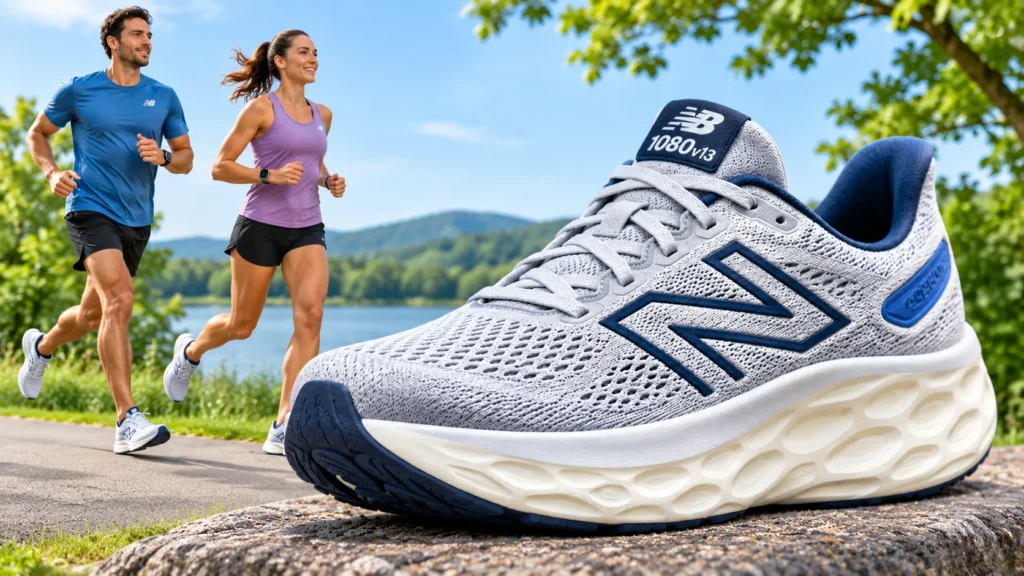
The 1080v13 is New Balance’s neutral, high-cushion road running shoe. Fresh Foam X sits under a breathable engineered mesh upper, while a curved sole helps each step roll forward.
- Run mostly at an easy, steady pace.
- Prefer a soft landing underfoot.
- Want breathable road shoes for warm days.
- You want more heel guidance: try Brooks Glycerin 21.
- You run on slick roads: consider ASICS Gel Nimbus 26.
- You need one shoe for frequent fast sessions.
New Balance Fresh Foam X 1080v13 Pros and Cons
- Soft 10.0 HA foam absorbs the feel of daily impacts.
- Breathability earned the top 5/5 lab grade.
- Measured weight is just 264 g in the tested sample.
- Rubber showed only 0.2 mm lab abrasion damage.
- 58.0% heel energy return lacks lively propulsion.
- Soft foam can feel unstable on longer tired runs.
- Toe-box roof feels low to some testers.
- Some wear testers saw outsole changes within 30 miles.
New Balance Fresh Foam X 1080v13 Key Features: What Do Tests Show?
Is the Fresh Foam X cushioning too soft?
It is exceptionally soft, and that is both its charm and its limit. RunRepeat recorded 10.0 HA on its older Shore A softness test, compared with its 20.1 HA sample average.
Foam firmness test — lower HA means softer
Bar lengths use the 36.1 HA upper end of RunRepeat’s reported comparison range.
Takeaway: Soft does not mean springy. That deep compression suits jogging more than racing.
Does the shoe feel bouncy at faster paces?
No. RunRepeat measured 58.0% energy return at the heel, close to its 58.7% test average. Doctors of Running also found the foam comfortable but not responsive.
Takeaway: Choose this model for easy miles, not speedwork.
How breathable is the engineered mesh upper?
Ventilation is a clear strength. RunRepeat awarded it 5/5 in its breathability test, above the 3.6/5 comparison average.
Takeaway: The airy upper is useful on hot road runs.
Is the 1080v13 stable enough for long runs?
Only if your stride is naturally stable. RunRepeat measured torsional rigidity at 2/5, while independent testers felt the soft midsole allowed unwanted movement.
Takeaway: Runners needing clear guidance should look elsewhere.
Will the outsole last?
Lab abrasion results are promising, but actual wear depends on your stride. RunRepeat recorded only 0.2 mm rubber damage in its standardized test.
Takeaway: Good rubber durability does not guarantee identical wear for every runner.
Doctors of Running noted visible wear after roughly 25 to 30 miles. These findings differ because lab abrasion and outdoor wear measure different conditions.
How smooth is the ride and heel-to-toe transition?
The curved sole rolls forward smoothly at an easy pace. RunRepeat measured a 5.6 mm drop, close to New Balance’s stated 6 mm.
Takeaway: It favors smooth transitions rather than sharp toe-off.
How Does the New Balance Fresh Foam X 1080v13 Perform in Real Tests?
Measured Performance — RunRepeat
- Heel shock absorption: 148 SA; test average 131 SA.
- Heel energy return: 58.0%; test average 58.7%.
- Breathability: 5/5; test average 3.6/5.
- Forefoot traction: 0.54; test average 0.52.
- Flexibility: 13.1 N to bend; test average 15.5 N.
New Balance Fresh Foam X 1080v13 Full Specifications
These figures combine New Balance’s published design details with RunRepeat’s measured test sample. Shoe size can change measured weight and dimensions.
| Specification | 1080v13 |
|---|---|
| Running category | Neutral road trainer |
| Midsole | Fresh Foam X |
| Upper | Engineered mesh |
| Outsole | NDurance rubber coverage |
| Official heel-to-toe drop | 6 mm |
| Lab-measured drop | 5.6 mm |
| Lab-measured heel stack | 34.1 mm |
| Lab-measured forefoot stack | 28.5 mm |
| Lab sample weight | 264 g / 9.3 oz |
| Midsole softness | 10.0 HA (older test method) |
| Removable insole | Yes |
| Reflective details | Yes |
How Does the New Balance Fresh Foam X 1080v13 Compare to Competitors?
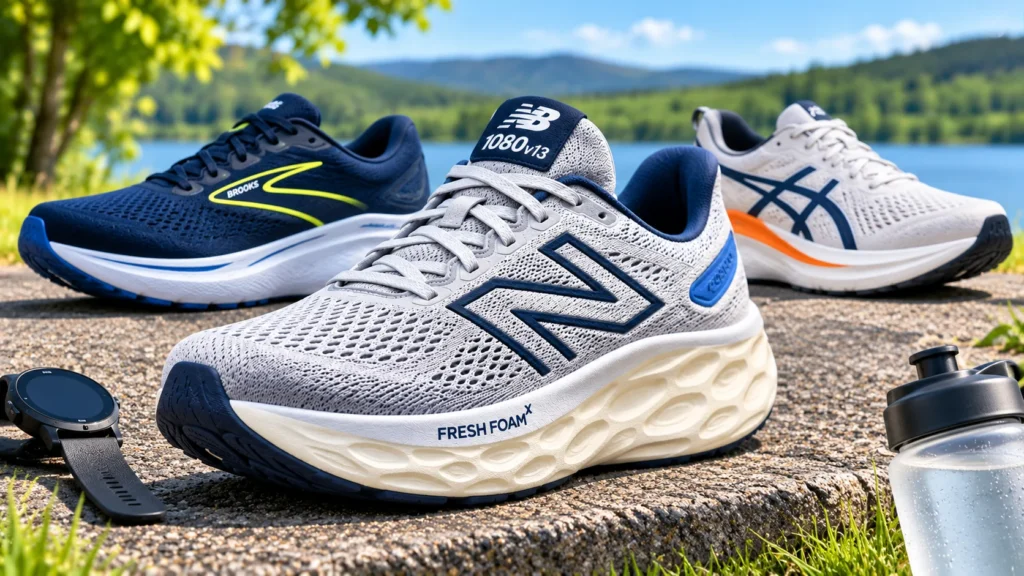
The Brooks Glycerin 21 is better suited to runners wanting a firmer, more guided heel. The ASICS Gel Nimbus 26 brings more stack and outstanding tested wet grip, but weighs more.
1080v13 vs Brooks Glycerin 21: Which feels more stable?
Choose the Glycerin 21 for a firmer heel and more stable landing. Its 10.6 mm measured drop and 100.0 mm heel platform contrast with the 1080v13’s lower drop and softer ride.
1080v13 vs ASICS Gel Nimbus 26: Which grips better?
Choose the Nimbus 26 for stronger wet-surface test results. RunRepeat measured 0.85 traction against the 1080v13’s 0.54, although the Nimbus 26 tested heavier.
These are published launch prices and same-site lab readings, not today’s retailer quotes.
| Feature | NB 1080v13 | Brooks Glycerin 21 | ASICS Nimbus 26 |
|---|---|---|---|
| Launch price | $165 | $160 | $160 |
| Weight tested | 264 g | 278 g | 303 g |
| Drop tested | 5.6 mm | 10.6 mm | 8.4 mm |
| Forefoot traction | 0.54 | 0.48 | 0.85 |
| Best match | Soft easy miles | Stable heel feel | Cushioning and grip |
For methods and full test details, see RunRepeat’s lab review and Doctors of Running’s field review.
New Balance Fresh Foam X 1080v13 Pricing: Is It Worth the Price?
It is worth considering when discounted below its $165 launch price, provided the soft fit works for you. Paying full price for an older version is harder to justify.
One tracked Amazon color variant showed $131.31 before a coupon and a $73.13 coupon-adjusted offer in late September. That tracker covers one listing and a short history, not every size or retailer.
Live Amazon pricing could not be confirmed here. Compare today’s size-specific total with newer models before ordering.
New Balance Fresh Foam X 1080v13 cushioned road running shoes
Who Should Buy the New Balance Fresh Foam X 1080v13?
Buy it if easy-road comfort matters more than speed, rebound, or support. Pick your size with care because the upper can feel low over the toes.
- Neutral runners recovering between harder training sessions.
- Walkers who enjoy soft, flexible cushioning.
- Easy-mile runners in warm weather.
- You need stability guidance during long runs.
- You want a springy daily trainer for intervals.
- You dislike pressure over your toes.
Bottom line: Choose the 1080v13 for soft, slow miles on smooth roads.
What Are Real Buyers Saying About the New Balance Fresh Foam X 1080v13?
A third-party Amazon price tracker displayed an 8.8/10 rating from 1,777 ratings for one men’s listing. Those figures were not checked directly against a live Amazon product page.
- Plush underfoot feel on everyday walks and runs.
- Light, breathable upper for warm-weather comfort.
- Smooth ride without a rigid, harsh toe-off.
- Soft platform can feel loose or unstable.
- Low toe-box roof can bother sensitive toes.
- Some testers report early outdoor outsole wear.
Final Verdict: Is the New Balance Fresh Foam X 1080v13 Worth It?
Yes, if you want one of the softer-feeling neutral road shoes for easy miles. The strong breathability result, smooth ride, and low test weight support that choice. But a cushioned landing is not the same as strong energy return, and the soft platform offers limited guidance. Choose the 1080v13 when your runs are relaxed and your stride is stable. Skip it for regular speed sessions, technical terrain, or a shoe that must correct excess foot movement. The smartest purchase is a well-fitting pair at a clear discount, not a full-price impulse buy.
New Balance Fresh Foam X 1080v13 soft daily trainer
Check the size and today’s price before you decide.
Buy New Balance 1080v13 — See Live Price Compare Alternatives
Frequently Asked Questions
Is the New Balance 1080v13 good for walking?
Yes. Its soft midsole, flexible ride, and breathable mesh can feel comfortable during daily walks. The lab recorded 13.1 N of force to bend the shoe, below its 15.5 N average. However, walkers who require added stability should consider a firmer model.
Does the New Balance 1080v13 run true to size?
It generally runs true to size, according to RunRepeat’s size assessment. Still, Doctors of Running reported a low toe-box ceiling and slight pressure near the big toe. Try your normal size first, then check toe clearance and heel hold before buying.
Can you use the New Balance 1080v13 for long runs?
Yes, if you have a stable stride and enjoy a soft ride. Independent reviewers liked it for relaxed mileage, but some found the platform less secure when fatigue set in. Its official 6 mm drop can also feel unfamiliar to heel strikers used to higher shoes.
Is the New Balance 1080v13 good for flat feet?
It is not a dedicated stability shoe for flat feet. The soft midsole and 2/5 torsional rigidity result offer little firm guidance. Arch shape alone cannot decide shoe suitability; your comfort and control while running matter more. Seek individual fitting advice if needed.
How durable is the New Balance 1080v13 outsole?
Lab durability is strong, but outdoor experience varies. RunRepeat measured just 0.2 mm outsole abrasion in its test, while Doctors of Running noticed wear around 25 to 30 miles. Check high-wear zones often, especially if you land hard on one edge.
What is the difference between the 1080v13 and a firmer daily trainer?
The 1080v13 puts softness first, while firmer trainers can feel steadier at higher paces. Its midsole tested at 10.0 HA on RunRepeat’s older method, compared with a 20.1 HA average. Choose by the ride you like, not the cushioning label alone.
Affiliate Disclosure: As an Amazon Associate, I earn from qualifying purchases. Links may earn a commission at no extra cost to you.