

Quick Answer
Yes, men can wear women’s running shoes for running, walking, or everyday use; what matters is a secure, comfortable fit—not the gender label. In many US size charts, add about 1.5 sizes to your men’s size, then check the actual width and shape using the Brooks width and conversion guide.
Five things to check first
- Length: A US men’s 9 often corresponds to a US women’s 10.5.
- Width: Women’s standard is usually B; men’s standard is usually D.
- Toe room: Leave comfortable space ahead of your longest toe.
- Heel security: Your heel should stay put without painful pressure.
- Test run: Walk and jog briefly before committing to the pair.
I understand why runners ask this when they spot a better color, a better sale, or a promising narrower fit in the women’s section. The answer is simple, but choosing the right pair takes more than converting a number.
Here is how I’d compare sizing, shape, comfort, and real running-shoe options in 2026.
Is It Okay for Men to Wear Women’s Running Shoes?
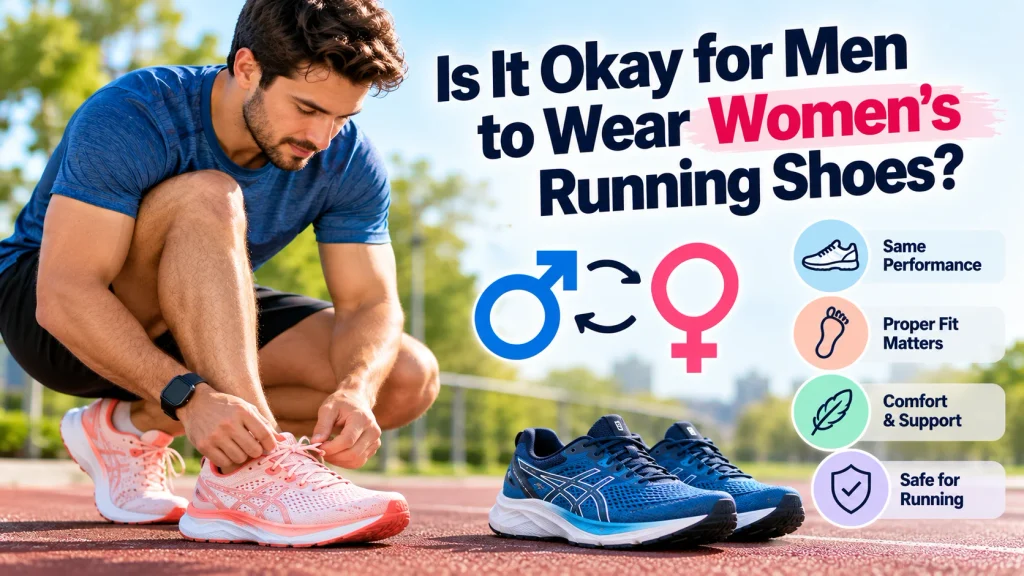
Absolutely. Men’s and women’s labels describe a brand’s sizing and design categories, not who is allowed to wear the shoes.
If a women’s model fits your foot and supports your running needs, there’s no practical reason to reject it because of its label. The same principle applies when women find a better fit in men’s shoes.
- Good reason to switch: A men’s regular-width shoe feels too roomy at the heel or midfoot.
- Another good reason: A particular women’s color or size is available when your preferred men’s option isn’t.
- Reason to reconsider: The women’s shoe squeezes your toes, presses your instep, or changes how comfortably you run.
What Does a Women’s Running Shoe Actually Mean?
A women’s running shoe is a model sold using women’s size labels and, sometimes, a different fit shape. Brands may use distinct lasts—the foot-shaped forms used to design shoes—for different versions.
That doesn’t mean every women’s shoe has identical proportions, softer cushioning, or less support. Compare the actual model and its specifications rather than relying on assumptions.
How Are Men’s and Women’s Running Shoes Different?
The most consistent differences are sizing and standard width labels. Other differences, such as heel shape, upper volume, weight, or midsole design, depend on the shoe brand and model.
Start by understanding the standard US width codes. They explain why a pair can be long enough yet still feel tight.
| Fit category | Men’s code | Women’s code |
|---|---|---|
| Narrow | B | 2A |
| Standard / medium | D | B |
| Wide | 2E | D |
| Extra wide | 4E | 2E |
These codes reflect guidance from major running-shoe brands, including the ASICS shoe-width guide. Width availability still varies by model, color, and country.
Here’s the important catch: a women’s D is labeled wide, while a men’s D is labeled standard. The same letter does not guarantee two different models will fit identically.
Are Women’s Running Shoes Narrower Than Men’s?
At their standard widths, women’s running shoes are typically designed for a narrower fit. This makes the women’s section worth exploring if standard men’s shoes feel loose.
But a women’s wide model can offer a very different experience from a women’s standard model. The New Balance width guide also recommends choosing width based on how your current shoes fit.
Do Women’s Shoes Have Different Cushioning or Support?
Some brands change materials, geometry, or tuning between men’s and women’s versions. Others keep the basic technology similar, with differences mainly in dimensions and fit.
Don’t assume women’s shoes are automatically too soft for men or unsuitable for heavier runners. Check the specific shoe’s intended use, fit, and your comfort over a short run.
What Women’s Running Shoe Size Should a Man Buy?
For many US running-shoe charts, add 1.5 to your men’s size to get a starting women’s size. That’s a conversion estimate, not a promise that the shoe will fit.
| US men’s | US women’s starting point |
|---|---|
| 7 | 8.5 |
| 8 | 9.5 |
| 9 | 10.5 |
| 10 | 11.5 |
| 11 | 12.5 |
This conversion matches the usual Brooks US chart, but brands may differ. For a second reference, compare the brand’s official size guide before purchasing.
If you shop by European size or foot length in centimeters, use that brand’s own chart instead of translating US sizes twice. Check how the manufacturer defines the measurement.
Example: A Man Who Wears US Size 9
Suppose you normally wear a men’s US 9, standard width D. A women’s US 10.5 gives you a sensible starting point for length.
Next, try women’s wide D and standard B versions if both exist. I’d compare those fits before even thinking about color or discount.
A women’s D may be closer to your preferred width label, but the heel and instep still need checking. Labels never replace a fit test.
How Can a Man Check the Fit of Women’s Running Shoes?
Test length, width, heel hold, and comfort under movement. A good running shoe should feel secure without forcing your toes together.
- Measure both feet. Check length and width, ideally later in the day when feet may be slightly larger.
- Start with the conversion chart. Add roughly 1.5 US sizes only if the manufacturer uses that relationship.
- Choose a width deliberately. Consider women’s wide D if you normally wear men’s standard D, but compare alternatives.
- Wear your running socks. Thin and thick socks can change how a close-fitting upper feels.
- Check the toe box. Make sure your toes can spread and your longest toe doesn’t hit the front.
- Walk, turn, and jog. Watch for heel slipping, side pressure, and rubbing around the ankle.
- Reassess after movement. A pair that looks correct on paper may feel wrong once you start running.
Brooks suggests roughly a thumbnail’s width of room beyond the longest toe as a fit reference. Treat that as a practical starting point, not a rigid measurement for every foot.
What Are the Warning Signs of a Poor Fit?
Pressure points often reveal a mismatch faster than a size number. Don’t expect an uncomfortable shoe to become the right shape simply because you keep wearing it.
- Pinched toes: The toe box or forefoot may be too narrow.
- Tingling or numbness: The upper may be creating too much pressure.
- Heel lift: The rearfoot fit may be too loose, even when length is correct.
- Foot sliding forward: Fit, lacing, or size may need changing.
- Repeated rubbing: The collar or shoe shape may not suit your foot.
If a shoe repeatedly causes pain, stop using it for runs and consider a professional fitting. Persistent symptoms deserve advice from an appropriate healthcare professional.
Who Might Benefit From Women’s Running Shoes?
Men with comparatively narrow feet or heels are the most obvious candidates. A women’s model can also be useful when a specific shape simply fits better.
- Narrow-footed runners: Women’s standard B may feel more secure than men’s standard D.
- Men with smaller feet: Women’s ranges may offer more color and model choices at corresponding lengths.
- Runners seeking a particular design: The best-fitting or most appealing colorway may sit in the other department.
- Budget-conscious shoppers: Availability and clearance prices can differ between versions.
One detail I always prioritize is heel security without forefoot squeeze. A snug heel is helpful, but it shouldn’t come at the expense of comfortable toes.
When Should a Man Avoid Women’s Running Shoes?
A women’s shoe isn’t a smart buy if its length, width, or overall shape doesn’t work. Men who need unusually roomy forefeet or high-volume uppers may have fewer suitable choices.
Some women’s versions also stop at smaller maximum sizes than their men’s counterparts. Check available sizes before spending time comparing features.
- Very wide feet: Men’s 2E or 4E options may offer more suitable volume.
- High insteps: Tightness beneath the laces can remain even in the correct length.
- Specific stability needs: Choose a model based on required support features, not department labels.
- Long-distance rubbing: A small mismatch can become more noticeable over longer runs.
If you use orthotics, check that the removable insole, internal volume, and heel hold work with them. An in-store fitting is especially useful when your requirements are unusual.
Are Women’s Running Shoes Good for Running, the Gym, and Walking?
Yes, provided the shoe suits the activity and fits correctly. A women’s road-running trainer can work for a man’s easy runs, treadmill sessions, and ordinary walking.
For heavy lifting or lateral court sports, choose shoes designed for those movements rather than assuming any running trainer is ideal. Activity-specific demands still matter more than the men’s or women’s label.
How Should You Shop for Women’s Running Shoes Online?
Start with your measured length and preferred width, then compare the same model across both categories. Read the size chart and return terms before ordering.
- Check the exact model: Similar model names can have different fits across versions.
- Look for width selectors: Standard, narrow, and wide aren’t interchangeable.
- Confirm size availability: Some colorways don’t come in every width.
- Prefer flexible returns: Trying shoes indoors first helps protect your options.
- Compare the total price: Include shipping and any return costs.
For online shopping, I would order one carefully chosen size with a clear return policy instead of guessing from a generic conversion chart. The wrong width can spoil an otherwise excellent shoe.
Women’s Running Shoes Worth Comparing in 2026
If you’re ready to test the idea, these three real models give you different starting points. These editorial fit scores reflect published specifications and suitability, not hands-on testing or customer ratings.
🏆 Best for width choices
New Balance Fresh Foam X 880v15 (Women’s)
★★★★½ 4.5/5 editorial fit score
A neutral daily trainer with Fresh Foam X cushioning and published women’s 2A, B, D, and 2E width options. I’d start here when comparing several widths matters more than finding a particular color; verify current stock in your size.
👟 Best balanced daily trainer
Brooks Ghost 18 (Women’s)
★★★★☆ 4.0/5 editorial fit score
This neutral road trainer uses DNA LOFT v3 cushioning and has a published 10 mm drop. Narrow, standard, wide, and extra-wide women’s width options are listed in some markets; I’d consider it for steady daily miles after checking the exact fit.
☁️ Best cushioned alternative
ASICS GEL-CUMULUS 28 (Women’s)
★★★★☆ 4.0/5 editorial fit score
ASICS lists FF BLAST PLUS and PureGEL cushioning for neutral daily training, with a women’s wide version in its lineup. I’d compare this one if you prefer a smooth cushioned ride, but confirm whether your preferred width is sold locally.
Frequently Asked Questions
Can men wear women’s running shoes without hurting their feet?
Yes—a women’s label alone does not make a running shoe harmful for men; problems arise when the shoe is too short, narrow, loose, or otherwise unsuited to your feet. Check your fit carefully, and stop running in shoes that cause repeated pain.
Is men’s size 9 the same as women’s size 10.5?
In many US shoe-size systems, men’s 9 corresponds to women’s 10.5 in approximate length, but the shoes can still have different widths and shapes. Check the specific brand’s chart, then try the pair with your usual running socks before buying.
Should a man buy women’s wide running shoes?
Women’s wide D is worth trying if you normally wear men’s standard D, especially when men’s shoes feel loose in other areas. A shared width code doesn’t guarantee identical dimensions, so test the toe box, instep, and heel before deciding.
Are women’s running shoes less supportive for men?
Not necessarily: support depends on the shoe’s design, geometry, cushioning, and how it fits your foot. Some brands change features between versions while others use similar technology, so compare the exact models rather than assuming a women’s shoe has less support.
Can a man race or run long distances in women’s running shoes?
Yes, if the shoes fit properly and suit the distance and surface; test them on shorter runs before racing or attempting long workouts. Pay attention to toe pressure, heel movement, and rubbing, since minor fit issues can become more noticeable over time.
Final Verdict: Choose the Fit, Not the Label
Men can absolutely wear women’s running shoes in 2026. Start with the usual US size conversion, examine width carefully, and judge the shoe by how it performs on your foot.
If you find a women’s model that feels secure, leaves room for your toes, and stays comfortable on a test run, it’s a legitimate choice. Compare your size and width first—then pick the pair you’ll enjoy wearing.


