
Quick Answer
Zero-drop running shoes keep your heel and forefoot at the same height, while traditional running shoes usually raise the heel by several millimeters. Neither design is automatically better for comfort, performance, or injury prevention. Your running history, preferred fit, and ability to adapt matter more than choosing the lowest drop. A randomized running shoe study found no overall injury-risk advantage for zero-drop shoes over higher-drop shoes.
Key Differences
- Heel elevation: Zero-drop shoes have a 0 mm difference; traditional models often use 8–12 mm.
- Calf demands: Moving to zero drop can increase demands on the calves and Achilles tendon.
- Cushioning: Both designs can provide substantial underfoot cushioning.
- Running mechanics: Shoe drop may influence movement, but it doesn’t guarantee a specific foot strike.
- Best choice: Choose the geometry that feels comfortable and supports consistent, pain-free training.
My Recommendation
- New runners: Start with comfortable shoes rather than assuming zero drop is superior.
- Curious runners: Try zero-drop footwear gradually while retaining your familiar shoes.
- Unsure runners: Consider a moderate 4–6 mm drop before making a larger change.
Choosing between zero-drop and traditional running shoes can feel surprisingly complicated. Both designs have loyal supporters, but the marketing often makes their differences sound bigger than the evidence supports.
I prefer comparing how shoes fit, feel, and affect training rather than treating one design as universally better. This guide explains the mechanics, benefits, limitations, and safest ways to explore a different heel drop.
What Are Zero Drop and Traditional Running Shoes?
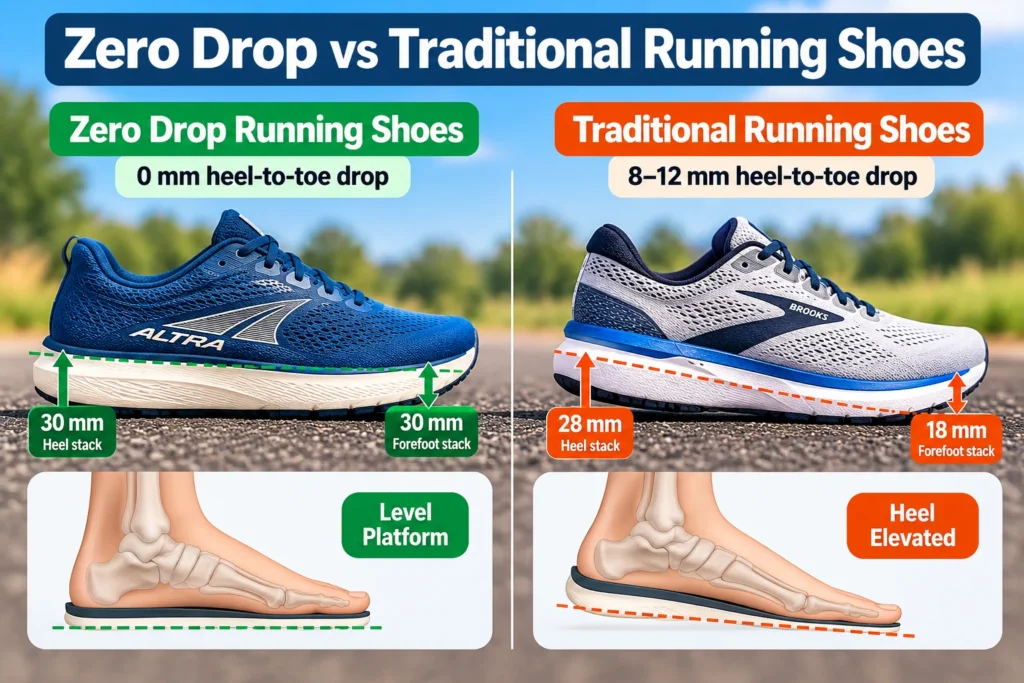
Zero-drop running shoes have equal heel and forefoot stack heights. Traditional running shoes usually place the heel higher than the forefoot.
This height difference is called heel-to-toe drop. Manufacturers normally express it in millimeters.
What Does Zero Drop Mean?
A zero-drop shoe has a stated heel-to-toe drop of 0 mm. For example, a shoe with 30 mm of material under both the heel and forefoot has zero drop.
That doesn’t mean the shoe has no cushioning. Some zero-drop models have thick midsoles designed for everyday road running.
- Heel-to-toe drop: 0 mm.
- Foot position: No built-in heel elevation relative to the forefoot.
- Cushioning: Can range from minimal to highly cushioned.
- Potential trade-off: Greater adaptation demands for runners accustomed to elevated heels.
What Makes Traditional Running Shoes Different?
Traditional running shoes commonly have a positive heel-to-toe drop. An 8 mm shoe, for example, places the heel 8 mm higher than the forefoot.
Many popular daily trainers fall around 8–12 mm, although conventional shoes also exist with smaller drops. The category isn’t defined by one mandatory measurement.
- Heel-to-toe drop: Often 8–12 mm, depending on the model.
- Heel geometry: More height beneath the heel than the forefoot.
- Cushioning: Available in firm, balanced, and soft designs.
- Practical advantage: Familiar geometry for runners already using similar shoes.
Zero Drop vs Traditional Running Shoes: Key Differences
The main difference is shoe geometry, not overall quality. The table below compares common design characteristics rather than promising identical results for every runner.
| Feature | Zero Drop | Traditional |
|---|---|---|
| Typical drop | 0 mm | Often 8–12 mm |
| Heel elevation | Level with forefoot | Raised relative to forefoot |
| Cushioning | Minimal to substantial | Minimal to substantial |
| Calf/Achilles demand | May increase during transition | Often more familiar to established users |
| Foot strike | Not predetermined | Not predetermined |
| Adaptation | Important when switching from higher drop | Often simpler if already accustomed |
| Best fit | Runners comfortable with level geometry | Runners comfortable with heel elevation |
Important: Two shoes with identical drops may feel completely different. Foam firmness, rocker shape, flexibility, and fit also determine the running experience.
How Does Heel-to-Toe Drop Affect Running Mechanics?
Heel-to-toe drop can influence ankle position and the distribution of mechanical demands during running. However, footwear alone doesn’t control your entire running technique.
Do Zero Drop Shoes Change Your Foot Strike?
Zero-drop shoes may encourage some runners to land differently, but they don’t guarantee midfoot or forefoot striking. Running speed, habits, and individual movement patterns also matter.
A six-month randomized biomechanics study compared cushioned shoes with 0, 6, and 10 mm drops. Researchers found no meaningful drop-specific long-term changes across most measured running variables.
My practical takeaway is simple: don’t force a forefoot strike just because your shoes have zero drop. Concentrate on comfortable, controlled running instead.
What Happens to Your Calves and Achilles Tendon?
Switching from elevated heels to zero drop changes the ankle’s starting position. This can increase demands on the calf muscles and Achilles tendon, particularly during adaptation.
The exact effect depends on your mechanics and the shoe’s other features. Cushioning alone doesn’t eliminate these demands.
- Calf muscles: May experience unfamiliar workload and soreness.
- Achilles tendon: May experience greater strain under certain running conditions.
- Foot muscles: May encounter different stabilization requirements.
- Training tolerance: Determines how quickly a runner can adapt.
A systematic review of running footwear biomechanics identifies increased ankle and forefoot loading with minimalist footwear. These findings shouldn’t automatically be applied to every highly cushioned zero-drop model.
Are Zero Drop Running Shoes Better for Your Knees?
Zero-drop running shoes aren’t proven to prevent knee injuries or relieve knee pain for everyone. Changing shoe geometry may alter joint loading, but individual responses vary.
A lower heel doesn’t automatically mean lower knee stress. Running technique, training volume, strength, and existing symptoms all influence how your body responds.
- Possible benefit: Some runners may prefer the movement characteristics of lower-drop footwear.
- Important limitation: Lower drop can shift demands toward the ankle and calf.
- Practical decision: Avoid changing footwear solely to treat a diagnosed knee condition without professional guidance.
If your knees hurt while running, examine training changes and symptoms before blaming shoe drop. Persistent pain deserves assessment by a qualified healthcare professional.
Do Zero Drop Shoes Reduce Running Injuries?
Current evidence doesn’t establish zero-drop shoes as safer than traditional running shoes overall. No single heel-to-toe drop consistently prevents running injuries across all runners.
A randomized trial involving 553 recreational runners compared shoes with 0, 6, and 10 mm drops. Overall injury risk didn’t significantly differ between the three groups.
The researchers also observed different associations among occasional and regular runners. Those subgroup findings don’t establish a universal rule about which footwear everyone should use.
A broader Cochrane review of running shoes and injury prevention found uncertainty about the injury effects of different footwear categories. Much of the supporting evidence had low or very low certainty.
What Factors Matter More Than Shoe Drop?
I would prioritize a comfortable fit and manageable training demands before chasing a particular drop measurement. A dramatic footwear change during a demanding training block creates another variable to manage.
- Comfort: Avoid persistent pressure, rubbing, or pain.
- Fit: Check toe space, heel security, and midfoot hold.
- Training: Increase distance and intensity according to your recovery.
- Adaptation: Introduce unfamiliar footwear gradually.
- Recovery: Respond early to worsening soreness or stiffness.
Who Should Consider Zero Drop Running Shoes?
Zero-drop shoes may suit runners who prefer a level platform and are willing to adapt gradually. They can also appeal to people seeking generous forefoot space, although toe-box width is a separate design feature.
Potentially Good Candidates
- Runners already comfortable in zero-drop footwear.
- People interested in exploring different shoe geometry.
- Runners who can introduce a new pair during lower-volume training.
- Buyers who find a zero-drop model with excellent overall fit.
Who Should Be More Cautious?
- Runners experiencing Achilles tendon pain or persistent calf symptoms.
- People recovering from foot or ankle injuries.
- Runners planning a major mileage increase or upcoming race.
- Anyone unable to tolerate even short periods in lower-drop footwear.
These aren’t absolute restrictions. However, a physical therapist or sports healthcare professional can help determine whether changing heel drop is appropriate.
Who Should Choose Traditional Running Shoes?
Traditional running shoes remain sensible for runners who already feel comfortable and train consistently in them. There’s no evidence-based reason to abandon a reliable shoe simply because zero-drop alternatives exist.
A raised heel can feel more familiar to runners accustomed to conventional footwear. It may also make a sudden increase in calf and Achilles demand less likely than an abrupt switch to zero drop.
- Beginners: A conventional daily trainer can be an accessible starting point.
- Experienced runners: Familiar geometry helps avoid unnecessary changes during established training.
- Comfort-focused buyers: Traditional shoes offer extensive cushioning and fit choices.
- Transition-sensitive runners: Remaining with familiar footwear may be preferable until symptoms or recovery concerns are addressed.
Is a 4–6 mm Drop a Good Middle Ground?
A 4–6 mm heel-to-toe drop provides some heel elevation without the larger difference found in many traditional trainers. It can be a practical option for runners exploring lower-drop designs.
However, a moderate-drop shoe doesn’t guarantee an easier transition. Its overall cushioning, flexibility, and fit also influence comfort.
For example, the Topo Athletic Phantom 4 has a stated 35 mm heel stack and 30 mm forefoot stack. Subtracting those measurements gives its advertised 5 mm drop.
That’s the comparison I find most useful when reading specifications. Always compare heel and forefoot measurements rather than relying on cushioning labels.
Are Zero Drop Shoes the Same as Barefoot Running Shoes?
No. Zero drop describes heel-to-toe height difference, while barefoot-style or minimalist footwear also emphasizes low stack height, flexibility, and ground feel.
A zero-drop shoe with a 30 mm midsole has substantially more material underfoot than a minimalist shoe with a thin sole. Both can have the same nominal drop.
- Zero drop: Equal heel and forefoot heights.
- Minimalist: Typically thin, flexible construction with greater ground feel.
- High cushioning: More material between the foot and ground, regardless of drop.
- Wide toe box: Extra forefoot room, independent of drop or cushioning.
Don’t assume every zero-drop shoe behaves like barefoot footwear. Examine its complete construction before deciding how to use it.
How Do You Transition From Traditional to Zero Drop Running Shoes?
The safest practical approach is gradual exposure with regular symptom checks. Your previous footwear, training history, and recovery determine the right pace.
Physical therapy guidance on transitioning to minimalist footwear recommends short initial periods, strengthening, and alternating footwear. The same caution is useful when making a major drop change, although cushioned zero-drop shoes aren’t necessarily minimalist.
Six Steps for a Gradual Transition
Begin with walking. Try approximately 10–15 minutes in the new shoes. Check how your calves and feet feel later and the following morning.
Keep your current shoes. Continue using familiar trainers for most running while you assess the new pair.
Introduce short, easy runs. Once walking feels comfortable, try a brief running exposure instead of immediately completing your normal distance.
Increase slowly. Add time only when your body responds well. There is no universally safe weekly increase that fits everyone.
Support your calves and feet. Use appropriate strength and mobility exercises without provoking pain.
Respond to warning signs. Reduce or stop new-shoe running if pain worsens, changes your gait, or persists into subsequent days.
Transition timeline: Some runners require several weeks or longer. Treat progression as symptom-guided, not a deadline.
Don’t begin an aggressive transition just before a marathon or important training session. Consistency is more valuable than switching quickly.
How Can You Choose the Right Running Shoe Drop?
Start with the heel drop you already wear comfortably, then consider whether you have a specific reason to change. Shoe geometry should support your running rather than become a goal itself.
Five Things to Check Before Buying
- Current drop: Check the manufacturer’s specifications for your existing shoes.
- Fit: Make sure your toes have space without excessive movement.
- Heel security: Check for slipping or uncomfortable collar pressure.
- Cushioning: Choose a firmness and stack height appropriate for your preference.
- Running comfort: Test the shoes at an easy pace when possible.
A shoe that feels excellent while standing may behave differently during running. If possible, use a store treadmill or a retailer’s permitted trial period.
Remember that advertised drop measurements can differ from independent measurements. Use manufacturer specifications as a starting point rather than laboratory-perfect values.
What Mistakes Should You Avoid When Choosing Shoe Drop?
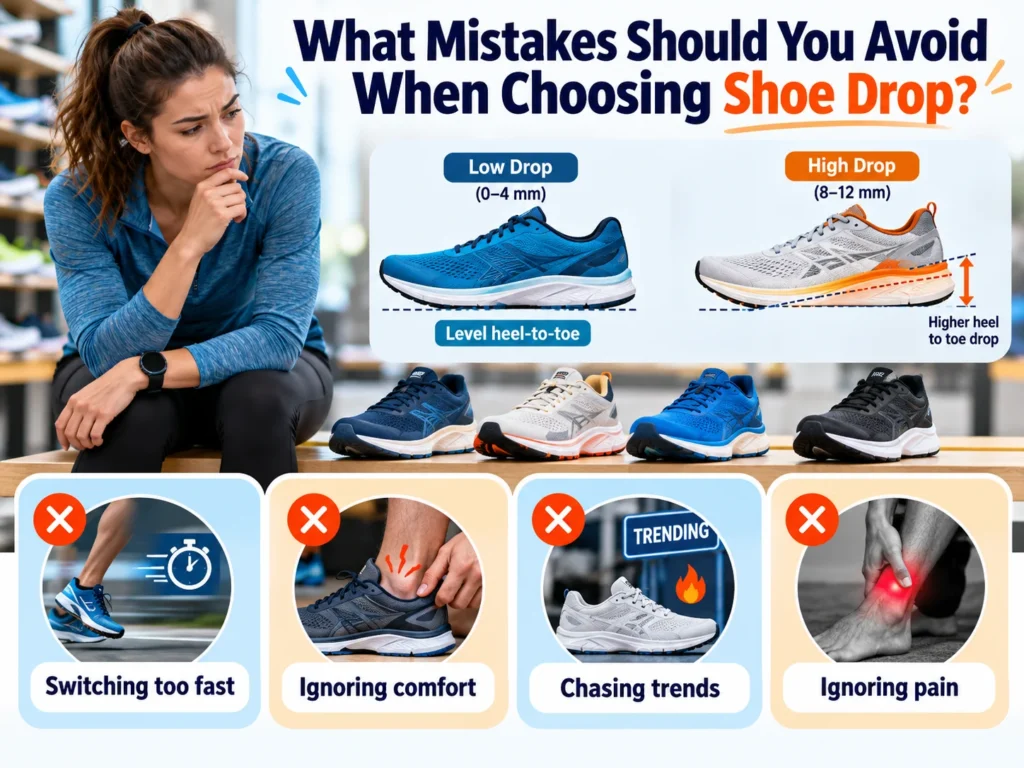
The biggest mistake is assuming that lower drop automatically means healthier running. Zero drop represents a design choice, not a medical benefit.
- Switching overnight: Replacing all running mileage with unfamiliar zero-drop footwear.
- Ignoring pain: Treating persistent Achilles or foot pain as normal adaptation.
- Confusing terms: Assuming zero drop always means minimal cushioning.
- Forcing technique: Deliberately changing foot strike without a clear reason.
- Ignoring fit: Choosing a drop number despite heel slipping or toe pressure.
- Overlooking shoe design: Comparing heel drop without considering rocker, foam, and flexibility.
Another mistake is changing footwear while simultaneously increasing mileage or speed. When several things change together, identifying the cause of discomfort becomes harder.
Which Running Shoes Are Worth Considering in 2026?
If you’re comparing these designs, I would shortlist one zero-drop trainer, one moderate-drop option, and one traditional trainer. These examples highlight genuine differences in geometry.
Editorial note: The ratings below assess published specifications, intended use, and design trade-offs. They aren’t customer review averages or claims of personal wear-testing.
Affiliate disclosure: As an Amazon Associate, we earn from qualifying purchases.
🏆 Zero-Drop Daily Trainer
Altra Torin 9
★★★★½ 4.5/5
Specs: 0 mm drop, 28 mm stack, P35X midsole, and neutral support.
My zero-drop shortlist starts here because the Torin 9 combines level geometry with meaningful cushioning. Its main limitation is that runners accustomed to elevated heels still need time to adapt.
⚖️ Moderate-Drop Alternative
Topo Athletic Phantom 4
★★★★½ 4.5/5
Specs: 5 mm drop, 35 mm heel stack, 30 mm forefoot stack, and high cushioning.
I’d consider the Phantom 4 for runners wanting a roomy toe box and moderate heel elevation. It offers a middle-ground geometry, although cushioning and fit must still suit the individual.
👟 Traditional Daily Trainer
Brooks Ghost 18
★★★★½ 4.5/5
Specs: 10 mm drop, DNA LOFT v3 cushioning, and a neutral daily-running design.
My traditional-shoe recommendation is the Ghost 18 for its conventional geometry and everyday versatility. Its higher drop won’t appeal equally to runners who prefer a level platform.
Frequently Asked Questions
Are Zero Drop Running Shoes Better for Beginners?
Not necessarily. Beginners can run in zero-drop shoes, but there is no clear evidence that they are universally better than traditional running shoes. A comfortable fit, appropriate training progression, and gradual adaptation are more important than choosing a particular heel drop.
Can You Wear Zero Drop Running Shoes Every Day?
Yes, if they fit properly and you tolerate them comfortably. However, changing from higher-drop footwear may require gradual exposure. Start with shorter periods and check for calf, Achilles, or foot discomfort before making zero-drop shoes your everyday option.
Do Zero Drop Running Shoes Help With Plantar Fasciitis?
Zero-drop shoes are not an established treatment for plantar fasciitis. Changing shoe geometry can alter foot-loading demands, and some people may experience increased discomfort. Anyone managing plantar heel pain should seek individualized advice before making a substantial footwear change.
Can You Alternate Between Zero Drop and Traditional Shoes?
Yes. Alternating footwear can help runners introduce an unfamiliar drop while retaining shoes they already tolerate. Begin with brief, easy exposures in the new pair and avoid sudden increases in training workload. Reduce use if symptoms worsen or persist.
Are Zero Drop Running Shoes Faster?
Not automatically. Running economy depends on multiple factors, including shoe weight, foam, stiffness, geometry, and individual biomechanics. Some runners may perform well in zero-drop footwear, but a 0 mm drop alone doesn’t guarantee faster race times or improved efficiency.
Final Verdict: Zero Drop vs Traditional Running Shoes
Neither zero-drop nor traditional running shoes are universally better in 2026. The right design depends on your comfort, running experience, training demands, and response to footwear changes.
If your current traditional shoes work well, there’s no need to switch. If you’re interested in zero drop, explore it patiently rather than changing your entire running routine overnight.
My final recommendation: Choose fit and consistent comfort first, then evaluate heel drop. A comfortable shoe you can train in reliably offers more practical value than any advertised geometry advantage.