
Quick Answer
Are minimalist running shoes better? They can be better for runners who prefer flexibility, ground feedback, and a natural-feeling stride. However, research does not show that they prevent more injuries than traditional running shoes. The best choice depends on your comfort, foot strength, training goals, and ability to adapt gradually. The American Academy of Orthopaedic Surgeons recommends a careful transition.
Key Differences That Matter
- Foot muscle activity: Minimalist shoes may encourage greater use of certain foot muscles.
- Ground feedback: Thin, flexible soles make surface changes easier to feel.
- Injury prevention: There is no convincing evidence that minimalist shoes consistently reduce overall running injuries.
- Calf and foot loading: Switching can increase stress on the Achilles tendon, calves, and forefoot.
- Daily comfort: Traditional cushioning may feel better for runners who need more underfoot protection.
Practical Verdict
- Choose minimalist: When you enjoy ground feel and can build tolerance gradually.
- Choose traditional: When cushioning, familiar comfort, and dependable daily mileage matter more.
Minimalist running shoes promise a simpler running experience, but fewer shoe materials do not automatically mean better performance. I think the useful question is whether their design matches what your feet and training need.
In this 2026 guide, I’ll explain their benefits, risks, research evidence, and practical buying considerations.
What Are Minimalist Running Shoes?
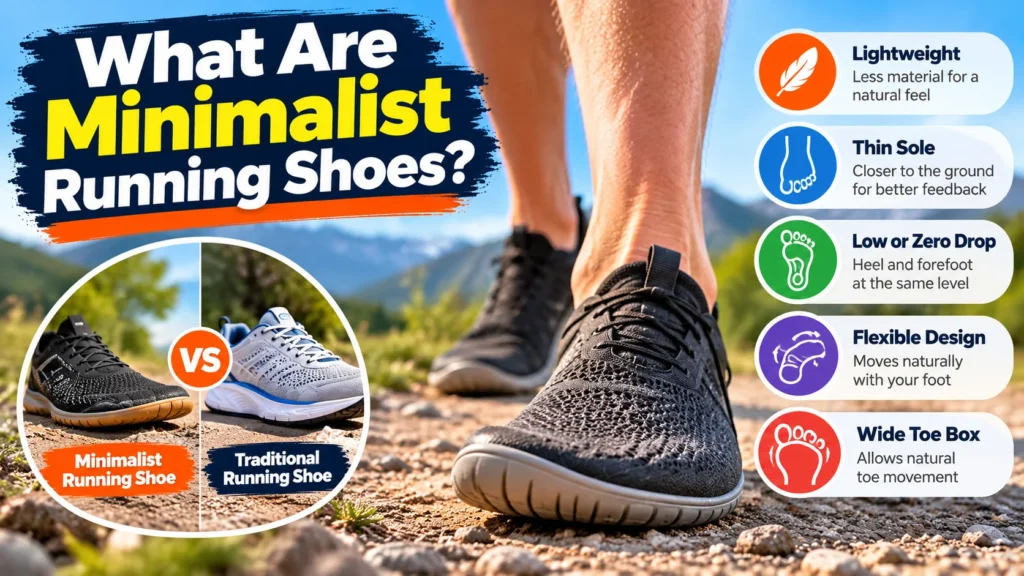
Minimalist running shoes are lightweight, flexible shoes designed to interfere less with natural foot movement. They generally have thin soles, limited cushioning, and little structural support.
Many models also feature a wide toe box and zero heel-to-toe drop. These characteristics allow more foot movement but expose runners to different physical demands.
What Features Make a Shoe Minimalist?
- Low stack height: Less material separates the foot from the ground.
- Low or zero drop: The heel sits at or near the forefoot’s height.
- Flexible construction: The sole bends more easily during movement.
- Minimal stability features: The shoe provides limited mechanical guidance.
- Lightweight design: Less foam and reinforcement generally reduce weight.
- Natural toe movement: Many designs provide additional forefoot space.
These characteristics vary by model. A zero-drop shoe with thick cushioning is not necessarily minimalist.
Are Minimalist and Barefoot Shoes the Same?
Minimalist shoes imitate some aspects of barefoot movement while protecting the foot. Barefoot-style shoes usually represent the more flexible, thin-soled end of the minimalist category.
True barefoot running means running without shoes. Even the thinnest footwear changes surface feedback and protects against direct contact.
Are Minimalist Running Shoes Better for Your Feet?
Minimalist running shoes may improve certain aspects of foot strength and movement. However, stronger feet do not automatically translate into fewer injuries or faster running.
1. They May Help Strengthen Foot Muscles
Traditional shoes often provide cushioning and support that change how the foot works. Minimalist footwear requires the foot to perform more of its normal movement and stabilization tasks.
A 2025 systematic review and meta-analysis examined 28 trials involving 1,399 participants. It found evidence that minimalist footwear may improve certain measures of foot strength.
However, the researchers rated the evidence as low to very low certainty. The results should not be interpreted as proof that minimalist shoes improve every measure of foot health.
2. They Provide More Ground Feedback
Thin soles allow runners to feel more information about the surface beneath them. This sensory feedback may influence how someone places and loads their feet.
I consider this an appealing feature for runners who enjoy a connected, flexible ride. However, greater ground sensation does not guarantee better balance or fewer injuries.
3. They Encourage Natural Foot Movement
Flexible soles permit more bending through the foot during running. Many minimalist shoes also provide room for the toes to spread.
These features can feel less restrictive than stiff, narrow footwear. Still, a roomy toe box can also exist in conventional running shoes.
4. They Can Change Running Mechanics
Some runners adopt shorter strides or land farther forward on their feet after switching. These changes affect how forces move through the lower body.
A biomechanics review describes lower knee loading and greater ankle loading in some minimalist-running conditions. The important distinction is that stress often moves rather than disappears.
Are Minimalist Running Shoes Better Than Traditional Running Shoes?
Neither shoe category wins for every runner. Minimalist footwear emphasizes movement and feedback, while traditional footwear generally offers more cushioning and underfoot protection.
The following comparison highlights the design differences that affect everyday running.
| Feature | Minimalist Shoes | Traditional Shoes |
|---|---|---|
| Cushioning | Usually thin and minimal | Usually moderate to substantial |
| Heel drop | Commonly 0 mm | Often 4-12 mm, but varies |
| Sole flexibility | Generally high | Varies from flexible to stiff |
| Ground feel | More pronounced | Usually reduced by cushioning |
| Foot protection | Less underfoot padding | More material beneath the foot |
| Adaptation | Often requires a gradual transition | Usually more familiar to conventional-shoe runners |
| Best fit | Runners prioritizing flexibility and ground feedback | Runners prioritizing cushioning and protection |
Note: These are common category characteristics, not fixed standards. Individual shoe models may overlap.
Do Minimalist Running Shoes Reduce Running Injuries?
Current evidence does not establish that minimalist running shoes reduce overall injury rates. They change biomechanics, but different loading patterns can create different injury concerns.
A randomized trial involving 140 recreational runners compared minimalist footwear, running retraining, and a control program. It found no statistically significant difference in overall running-injury incidence between the groups.
The researchers also examined where injuries occurred. Read the randomized trial findings on PubMed for the full results.
Why Can Minimalist Shoes Cause Problems?
Moving from cushioned shoes to thin, flat footwear changes how your lower limbs manage each step. Tissue adaptation takes time, especially when someone also changes their running technique.
Potential problems include:
- Calf overload: Additional muscular demands may produce persistent soreness.
- Achilles tendon pain: Lower-drop running can increase tendon loading.
- Forefoot discomfort: Metatarsal bones may experience unfamiliar stresses.
- Stress injuries: Repeated loading without adequate adaptation can contribute to bone stress problems.
- Plantar discomfort: Some runners experience irritation when activity increases too quickly.
These issues are not inevitable. They become more concerning when a runner changes footwear and mileage simultaneously.
Persistent focal bone pain, swelling, limping, or worsening tendon pain deserves professional assessment. Do not try to run through these symptoms.
Can Minimalist Running Shoes Improve Speed and Running Economy?
Minimalist footwear may improve running economy in some testing conditions, partly because the shoes weigh less. Running economy describes how much energy you use at a given speed.
However, improved economy in a laboratory does not guarantee a faster race. Training history, technique, comfort, and fatigue still influence performance.
Are Minimalist Shoes Better for Long-Distance Running?
They can work for experienced minimalist runners, but they are not automatically ideal for longer distances. Repeated foot and calf loading becomes increasingly important as mileage rises.
I would prioritize familiar comfort and consistent training over chasing a supposedly natural shoe design. A runner comfortable in cushioned footwear has no obligation to switch.
Are They Better Than Carbon-Plated Racing Shoes?
These categories solve different problems. Minimalist shoes prioritize flexibility, while carbon-plated racing shoes usually combine high-performance foam with a stiff plate.
Runners seeking maximum race-day efficiency should not assume a thinner shoe is faster. Race performance depends on the complete footwear system and the individual runner.
Who Should Consider Minimalist Running Shoes?
Minimalist shoes make the most sense for runners interested in ground feedback and gradual foot conditioning. They are less attractive when an immediate switch would disrupt comfortable, injury-free training.
They May Suit You If:
- You enjoy flexible footwear and low-to-the-ground movement.
- You have healthy feet and can reduce your initial running workload.
- You want to experiment with foot strength and movement awareness.
- You prefer minimal cushioning for short, controlled running sessions.
- You are willing to track how your calves, tendons, and feet respond.
Be More Cautious If:
- You currently have Achilles tendinopathy or recurring calf pain.
- You have a history of metatarsal stress fractures.
- You experience unexplained foot pain during everyday walking.
- You have reduced foot sensation or a condition affecting protective sensation.
- You are preparing for a race and cannot afford to disrupt training.
These concerns do not necessarily rule out minimalist footwear permanently. They do justify getting individualized advice before experimenting.
How Do You Transition to Minimalist Running Shoes Safely?
The safest general approach is to introduce minimalist footwear gradually while maintaining your usual shoes. Your muscles, tendons, and bones need time to tolerate unfamiliar loading.
Oregon Health & Science University recommends a slow transition that may take several months.
A Practical Transition Framework
- Start with walking: Try brief periods on familiar, even surfaces before running.
- Check everyday comfort: Ensure your toes have room and your heel stays secure.
- Add short running intervals: Begin with easy efforts measured in minutes, not miles.
- Keep your regular shoes: Continue most established mileage in familiar footwear.
- Build strength: Add appropriate foot exercises and progressive calf strengthening.
- Increase one variable: Extend minimalist running time only when your body tolerates the current workload.
- Review symptoms: Reduce exposure when pain, altered gait, or persistent soreness appears.
For example, a healthy runner might begin with walking before attempting a few minutes of easy minimalist running. That is an illustrative starting point, not a universal prescription.
Some runners require much longer than others. Age, previous injuries, training volume, and starting footwear all matter.
What Should You Avoid During the Transition?
- Changing everything: Do not increase speed, distance, and minimalist exposure together.
- Forcing a forefoot strike: Avoid exaggerated tiptoe running to imitate barefoot technique.
- Ignoring persistent pain: Discomfort that changes your stride is a warning.
- Running on demanding terrain: Begin on predictable surfaces before attempting technical trails.
- Following rigid deadlines: Your response matters more than a predetermined weekly schedule.
How Can You Choose the Right Minimalist Running Shoes?
Start with fit and intended use, then compare sole construction. A popular barefoot shoe will not help if its shape or protection level feels wrong.
1. Examine Stack Height and Cushioning
Stack height describes the amount of material under your foot. Lower stack heights generally create more ground feedback and less separation from surface irregularities.
As a concrete example, Merrell lists the Vapor Glove 6 at 6 mm total stack height. Xero Shoes describes the HFS II as having a 9 mm stack, offering a different balance of protection and feel.
2. Understand Heel-to-Toe Drop
Heel-to-toe drop is the height difference between the heel and forefoot. A zero-drop shoe keeps these levels equal.
Zero drop does not indicate how much cushioning a shoe contains. A thick cushioned shoe can also have zero drop.
3. Check Toe Box Fit
Your toes should spread comfortably without pressing against the upper. However, the midfoot and heel still need a secure fit.
Try shoes while standing, walking, and taking a few careful steps. Do not assume every barefoot brand has the same shape.
4. Match the Outsole to Your Running Surface
Road-oriented soles usually prioritize smooth transitions and predictable pavement contact. Trail-oriented designs may feature added tread for traction.
More aggressive traction does not automatically make a minimalist shoe suitable for every technical trail. Protection, grip, and personal experience still matter.
What Mistakes Should You Avoid When Choosing Minimalist Shoes?
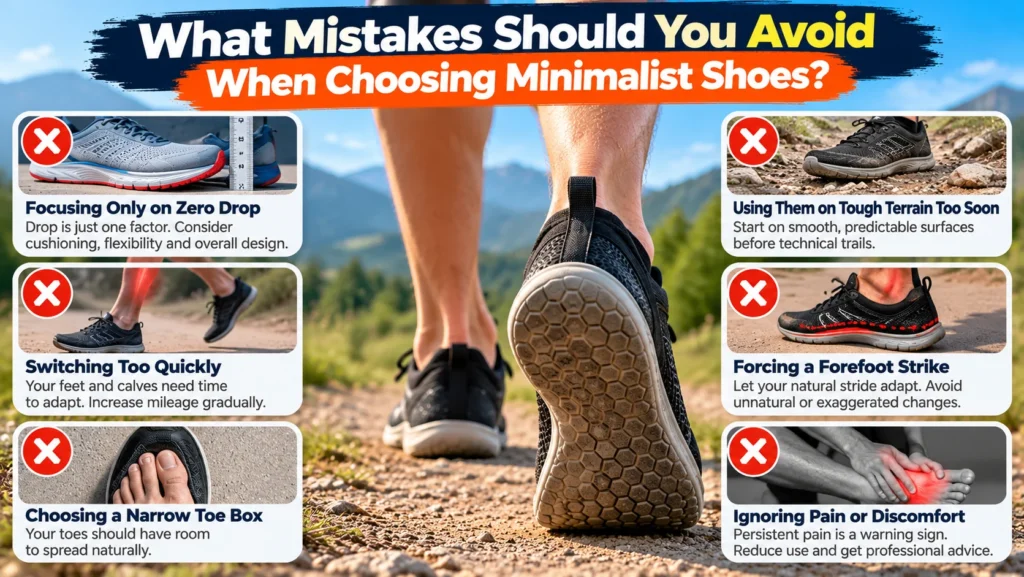
The biggest mistake is treating minimalist shoes as an automatic upgrade. They represent a different footwear approach, not a guaranteed improvement.
- Buying solely for zero drop: Drop alone cannot describe cushioning, flexibility, or overall shoe behavior.
- Confusing soreness with progress: Muscle fatigue and developing injury symptoms require different responses.
- Ignoring comfort: An uncomfortable shoe does not become appropriate because it has a natural-looking design.
- Expecting instant strength gains: Foot adaptation requires progressive, repeated exposure.
- Assuming lighter means faster: Race efficiency involves more than shoe weight.
- Choosing inadequate protection: Sharp gravel and uneven surfaces may demand different footwear.
My approach is to evaluate the complete shoe before considering its category. Fit, running environment, and adaptation demands should drive the decision.
Which Minimalist Running Shoes Are Worth Considering in 2026?
Three established models illustrate different minimalist priorities. These are specification-based editorial selections, not claims of hands-on testing or measured performance rankings.
Affiliate disclosure: The following Amazon links are product searches. Qualifying purchases may earn a commission at no extra cost to you. Ratings reflect editorial fit assessments, not customer review averages.
🏆 Versatile Road Option
Xero Shoes HFS II
★★★★½ — 4.5/5 Editorial Rating
Features a zero-drop design, flexible construction, and approximately 9 mm stack height. I favor its balance of ground feedback and added underfoot protection for runners exploring minimalist road footwear, although adaptation is still necessary.
🌿 Strong Ground-Feel Option
Merrell Vapor Glove 6
★★★★☆ — 4.0/5 Editorial Rating
Offers zero drop, a 6 mm stack height, and a Vibram EcoStep outsole. I consider it a stronger option for runners seeking pronounced ground feedback, but its minimal cushioning makes gradual adaptation especially important.
🦶 Individual-Toe Design
Vibram FiveFingers V-Run
★★★★☆ — 4.0/5 Editorial Rating
Uses individual toe compartments, flexible construction, and a lightweight design. Manufacturer specifications include a 2.5 mm rubber outsole and 4 mm EVA midsole. I would reserve this distinctive fit for runners comfortable with toe-separated footwear.
Frequently Asked Questions
Are minimalist running shoes better for beginners?
Not necessarily. Beginners often benefit from comfortable shoes that allow consistent training without adding another major adaptation challenge. Minimalist footwear can be an option, but it should be introduced gradually rather than immediately replacing comfortable running shoes.
Do minimalist running shoes strengthen your feet?
They may improve certain foot-strength measures by changing muscular demands during movement. Research supports possible benefits, but the certainty of evidence is limited. Foot-strengthening exercises can also help, so buying minimalist shoes is not the only approach.
Can minimalist running shoes help plantar fasciitis?
There is insufficient evidence to recommend minimalist running shoes as a universal treatment for plantar fasciitis. Less cushioning and different loading patterns may aggravate symptoms in some people. A clinician can help assess footwear and appropriate rehabilitation.
How long does it take to adapt to minimalist running shoes?
Adaptation varies significantly. Some healthy runners may tolerate short sessions relatively quickly, while building meaningful running mileage can take several months. Progress should depend on comfort, recovery, and symptom response rather than a fixed deadline.
Are minimalist running shoes good for everyday walking?
They can be comfortable for everyday walking if they fit properly and your feet tolerate them. Walking may also provide an introduction before minimalist running. Start with manageable exposure and reconsider the shoes if persistent discomfort develops.
Final Verdict: Are Minimalist Running Shoes Better?
Minimalist running shoes are better for some runners, but not for everyone. Their strongest advantages involve flexibility, ground feedback, and the potential to develop certain foot-strength qualities.
Those benefits must be balanced against reduced cushioning and greater adaptation demands. Research does not establish them as a superior injury-prevention strategy.
My recommendation: Choose shoes that feel comfortable, match your training, and let you run consistently. If minimalist footwear interests you, introduce it carefully instead of replacing your entire running-shoe rotation overnight.
Your best running shoe is not necessarily the one with the least cushioning. It is the one that supports your goals without creating unnecessary problems.