

Quick Answer
The HOKA Challenger ATR 7 wins for mixed-terrain running with its 4 mm outsole lugs. The HOKA Mach 6 wins for road training with its lighter 232 g build. Choose the Challenger for gravel, dirt, and paved routes. Pick the Mach 6 for faster road workouts and daily training.
Which HOKA shoe fits your running routes?
- Challenger ATR 7 offers 4 mm lugs for loose surfaces.
- Mach 6 weighs around 20 g less per shoe.
- Both shoes feature neutral support and an advertised 5 mm drop.
⚡ Quick Verdict — Challenger ATR 7 vs Mach 6
HOKA Challenger ATR 7
RunRepeat overall score
$145 (reference retail price)
✅ Best for:
Runners who switch between paved roads, gravel paths, and light trails.
HOKA Mach 6
RunRepeat overall score
$140 (reference retail price)
✅ Best for:
Road runners who want a light shoe for daily miles and faster workouts.
| Category | Challenger 7 | Mach 6 |
|---|---|---|
| Overall mixed-terrain winner | 🏆 | — |
| Best road-running value | — | ✅ |
| Gravel traction | ✅ | — |
| Speed workouts | — | ✅ |
| Terrain versatility | ✅ | — |
Bottom line: Challenger ATR 7 wins for mixed-terrain runners, while Mach 6 offers better speed and value for road-focused training.
Scores come from independent RunRepeat reviews. Prices are published retail references, not verified live Amazon offers. Amazon buttons open product search results.
- Challenger ATR 7 wins for mixed surfaces with its 4 mm lugs.
- Mach 6 costs $5 less at the published reference prices.
- Challenger ATR 7 suits long runs across roads and gravel paths.
- Mach 6 suits beginners who mainly run on paved routes.
- The biggest difference is mixed-terrain traction versus road-running speed.
Does your daily run begin on pavement and end on a dirt path? Choosing the right running shoe can make that route easier.
This HOKA Challenger ATR 7 review compares two shoes with different strengths. Both offer cushioning, low weight, and a familiar HOKA design.
However, the outsole changes how each shoe works outside your home. The Challenger handles loose ground, while the Mach favors smooth roads.
I’m Steven Tyler, writing for Footwear Hiker. I compared published product specifications, independent laboratory results, and runner feedback.
I did not personally wear-test these two pairs. The recommendations below reflect their documented features and practical use cases.
You don’t need a heavy mountain shoe for every gravel path. You also don’t need trail lugs for every daily road run.
The right choice depends on where your feet spend the most time. Fit, traction, and price all affect the final decision.
Both models have newer versions available. That makes their current selling prices especially important when shopping for older stock.
Here’s how these two HOKA running shoes compare when your route changes.
What Is the HOKA Challenger ATR 7 Designed to Do?
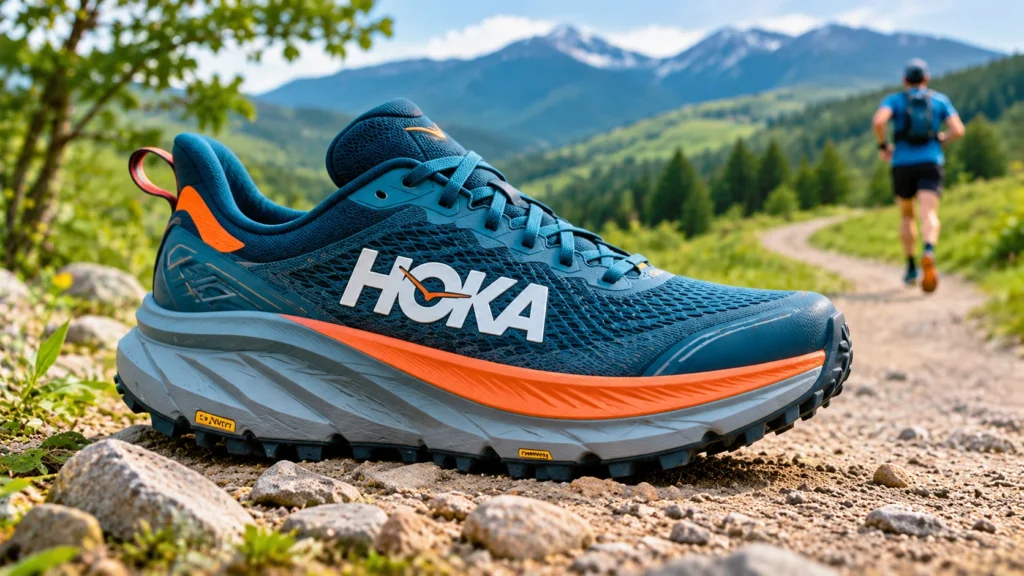
Best for: Daily runs across pavement, gravel, and well-maintained trails.
Not ideal for: Deep mud, technical mountain trails, or road speed sessions.
Reference retail price: $145.
Live Amazon pricing could not be verified.
Primarily, the HOKA Challenger ATR 7 serves runners who explore mixed terrain. It combines a cushioned road-shoe feel with added grip for loose surfaces.
The shoe uses compression-molded EVA, or ethylene-vinyl acetate, for underfoot cushioning. Its engineered mesh upper helps air move around the foot. An extended heel pull makes the shoe easier to put on.
HOKA uses 4 mm lugs across sections of the rubber outsole. Smaller central lugs support smoother movement on firm ground. Larger outer lugs help the shoe engage uneven surfaces.
At a reference price of $145, the Challenger targets runners seeking versatility. Its men’s reference weight sits near 252 grams. For example, a route with sidewalks and compact gravel suits this design well.
The Challenger’s main appeal comes from its broad range of uses. However, that range does not include every type of trail. Deep mud, slick rocks, and steep mountain routes demand more specialized grip.
- Works across roads and light trails.
- Comfortable cushioning for steady miles.
- Gravel-friendly 4 mm lugs.
- Light for a mixed-terrain shoe.
- Wide versions available in selected markets.
- Useful extended heel pull.
- Not ideal for deep mud.
- Less suited to fast road workouts.
- Standard mesh lacks waterproof protection.
- Exposed foam can show surface wear.
- Older-model size availability varies.
HOKA Challenger ATR 7 Running Shoes
Road-to-trail cushioning, engineered mesh, and gravel-ready traction.
Reference retail price: $145.
Check your size, width, seller, and current price before ordering.
What Is the HOKA Mach 6 Designed to Do?
Best for: Daily road runs, tempo workouts, and steady long runs.
Not ideal for: Muddy trails or runners needing a broad standard toe box.
Reference retail price: $140.
Live Amazon pricing could not be verified.
Primarily, the HOKA Mach 6 helps road runners train at different speeds. It combines low weight with responsive cushioning and a smooth road outsole.
The midsole uses supercritical EVA foam instead of conventional molded EVA. This manufacturing process helps create a light and responsive foam structure. A creel jacquard mesh upper keeps the shoe’s build relatively light.
HOKA lists the men’s reference weight at 232 grams. That makes the Mach about 20 grams lighter than the Challenger. Its advertised 5 mm drop matches the Challenger’s published drop.
At a reference retail price of $140, the Mach offers road-training versatility. You can use it for an easy morning run or a planned tempo session. Our HOKA Mach 6 review covers the shoe’s fit and design in greater detail.
The main concern is the shape around the toes. Independent testers found the standard fit tapered toward the front. Runners with broad feet should test the fit or consider a wide version.
- Lightweight road-running design.
- Responsive supercritical EVA foam.
- Suitable for several training paces.
- Strategic rubber outsole coverage.
- Lower reference retail price.
- No rigid racing plate.
- Standard toe box can feel narrow.
- No dedicated trail lugs.
- Thin tongue padding.
- Not designed for muddy ground.
- Limited protection against trail debris.
HOKA Mach 6 Road Running Shoes
Lightweight construction, responsive foam, and versatile road performance.
Reference retail price: $140.
Current offers depend on size, color, and seller availability.
How Do the HOKA Challenger ATR 7 and Mach 6 Specifications Compare?
In short, the Challenger ATR 7 offers a more trail-ready outsole. The Mach 6 offers a lighter build and a more responsive road-training design.
| Specification | Challenger ATR 7 | Mach 6 | Winner |
|---|---|---|---|
| Men’s model number | 1134497 | 1147790 | — |
| Reference retail price | $145 | $140 | Mach 6 |
| Shoe category | Road-to-trail | Road running | Use-dependent |
| Men’s reference weight | 252 g / 8.9 oz | 232 g / 8.2 oz | Mach 6 |
| Advertised heel drop | 5 mm | 5 mm | Tie |
| Midsole | Compression-molded EVA | Supercritical EVA | Mach 6 for speed |
| Upper material | Engineered mesh | Creel jacquard mesh | Use-dependent |
| Outsole | Durabrasion rubber | Strategic rubber coverage | Use-dependent |
| Trail lugs | 4 mm | None dedicated | Challenger 7 |
| Support type | Neutral | Neutral | Tie |
| Carbon plate | No | No | Tie |
| Heel design | Extended heel pull | Streamlined collar | Use-dependent |
| Width options | Regular and wide | Regular and wide | Tie |
| Waterproof standard upper | No | No | Tie |
| Speed training | Secondary use | Well suited | Mach 6 |
| Gravel running | Well suited | Firm paths only | Challenger 7 |
| Terrain versatility | Roads and light trails | Mainly roads | Challenger 7 |
These figures describe standard men’s reference models. Actual shoe weight changes with size, width, and manufacturing differences.
Published heel drop also differs from measurements taken in independent laboratories. Treat the advertised 5 mm figures as design specifications.
The outsole remains the most useful comparison point for mixed-terrain runners. A lighter shoe does not automatically perform better on loose ground.
Which Shoe Performs Better on Roads and Trails?
Primarily, the Challenger ATR 7 wins for mixed-terrain runs. The Mach 6 wins when your route stays on smooth pavement.
Which Shoe Is Better for Road Running?
The Mach 6 wins for road running because of its lighter build. Its outsole and midsole work together for smooth paved routes.
The roughly 20-gram difference per shoe helps reduce weight on each step. Foam response and fit also affect how light a shoe feels.
Consider a 5-kilometer route through your neighborhood. The Mach 6 works well when that route includes sidewalks and paved turns.
The Challenger can cover the same route without becoming useless. Its trail lugs simply offer fewer benefits on clean, dry pavement.
Which Shoe Is Better for Gravel and Light Trails?
The Challenger ATR 7 wins for gravel, packed dirt, and light trails. Its 4 mm lugs help the outsole engage loose ground.
Imagine running three kilometers on pavement before entering a forest path. The Challenger lets you make that change without swapping shoes.
Its mixed-terrain design also suits park paths and firm country tracks. These surfaces do not always need aggressive mountain-running footwear.
However, deep mud can fill the gaps between outsole lugs. The Challenger has limits when trails become steep, wet, or rocky.
Choose your shoe for the hardest surface you encounter regularly. A short section of loose gravel can matter more than several kilometers of smooth pavement.
Which Shoe Offers Better Cushioning and Speed?
In short, the Mach 6 wins for responsive road training. The Challenger ATR 7 offers cushioning better matched to relaxed mixed-surface runs.
How Does the Midsole Foam Compare?
The Mach 6 uses supercritical EVA foam for a more performance-focused ride. The Challenger uses traditional compression-molded EVA for cushioned mixed-terrain running.
Different foam structures can change rebound, weight, and underfoot feel. The amount of foam alone cannot tell you how fast a shoe feels.
Independent road-shoe tests support the Mach’s use across several running paces. Its design does not require a carbon plate to provide a lively ride.
The Challenger takes a different approach to everyday comfort. Its outsole and foam combination helps it move between surface types.
Which Shoe Is Better for Long Runs?
The Mach 6 wins for long road runs with faster sections. Challenger ATR 7 wins when long runs include dirt and gravel.
For example, consider a 15-kilometer road run at a steady pace. The Mach’s lighter design offers a clear reason to choose it.
Now consider a long route with farm tracks and paved roads. The Challenger’s outsole becomes a more useful feature on that route.
Runners who want more cushioning for relaxed pavement miles should compare alternatives. Our HOKA Bondi 9 review explains another approach to underfoot comfort.
Which Shoe Is Better for Tempo Training?
The Mach 6 wins for tempo training, intervals, and faster daily runs. Its lower weight and responsive midsole favor changes in pace.
Tempo training means running at a sustained, challenging but controlled pace. You can perform these workouts without a dedicated racing shoe.
The Challenger can handle faster efforts on firm paths. However, speed training is not its main design goal.
Choose the shoe that matches both your workout and your surface. Speed matters less when loose ground limits your footing.
Which HOKA Running Shoe Offers Better Value?
Primarily, the Mach 6 offers better value for road-only runners. The Challenger ATR 7 offers better value for people who regularly switch surfaces.
The published reference prices are $140 and $145. That creates a $5 difference before discounts, shipping, and taxes.
Paying $5 more for trail lugs makes sense when you need them. Paying extra for unused features brings little benefit.
| Value Factor | Challenger 7 | Mach 6 |
|---|---|---|
| Reference price | $145 | $140 |
| Road-training value | Good | Better |
| Mixed-terrain value | Better | Limited |
| Speed-training value | Secondary | Better |
| One-shoe versatility | Multiple surfaces | Multiple road paces |
A clearance deal can change the price comparison completely. Check the actual cost of your size rather than the lowest advertised offer.
Remember that these are older running shoe models. Compare their discounted prices with the newer Challenger 8 and Mach 7.
Fit remains more valuable than a small discount. An uncomfortable clearance shoe offers poor value if you stop wearing it.
Which Shoe Has Better Grip and Durability?
Primarily, the Challenger ATR 7 wins for grip on loose terrain. The Mach 6 uses a rubber layout better matched to paved surfaces.
How Do Their Outsoles Differ?
The Challenger uses 4 mm lugs to engage dirt and gravel. The Mach uses a flatter outsole design for road running.
HOKA places different lug shapes across the Challenger’s outsole. This arrangement helps balance firm-ground movement with loose-ground traction.
Trail lugs do not guarantee better grip on every wet surface. Rubber material, tread contact, surface texture, and running speed also matter.
For demanding rocky terrain, consider our HOKA Speedgoat 6 review before settling on the Challenger.
Which Shoe Is Likely to Last Longer?
Neither shoe guarantees a longer lifespan for every runner. Durability depends heavily on the surface, running form, mileage, and care.
Repeated pavement use gradually wears down the Challenger’s raised lugs. Rough stones can also damage exposed sections of midsole foam.
The Mach’s rubber coverage helps protect parts of its road outsole. However, using it frequently on sharp rocks increases unnecessary wear.
Inspect both shoes for smooth tread areas and uneven foam compression. Replace damaged footwear when its grip or support becomes unreliable.
Neither standard shoe provides reliable protection against ice, deep mud, or slippery rock. Avoid unsafe surfaces and choose purpose-built footwear when conditions demand extra traction.
Which Shoe Wins in Real-World Running Situations?
In short, the Challenger wins when routes change surface types. The Mach 6 wins when road runners change their training pace.
| Running Situation | Winner | Reason |
|---|---|---|
| Daily 5K road run | Mach 6 | Light road-focused build |
| Gravel park paths | Challenger 7 | 4 mm trail lugs |
| Road tempo session | Mach 6 | Responsive foam |
| Mixed-terrain long run | Challenger 7 | Surface versatility |
| Treadmill running | Mach 6 | Road-oriented outsole |
| Cold, dry dirt paths | Challenger 7 | Loose-ground traction |
| Outdoor coaching on mixed paths | Challenger 7 | Mixed-surface design |
| Road 10K training | Mach 6 | Versatile training pace |
Can the Challenger ATR 7 Replace Two Running Shoes?
Yes, the Challenger can cover both road running and easy trail running. That makes it useful for runners who prefer owning one pair.
For example, you may run on roads during the working week. Your weekend runs may take you onto gravel and forest paths.
One mixed-terrain shoe can reduce the need for a second pair. However, specialized workouts or demanding trails can still justify separate footwear.
The Challenger’s strength is broad usefulness rather than maximum performance everywhere.
Can You Use the Mach 6 on Trails?
You can use the Mach 6 on short, firm, dry gravel paths. It remains a road shoe rather than a dedicated trail model.
A well-maintained park path presents fewer problems than loose mountain terrain. Large rocks, mud, and steep descents demand more careful footwear choices.
If most of your weekly miles happen off-road, choose the Challenger. Its outsole matches that use more closely.
The Mach 6 makes more sense when off-road sections remain occasional and mild.
Is the Challenger ATR 7 Price Difference Worth It?
Yes, the $5 reference price difference is worthwhile for mixed-terrain runners. Road-only runners have little reason to pay extra for trail lugs.
The Challenger’s $145 reference price reflects its more specialized outsole design. The Mach’s $140 reference price targets road-training performance.
Consider the terrain you expect to run on each week. That decision provides more useful guidance than comparing price alone.
Suppose you find a Challenger for $100 and a Mach for $110. In that example, the Challenger becomes the cheaper option.
Those example prices are hypothetical, not verified current offers. Older-model discounts vary with the remaining sizes and colors.
Compare clearance prices against the newer Challenger 8 and Mach 7. A previous-generation shoe makes more financial sense when its fit, condition, and discount justify the purchase.
Who Should Buy Which HOKA Running Shoe?
Primarily, mixed-terrain runners should buy the Challenger ATR 7. Road runners who value speed and lighter footwear should choose the Mach 6.
Think about your weekly routes rather than your longest planned adventure. A shoe should work well for the runs you complete most often.
Buy the Challenger ATR 7 If:
- You run on pavement and gravel.
- You explore easy forest trails.
- You prefer relaxed, steady runs.
- You want one mixed-terrain shoe.
- Your routes include loose dirt.
Skip the Challenger If:
- You mainly train for road speed.
- You regularly face deep mud.
- You need technical mountain grip.
Buy the Mach 6 If:
- You mainly run on paved roads.
- You enjoy tempo workouts.
- You prefer lightweight shoes.
- You run on treadmills often.
- You want one versatile road trainer.
Skip the Mach 6 If:
- Your routes involve loose trails.
- You need aggressive outsole lugs.
- The tapered toe box feels tight.
- Both shoes squeeze your toes or cause painful pressure.
- You require specialized footwear for ice or technical mountain trails.
- You prefer a dedicated stability shoe.
- You need waterproof protection from the standard versions.
- A newer model fits better at a similar selling price.
Comfort-focused road runners may prefer a more relaxed daily trainer. Our HOKA Clifton 10 review covers a useful alternative.
Always try running shoes with the socks you normally wear. Your toes should have enough room during movement and downhill steps.
What Are Real Buyers and Reviewers Saying About Both Shoes?
Published wear tests favor the Challenger for mixed-surface versatility. Road-shoe reviewers favor the Mach 6 for its low weight and lively ride.
Independent reviewers also identify limits that matter to prospective buyers. The Challenger does not suit every trail, and the Mach can feel narrow.
Independent Reviewer and Runner Feedback
Positive themes
- Comfort across several surface types.
- Smooth enough for regular road miles.
- Useful grip on maintained trails.
Common limitations
- Less suitable for demanding terrain.
- Not a dedicated speed-training shoe.
- Limited deep-mud performance.
Positive themes
- Low weight during road training.
- Responsive feel at faster paces.
- Suitable for several workout types.
Common limitations
- Tapered standard toe box.
- Minimal tongue padding.
- Limited loose-ground traction.
These themes summarize published independent reviews and public runner discussions. They are not verified Amazon customer-review statistics.
A public runner discussion describes extended Mach 6 use across multiple pairs. That account provides helpful context but cannot establish a universal lifespan.
Individual running experiences vary with foot shape, weight, pace, and surface. Use such reports as guidance rather than a guarantee of identical results.
Amazon customer reviews could not be accessed for this comparison. No Amazon ratings, buyer quotations, or review counts have been invented.
How Should You Care for HOKA Running Shoes?

Primarily, clean HOKA running shoes by hand and let them air-dry. Gentle care helps protect the mesh, foam, and outsole materials.
1. Remove Dirt After Trail Runs
Brush loose dirt from the Challenger’s outsole after muddy or dusty runs. Small stones can also become trapped between its raised lugs.
Use a soft brush to clear debris without cutting the rubber. Avoid sharp tools that could damage the exposed midsole foam.
2. Clean the Mesh Upper Gently
Use mild soap, lukewarm water, and a soft cloth. Avoid harsh chemicals that can weaken shoe materials or affect their finish.
For more detailed instructions, follow our guide to clean running shoes without unnecessary damage.
3. Let Both Shoes Air-Dry Naturally
Dry the shoes in a shaded space with good airflow. Remove the insoles when possible to help moisture escape.
Do not place wet shoes beside heaters or inside tumble dryers. High heat can damage adhesives and change the shape of shoe materials.
4. Store Shoes in a Cool, Dry Place
Keep your shoes away from direct sunlight and damp storage areas. A ventilated shoe rack works better than a sealed, wet sports bag.
Allow both shoes to dry fully before putting them away. Trapped moisture can encourage odor and material deterioration.
5. Inspect the Outsole and Cushioning
Check the rubber and foam for uneven wear or damage. The Challenger needs usable tread for its mixed-terrain role.
The Mach needs sound outsole coverage for regular road training. Replace shoes that lose dependable grip or develop structural damage.
Track your running distance to understand how much use each pair receives. Mileage alone should not determine whether a shoe remains suitable.
6. Check Warranty and Return Conditions
Review the seller’s return policy before ordering older running shoe models. Some clearance offers have stricter return conditions.
Warranty coverage can also depend on your country and retailer. Keep your purchase receipt and check the manufacturer’s local terms.
Do not assume normal outsole wear qualifies as a manufacturing fault. Ask the seller about coverage before making a claim.
How Was This HOKA Shoe Comparison Researched?
This comparison uses published manufacturer specifications, independent shoe reviews, and runner discussions. It does not represent personal wear testing by Footwear Hiker.
Manufacturer information establishes the intended use and advertised construction of both shoes. Independent reviews help explain their real-world strengths and limitations.
The reference weights and heel drops describe published product specifications. Laboratory measurements may differ because of shoe size and measurement methods.
Reference retail prices provide a consistent starting point for the value comparison. They do not guarantee that older stock remains available at those prices.
Amazon blocked direct listing verification during research. The shopping links therefore lead to product search results instead of unverified individual listings.
Final Verdict: Is the HOKA Challenger ATR 7 Worth Buying?
Yes, the HOKA Challenger ATR 7 remains worth considering for mixed-terrain running. Its 4 mm lugs make it more useful when paved routes turn into dirt paths.
The HOKA Mach 6 remains the stronger choice for road-focused training. Its 232-gram reference weight and responsive foam suit faster road workouts.
At published retail prices, the Challenger costs only $5 more. That difference is small when you regularly need mixed-terrain traction.
However, the best purchase also depends on the available discount. Check the newer Challenger 8 and Mach 7 before paying full price.
My recommendation is simple: buy for your regular route, not your occasional ambition. The right outsole and comfortable fit matter more than collecting features.
🏆 Choose Your HOKA Running Shoe
Best for roads, gravel, light trails, and mixed-terrain daily running.
Reference price: $145
Best for lightweight road training, tempo runs, and daily paved miles.
Reference price: $140
Check current prices, stock, width options, and return conditions before purchasing.
Frequently Asked Questions
1. Which is better, HOKA Challenger ATR 7 or Mach 6?
The HOKA Challenger ATR 7 is better for mixed-terrain running. The HOKA Mach 6 is better for daily road training and faster workouts. The Challenger features 4 mm outsole lugs, while the Mach uses a lighter road-focused design. Choose according to your regular running surface.
2. What is the difference between HOKA Challenger ATR 7 and Mach 6?
The main difference is the outsole design and intended running surface. The Challenger uses trail lugs for gravel and dirt paths. The Mach 6 uses supercritical EVA foam and a road-focused outsole. The Mach also weighs around 20 grams less per shoe at reference sizes.
3. Is the HOKA Challenger ATR 7 good for road running?
Yes, the HOKA Challenger ATR 7 works well for everyday road running. Its outsole design balances firm-ground movement with light-trail traction. However, frequent pavement running can wear down its raised lugs. Choose the Mach 6 if nearly all your training happens on smooth roads.
4. Is the HOKA Challenger ATR 7 waterproof?
No, the standard HOKA Challenger ATR 7 does not have a waterproof upper. Its engineered mesh supports airflow but allows water to enter. HOKA also produced a separate GTX version with a waterproof membrane. Check the exact product name before buying footwear for wet conditions.
5. Is the HOKA Challenger ATR 7 suitable for beginners?
Yes, the Challenger ATR 7 suits beginners who run on roads and easy trails. Its cushioning and mixed-terrain outsole offer practical everyday versatility. Beginners who mainly run on pavement should also consider the Mach 6. Comfortable fit and suitable traction matter more than the runner’s experience level.
Affiliate Disclosure: As an Amazon Associate, I earn from qualifying purchases. This article contains affiliate links. If you purchase through these links, I may earn a commission at no additional cost to you.


