

Quick Answer
Running shoes should fit securely around your heel and midfoot while leaving approximately a thumb’s width of space beyond your longest toe. Your toes should move comfortably without rubbing, and your heel shouldn’t slip during running. The REI running shoe fitting guide also recommends checking your shoes while standing and moving.
Five Steps to Check Your Running Shoe Fit
- Step 1 — Toe space: Leave roughly 10–13 mm (about half an inch) beyond your longest toe.
- Step 2 — Toe width: Make sure your toes can spread without pressing against the sides.
- Step 3 — Heel security: Check that your heel stays comfortably in place while moving.
- Step 4 — Midfoot comfort: Look for a gentle, secure hold without painful pressure.
- Step 5 — Movement test: Walk or jog to check for rubbing, slipping, or toe contact.
Important: Running shoes should feel comfortable immediately. Don’t depend on a break-in period to fix incorrect sizing.
Knowing how running shoes should fit can make the difference between enjoying your daily miles and constantly adjusting uncomfortable footwear.
I like to approach running shoe fitting as a combination of length, width, and security rather than relying on the size printed inside the shoe. This guide explains how to check each area, recognize problems, and choose a better fit in 2026.
What Does a Proper Running Shoe Fit Actually Mean?

A proper running shoe fit means your foot has enough space to move naturally while remaining secure inside the shoe. The heel and midfoot should feel supported, while the toes have room to spread during each stride.
Running creates repeated movement and pressure that casual walking doesn’t fully reproduce. That’s why a shoe that feels comfortable while sitting may feel restrictive during a run.
A good fit depends on five areas:
- Length: Enough space between your longest toe and the shoe’s front.
- Width: No squeezing across the ball of your foot.
- Toe-box depth: Enough vertical room above your toes.
- Midfoot: A secure hold without uncomfortable pressure.
- Heel: Minimal slipping during normal movement.
The goal isn’t to make every part equally tight. Different areas need different amounts of freedom.
How Much Room Should You Have in the Toe Box?
Most runners should aim for approximately a thumb’s width between their longest toe and the front of the shoe. This is a practical starting point rather than an exact measurement for every foot.
The American Academy of Orthopaedic Surgeons recommends at least half an inch of space in athletic shoes. It also emphasizes adequate room to wiggle your toes.
How to Check Your Toe Space
- Put on your normal running socks.
- Stand upright with your weight on both feet.
- Make sure your heel rests against the back of the shoe.
- Find your longest toe, which may not be your big toe.
- Press gently on the shoe’s upper to locate the toe.
- Check the space between that toe and the front.
If the shoe has a stiff toe cap, locating your toe through the upper may be difficult. A removable insole can provide another useful reference for length and width.
Can Too Much Toe Room Be a Problem?
Yes. Excessive front space can allow your foot to slide forward, especially on downhill sections.
Extra length can also position the shoe’s flex point incorrectly against your foot. Try a different width or shape before automatically choosing a much longer shoe.
How Should Running Shoes Fit Around Your Toes and Forefoot?
The forefoot should feel comfortably supported without squeezing your toes together. Your toes need enough room to spread as your foot accepts weight.
The toe box is the front section of a shoe surrounding your toes. Its width, height, and shape all affect comfort.
Signs Your Toe Box Fits Correctly
- Your toes can wiggle freely.
- Your little toe doesn’t press painfully against the upper.
- Your forefoot stays supported without noticeable squeezing.
- Your toenails don’t rub against the shoe’s roof.
- You don’t experience tingling or numbness.
One fitting mistake I would avoid is treating more length as the solution to every tight shoe. Sometimes the real problem is insufficient width or toe-box depth.
For example, a runner might have comfortable space in front but experience pressure around the little toe. A wider or differently shaped shoe may solve that problem more effectively.
How Snug Should Running Shoes Fit Around the Midfoot and Heel?
Your running shoes should feel comfortably snug around the midfoot and heel without pinching. These areas help keep your foot positioned correctly during movement.
Midfoot Fit
The midfoot is the middle portion of your foot, between your heel and forefoot. Your laces should secure this area without creating painful pressure across the top.
Look for these signs:
- The shoe moves naturally with your foot.
- Your midfoot doesn’t slide sideways.
- The tongue doesn’t dig into your foot.
- The laces provide a secure hold without needing excessive tightening.
Heel Fit
Your heel should stay mostly in place when walking or running. Repeated lifting or rubbing suggests the heel fit needs attention.
A little movement doesn’t automatically mean the shoe is unusable, but noticeable slipping deserves a closer look.
The American Orthopaedic Foot & Ankle Society’s fitting advice recommends a secure heel and comfortable movement from the first try-on.
What If Your Heel Keeps Slipping?
Try adjusting your laces before changing shoe size. A runner’s loop, also called heel-lock lacing, can sometimes improve heel security.
- Lace your shoes normally until the final two eyelets.
- Create a small loop on each side using the upper eyelets.
- Cross each lace through the opposite loop.
- Pull gently to secure the heel.
- Tie normally and test the fit while walking.
If your heel continues slipping, the shoe’s heel shape may not match your foot. Lacing cannot correct every fit problem.
Should Running Shoes Fit Tight or Loose?
Running shoes should fit securely, not tightly or loosely. A balanced fit combines comfortable toe space with dependable midfoot and heel support.
The following comparison helps distinguish common fit problems.
| Fit Area | Too Tight | Correct Fit | Too Loose |
|---|---|---|---|
| Toe length | Toes touch the front | About 10–13 mm clearance | Excessive front space |
| Forefoot | Pinching or numbness | Comfortable toe movement | Sideways movement |
| Midfoot | Painful lace pressure | Secure, gentle hold | Foot shifts inside |
| Heel | Collar digs into skin | Secure with little movement | Repeated slipping |
My practical rule: Your shoes should hold your feet securely without making you constantly aware of their pressure. If you’re adjusting them every few minutes, investigate the fit.
How Do You Measure Running Shoe Size Correctly?
Measure both feet while standing, preferably later in the day. Use the larger foot as your starting point when selecting a shoe size.
Your feet can change in size and volume over time. Previous shoe purchases aren’t always a reliable measurement.
Step-by-Step Running Shoe Measurement
- Prepare: Put on the socks you normally wear for running.
- Position: Stand on a sheet of paper against a wall.
- Mark: Mark the end of your longest toe.
- Measure: Record the distance from the wall to the mark.
- Repeat: Measure the other foot and compare results.
- Match: Consult the manufacturer’s size chart and try on the corresponding size.
Also measure the widest part of your forefoot if width is a recurring problem. A specialty running store can provide more accurate length and width measurements.
What Do Running Shoe Width Letters Mean?
Running shoe widths use letter codes that differ between men’s and women’s sizing systems. These common US conventions provide a helpful reference.
| Width | Men’s US | Women’s US |
|---|---|---|
| Narrow | B | 2A |
| Standard | D | B |
| Wide | 2E | D |
| Extra wide | 4E | 2E |
These conventions are also explained in Brooks’ shoe-width guide. Available widths and actual fit vary between models.
A wide shoe doesn’t necessarily have a dramatically wider toe box. Its upper volume and overall shape also matter.
Should You Buy Running Shoes Half a Size Bigger?
Many runners benefit from trying a half-size larger than their casual shoe size. However, increasing your size isn’t necessary if your current shoe already provides the correct fit.
Dress shoes, casual sneakers, and running shoes can use different shapes and sizing conventions. Always judge the physical fit instead of automatically following a fixed size-up rule.
When Should You Try a Larger Size?
- Your longest toe repeatedly touches the shoe’s front.
- Your toes feel cramped after normal running.
- You experience pressure around your toenails.
- Your foot lacks sufficient lengthwise clearance while standing.
If the shoe feels too narrow but already has enough length, try a different width first. A longer shoe could introduce unnecessary movement.
How Can You Tell If Running Shoes Are Too Small or Too Big?
Common signs of poor sizing include toe pain, numbness, blisters, excessive heel slipping, and repeated foot movement. These symptoms can have other causes, but footwear fit is an important factor to check.
Signs Your Running Shoes May Be Too Small
- Toes repeatedly hit the front.
- Toenails experience pressure or bruising.
- The forefoot feels squeezed.
- Your toes become numb or tingly.
- There isn’t enough room to spread your toes.
Signs Your Running Shoes May Be Too Big
- Your heel slips repeatedly.
- Your foot slides forward or sideways.
- You must overtighten the laces.
- Excessive movement creates friction.
- The shoe’s bending point feels poorly positioned.
Remember that a correctly sized shoe can still have an unsuitable shape. Length alone doesn’t determine comfort.
Persistent numbness, repeated bruising, or significant pain deserves professional assessment rather than continued experimentation with uncomfortable shoes.
How Should Running Shoes Fit for Different Foot Shapes?
Running shoes should accommodate your individual foot shape rather than force your feet into a standard design. Width, arch height, heel shape, and foot volume can change how the same model feels.
Wide Feet
Look for wider options or an anatomical toe box. Focus on forefoot comfort without sacrificing midfoot stability.
Narrow Feet
Look for a shape that provides a secure heel and midfoot. Avoid choosing excessively roomy shoes simply because the length feels correct.
High-Volume Feet
High-volume feet need more room through the upper, often across the instep. A shoe can have the right length but feel too tight over the top.
Flat Feet or High Arches
Arch shape may influence comfort, but it doesn’t determine a single correct shoe model. Evaluate your individual fit, running comfort, and support needs.
The American Podiatric Medical Association provides additional information about shoe selection and foot types.
How Should Running Shoes Fit for Long Runs and Downhill Running?
Long-distance running shoes need sufficient toe room and secure support as your feet change during exercise. Downhill running also makes forward foot movement particularly important.
A shoe that passes a short walking test may still cause problems over longer distances. Check the fit through realistic movement whenever possible.
For Long-Distance Running
- Choose adequate toe clearance from the beginning.
- Avoid pressure points that may worsen as your feet swell.
- Check the fit using your actual running socks.
- Test new shoes on shorter runs before long events.
For Downhill or Trail Running
- Check that your toes don’t hit the front on descents.
- Maintain enough midfoot support to limit forward sliding.
- Use secure lacing without overtightening.
- Consider terrain-appropriate traction and protection.
I would prioritize downhill toe clearance when evaluating a trail shoe. Comfortable space while standing isn’t enough if the foot slides forward repeatedly on descents.
What Mistakes Should You Avoid When Fitting Running Shoes?
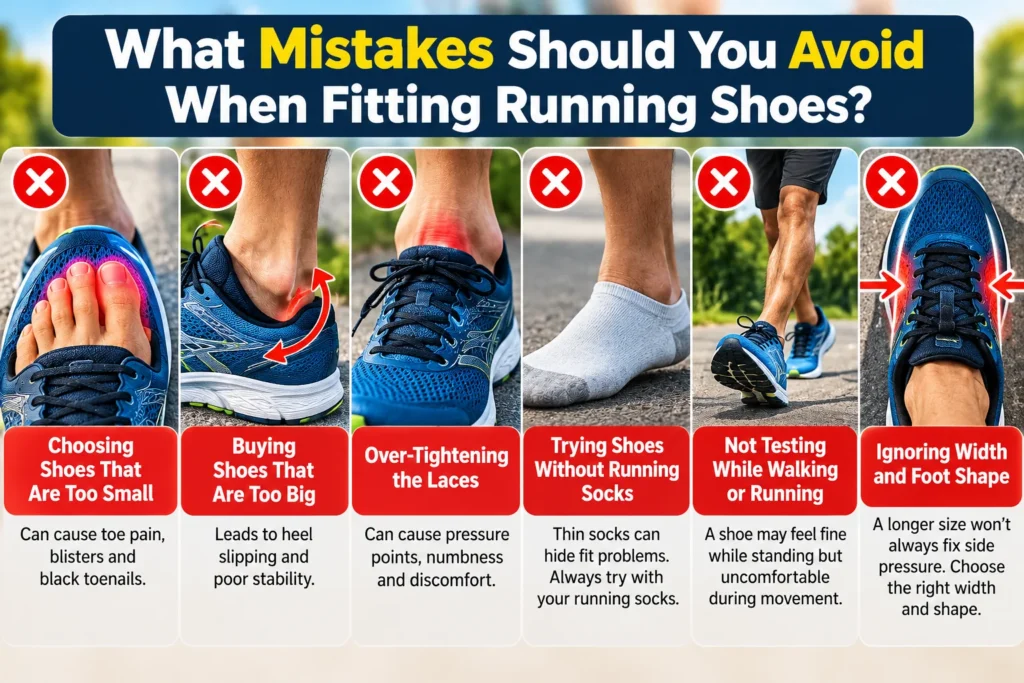
The biggest fitting mistakes involve trusting your usual size, ignoring width, and testing shoes without running socks. These choices can hide important fit problems.
- Buying by size alone: Different models can fit differently even with identical labels.
- Ignoring your larger foot: Always ensure the larger foot has adequate space.
- Choosing tight shoes: Don’t expect major pressure points to disappear after breaking them in.
- Skipping movement tests: Walk or jog before deciding.
- Overlooking width: A longer shoe won’t necessarily resolve side pressure.
- Testing in thin socks: Wear the socks you’ll actually run in.
- Ignoring discomfort: Persistent rubbing or numbness is a reason to reassess.
A helpful approach is to solve one fit problem at a time. Determine whether the issue involves length, width, volume, or heel security before changing models.
How Can You Test Running Shoes Before Buying Them?
A practical fitting test combines standing measurements with walking and jogging. Don’t judge shoes solely by how soft they feel when you first put them on.
- Try shoes later in the day, when your feet may be larger.
- Wear your normal running socks and any orthotics.
- Lace both shoes comfortably and stand upright.
- Check toe length, width, and upper pressure.
- Walk and jog briefly to evaluate security.
- Try gentle turns and a short incline if available.
- Compare at least two sizes or widths when uncertain.
Before buying online, review the retailer’s return policy. Test new shoes indoors first so you can identify problems without unnecessarily affecting return eligibility.
Pay attention to pressure points immediately. A correctly fitting running shoe should feel comfortable from the beginning.
Which Running Shoes Are Worth Considering for a Comfortable Fit in 2026?
The best running shoe depends on your foot shape and the fit problems you want to solve. These three models offer different starting points for runners comparing width, everyday security, and toe-box space.
I would shortlist them by their design features rather than assume any one model fits everyone. The ratings below are editorial fit-versatility indicators, not customer-review averages or hands-on test scores.
🏆 Best Width Selection
New Balance 1080v15
★★★★½ — 4.5/5
The 1080v15 features Infinion cushioning, a 6 mm heel-to-toe drop, and multiple width options. I’d start here when standard-width shoes feel restrictive, because trying alternative widths is more useful than guessing a longer size.
👟 Best Everyday Fit Option
Brooks Ghost 18
★★★★☆ — 4/5
The Ghost 18 combines balanced cushioning with a secure heel design and multiple width choices. I’d compare its heel lockdown and forefoot comfort against another daily trainer before choosing.
🦶 Best Roomy Toe Box
Topo Athletic Phantom 4
★★★★½ — 4.5/5
The Phantom 4 features an anatomical toe box, secure midfoot design, and 5 mm drop. I would consider it for runners who need more natural toe space without an excessively loose heel.
Buying tip: Always verify the exact model, size, and width shown by the retailer. A well-reviewed shoe isn’t a good purchase if its shape doesn’t suit your feet.
Frequently Asked Questions About Running Shoe Fit
Should running shoes feel tight when you first buy them?
No. Running shoes should feel comfortably secure when you first try them on. Mild contact around the midfoot is normal, but painful squeezing, toe pressure, or numbness suggests an unsuitable fit. Don’t rely on a break-in period to correct a shoe that’s too small.
How much space should be between your longest toe and the shoe?
A useful starting point is roughly a thumb’s width, or approximately 10–13 mm. Measure while standing and check your longest toe rather than assuming it’s your big toe. The correct amount also depends on how securely the shoe holds your foot during movement.
Is it normal for your heel to slip in running shoes?
A small amount of heel movement can occur, but noticeable repeated slipping isn’t ideal. Try adjusting your laces or using a runner’s loop. If the movement continues, consider another width or a shoe with a differently shaped heel.
Should running shoes be bigger than everyday sneakers?
Sometimes, but not automatically. Many runners need more toe clearance than their casual footwear provides, especially during longer workouts. Compare actual fit rather than assuming you always need a half-size increase. Running shoe sizing and shape can differ between brands.
Can running shoes that fit poorly cause foot pain?
Poor-fitting shoes can contribute to pressure, rubbing, blisters, and toe discomfort. However, running-related foot pain can also have causes unrelated to footwear. If discomfort persists despite changing shoes, seek guidance from a qualified healthcare professional.
Final Verdict: How Should Running Shoes Fit?
The best running shoe fit combines enough toe room with a secure midfoot and heel. Your toes should move comfortably, and your feet shouldn’t slide around or experience painful pressure.
Start with approximately a thumb’s width of front clearance, then confirm the width and heel fit. Most importantly, test both shoes while moving instead of trusting the size label alone.
Before your next purchase: Measure both feet, bring your running socks, compare available widths, and choose the pair that feels comfortable from the first step.


Steven is a former sportsperson and now a full-time businessman and research writer. He is the mastermind of this site, and he created this site to help people who need specialized shoes for different activities. When he was a sportsperson, he was very passionate about different types of shoes for his sports purpose. The passion he had for shoes at that time now turned into his profession. Besides his shoe business, he loves sharing his knowledge and experience with people and helping them maintain healthy feet.
More Posts
