

Quick Answer
Yes, running shoes often need to be about half a size bigger than everyday shoes, but not everyone needs to size up. Your running shoes should provide approximately one thumb-width (about 1 cm to 1.3 cm) between your longest toe and the front of the shoe. The heel and midfoot should remain secure without squeezing your foot. Learn more about proper running shoe toe room before choosing your size.
Five Running Shoe Sizing Rules
- Half-size adjustment: Try half a size larger if your regular shoes leave insufficient toe space.
- Toe clearance: Keep approximately one thumb-width between your longest toe and the shoe’s front.
- Secure heel: Your heel should stay reasonably stable while walking and running.
- Natural toe movement: Your toes should spread and wiggle without pressure.
- Width matters: Choose a wider fit instead of extra length when your forefoot feels squeezed.
Best Way to Confirm Your Size
- Test both feet: Wear your running socks, check the larger foot, and jog briefly to confirm the fit.
You’ve probably heard that running shoes should be half a size bigger than your normal shoes. That advice can help, but it isn’t a universal sizing rule.
A shoe that’s too short can bruise your toes. One that’s too long may slip, rub, and feel unstable.
I prefer judging the space inside a shoe rather than trusting the size printed on its label. This guide explains when sizing up makes sense and how to recognize a comfortable fit.
Should Running Shoes Be Half a Size or a Full Size Bigger?
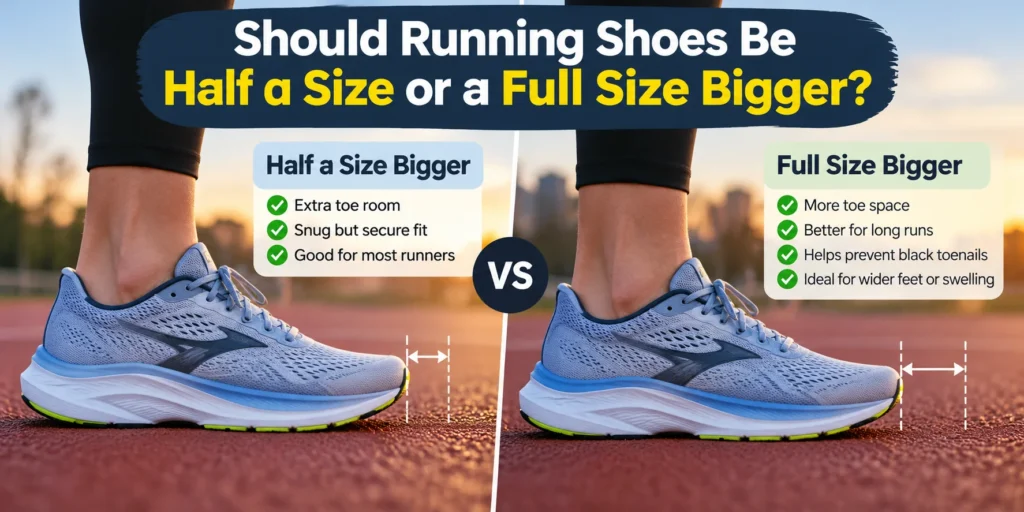
Most runners should start by comparing their usual shoe size with a half-size larger option. A full-size increase is sometimes appropriate, but only when the actual fit requires it.
The important distinction is whether you’re comparing running shoes with dress shoes, casual sneakers, or another running shoe. Those categories don’t always fit the same way.
For example, a runner who wears US size 9 casual shoes might prefer size 9.5 running shoes. Someone whose casual shoes already have generous toe room might stay in size 9.
The following table shows useful starting points, not guaranteed conversions.
| Current Fit | What to Try | Key Check |
|---|---|---|
| Casual shoes fit close to toes | Half a size larger | Thumb-width clearance |
| Current running shoes fit correctly | Same size first | Heel security and toe movement |
| Toes still touch after half-size increase | Another half size or a different model | Avoid excessive heel movement |
| Sides feel tight, length is correct | Same length in wide width | Forefoot pressure disappears |
My rule is simple: never select a bigger number unless it improves the fit. Shoe size is a starting point, not the final answer.
Why Do Running Shoes Need More Room Than Everyday Shoes?
Running shoes need enough space to accommodate foot movement, natural spreading, and changes in foot volume during exercise. This doesn’t mean the entire shoe should feel loose.
1. Your Feet Can Swell During Running
Exercise, heat, and prolonged time on your feet can increase foot volume. A shoe that feels comfortable before running may become restrictive later.
That’s why I recommend testing running shoes later in the day. The REI running shoe fitting guide also recommends shopping when feet are larger.
2. Your Foot Changes Shape Under Load
Your foot naturally spreads when it supports your weight. Running adds repeated loading that makes toe-box space especially important.
The front of the shoe should allow this movement without pressing against your toes. A snug heel helps prevent unnecessary sliding.
3. Downhill Running Moves Your Foot Forward
Descending hills can increase forward pressure inside your shoes. If the toe box is too short, your longest toes may repeatedly hit the front.
Extra clearance helps reduce this problem, although proper lacing and heel support matter too.
4. Running Socks and Insoles Change the Fit
Thicker socks occupy more internal space than thin casual socks. Orthotic insoles can also change the available room and heel position.
Always test shoes with the accessories you intend to use.
- Wear your normal running socks during fitting.
- Bring prescription or custom orthotics when applicable.
- Check fit after walking for several minutes.
- Allow room for your feet to expand during longer sessions.
How Much Extra Space Should Running Shoes Have?
Running shoes should generally have approximately one thumb-width of space beyond your longest toe. For many adults, this works out to roughly 10–13 mm, depending on thumb size.
The goal is enough clearance for movement without sacrificing a secure fit.
How to Perform the Thumb-Width Test
- Stand upright: Put your full weight on both feet.
- Position your heel: Keep your heel seated against the back of the shoe.
- Find your longest toe: It may be your big toe or second toe.
- Check the gap: Press gently on the front of the upper to estimate the remaining space.
- Move naturally: Walk or jog to see whether your toes hit the front.
Don’t force your thumb between your foot and the shoe. The test estimates lengthwise clearance rather than measuring the entire toe box.
If the upper makes your toe position difficult to identify, remove the insole and compare it with your foot. Remember that insole length is only an approximate fit check.
How Do You Know Whether to Size Up Running Shoes?
Size up when the shoe is too short, not simply because a sizing chart recommends it. Your symptoms and fit test should guide the decision.
Signs Your Running Shoes Are Too Small
- Toe contact: Your longest toe repeatedly touches the shoe’s front.
- Bruised toenails: Repeated pressure causes tenderness or dark discoloration.
- Toe blisters: Friction develops around or between your toes.
- Numbness: Your toes tingle or lose sensation while running.
- Restricted movement: You cannot wiggle your toes comfortably.
- Increasing discomfort: Shoes feel tighter as your workout continues.
These problems don’t always mean you need more length. A narrow toe box or insufficient shoe volume can produce similar symptoms.
Signs Your Running Shoes Are Too Big
- Heel slipping: Your heel repeatedly lifts or rubs against the collar.
- Forward sliding: Your foot moves excessively toward the shoe’s front.
- Unstable corners: Your foot shifts sideways during direction changes.
- Excessive lace tightening: You must overtighten the laces to feel secure.
- Unnecessary toe space: A large front gap remains even when your heel is seated correctly.
A little flexibility is normal, but uncontrolled movement isn’t. If the shoe still feels loose after reasonable lacing adjustments, consider a smaller size or different shape.
How Can You Measure Your Feet Before Buying Running Shoes?
Measure both feet while standing, preferably later in the day. Use the larger foot as your primary sizing reference.
Foot length is only one measurement, so you’ll still need to evaluate width and shoe shape.
Step-by-Step Home Foot Measurement
- Prepare the tools: Get paper, a pencil, a ruler, and your usual running socks.
- Place paper on the floor: Position it against a wall on a hard surface.
- Stand naturally: Put your heel against the wall with weight on your foot.
- Mark the longest toe: Mark its position carefully without angling the pencil excessively.
- Measure the length: Record the distance from the wall to the mark in millimeters.
- Measure the other foot: Repeat and retain the larger measurement.
- Check the brand chart: Compare your measurement with that manufacturer’s specific size guide.
Don’t automatically add a fixed amount to your measured foot length before using a brand chart. Some charts already account for the recommended allowance.
If possible, confirm your result with a Brannock Device at a specialist shoe store. This tool helps assess foot length, arch length, and width.
Example: Choosing Between US Size 9 and 9.5
Imagine your everyday shoes are US size 9. You try two running shoe sizes with the same socks and lacing.
- Size 9: Your toes nearly touch the front during a short jog.
- Size 9.5: You gain suitable front clearance while your heel stays secure.
- Decision: Size 9.5 is the better fit for that particular shoe.
Now consider a different running shoe in size 9 that already provides proper toe clearance. There’s no reason to automatically move up to 9.5.
That’s why two models with the same printed size can produce different fitting decisions.
Should You Buy Bigger Running Shoes If You Have Wide Feet?
Not necessarily. If your toes have enough forward clearance but your forefoot feels compressed, try a wider shoe rather than a longer one.
Increasing shoe length may also loosen the heel and midfoot. The result can be an uncomfortable combination of excess movement and continued side pressure.
A wide toe box and a wide shoe aren’t always the same thing. Some shoes have a naturally rounded front, while others offer different width versions.
For more detail, read the running shoe width and sizing guide.
Common Running Shoe Width Labels
| Width | Men’s Label | Women’s Label |
|---|---|---|
| Narrow | B | 2A |
| Standard | D | B |
| Wide | 2E | D |
| Extra Wide | 4E | 2E |
These are common US width conventions, not universal measurements. Brooks’ official width guidance explains the distinctions.
Use the Removable Insole Test
Remove the insole and stand on it with your heel aligned. Check whether your foot extends beyond its edges, especially near the ball of your foot.
The University of Florida’s clinical running shoe sizing guidance recommends checking how the foot matches the footbed.
The test isn’t perfect because upper shape and internal volume also matter. However, it helps identify shoes that may be too narrow.
Should Long-Distance Runners Buy Larger Shoes?
Long-distance runners may need more room than their everyday footwear provides. Longer sessions increase the importance of accommodating changes in foot volume and preventing repeated toe contact.
Still, buying an entire size larger without checking the fit can create different problems.
What Changes During Longer Runs?
- Feet may become warmer and more swollen.
- Repeated strides may increase toe rubbing.
- Moisture can change how socks and shoes feel.
- Small fit problems may become more noticeable over time.
I would favor a secure heel and generous toe clearance over a close-fitting racing-style feel for most long training runs. Comfort remains the priority.
Should Trail Running Shoes Be a Size Bigger?
Trail shoes need enough toe space for uneven terrain and descents, but they also need dependable foot security. Simply sizing up isn’t always the best answer.
Loose shoes can let your feet slide on technical sections. Poor lockdown may become especially noticeable on steep descents or uneven surfaces.
Trail Shoe Fit Checklist
- Check toe clearance while standing.
- Walk downhill on a safe incline if possible.
- Confirm that your toes don’t hit the front.
- Check heel stability during turns.
- Test the shoes with your intended trail socks.
If the toe box feels short but the heel is already loose, try a different shoe shape. Going longer may only increase unwanted movement.
Can You Fix Running Shoes That Feel Slightly Too Big?
Minor fit problems can sometimes improve through lacing adjustments. However, lacing cannot reliably correct a shoe that’s substantially too long or wide.
Try a Runner’s Loop for Heel Slipping
A runner’s loop uses the additional top eyelets to improve heel lockdown. It can help reduce mild heel lifting without crushing the forefoot.
- Thread each lace through the last eyelet on its own side, leaving a small loop.
- Cross the lace ends through the opposite loops.
- Pull gently to secure the heel area.
- Tie the shoes without excessive pressure.
- Walk and jog to check for rubbing or discomfort.
Stop tightening if you experience pressure, tingling, or discomfort across the top of your foot.
If your heel continues slipping significantly, a different shoe size or heel shape is usually the better solution.
What Mistakes Should You Avoid When Sizing Up Running Shoes?
The biggest mistake is treating half a size larger as a guaranteed rule. Proper fitting requires checking the entire shoe.
Seven Common Running Shoe Sizing Mistakes
- Following the size label blindly: Brands and models can fit differently.
- Ignoring width: A longer shoe may not solve forefoot squeezing.
- Shopping too early: Morning measurements may not reflect later foot volume.
- Ignoring the larger foot: Both shoes must accommodate your longer foot.
- Using the wrong socks: Sock thickness changes the internal fit.
- Accepting heel slipping: Excessive movement can create rubbing and instability.
- Expecting shoes to stretch longer: Running shoe length should fit correctly when purchased.
Another mistake is choosing a different shoe category to solve a sizing issue. Neutral and stability shoes serve different support preferences, not fixed foot-length categories.
Our neutral vs stability running shoes comparison explains that distinction.
How Can You Choose the Right Running Shoe Size Online?
Online shopping makes trying multiple sizes harder, so accurate measurements and return policies become more important. Never assume your existing size transfers perfectly to a new model.
Before Ordering, Check These Details
- Measure both feet while standing.
- Compare the larger measurement with the model’s size guide.
- Check available shoe widths.
- Read fit information for that exact model and version.
- Confirm the retailer’s exchange and return policy.
- Consider ordering two nearby sizes if returns allow it.
- Test indoors before using the shoes outside.
As of 2026, manufacturers still use different shoe shapes and sizing systems. Even a familiar brand can change the fit of an updated model.
The ASICS running shoe fit guidance also emphasizes toe room, width, and trying shoes later in the day.
Does Running Shoe Size Depend on Arch Support?
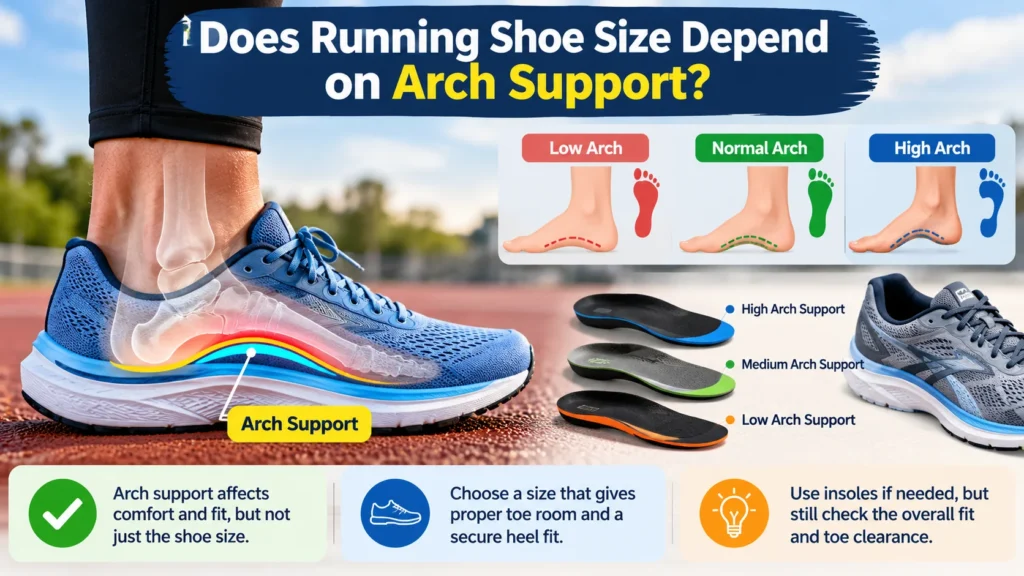
Arch support affects underfoot comfort and foot position, but it doesn’t determine how much toe clearance you need. The correct length should still allow natural movement.
Runners using supportive insoles should test them inside the intended shoes. An insole may change the available volume or how securely the heel sits.
For more context, explore whether running shoes need arch support.
Three Running Shoes Worth Comparing for Fit and Sizing
If you’re shopping for new running shoes, I would compare models with different width or toe-box options. The following three shoes illustrate useful alternatives rather than one-size-fits-all recommendations.
These are fit-oriented shopping suggestions based on published specifications, not personal wear-test results. The editorial suitability stars below aren’t customer-review averages.
🏆 Best for Multiple Width Options
Brooks Ghost 18
★★★★★ 5/5 editorial fit-option rating
The Ghost 18 combines balanced cushioning with narrow, standard, wide, and extra-wide options in selected versions. I would start here when comparing forefoot fit without automatically increasing shoe length.
👟 Best Wide-Fit Alternative
ASICS Gel-Cumulus 28 Wide
★★★★☆ 4/5 editorial fit-option rating
The Gel-Cumulus 28 offers neutral support, cushioned daily-running performance, and wide-fit versions. Its published 8 mm heel drop and width choices make it worth comparing when standard shoes squeeze your forefoot.
🦶 Best for a Roomier Toe Shape
Altra Torin 9
★★★★☆ 4/5 editorial fit-option rating
The Torin 9 uses Altra’s FootShape design for natural toe spreading and a zero-drop platform. I would compare it for toe-box shape, while allowing a gradual adjustment period if you’re unfamiliar with zero-drop shoes.
Frequently Asked Questions About Running Shoe Sizing
Should I buy running shoes half a size bigger than my normal shoes?
Many runners benefit from trying a half-size larger shoe, especially when their everyday footwear fits closely around the toes. However, your final size should provide approximately one thumb-width of front clearance, comfortable forefoot width, and secure heel movement. Don’t size up if your current size already fits correctly.
Is it okay to wear running shoes one full size bigger?
Yes, if the shoes genuinely fit your feet correctly. A full-size increase may work when comparing close-fitting dress shoes with running shoes, but it isn’t automatically necessary. Make sure your heels remain secure and your feet don’t slide excessively inside the shoes.
Should running shoes feel tight when you first buy them?
No. Running shoes should feel secure around the heel and midfoot without creating painful pressure. Your toes should have enough space to spread and move naturally. Don’t buy uncomfortably tight shoes expecting their length to stretch during the break-in period.
Should running shoes be bigger for long-distance running?
Long-distance running increases the importance of adequate toe room because feet can change volume during prolonged activity. Some runners may need a larger size than their casual footwear. However, the correct choice still depends on toe clearance, width, and heel security rather than distance alone.
Is it better for running shoes to be slightly big or slightly small?
Neither is ideal, but mild extra toe clearance is generally preferable to toes repeatedly hitting the front. The heel and midfoot must still remain secure. If one size feels cramped and the next slips excessively, try a different width, shape, or shoe model.
Final Verdict: Should Running Shoes Be a Size Bigger?
Running shoes often fit best about half a size larger than everyday shoes, but proper fit matters more than the number on the label.
Your ideal pair provides enough room for natural toe movement while keeping the heel and midfoot comfortably secure.
Before purchasing, remember these essentials:
- Start with your measured foot size and the brand’s chart.
- Look for approximately one thumb-width of toe clearance.
- Choose additional width when length is already sufficient.
- Try shoes later in the day with your running socks.
- Walk or jog before deciding which size fits best.
My final recommendation is to compare your regular size with the next half size, then let the fit decide. A running shoe should protect your toes without making the rest of your foot feel loose.
Ready to buy your next pair? Use the fit checklist above, compare available widths, and choose the shoe that feels comfortable from the first steps.


