

Quick Answer
The HOKA Mach 6 is the better running shoe for most runners because it costs $140 and handles daily training well. The $260 Nike Vaporfly 4 wins for competitive racing with its lightweight ZoomX foam and carbon fiber plate. Choose the Nike for race performance and the HOKA for everyday versatility.
Which running shoe fits your goals?
- Nike Vaporfly 4 wins for competitive road racing.
- HOKA Mach 6 saves $120 at reference retail prices.
- Mach 6 is more practical for regular training.
⚡ Quick Verdict — Nike Vaporfly 4 vs HOKA Mach 6
Nike Vaporfly 4
Editorial rating for overall versatility
$260 (reference retail price)
✅ Best for:
Competitive runners chasing personal records in road races.
HOKA Mach 6
Editorial rating for overall versatility
$140 (reference retail price)
✅ Best for:
Daily runners who want one shoe for training and faster workouts.
| Category | Vaporfly 4 | Mach 6 |
|---|---|---|
| Overall Winner | — | 🏆 |
| Best Value | — | ✅ |
| Competitive Racing | ✅ | — |
| Daily Training | — | ✅ |
| Lightweight Design | ✅ | — |
Bottom line: The Mach 6 wins for everyday runners seeking better value, while the Vaporfly 4 earns its premium price when competitive racing is your main goal.
- The HOKA Mach 6 wins overall because it handles more types of runs.
- The Mach 6 costs $120 less at reference retail prices.
- The Nike Vaporfly 4 is the stronger choice for competitive road racing.
- Beginners benefit more from the Mach 6’s non-plated design and lower price.
- The biggest difference is the Vaporfly 4’s carbon fiber plate and race-focused construction.
Buying a fast running shoe can get confusing when two models serve different goals. The Nike Vaporfly 4 and HOKA Mach 6 are perfect examples.
Both shoes offer responsive cushioning and a lightweight feel. However, one targets race performance while the other supports regular training.
The Nike Vaporfly 4 uses premium ZoomX foam and a carbon fiber plate. Its design helps runners maintain faster paces during road races.
The HOKA Mach 6 takes a more practical approach. It offers responsive supercritical foam without the stiffness of a carbon plate.
I’m Steven Tyler, and this comparison brings together manufacturer specifications and independent shoe testing. It does not claim that FootwearHiker personally completed a wear test.
This Nike Vaporfly 4 review explains how both shoes compare in speed, comfort, fit, durability, and value. It also identifies which shoe makes more sense for different running goals.
You do not always need the most expensive shoe to run faster. Sometimes, the shoe that supports consistent training delivers greater long-term value.
What Is the Nike Vaporfly 4 Designed to Do?
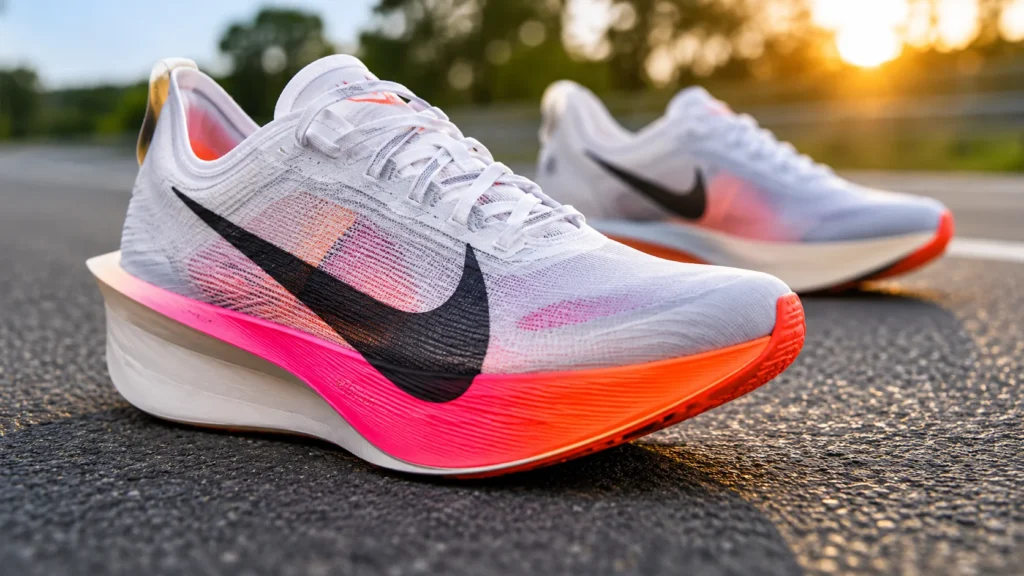
Quick Verdict: The Nike Vaporfly 4 is a premium carbon-plated racing shoe designed for fast road races and personal record attempts.
Ratings are editorial assessments based on intended use, design, published testing, and reference pricing.
Best for: Competitive road runners and experienced athletes.
Not ideal for: Budget buyers and runners seeking one everyday shoe.
Reference retail price: $260.
The Nike Vaporfly 4 focuses on efficient movement at faster running paces. Nike combines ZoomX foam with a full-length carbon fiber Flyplate.
ZoomX foam compresses under load and rebounds as the foot moves forward. The stiff plate changes how the shoe bends during each stride.
These features create a lightweight racing platform for sustained faster efforts. Independent laboratory testing from RunRepeat measured the shoe at just 166 grams.
The shoe also features a lightweight mesh upper that reduces unnecessary material. Its construction prioritizes racing rather than everyday protection and long-term training use.
The Vaporfly 4 has a manufacturer-stated 6 mm heel-to-toe drop. This measures the height difference between the heel and forefoot.
Compared with the previous Vaporfly 3, the newer model emphasizes lower weight and revised geometry. Some runners prefer this more direct racing feel, while others prefer deeper cushioning.
At $260, the Vaporfly 4 represents a significant investment. Its strongest appeal comes from dedicated racing rather than slow recovery miles.
✅ Nike Vaporfly 4 Pros
- Exceptionally lightweight construction.
- Responsive ZoomX racing foam.
- Full-length carbon fiber Flyplate.
- Designed for competitive road racing.
- Lightweight, breathable mesh upper.
- Fast turnover during harder efforts.
- Suitable for multiple road race distances.
❌ Nike Vaporfly 4 Cons
- High $260 reference retail price.
- Less practical for everyday training.
- Race-oriented fit can feel restrictive.
- Less accommodating for some wide feet.
- Not a dedicated stability shoe.
- Limited outsole coverage in some areas.
- Carbon plate may feel stiff at slow speeds.
Nike Vaporfly 4 Road Racing Shoes
Best use: Competitive road races and selected speed sessions.
Reference retail price: $260.
- ZoomX foam cushioning.
- Full-length carbon fiber Flyplate.
- Lightweight racing upper.
- 6 mm manufacturer-stated drop.
Check Nike Vaporfly 4 on Amazon
Affiliate search link. Check the exact model, size, seller, availability, and live price before buying.
What Is the HOKA Mach 6 Designed to Do?
Quick Verdict: The HOKA Mach 6 is a lightweight performance trainer that balances daily comfort, responsiveness, and affordable pricing.
Ratings are editorial assessments, not Amazon customer ratings or personal wear-test scores.
Best for: Daily training, tempo runs, and recreational road races.
Not ideal for: Runners seeking maximum cushioning or dedicated motion control.
Reference retail price: $140.
The HOKA Mach 6 serves runners who need speed without sacrificing everyday usability. It combines supercritical foam with a lightweight, non-plated design.
Unlike the Nike Vaporfly 4, the Mach 6 does not contain a carbon fiber plate. Its foam and sole geometry provide responsiveness without relying on a rigid plate.
This construction makes the shoe suitable for different running speeds. You can use it for easy morning runs and faster evening workouts.
Independent laboratory testing measured the Mach 6 at approximately 232 grams. That places it within a lightweight category for daily performance trainers.
The shoe uses a creel jacquard upper that balances structure and ventilation. Its streamlined shape can feel snug for runners with wider feet.
HOKA also adds strategic rubber coverage to the outsole. This represents an important practical improvement over the exposed foam design of the Mach 5.
The manufacturer lists a 5 mm heel-to-toe drop. Independent measurements can differ because laboratories use specific measurement procedures.
At $140, the Mach 6 offers a lower entry cost than premium racing shoes. It makes sense for runners who train several times each week.
✅ HOKA Mach 6 Pros
- Versatile daily training performance.
- Responsive supercritical foam.
- Lightweight construction.
- More affordable than the Vaporfly 4.
- Suitable for tempo sessions.
- Strategic rubber outsole coverage.
- Wide versions available in selected markets.
- No rigid carbon fiber plate.
❌ HOKA Mach 6 Cons
- Heavier than the Vaporfly 4.
- Less specialized for competitive racing.
- Standard width can feel narrow.
- Not designed for technical trails.
- Less plush than maximum-cushion shoes.
- Does not provide dedicated stability control.
HOKA Mach 6 Road Running Shoes
Best use: Daily running, tempo workouts, and recreational racing.
Reference retail price: $140.
- Responsive supercritical foam midsole.
- Lightweight non-plated construction.
- Creel jacquard mesh upper.
- 5 mm manufacturer-stated drop.
Affiliate search link. Product availability, seller, size, and prices can change.
How Do the Nike Vaporfly 4 and HOKA Mach 6 Specifications Compare?
The Nike Vaporfly 4 wins on race-focused construction and low weight. The HOKA Mach 6 offers a more affordable and versatile training platform.
The following table highlights the main technical differences. It separates independent laboratory weights from manufacturer-stated heel-to-toe drops.
| Specification | Nike Vaporfly 4 | HOKA Mach 6 |
|---|---|---|
| Brand | Nike | HOKA |
| Model | Vaporfly 4 | Mach 6 |
| Category | Road racing | Daily performance training |
| Reference Retail Price | $260 | $140 |
| Lab Weight | 166 g / 5.9 oz | 232 g / 8.2 oz |
| Midsole Foam | Nike ZoomX | Supercritical foam |
| Carbon Fiber Plate | Full-length Flyplate | None |
| Manufacturer Drop | 6 mm | 5 mm |
| Upper | Engineered mesh | Creel jacquard |
| Outsole | Lightweight rubber coverage | Strategic rubber coverage |
| Support Type | Neutral | Neutral |
| Running Surface | Road | Road |
| Daily Training | Limited suitability | Excellent suitability |
| Tempo Runs | Excellent | Excellent |
| Competitive Racing | Primary purpose | Secondary purpose |
| Wide Fit Options | Limited | Selected wide versions |
| Ideal Buyer | Competitive racer | Everyday performance runner |
Weights refer to independently tested samples and can vary by shoe size. Reference prices do not represent verified live Amazon offers.
The Vaporfly 4 weighs 66 grams less than the Mach 6 in the cited laboratory measurements. That difference matters most when runners prioritize low weight during repeated fast strides.
However, lower weight does not automatically improve every running experience. Training shoes need enough material to withstand regular use and provide dependable comfort.
Which Running Shoe Is Faster: Nike Vaporfly 4 or HOKA Mach 6?
The Nike Vaporfly 4 is the stronger choice for competitive racing. Its lighter build, carbon fiber plate, and ZoomX foam target faster road running.
The HOKA Mach 6 remains a capable speed training shoe. However, its main strength comes from balancing speed with everyday versatility.
How Does the Carbon Fiber Plate Affect Speed?
The Vaporfly 4’s carbon fiber plate increases longitudinal stiffness and influences how the shoe moves through each stride.
The plate works together with the foam and sole geometry. These features can improve running economy for some runners.
Running economy describes the energy your body needs to maintain a certain pace. Better economy can help a runner sustain a given effort.
However, a carbon plate does not guarantee faster race times. Individual mechanics, fitness, fit, and running speed influence the actual benefit.
Which Shoe Works Better for Tempo Runs?
The HOKA Mach 6 is the more practical choice for regular tempo sessions. It delivers responsive cushioning without using an expensive racing plate.
Tempo runs involve sustained efforts that are harder than easy runs. A shoe must feel controlled and comfortable during these workouts.
The Vaporfly 4 works well for selected race-pace sessions. Using it occasionally can help runners become familiar with their race-day footwear.
For frequent weekly workouts, the Mach 6 provides better overall value.
Which Shoe Is Better for 5K and 10K Races?
The Nike Vaporfly 4 is the better performance-focused option for competitive 5K and 10K road races.
Its low weight and stiff racing construction suit sustained faster efforts. The Mach 6 remains a reasonable option for recreational runners.
A runner completing a first 5K does not need a carbon-plated shoe. Comfortable footwear and appropriate training matter more than premium race technology alone.
Choose the Vaporfly 4 for competitive racing. Choose the Mach 6 for repeatable speed training at a lower ownership cost.
Which Shoe Offers Better Comfort, Fit, and Stability?
The HOKA Mach 6 offers better everyday comfort for most runners. Its non-plated design makes it more adaptable across different running speeds.
The Vaporfly 4 can feel comfortable during racing. However, its focused construction does not suit every runner or every pace.
Which Shoe Has Better Cushioning?
The Vaporfly 4 provides race-focused cushioning through its ZoomX midsole. The Mach 6 delivers responsive cushioning designed for repeated training sessions.
Both shoes balance cushioning with a fast ride. Neither model necessarily delivers the plushest experience for slow recovery runs.
Runners who prefer deeper and softer cushioning should consider other models. The HOKA Bondi and Nike Vomero product lines provide useful starting points.
Which Running Shoe Fits Wider Feet?
The HOKA Mach 6 is the better starting point for wider feet because selected versions offer wide sizing.
Its standard version can still feel narrow through parts of the shoe. Runners should not assume that every HOKA model has a spacious fit.
The Vaporfly 4 uses a snug race-oriented upper. This fit helps hold the foot during fast running.
However, runners with broad forefeet should check for pressure around the toes. A tight racing shoe can become uncomfortable as feet expand during longer runs.
Which Shoe Provides Better Stability?
The HOKA Mach 6 is generally the more practical platform for varied daily paces. Neither model provides dedicated motion-control support.
The Vaporfly 4 uses a lightweight race geometry that may feel less secure for some runners. Heel strikers and runners who need additional support should assess the fit carefully.
Runners with ongoing discomfort should seek suitable footwear guidance rather than relying on a carbon plate for stability.
The Mach 6 provides a more adaptable ride for regular runs, provided its fit matches your foot shape.
Which Running Shoe Offers Better Value for Money?
The HOKA Mach 6 wins on value because it costs $120 less at reference retail prices. It also covers more types of everyday running.
The Nike Vaporfly 4 costs $260 compared with $140 for the Mach 6. That makes the Nike approximately 86% more expensive.
The higher price reflects the Vaporfly’s specialized racing construction. It does not mean every runner receives 86% more performance.
How Does Cost Per Mile Compare?
The Mach 6 generally makes more financial sense for frequent training. Its lower purchase price reduces the cost of building a running shoe rotation.
The table below uses hypothetical mileage scenarios to illustrate ownership costs. These figures are examples, not verified shoe lifespan estimates.
| Illustrative Mileage | Vaporfly 4 | Mach 6 |
|---|---|---|
| 200 miles | $1.30/mile | $0.70/mile |
| 300 miles | $0.87/mile | $0.47/mile |
| 400 miles | $0.65/mile | $0.35/mile |
Actual shoe life depends on running mechanics, body weight, surfaces, and usage. Racing performance can decline before a shoe shows major visible damage.
Can the Mach 6 Replace an Expensive Racing Shoe?
Yes, the HOKA Mach 6 can serve as both a training and racing shoe for recreational runners.
Its lightweight design and responsive cushioning support harder efforts. This makes it a practical choice for runners who prefer owning fewer shoes.
Competitive athletes with specific time goals may still benefit from dedicated racing footwear. Those runners should evaluate the Vaporfly 4 during suitable training sessions before racing.
The Mach 6 offers greater training flexibility and a $120 lower reference purchase price.
Which Running Shoe Is More Durable?
The HOKA Mach 6 is the more practical choice for regular training mileage. Its construction balances low weight with outsole protection and everyday use.
The Vaporfly 4 prioritizes racing performance. Its lightweight design reduces unnecessary materials that could add weight.
How Do Their Outsoles Compare?
The Mach 6 uses strategically placed rubber to protect important contact areas. This design helps separate it from the previous Mach 5.
The Vaporfly 4 also uses rubber in selected outsole areas. Its coverage reflects the need to reduce weight for competition.
Both shoes can show different wear patterns based on foot strike. A runner who lands heavily on the heel may wear specific rubber areas faster.
Which Shoe Handles Wet Roads Better?
Neither shoe guarantees secure grip on every wet surface. Road texture, weather, outsole wear, and running mechanics all affect traction.
Reduce speed on painted road markings, metal covers, wet leaves, and smooth tiles. These surfaces can become slippery even with quality running shoes.
The Mach 6 remains a practical daily option during changing weather. However, runners should assess traction rather than treating either model as slip-proof.
Which Running Shoe Works Better in Cold Weather?
The Mach 6 is the more practical general-purpose choice for regular winter road training. Neither shoe provides dedicated insulation or waterproof protection.
Cold temperatures can change how running shoe foams respond under load. Both models may feel different compared with their ride in warm conditions.
Use suitable running socks and avoid icy routes when grip becomes unreliable. Dedicated winter running shoes may work better on snow or ice.
Neither shoe guarantees injury prevention. Introduce carbon-plated shoes gradually and stop running if you experience persistent or worsening pain.
The Mach 6 is designed for regular training, while the Vaporfly 4 makes more sense when reserved for performance-focused efforts.
Which Shoe Works Best for Different Types of Runs?
The Nike Vaporfly 4 wins for competitive races, while the HOKA Mach 6 wins for most training situations. Your running schedule determines which purchase makes more sense.
| Running Situation | Recommended Shoe | Reason |
|---|---|---|
| Daily 5K training | HOKA Mach 6 | Versatile and affordable |
| Competitive 5K race | Nike Vaporfly 4 | Lightweight racing design |
| Weekly tempo runs | HOKA Mach 6 | Responsive non-plated ride |
| Competitive half marathon | Nike Vaporfly 4 | Race-focused foam and plate |
| First marathon on a budget | HOKA Mach 6 | Lower price and training flexibility |
| Marathon personal record attempt | Nike Vaporfly 4 | Dedicated racing construction |
| Cold-weather road training | HOKA Mach 6 | Practical everyday use |
| Group fitness running sessions | HOKA Mach 6 | Suitable for varied training paces |
Which Shoe Is Better for Beginners?
The HOKA Mach 6 is the better option for most beginners comparing these two models.
New runners benefit from comfortable shoes that support consistent training. The Mach 6 handles different paces without requiring a dedicated race-day shoe.
Beginners who prefer a softer or more stable platform should explore other daily trainers. Fit remains more important than a shoe’s popularity.
Which Shoe Is Better for Marathon Running?
The Nike Vaporfly 4 is the stronger performance-focused marathon option for runners who tolerate its geometry and cushioning.
However, marathon comfort depends on individual preferences over long distances. Some runners may prefer a shoe with more cushioning or a wider platform.
The Mach 6 can also handle marathon distances when its fit and ride suit the runner. Always complete appropriate long training runs before choosing race-day footwear.
Can You Use Both Shoes in a Running Rotation?
Yes, the Vaporfly 4 and Mach 6 can complement each other in a two-shoe rotation.
Use the Mach 6 for most weekly mileage, including easy and tempo runs. Reserve the Vaporfly 4 for selected race-pace workouts and important events.
This arrangement helps preserve the racing shoe for the sessions where its specialized design matters most.
- Monday: Rest or cross-training.
- Tuesday: Easy run in the Mach 6.
- Wednesday: Tempo workout in the Mach 6.
- Thursday: Rest or recovery.
- Friday: Selected race-pace workout in the Vaporfly 4.
- Saturday: Easy run in the Mach 6.
- Sunday: Comfortable long run in the Mach 6.
This example illustrates footwear selection, not a personalized training prescription.
Is the Nike Vaporfly 4 Worth the Extra $120?
The Nike Vaporfly 4 is worth the extra $120 for runners who prioritize competitive road racing. Most everyday runners receive better value from the Mach 6.
The additional money pays for specialized foam, a carbon fiber plate, and lightweight construction. Those features have greater relevance during performance-focused efforts.
If you run three times each week for general fitness, premium racing technology may offer limited practical value. The Mach 6 already provides a responsive ride for varied workouts.
Competitive runners face a different decision. They may value small performance advantages when preparing for an important race.
Consider how often you will use the Vaporfly 4 for its intended purpose. A shoe reserved for several races each season serves a different role from a daily trainer.
Compare sale prices before making your decision. Older colorways and previous-generation models can reduce the cost of premium racing shoes.
Who Should Buy the Nike Vaporfly 4 or HOKA Mach 6?
Buy the Nike Vaporfly 4 if your main goal is competitive racing. Buy the HOKA Mach 6 if you need one shoe for regular training and occasional races.
Buy the Nike Vaporfly 4 If:
- You compete in road races.
- You want a lightweight carbon-plated shoe.
- You are chasing a personal record.
- You already own suitable training shoes.
- You enjoy a stiff, responsive racing ride.
Skip It If:
- You need an affordable daily trainer.
- You prefer flexible running shoes.
- You need extra stability or a wide fit.
- You rarely perform race-focused workouts.
Buy the HOKA Mach 6 If:
- You run several times each week.
- You want one versatile running shoe.
- You enjoy easy runs and tempo sessions.
- You want to spend less than premium racing prices.
- You prefer a non-plated running shoe.
Skip It If:
- You want dedicated carbon-plated racing technology.
- You need maximum soft cushioning.
- You require motion-control support.
- You mainly run on technical trails.
When Should You Avoid Both Shoes?
Neither model is an ideal choice for every runner. Consider alternative shoes when your needs fall outside neutral road running.
- Maximum cushioning: Consider the HOKA Bondi or Nike Vomero series.
- Dedicated stability: Consider the HOKA Arahi or ASICS GEL-KAYANO series.
- Technical trails: Consider the HOKA Speedgoat or Nike Zegama series.
- Premium marathon alternatives: Consider the Nike Alphafly or HOKA Rocket X series.
Choose shoes based on comfort, running surface, support needs, and intended use.
What Are Real Runners Saying About Both Products?
Independent reviews generally highlight the Vaporfly 4’s lightweight racing performance and the Mach 6’s versatility. Fit and ride preferences remain important limitations for both models.
The following summaries reflect published shoe evaluations rather than invented Amazon customer testimonials. Direct Amazon review access was unavailable during research.
Nike Vaporfly 4 Review Themes
Common Strengths
- Exceptionally low measured weight.
- Purpose-built racing construction.
- Responsive performance during faster efforts.
- Refined racing geometry.
Reported Limitations
- High purchase price.
- Limited everyday versatility.
- Fit and stability concerns for some runners.
- Less appeal for runners seeking plush cushioning.
Research basis: RunRepeat and RTINGS independent evaluations.
HOKA Mach 6 Review Themes
Common Strengths
- Lightweight daily training design.
- Responsive supercritical foam.
- Useful performance across different paces.
- Competitive reference retail price.
Reported Limitations
- Potentially snug standard-width fit.
- Less specialized for elite racing.
- Not the softest recovery shoe.
- Limited suitability for technical terrain.
Research basis: RunRepeat, RTINGS, and Believe in the Run.
The important lesson is that shoe reviews reflect different runners and preferences. A lightweight shoe that suits one athlete may feel uncomfortable to another.
Check reviews from runners with similar foot shapes and training goals. Their experiences can provide more useful context than a single overall score.
How Should You Clean and Maintain These Running Shoes?
Clean both shoes gently by hand and allow them to dry naturally. Avoid washing machines, strong chemicals, and high heat that can damage shoe materials.
Regular care helps maintain the upper, foam, outsole, and overall fit. The Vaporfly 4 also benefits from reserving its specialized construction for appropriate sessions.
How Should You Clean the Nike Vaporfly 4?
Use a soft brush, mild soap, and a damp cloth to clean the Vaporfly 4. Avoid fully soaking its lightweight upper and midsole.
- Remove loose dirt using a soft brush.
- Prepare a small amount of mild soapy water.
- Wipe the upper gently with a damp cloth.
- Clean rubber contact areas carefully.
- Remove remaining soap with a clean damp cloth.
- Allow the shoes to air-dry indoors.
Do not use a hair dryer or place the shoes near a heater. Excessive heat can damage foam, adhesives, and upper materials.
How Should You Clean the HOKA Mach 6?
Clean the Mach 6 with a soft brush and mild cleaning solution. Focus on removing dirt from the mesh and outsole grooves.
Remove the insoles when appropriate and allow them to dry separately. Avoid pulling out insoles that the manufacturer permanently attaches.
Keep the shoes in a dry, ventilated area between runs. This reduces moisture buildup and helps control unwanted odors.
How Can You Make Both Shoes Last Longer?
Match each shoe to its intended running surface and purpose. Avoid using lightweight road running shoes for demanding technical trails.
- Rotate shoes when frequent training leaves them damp.
- Avoid unnecessary exposure to extreme heat.
- Store shoes away from direct sunlight.
- Remove dirt before it builds up in the outsole.
- Untie laces before taking shoes off.
- Inspect the upper, midsole, and outsole regularly.
- Reserve racing shoes for performance-focused sessions.
When Should You Replace Your Running Shoes?
Replace running shoes when their structure, comfort, grip, or performance no longer meets your needs. Mileage alone cannot determine the exact replacement point.
Look for uneven wear, damaged uppers, reduced grip, or unusual midsole compression. Racing shoes may lose their preferred performance feel before major visible damage develops.
Inspect both shoes regularly and compare how they feel during familiar runs. Persistent discomfort deserves attention rather than simply increasing running mileage.
What Buying Mistakes Should You Avoid?
The biggest mistake is buying the Vaporfly 4 simply because it costs more. Premium racing technology does not automatically make a shoe better for daily training.
Another common mistake involves choosing a shoe without checking its fit. Both models can feel different across foot shapes and sizes.
- Ignoring intended use: Match racing shoes to races and training shoes to regular mileage.
- Buying the wrong size: Check toe space and heel security before running.
- Overlooking width: Standard-width shoes do not suit every foot.
- Expecting guaranteed speed gains: Carbon plates do not improve every runner’s performance.
- Ignoring sale prices: Compare current offers against reference retail prices.
- Racing in new shoes: Complete suitable training sessions before race day.
- Ignoring return policies: Confirm seller conditions before purchasing.
A well-fitting shoe that supports regular running often offers greater value than an unsuitable premium model.
How Was This Nike Vaporfly 4 vs HOKA Mach 6 Comparison Researched?

This comparison uses manufacturer specifications, published laboratory measurements, and independent running shoe evaluations. It does not claim original hands-on testing by FootwearHiker.
The research prioritizes measurable differences such as shoe weight, drop, foam construction, plate technology, and reference retail prices.
Independent measurements provide additional context because official weights and laboratory weights can differ. Shoe size and testing procedures influence those results.
What Research Sources Were Used?
- Nike Vaporfly 4 official product information — manufacturer design and technical specifications.
- HOKA Mach 6 product specifications — retail pricing and intended use.
- RunRepeat Nike Vaporfly 4 laboratory review — measured construction, weight, and performance characteristics.
- RunRepeat HOKA Mach 6 laboratory review — independent measurements and design analysis.
- RTINGS Nike Vaporfly 4 review — independent performance evaluation.
- RTINGS HOKA Mach 6 review — use-case suitability and construction analysis.
The editorial ratings in this article reflect overall versatility, intended use, design, and reference pricing. They do not represent verified Amazon ratings or original laboratory scores.
Product recommendations remain independent of affiliate commission rates. Live prices, availability, and seller information should be checked before purchase.
Final Verdict: Nike Vaporfly 4 or HOKA Mach 6?
The HOKA Mach 6 is the overall winner for most everyday runners. The Nike Vaporfly 4 is the better choice for runners focused on competitive road racing.
The Mach 6 combines responsive cushioning with a lightweight, non-plated construction. Its $140 reference retail price makes it easier to justify for regular training.
The Vaporfly 4 offers a specialized racing experience with ZoomX foam and a carbon fiber plate. Its $260 reference price makes more sense for dedicated performance goals.
If you only want one pair of running shoes, the Mach 6 is the more practical option. If you already have a daily trainer, the Vaporfly 4 can add a dedicated racing option.
The best purchase depends on how you spend most of your running time. Buy the shoe that supports your actual routine rather than your occasional ambitions.
Our Final Running Shoe Recommendations
Nike Vaporfly 4
Best for Competitive Racing
$260
Premium ZoomX foam and carbon-plated racing construction.
🏆 EDITOR’S CHOICE
HOKA Mach 6
Best Overall Value
$140
Responsive cushioning and versatile everyday running performance.
Displayed prices are reference retail prices. Amazon prices and availability may vary.
Frequently Asked Questions
1. Is the Nike Vaporfly 4 better than the HOKA Mach 6?
The Nike Vaporfly 4 is better for competitive road racing. Its ZoomX foam, carbon fiber plate, and low weight support performance-focused running. The HOKA Mach 6 is better for everyday training, versatility, and affordability.
2. Can I use the Nike Vaporfly 4 for daily running?
Yes, you can use the Nike Vaporfly 4 for daily running if its fit and ride suit you. However, its high price and race-focused construction make it less practical than a dedicated daily trainer. Reserving it for selected faster sessions often makes more financial sense.
3. Is the HOKA Mach 6 good for marathon running?
Yes, the HOKA Mach 6 can work for marathon running when it provides enough comfort and support for your needs. Its responsive foam and lightweight construction make it suitable for sustained road efforts. Test it during appropriate long runs before race day.
4. Does the Nike Vaporfly 4 have a carbon fiber plate?
Yes, the Nike Vaporfly 4 contains a full-length carbon fiber Flyplate. The plate works with ZoomX foam and shoe geometry to create a race-focused ride. The HOKA Mach 6 does not contain a carbon fiber plate.
5. Which shoe is better for beginner runners?
The HOKA Mach 6 is the better choice for most beginners comparing these models. It costs less and handles a wider range of training sessions. Beginners should prioritize comfortable fit and consistent training rather than expensive racing technology.
Affiliate Disclosure: As an Amazon Associate, FootwearHiker earns from qualifying purchases. This article contains affiliate links. We may receive a commission if you purchase through these links, at no additional cost to you. Recommendations are based on product research, intended use, and comparative value.


