

Quick Answer
A carbon-plated running shoe is a performance running shoe with a stiff carbon-fiber plate embedded inside its cushioned midsole. The plate works with responsive foam and curved shoe geometry to help runners move efficiently, especially at faster speeds. A 2026 systematic review of carbon-plated footwear found average metabolic-demand reductions of approximately 2–3%, although individual results vary.
Five Things to Know
- Carbon plate: Increases the shoe’s lengthwise stiffness and influences how your foot rolls forward.
- Responsive foam: Compresses and rebounds, helping reduce energy losses.
- Primary purpose: Supports efficient running during races and faster workouts.
- Best users: Runners seeking race performance who find the shoe comfortable and stable.
- Main limitation: Higher prices, specialized designs, and less versatility than everyday trainers.
Before Buying
- Check your fit: Test the shoe at your usual running pace and intended race pace.
- Keep perspective: A carbon plate cannot replace training, recovery, or comfortable footwear.
Carbon-plated running shoes have changed how many runners approach race day. Their unusual combination of cushioning, stiffness, and lightweight construction can make ordinary running shoes feel surprisingly different.
But does a carbon plate make you faster, and should you buy one? I’ll explain the technology, research, advantages, drawbacks, and practical buying considerations.
What Is a Carbon-Plated Running Shoe?
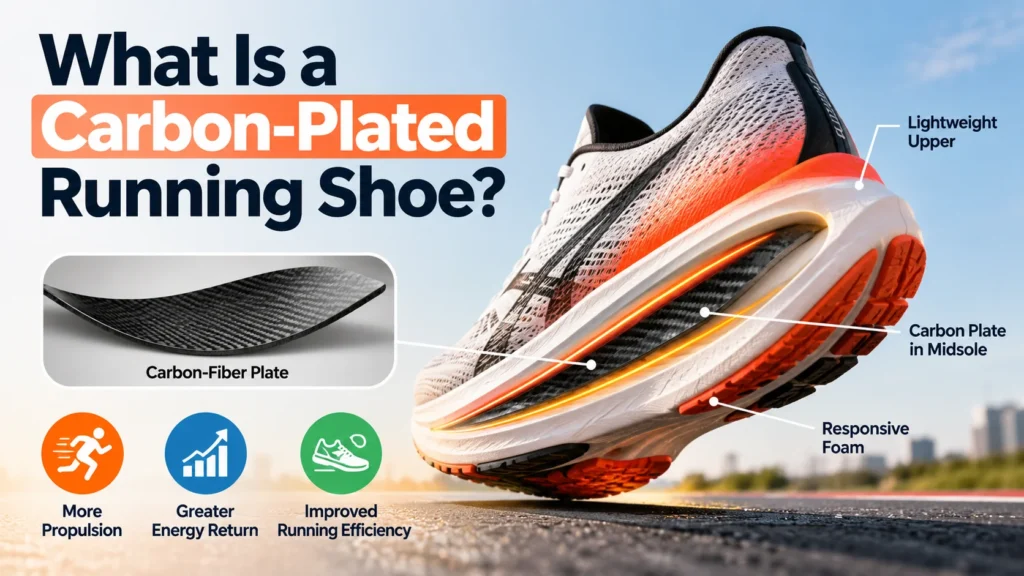
A carbon-plated running shoe contains a carbon-fiber plate within its midsole. Manufacturers combine this stiff component with specialized cushioning to influence the way the shoe bends and rolls during running.
The plate usually extends through much of the shoe’s length. However, its shape, thickness, placement, and stiffness vary between models.
Simple definition: A carbon-plated running shoe is footwear engineered to combine a stiff internal plate, responsive cushioning, and efficient forward movement.
What Is the Carbon Plate Made Of?
Carbon-fiber plates generally use carbon fibers held within a resin-based composite structure. The resulting material can be lightweight and highly resistant to bending.
Manufacturers can adjust the plate’s stiffness by changing its construction. A curved plate can also behave differently from a flatter design.
Where Is the Carbon Plate Located?
The plate sits inside the midsole, between cushioning layers or within a specially shaped foam structure. Its exact position affects how the surrounding foam compresses.
It isn’t normally a removable insert. The plate forms part of the shoe’s integrated design.
What Makes a Carbon-Plated Shoe Different?
- Higher bending stiffness: The sole resists bending more than many conventional training shoes.
- High-rebound foam: Lightweight materials help reduce energy lost during compression.
- Rocker geometry: A curved sole promotes smoother forward rolling.
- Race-focused construction: Lightweight uppers and carefully placed outsole rubber reduce unnecessary weight.
- Specialized fit: Some models prioritize secure racing performance over relaxed everyday comfort.
The complete design matters more than the plate alone. Two carbon-plated shoes can feel completely different.
How Do Carbon-Plated Running Shoes Work?
Carbon-plated shoes work through the interaction of plate stiffness, foam properties, and sole geometry. Together, these features can reduce the energy required to maintain a particular running speed.
The shoe doesn’t create energy or run for you. It changes how forces move through the shoe during each stride.
1. The Plate Changes How the Shoe Bends
Traditional running shoes usually allow more bending beneath the forefoot. Carbon plates increase longitudinal bending stiffness, meaning the shoe resists bending along its length.
This can influence movement around the toe joints and change the mechanical demands of running. The ideal stiffness depends on the runner and shoe design.
2. Responsive Foam Compresses and Rebounds
Modern racing shoes commonly use lightweight, responsive midsole foams. These materials compress under pressure and rebound as the foot moves forward.
Some racing foams use PEBA-based materials rather than conventional EVA formulations. Foam chemistry, density, and construction influence how much energy returns.
3. Rocker Geometry Encourages Forward Movement
A rocker is a curved sole shape designed to guide the foot through its forward movement. Combined with a stiff plate, it can create a rolling sensation.
This sensation is sometimes described as propulsion. It isn’t a motor-like push, but a consequence of the shoe’s geometry and your running movement.
4. Lightweight Construction Limits Extra Effort
Every additional gram adds weight the runner must repeatedly accelerate. Manufacturers therefore try to balance cushioning, traction, durability, and weight.
That balance matters. A stiff plate inside an unnecessarily heavy or poorly designed shoe may not deliver the expected efficiency benefit.
Do Carbon-Plated Running Shoes Actually Make You Faster?
Carbon-plated running shoes can improve running economy, but they don’t guarantee faster race times. Running economy describes the energy required to maintain a given running speed.
A 2026 systematic review and meta-analysis reported an average metabolic-demand reduction of approximately 2.75% across its measured outcomes.
However, most studies examined complete shoe designs. Researchers couldn’t attribute every improvement exclusively to the carbon plate.
What Does a 3% Improvement in Running Economy Mean?
A 3% running-economy improvement means using approximately 3% less energy at the same speed under comparable testing conditions. It does not mean automatically finishing a race 3% faster.
Your performance still depends on fitness, pacing, course conditions, fatigue, and individual biomechanics. A comfortable shoe may outperform a theoretically faster shoe that doesn’t suit your feet.
Does Running Speed Affect the Benefit?
Yes, speed can influence how a plated shoe performs. Plate stiffness, foam compression, and stride mechanics interact differently across running speeds.
Some runners benefit at moderate speeds. Others experience greater advantages during faster running, while certain models may feel awkward at slower paces.
Can Recreational Runners Benefit?
Yes. Carbon-plated technology isn’t exclusively for elite runners, and some recreational runners show measurable improvements.
Nevertheless, the benefit isn’t universal. I would prioritize a comfortable, stable fit before choosing a shoe because of its claimed performance advantage.
Carbon Plate vs. Nylon Plate vs. Regular Running Shoes: What’s the Difference?
Carbon, nylon, and unplated running shoes offer different combinations of stiffness, flexibility, and intended use. Neither plate material alone determines overall shoe quality.
| Feature | Carbon Plate | Nylon Plate | No Plate |
|---|---|---|---|
| Typical stiffness | High | Moderate to high | Depends on shoe construction |
| Flexibility | Usually relatively rigid | Often more flexible | Often more adaptable |
| Common purpose | Racing and fast workouts | Tempo runs and speed training | Daily running and varied training |
| Specific example | Saucony Endorphin Pro 4 | Saucony Endorphin Speed 4 | Nike Pegasus 41 |
| Main trade-off | Price and specialization | Less rigid racing feel | May lack plated-racing efficiency |
These are general category tendencies, not universal rules. Foam, plate geometry, and construction can make individual models behave differently.
Is a Carbon Plate Better Than a Nylon Plate?
Carbon plates generally suit race-focused designs requiring greater stiffness. Nylon plates can provide a more flexible feeling that some runners prefer for frequent speed training.
Neither material guarantees better running economy. The complete shoe must match your running mechanics.
Are Carbon Shoes Better Than Regular Running Shoes?
Carbon-plated shoes may offer better running economy during racing. Regular training shoes often provide greater versatility for easy running, recovery, and everyday mileage.
For many runners, the most practical solution is using different shoes for different workouts.
Who Should Wear Carbon-Plated Running Shoes?
Carbon-plated shoes are worth considering when improving race performance is a meaningful goal. They can suit runners across several experience levels, provided the design feels comfortable and predictable.
Who Is Most Likely to Benefit?
- Road racers: Runners preparing for 5K, 10K, half-marathon, or marathon events.
- Experienced recreational runners: People looking for an efficient race-day option.
- Tempo runners: Athletes doing structured workouts near their faster training speeds.
- Personal-best seekers: Runners interested in exploring equipment-related performance gains.
- Comfortable plated-shoe users: Anyone whose mechanics and fit work well with the shoe.
Who Might Prefer Regular Running Shoes?
Some runners may be better served by traditional daily trainers. This is especially true when comfort, affordability, or stability matters more than racing efficiency.
- Beginners primarily building consistent running habits.
- Runners who prefer flexible, predictable cushioning.
- People who experience instability in high-stack racing shoes.
- Anyone recovering from an injury who has not established a comfortable return-to-running plan.
- Runners who mainly exercise through relaxed jogging or walking.
If your priority is extra guidance rather than race speed, compare neutral vs. stability running shoes before choosing a specialized racing model.
Are Carbon-Plated Running Shoes Good for Beginners?
Beginners can wear carbon-plated running shoes, but they rarely need them to start running. A comfortable daily trainer is generally a more versatile first purchase.
New runners benefit most from consistent training and manageable progression. Buying advanced footwear doesn’t remove the need to build strength and endurance.
When Might a Beginner Consider Carbon Shoes?
- They already run comfortably and want to prepare for a race.
- They can test the shoes before purchasing.
- The shoe fits without excessive pressure or instability.
- The purchase fits their budget without replacing essential training footwear.
I would treat a carbon-plated shoe as optional equipment rather than a requirement. Your regular running shoes should still feel comfortable.
Can You Use Carbon-Plated Running Shoes Every Day?
You can use carbon-plated shoes for daily training, but race-focused models aren’t always the most practical choice. Their construction often prioritizes performance rather than maximum everyday versatility.
Some runners comfortably use plated models for frequent workouts. Others reserve them for races and demanding training sessions.
Why Do Runners Rotate Their Shoes?
- Different training needs: Easy runs and racing don’t require identical footwear.
- Cost management: Using daily trainers can reduce wear on expensive racing models.
- Ride variety: Different shoe designs change the sensations and mechanical demands of running.
- Comfort: A flexible trainer may feel more natural at slower speeds.
Rotating footwear isn’t guaranteed to prevent injury. However, it gives you flexibility when choosing shoes for different sessions.
Are Carbon-Plated Running Shoes Safe?
Carbon-plated running shoes are not inherently unsafe. However, their stiffness, cushioning height, and geometry can change how your legs and feet experience running forces.
Research hasn’t established that these shoes universally increase or decrease injury rates. Individual responses and longer-term effects remain important areas of study.
What Potential Problems Should You Watch For?
- Unstable landings: Tall or narrow platforms may feel less secure.
- Calf discomfort: A different shoe design may change lower-leg demands.
- Forefoot pressure: Stiffness or poor fit may create uncomfortable contact.
- Heel slipping: Lightweight racing uppers may fit differently from training shoes.
- Sudden workload changes: Running farther or faster too quickly can increase injury risk regardless of footwear.
Introduce unfamiliar shoes gradually, and stop if they cause persistent or worsening pain. Seek professional assessment for significant symptoms rather than assuming a different plate will solve them.
How Do You Choose Your First Carbon-Plated Running Shoe?
Start with comfort, fit, and intended use. A prestigious racing model offers little value if its shape doesn’t work for your feet.
Step 1: Choose Your Main Running Goal
Decide whether you need the shoe for short races, half-marathons, marathons, or occasional speed workouts. This helps narrow the selection.
Some models prioritize an aggressive racing sensation. Others provide a smoother experience for longer distances.
Step 2: Check Your Toe Room
Your toes should have space to move without hitting the front during running. The heel should stay secure during acceleration.
Use our running shoe toe-room guide to evaluate front-foot clearance before buying.
Step 3: Confirm the Correct Width
A tight midfoot or narrow forefoot can make an otherwise efficient shoe uncomfortable. Don’t assume your usual size fits every racing model.
Check the correct running shoe width and compare the shape with your current comfortable pair.
Step 4: Evaluate Stability
Stand, walk, and jog in the shoe when possible. Notice whether the platform feels predictable during turns and changes in pace.
Higher cushioning doesn’t always mean greater stability. Platform width and foam softness also influence the experience.
Step 5: Compare Heel-to-Toe Drop
Heel-to-toe drop is the height difference between the heel and forefoot. It can influence running feel and loading patterns.
For example, the Nike Vaporfly 4 has a manufacturer-listed 6 mm drop, while the Saucony Endorphin Pro 4 has an 8 mm drop.
Step 6: Think About Your Support Needs
Carbon plates aren’t the same as arch supports. A shoe can include advanced racing technology without offering the support you prefer.
Our guide on arch support in running shoes explains why comfort and individual needs matter more than labels.
Step 7: Test the Shoes Gradually
- Wear the shoes briefly indoors to check pressure points.
- Try a short, comfortable run if the fit feels secure.
- Introduce a limited amount of faster running.
- Evaluate comfort during the run and afterward.
- Increase use gradually when the shoes feel comfortable.
- Avoid making an important race your first running test.
My preferred buying rule is simple: fit first, function second, marketing last. The most expensive pair isn’t automatically your best racing shoe.
Which Carbon-Plated Running Shoe Features Matter Most?
Four features deserve particular attention: plate design, midsole foam, heel-to-toe drop, and fit. Shoe weight and outsole construction also affect the overall experience.
Examples of Real Carbon-Plated Running Shoes
- Nike Vaporfly 4: Uses a full-length carbon-fiber Flyplate and ZoomX foam. Nike lists a 6 mm drop and approximately 190 g for a men’s US size 10. See Nike’s Vaporfly 4 technology announcement.
- Saucony Endorphin Pro 4: Combines a full carbon plate with PWRRUN HG and PWRRUN PB foams. It features an 8 mm drop and SPEEDROLL geometry, according to Saucony’s Endorphin Pro 4 specifications.
- ASICS Metaspeed Sky Tokyo: Combines a full-length carbon plate with FF LEAP and FF TURBO PLUS cushioning. The official ASICS Metaspeed collection describes it as designed for stride-length-oriented runners.
These specifications describe actual design differences, not guaranteed performance rankings. The same model can feel different across runners.
Are Carbon-Plated Running Shoes Legal for Racing?
Yes. Carbon-plated running shoes are permitted in road racing when they comply with the applicable competition rules.
For relevant World Athletics road competitions, the regulations include a maximum sole thickness of 40 mm and restrictions on embedded rigid plates.
You can review the current requirements in the World Athletics official rule documents. The 2026 athletic shoe regulations took effect on April 20, 2026.
Check the specific shoe’s approval status before entering a competition where footwear regulations apply. Track, road, and other disciplines may have different requirements.
How Long Do Carbon-Plated Running Shoes Last?
Carbon-plated shoe lifespan depends on foam construction, outsole durability, running surface, usage, and individual mechanics. There is no universal mileage at which every carbon-plated shoe stops working.
A shoe may remain usable after its original racing feel changes. The carbon plate itself isn’t necessarily the first component to show meaningful wear.
Signs Your Racing Shoes May Need Replacing
- The outsole has worn through in important contact areas.
- The foam feels noticeably less responsive than before.
- The shoe becomes unstable or uneven.
- The upper no longer holds your foot securely.
- You experience persistent discomfort associated with the worn pair.
Track the shoe’s mileage and inspect its condition regularly. Don’t assume a premium carbon plate makes every other component more durable.
What Mistakes Should You Avoid When Buying Carbon-Plated Running Shoes?
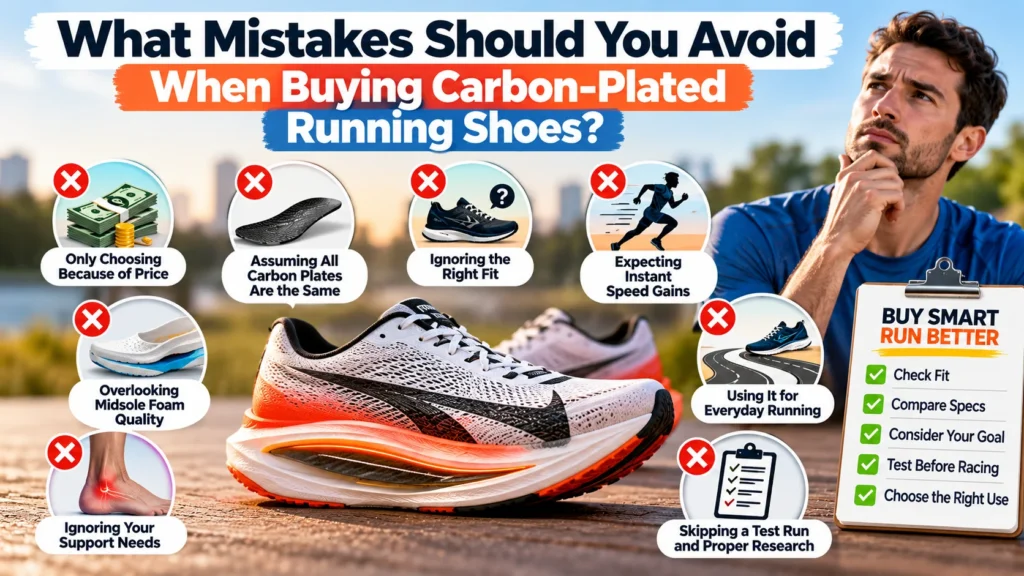
The biggest mistake is buying a racing shoe based solely on its carbon plate. Successful shoe selection requires attention to fit, intended use, and comfort.
- Assuming every plate is identical: Plate shape, stiffness, and placement vary substantially.
- Ignoring foam quality: Plate technology works with cushioning rather than replacing it.
- Buying the wrong fit: An uncomfortable racing shoe can undermine performance.
- Expecting automatic personal records: Laboratory efficiency gains don’t guarantee race-time improvements.
- Skipping familiarization: Your body may need time to adapt to different footwear.
- Choosing maximum stiffness: Greater stiffness isn’t automatically better for every runner.
- Ignoring race rules: Some highly cushioned performance models may not qualify for regulated competitions.
I would compare how two or three suitable shoes feel at realistic running speeds. That usually reveals more than looking at specifications alone.
Which Carbon-Plated Running Shoes Are Worth Considering in 2026?
These three models illustrate different carbon-plated racing approaches. Each offers a distinct balance of foam technology, plate design, and intended use.
Editorial note: The scores below are feature-based buying assessments, not Amazon customer ratings or claims of independent hands-on testing. Comfort, fit, and individual performance may differ.
🏆 Lightweight Racing Pick
Nike Vaporfly 4
★★★★◐ 4.5/5 — Editorial Fit
Features ZoomX cushioning, a full-length carbon Flyplate, and a 6 mm heel-to-toe drop. I would shortlist it for runners seeking a lightweight road racer for distances ranging from shorter events to marathons. Its specialized racing construction may be less versatile for easy daily runs.
⚡ Smooth Racing Option
Saucony Endorphin Pro 4
★★★★☆ 4/5 — Editorial Fit
Combines PWRRUN HG and PWRRUN PB foams with a full carbon plate and SPEEDROLL geometry. I would consider this model for runners seeking a rolling transition during racing and faster long-distance sessions. Check the fit carefully before committing.
🎯 Stride-Focused Racing Pick
ASICS Metaspeed Sky Tokyo
★★★★◐ 4.5/5 — Editorial Fit
Uses FF LEAP and FF TURBO PLUS foam with a full-length carbon plate. ASICS designs this model around stride-length-oriented racing mechanics. I would shortlist it for runners seeking that particular racing approach, while comparing it against other models for personal comfort.
Affiliate disclosure: As an Amazon Associate, we may earn from qualifying purchases. These links open Amazon search results; verify the exact model, seller, size, and availability before buying.
Frequently Asked Questions About Carbon-Plated Running Shoes
Do Carbon-Plated Running Shoes Make You Run Faster?
They can improve running economy, allowing some runners to maintain a particular speed with less energy. Research supports measurable average metabolic benefits, but individual improvements vary. Carbon-plated shoes don’t guarantee faster finishing times, and a shoe that feels uncomfortable may not provide a practical advantage.
Are Carbon-Plated Running Shoes Worth the Money?
They may be worthwhile for runners who race regularly and value potential performance improvements. However, they aren’t necessary for everyday fitness or recreational jogging. The best purchase depends on your budget, training goals, footwear comfort, and how frequently you’ll use the shoes for faster running.
Can You Walk in Carbon-Plated Running Shoes?
Yes, you can walk in carbon-plated running shoes, but specialized racing models may feel stiff or awkward at walking speeds. Their design primarily targets running efficiency. If walking is your main activity, a comfortable walking shoe or conventional running trainer is usually a more practical option.
Do Carbon Plates Prevent Running Injuries?
No. Current evidence doesn’t establish that carbon plates reliably prevent running injuries. They can change running mechanics and loading patterns, but those changes aren’t automatically beneficial for everyone. Proper fit, sensible training progression, recovery, and attention to persistent symptoms remain important regardless of shoe technology.
Can You Run a Marathon in Carbon-Plated Shoes?
Yes. Many carbon-plated running shoes are specifically designed for road races up to marathon distance. Choose a model that remains comfortable over longer runs, check its stability, and confirm its race eligibility when applicable. Use the shoes during appropriate training sessions before wearing them in a marathon.
Final Verdict: Do You Need Carbon-Plated Running Shoes?
Carbon-plated running shoes combine stiff internal plates, responsive foam, and specialized geometry to improve running efficiency. They can be useful for racing, but the benefits depend on the shoe and the individual runner.
For race-focused runners: A well-fitting carbon-plated shoe may provide a meaningful performance advantage. Compare options based on cushioning, stability, and running feel rather than marketing claims alone.
For beginners and casual runners: Comfortable daily training shoes remain an excellent choice. You don’t need a carbon plate to become a stronger or more consistent runner.
Your next step: Identify your main running goal, try suitable models at realistic speeds, and choose the pair that makes your running feel comfortable, controlled, and efficient.


