

Quick Answer
Underpronation in running, also called excessive supination, happens when your foot rolls inward less than usual after landing. More pressure stays along the outside of your foot, which can change how running forces are distributed. It is often associated with high arches, but foot shape alone cannot confirm it. The American Academy of Orthopaedic Surgeons’ footwear guidance explains how foot type can influence shoe selection.
Common signs to investigate
- Outer-edge pressure: Your weight stays noticeably toward the outside of your foot.
- Limited inward roll: Your foot shows relatively little pronation during midstance.
- High arches: You may have raised arches, although this is not proof.
- Uneven shoe wear: The outer outsole may wear faster, but wear patterns are not diagnostic.
- Recurring discomfort: Some runners experience lateral-foot or ankle symptoms.
How to confirm your running pattern
- Observe your stride: Record your feet from behind while running at a comfortable pace.
- Check your footwear: Look for clues without treating outsole wear as a diagnosis.
- Get an assessment: A qualified clinician can evaluate your gait if you have recurring pain.
If you’ve noticed unusual wear on your running shoes, you may wonder whether your feet are underpronating. It’s a useful question, especially when you’re choosing shoes or investigating discomfort.
I prefer to look at how a foot moves before recommending footwear based on arch height alone. This guide explains what underpronation means, how to recognize it, and what may help.
What Is Underpronation in Running?
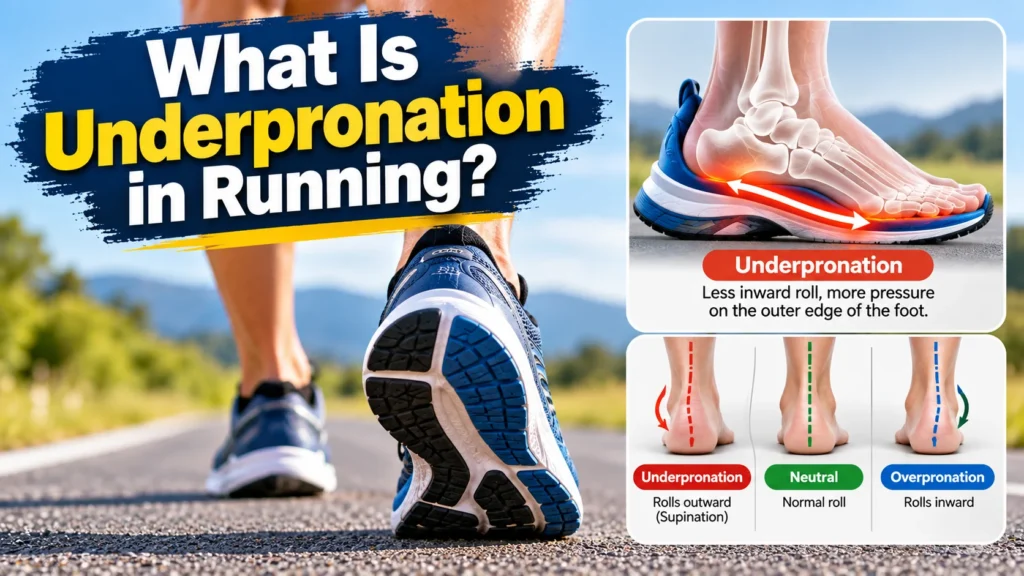
Underpronation is a running movement pattern in which the foot rolls inward less than expected during the weight-bearing phase of a stride. Runners often use the terms underpronation and supination interchangeably.
However, supination itself is a normal movement. Your foot naturally changes position throughout each running step.
How does normal pronation work?
During a typical running stride, the foot contacts the ground, accepts weight, and adjusts to the surface. Some inward rolling helps the foot adapt as the body moves forward.
The foot then becomes firmer during push-off. This combination supports both flexibility and propulsion.
- Initial contact: The foot meets the ground, sometimes toward the outside of the heel.
- Loading response: The foot pronates as it accepts body weight.
- Midstance: The body moves over the supporting foot.
- Push-off: The foot becomes a firmer platform for forward movement.
Underpronation becomes relevant when the inward movement remains limited during loading. The foot may continue bearing more force along its lateral, or outer, side.
Is underpronation the same as supination?
Not exactly in a technical sense. Supination is a normal foot movement, while underpronation describes reduced pronation during weight acceptance.
The distinction matters because every runner uses some supination. Seeing a foot turn outward does not automatically indicate a problem.
What Are the Signs of Underpronation While Running?
Signs of underpronation may include persistent outer-foot loading, limited inward movement, and certain outsole wear patterns. None can confirm underpronation by itself.
I would look for several consistent clues rather than relying on one observation.
Common movement and footwear clues
- Outer-foot loading: You appear to spend more time bearing weight along the lateral edge.
- Reduced pronation: Your foot shows limited inward movement after contact.
- High or rigid arches: Your arch may remain relatively raised while standing and running.
- Outer outsole wear: Your shoes may show pronounced wear around the outside heel or forefoot.
- Repeated ankle instability: Some runners report a tendency to roll their ankles outward.
- Lateral discomfort: Pressure or irritation may appear around the outer foot.
These clues are not unique to underpronation. Running speed, terrain, shoe construction, and previous injuries can change what you observe.
Can underpronation cause foot or ankle pain?
Some underpronating runners experience discomfort around the foot or ankle, particularly during demanding training. Possible problems include irritation of the outer-foot tissues and recurring ankle sprains.
However, underpronation does not automatically cause pain or injury. A runner can have a supinated foot posture and remain comfortable.
What Causes Underpronation in Runners?
Underpronation can reflect a combination of foot structure, joint mobility, movement habits, and previous injuries. Often, there is no single identifiable cause.
1. High arches and rigid foot structure
A high-arched foot may be relatively stiff during weight bearing. This can limit how much the foot changes shape as it accepts load.
Yet some runners with high arches pronate normally. Arch appearance alone doesn’t reveal your complete running mechanics.
2. Limited ankle or foot mobility
Restricted movement in certain foot or ankle joints may influence how your foot meets the ground. Your body might compensate through changes elsewhere in the lower limb.
The exact relationship differs between runners. A movement assessment can help identify relevant limitations.
3. Previous injuries
An earlier ankle sprain can affect balance, confidence, and movement control. Some runners then adopt a different loading pattern.
Persistent changes after injury deserve attention, particularly when instability or discomfort continues.
4. Running conditions and habits
- Running speed: Faster running can change contact and loading patterns.
- Uneven surfaces: Slopes and irregular terrain affect foot positioning.
- Fatigue: Tired muscles can alter movement coordination.
- Footwear: Shoe geometry and cushioning can influence how a stride feels.
These factors can affect loading without creating a permanent foot condition. Underpronation is best considered within the runner’s complete movement pattern.
Underpronation vs. Neutral Pronation vs. Overpronation: What’s the Difference?
The main difference is how much the foot rolls inward after contacting the ground. Neutral pronation involves a typical range of inward movement, while underpronation involves less and overpronation involves more.
| Feature | Underpronation | Neutral | Overpronation |
|---|---|---|---|
| Inward foot roll | Relatively limited | Typical range | Relatively increased |
| Common arch association | Higher arches | Various arch heights | Lower arches |
| Possible wear clue | More outer-edge wear | More distributed wear | More inner-edge wear |
| Typical shoe starting point | Comfortable neutral cushioning | Comfortable neutral footwear | Neutral or stability, depending on needs |
| Automatic injury diagnosis? | No | No | No |
These categories describe movement tendencies, not fixed medical diagnoses. The boundaries between them are not universally standardized.
A review of running footwear and injury paradigms also highlights limitations in selecting shoes solely from foot posture.
How Can You Tell If You Underpronate?
You can investigate underpronation by observing your running gait, checking your shoes, and considering your foot structure. A professional assessment provides more meaningful information when symptoms are present.
Step 1: Examine your current running shoes
Place both shoes on a flat surface and inspect the outsole. Compare wear around the outer heel, inner heel, and forefoot.
Strong outer-edge wear can be a clue, but it is not conclusive. Many runners naturally contact the ground toward the outside of the heel.
Step 2: Try a wet-footprint check
Wet the bottom of your foot and step onto a surface that shows your footprint clearly. A narrow connection between heel and forefoot may suggest a higher arch.
That result describes your footprint, not necessarily your running gait. Don’t diagnose underpronation from this test.
Step 3: Record your running movement
Ask someone to record a short video from behind while you run at your usual training pace. Try to capture several consecutive strides with both feet visible.
Look for consistent patterns rather than individual frames. Camera angles and shoe movement can make interpretation difficult.
Step 4: Consider professional gait analysis
A sports physical therapist or qualified foot specialist can assess joint mobility, strength, symptoms, and dynamic foot movement. This is particularly useful when repeated injuries affect your training.
A specialist may identify whether your apparent foot pattern is relevant to your symptoms or simply a normal variation.
Is Underpronation Bad for Running?
Underpronation is not necessarily harmful. Its significance depends on your symptoms, running demands, foot mobility, and overall injury history.
Some highly supinated feet have been associated with running injuries in observational research. However, the evidence does not prove that every underpronating runner will develop problems.
One prospective study followed 927 novice runners and found no statistically significant injury-risk difference for the supinated group compared with neutral feet.
Research on prescribing footwear by foot posture is similarly mixed. A Cochrane review of running shoes and injury prevention found limited evidence that matching shoes to foot posture prevents injuries.
What symptoms should you take seriously?
- Persistent pain along the outside of the foot.
- Repeated ankle sprains or episodes of giving way.
- Localized bone tenderness that worsens with impact.
- Swelling or discomfort that changes your walking pattern.
- Recurring pain that prevents normal training.
These symptoms can have several causes unrelated to pronation. Focal bone pain, particularly after increased training, requires assessment to exclude a stress injury.
What Running Shoes Are Best for Underpronation?
Comfortable neutral running shoes are a reasonable starting point for many underpronators. Look for suitable cushioning, a secure fit, and a smooth running feel.
I would not choose a shoe simply because its marketing describes it as suitable for supination. How it fits your actual foot matters more.
Important features to consider
- Comfortable cushioning: Enough protection for your usual running distance and surface.
- Neutral support: No unnecessary firm medial correction if you don’t need it.
- Secure heel fit: Limited slipping without painful pressure.
- Adequate toe space: Room for your toes to move naturally.
- Appropriate midsole feel: Cushioning that feels controlled rather than unstable.
- Proper width: A shape that accommodates your forefoot without squeezing.
A highly cushioned shoe is not automatically the best option. Some runners prefer moderately cushioned models with a more connected feel.
Should underpronators wear stability shoes?
Traditional stability shoes are generally designed to influence excessive inward foot movement. That makes them a less obvious first choice for someone whose foot already pronates relatively little.
Still, individual comfort and clinical needs can justify different designs. Don’t assume every stability feature is harmful.
How should you check running-shoe fit?
Try shoes while wearing your usual running socks, preferably later in the day. Walk and jog in them before deciding.
Many runners benefit from roughly a thumb’s width of toe room, although the correct space depends on foot shape and fit. The heel should remain secure without pressing uncomfortably.
Northwestern Medicine’s running-shoe fit guidance emphasizes comfort and choosing the correct fit rather than relying on trends.
Can You Improve Underpronation Naturally?
You may improve comfort, strength, and movement control through appropriate exercises and training adjustments. However, there is no universal exercise program proven to correct every underpronating gait.
The goal should be comfortable, capable movement rather than forcing your feet into a particular position.
1. Practice calf raises
Stand with your feet comfortably apart and rise onto your toes. Lower slowly while maintaining controlled foot alignment.
Start with a manageable number of repetitions. Progress only when the movement feels comfortable.
2. Improve single-leg balance
Stand on one foot near a stable support for approximately 20–30 seconds. Maintain control without gripping the floor excessively with your toes.
Repeat on the opposite side. Balance practice may be particularly useful after ankle injuries.
3. Strengthen foot muscles
Try gently shortening your foot by lifting the arch without curling your toes. This is sometimes called a short-foot exercise.
Use small, controlled movements. Stop if the exercise causes pain or cramping.
4. Check ankle mobility
A gentle knee-to-wall movement can help you explore ankle dorsiflexion, the motion that brings your shin forward over your foot. Compare both sides without forcing the joint.
If you notice significant restriction or pain, ask a clinician whether mobility work is appropriate.
5. Adjust running training gradually
- Increase running distance according to your recovery and experience.
- Introduce new shoes through shorter runs before long sessions.
- Alternate demanding days with easier training.
- Monitor recurring discomfort instead of running through worsening pain.
- Consider strength work for your calves, hips, and lower limbs.
A sudden change in footwear or running technique can redistribute forces across your body. That’s why I favor gradual adjustments over trying to correct your entire stride overnight.
When Should You See a Podiatrist or Physical Therapist?
Consider professional assessment when your foot mechanics coincide with recurring pain, instability, or difficulty running comfortably. You do not need treatment simply because someone labels your stride underpronated.
A clinician can examine possible causes beyond foot position, including strength, injury history, training load, and footwear fit.
- Repeated ankle sprains: Assess balance and ligament stability.
- Persistent lateral-foot pain: Check for tendon, joint, or bone problems.
- Sudden gait changes: Investigate new weakness or movement differences.
- Possible stress injury: Seek prompt assessment for focal bone pain.
- Ongoing difficulty: Review training demands and individual treatment needs.
If you cannot bear weight, have significant swelling, or experience sudden severe pain, obtain urgent medical assessment.
Three Neutral Running Shoes Worth Considering in 2026
If you’re comparing footwear for an underpronating stride, these are three useful neutral-shoe starting points. The recommendations below are based on published features, not personal wear testing or guaranteed injury prevention.
The star scores represent an editorial feature-fit assessment, not verified customer ratings. Your comfort during a proper fitting should determine the final choice.
🏆 Daily Running Pick
Brooks Ghost 18
★★★★☆ 4/5 Editorial feature-fit score
A neutral daily trainer with balanced cushioning, secure fit, and a 10 mm heel-to-toe drop. I would shortlist it for runners wanting a versatile everyday shoe rather than maximum softness.
☁️ Plush Cushioning Pick
ASICS GEL-NIMBUS 28
★★★★½ 4.5/5 Editorial feature-fit score
A maximum-cushioned neutral shoe using FF BLAST PLUS and PureGEL technology, with an 8 mm drop. I would consider it for runners who prioritize soft underfoot comfort during easier or longer runs.
👟 Width Options Pick
New Balance 1080v15
★★★★☆ 4/5 Editorial feature-fit score
A neutral cushioned running shoe with INFINION foam, a 6 mm drop, and multiple width options. It deserves consideration if standard-width shoes don’t fit your forefoot comfortably.
Affiliate disclosure: As an Amazon Associate, this website may earn from qualifying purchases. Products and availability depend on the seller. These shoes are not medical treatments for underpronation.
Frequently Asked Questions About Underpronation
Is underpronation common in runners?
Underpronation occurs in some runners, but its reported frequency depends on how researchers define and measure foot posture. There is no single reliable percentage that applies to every running population. Having high arches does not automatically mean you underpronate.
Can underpronation cause shin splints?
Some runners with underpronation experience shin discomfort, but shin splints have several possible contributing factors. Training changes, tissue loading, recovery, and strength may also matter. Persistent shin pain should be assessed rather than attributed to supination alone.
Do underpronators need special running shoes?
Not necessarily. Many underpronating runners are comfortable in well-fitting neutral running shoes. Cushioning and fit can guide your starting choice, but there is no universal shoe model that corrects underpronation or guarantees freedom from injury.
Can you have high arches without underpronating?
Yes. Arch height describes foot structure, whereas pronation describes movement during weight bearing. Runners with high arches can display different gait patterns. A dynamic assessment is more informative than relying on a standing footprint alone.
Can underpronation be corrected permanently?
There is no universal permanent correction, especially when the pattern reflects natural foot structure. Strengthening, mobility exercises, footwear adjustments, and rehabilitation may improve comfort or function. Treatment should target specific symptoms and limitations rather than appearance alone.
Final Takeaway: Should You Worry About Underpronation?
Underpronation in running means your foot rolls inward less than usual during loading. It can influence how forces travel through your foot, but it doesn’t automatically require treatment.
Start by considering your symptoms, running habits, and shoe fit. If you’re comfortable and running well, a visible movement pattern may not need changing.
When pain or repeated ankle problems appear, seek an individualized assessment. Comfortable footwear, gradual training, and good movement capacity are more useful goals than chasing a supposedly perfect foot position.


