

Quick Answer
The Brooks Hyperion Elite 6 wins for half-marathon and marathon racing. Its updated foam returned 88.4% of forefoot energy in RTINGS tests, versus 83.9% for the Elite 5. Choose the Elite 6 for stronger bounce and longer-race cushioning. Choose the Elite 5 if you prefer a more controlled ride or find a deep discount.
What changes most between these Brooks carbon racers?
- Elite 6: 88.4% measured forefoot energy return and a more forceful rocker.
- Elite 5: 83.9% measured forefoot energy return and a more familiar ride.
- The Elite 6 has more forefoot cushioning but lower stability scores.
Quick Verdict: Hyperion Elite 6 vs Elite 5
HYPERION ELITE 5
RTINGS half/full marathon score
$199.95 Brooks listed sale price; $275 original
Best for: Bargain hunters, 5K runners, and racers who want less aggressive geometry.
Opens Amazon search results; price varies.
HYPERION ELITE 6
RTINGS half/full marathon score
$275.00 Brooks listed price
Best for: Experienced racers seeking more bounce through long road races.
Opens Amazon search results; price varies.
| Category | Elite 5 | Elite 6 |
|---|---|---|
| Overall long-race pick | ❌ | 🏆 |
| Best sale value | ✅ | ❌ |
| Lab-measured energy return | ❌ | ✅ |
| RTINGS 5K/10K score | ✅ | ❌ |
| RTINGS stability score | ✅ | ❌ |
Bottom line: The Elite 6 wins for ambitious half-marathon and marathon racers because it delivers more rebound and cushioning; the Elite 5 is worth choosing when its lower price or steadier feel matters more.
- The Elite 6 leads RTINGS’ half/full marathon comparison, 8.3 versus 7.9.
- Brooks lists Elite 5 at $199.95, a $75.05 saving over Elite 6.
- The Elite 6 gives long-distance racers more tested forefoot cushioning.
- The Elite 5 scores higher in RTINGS’ 5K/10K and stability categories.
- The biggest change is ride character, not the tiny advertised weight difference.
Is the Brooks Hyperion Elite 6 worth buying when the Elite 5 is already a capable carbon-plated racing shoe? That is the right question for a runner facing a $275 price tag. Both shoes target fast road racing. Both use DNA GOLD foam and a carbon-fiber plate. Yet their ride and cushioning do not feel identical, according to independent testers.
I’m Steven Tyler. For this review, I compared Brooks’ published specifications with independent lab measurements and detailed road tests. I did not personally run in either pair. That distinction matters because race-day fit and stability are individual. A lab result can reveal differences without promising a faster race time for every runner.
The clearest upgrade is the Elite 6’s stronger rebound and deeper forefoot cushioning. The trade-off is a less settled platform and a heel collar that does not suit everyone. If you want to make sense of the numbers before buying, this compare running shoe specifications guide explains what to check first.
What Is the Brooks Hyperion Elite 6 Designed to Do?
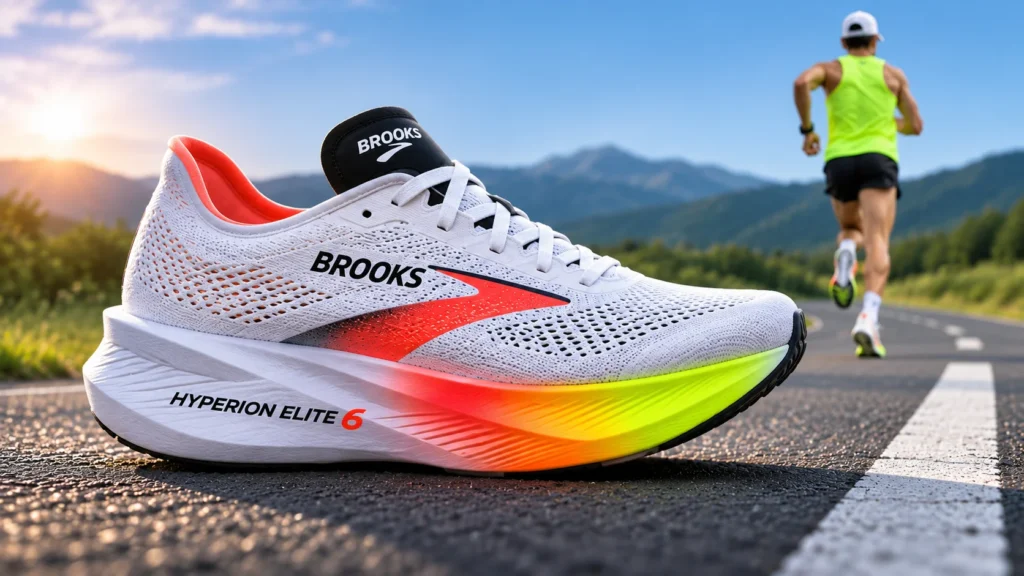
In short, the Brooks Hyperion Elite 6 is a lightweight road racing shoe for fast half marathons and marathons. Brooks pairs updated DNA GOLD foam with its redesigned SpeedVault+ carbon plate. A curved rocker helps the foot roll from landing to toe-off.
Quick verdict: Best for trained runners who want a lively, forward-rolling race shoe, not an all-purpose daily trainer.
Brooks lists the Elite 6 at $275, with a 7 mm heel-to-toe drop. The advertised weight is 6.8 ounces, or 192.8 grams. Its narrow, breathable upper targets a close racing fit. The shoe is meant for road speed, not for hiking, heavy walking, or high-mileage easy runs.
RTINGS measured 88.4% forefoot energy return and 89.9% heel energy return. These results show how much energy the foam and shoe system gave back in a lab compression test. They do not mean your legs use 88.4% less energy. The values are most helpful when compared under the same test method.
The key drawback is stability. RTINGS rated its stability at 5.5 out of 10, and noted possible heel rubbing from the unusual collar pads. Runners who need a stable platform or generous forefoot space should try it before paying full price.
- High measured energy return
- More cushioning under the forefoot
- Lightweight road-racing build
- Grippy outsole in independent tests
- Secure fit for feet that suit its shape
- $275 listed price
- Limited lateral stability
- Tapered toe box
- Heel pads can rub some runners
- Thin upper and outsole need care
Brooks Hyperion Elite 6 buying check
Brooks listed price: $275.00. Amazon’s live listing price and exact ASIN were not independently verified. The button opens a product search, not a specific item.
What Is the Brooks Hyperion Elite 5 Designed to Do?
In short, the Brooks Hyperion Elite 5 is a lighter-feeling, close-fitting carbon racer with a more traditional ride. It uses DNA GOLD polyether block amide foam, often called PEBA, and a size-tuned SpeedVault+ plate made with Arris technology.
Quick verdict: A smart race shoe when you like a firmer, less dramatic roll or find it well below original retail.
The Elite 5 started at $275. Brooks now shows $199.95 on its US product page, though stock and color choices change. Its listed drop is 8 mm, while its advertised weight is 6.9 ounces. It has a fast, snug TPU-pressed upper and silicone lace sleeves that help secure the foot.
RTINGS gives the Elite 5 a 7.9 score for half and full marathons. It earns 8.2 for 5K and 10K racing, ahead of the Elite 6’s 7.8. That does not prove it is universally faster over short distances. It shows how the tester scores each shoe’s characteristics for those uses.
Its narrower goal is also its strength. The Elite 5 does not push as much forefoot cushion under your stride. Some runners will prefer the firmer, less intrusive sensation. If older versions interest you, this Brooks Hyperion Elite 4 review explains how the series reached today’s DNA GOLD design.
- Lower listed sale price
- Strong RTINGS short-race score
- Slightly better stability rating
- Proven DNA GOLD foam
- Secure racing upper
- Less rebound than Elite 6 in lab tests
- Less forefoot cushioning
- Less pronounced forward roll
- Still a costly specialist shoe
- Sizes and colors may be limited
Brooks Hyperion Elite 5 buying check
Brooks listed sale price: $199.95, down from $275. Amazon’s live price and exact ASIN were not independently verified. Compare sellers and shoe sizes.
How Do the Brooks Hyperion Elite 6 and Elite 5 Specifications Compare?
In short, the Elite 6 has a revised plate and rocker, a slightly lower advertised drop, and more measured cushioning. The Elite 5 keeps the earlier Arris plate design and a calmer ride. Both are lightweight neutral road racing shoes.
| Specification | Hyperion Elite 5 | Hyperion Elite 6 | Advantage |
|---|---|---|---|
| Brooks listed price | $199.95 sale; $275 original | $275 | Elite 5 value |
| Foam | DNA GOLD PEBA | Updated DNA GOLD PEBA | Elite 6 rebound |
| Carbon plate | Arris SpeedVault+ design | Redesigned SpeedVault+ | Different feel |
| Advertised weight | 6.9 oz / 195.6 g | 6.8 oz / 192.8 g | Elite 6 |
| Advertised drop | 8 mm | 7 mm | Preference |
| RTINGS measured heel stack | 38.2 mm | 40.5 mm | Elite 6 cushion |
| RTINGS measured forefoot stack | 28.9 mm | 31.7 mm | Elite 6 cushion |
| RTINGS forefoot energy return | 83.9% | 88.4% | Elite 6 |
| RTINGS heel energy return | 84.7% | 89.9% | Elite 6 |
| RTINGS stability score | 6.1/10 | 5.5/10 | Elite 5 |
| Wide option shown by RTINGS | No | No | Neither |
Manufacturer weights and lab weights use different samples and methods. RTINGS weighed its tested Elite 5 at 200.9 grams and Elite 6 at 191.7 grams. Compare measurements from one lab rather than mixing them with the advertised figures.
Which Shoe Wins for Marathon Cushioning and Energy Return?
Primarily, the Hyperion Elite 6 wins for energy return and long-race cushioning. RTINGS measured 88.4% forefoot rebound, compared with 83.9% from the Elite 5. The same lab found 31.7 mm of forefoot stack in the new shoe versus 28.9 mm in the older one.
Those 2.8 extra millimeters at the front matter more than they sound. They place more material beneath the foot during push-off. For a runner who lands near the midfoot, that extra volume can change how the shoe feels during a hard late-race effort. It does not guarantee better personal performance.
At the heel, the gap is also clear. RTINGS recorded 89.9% energy return for the Elite 6 and 84.7% for the Elite 5. Its long-run cushioning tests favored the newer shoe. Brooks also tuned the plate and midsole geometry to encourage forward motion.
Here is the counterintuitive part: more bounce does not always feel better. A softer, taller platform can ask more of your ankles when you get tired. The Elite 5 may suit runners who want the foot to move with less help from a sharp rocker. Test both near your real race pace, not only while standing in a store.
The full RTINGS laboratory comparison details the measurements and their scoring. Its results support the Elite 6 as the stronger half-marathon and marathon shoe, while leaving space for individual fit preferences.
Which Brooks Hyperion Elite Fits Better and Feels More Stable?
In short, the Elite 5 has the better RTINGS stability score, but neither shoe is a strong choice for runners who need support. The older model scored 6.1 out of 10 for stability, versus 5.5 for the Elite 6.
The Elite 6 uses a taller forefoot and a more energetic shape. This helps speed, yet a runner who rolls inward or outward may notice extra movement. A carbon plate adds stiffness; it does not automatically provide motion control. Stability also depends on the runner’s foot, body mechanics, and pace.
Fit may matter even more. RTINGS found the Elite 6’s inner forefoot narrower than the Elite 5’s in its size comparison. RunRepeat measured a tapered toe area on the Elite 6, and Brooks markets the shoe as a close race-day fit. Feet that swell late in a marathon need enough room in front and at the sides.
The new heel collar deserves special care. Some RTINGS testers raised concerns about rubbing from the separated heel pads. Other road testers at Believe in the Run liked the secure heel hold. These reports are not a contradiction to hide. They show why a fast shoe needs a personal fit check.
Fit warning: Run at least one sustained workout in your intended race socks before choosing the Elite 6 for a marathon. Stop if the heel pads cause repeated rubbing.
Use this running shoe fitting checklist to check toe space, heel hold, and pressure points before the return window closes.
Which Shoe Offers Better Price and Value?
In short, the Elite 5 is the better value at Brooks’ listed sale price. The Elite 6 costs $275, while Brooks displays the Elite 5 at $199.95. That creates a $75.05 price difference before taxes and shipping.
Both started at the same $275 retail level. That means the Elite 6’s premium is not a higher original price. It comes from the newer model holding its launch-level price while the older shoe goes on sale. That distinction matters when looking at deals.
The added money buys measurable improvements: more forefoot foam, higher lab energy return, and a revised ride shape. Yet it does not buy a wider fit or stronger stability. If your Elite 5 already fits well and supports your preferred cadence, paying more is a choice, not an obligation.
Use a simple price test. At a $75 gap, choose the Elite 6 when you will race in it and its fit works. If the gap falls below $30, the new model becomes easier to justify. If the Elite 5 drops near $150 in your exact size, it becomes a strong budget racer. These are buying thresholds, not guaranteed market prices.
Check the total checkout cost and the seller’s identity. A low listing price has little value if the color, size, or return policy is wrong. This guide on whether to buy running shoes online covers the risks of buying specialty footwear without trying it first.
Which Shoe Handles Speed, Traction, and Durability Better?
Primarily, the Elite 6 offers a more energetic toe-off, while the Elite 5 remains a credible short-race option. The RTINGS 5K/10K category scores favor the older model, 8.2 to 7.8. Its half/full marathon scores reverse that order, 7.9 to 8.3.
Those category scores reveal the real buying split. Quick 5K efforts reward a direct, responsive ride. Long road races reward cushioning that still feels useful when you grow tired. A single shoe cannot maximize every runner’s preference across both jobs.
Independent reviewers praised the Elite 6’s grip. RunRepeat reported improved outsole traction compared with the Elite 5, but its abrasion test also showed a 1.7 mm worn indentation. That is worse than the 1.1 mm category average in the same test. Grip and life span are not the same measure.
RunRepeat also scored the Elite 6’s thin toe-box fabric 1 out of 5 for abrasion resistance. That does not mean the shoe will fail after one race. It means rough contact and frequent daily use are poor matches for a weight-saving race upper. Keep it away from gravel, trail debris, and careless shoe removal.
The unusual heel padding remains the biggest comfort risk. A secure heel for one runner can be a rubbing point for another. Test on dry pavement and, when safe, damp roads. Check whether your socks and lacing keep the shoe still without squeezing the midfoot.
For supporting laboratory detail, see RunRepeat’s cut-open Elite 6 review. It reports both grip strengths and wear concerns, which helps avoid one-sided claims about durability.
Which Hyperion Elite Wins in Real Running Situations?
In short, the Elite 6 is the more capable long-distance race tool, while the Elite 5 keeps its appeal for speed sessions and discount buyers. The right choice changes with distance, surface, and experience.
Which shoe is better for a fast half marathon?
Primarily, the Elite 6 wins when its close fit works. Its added forefoot cushioning and higher tested energy return suit sustained efforts. Use it for a race-pace session before your event to check heel comfort.
Which shoe is better for a full marathon?
Primarily, the Elite 6 is my pick for an experienced, stable runner. RTINGS’ marathon suitability score favors it, 8.3 to 7.9. A racer who feels unsteady in tall, soft shoes should value control over the higher score.
Which shoe is better for a road 5K or 10K?
In short, the Elite 5 has the stronger RTINGS category score. Its more direct feel can appeal during quick efforts. The Elite 6 remains fast, and some runners will prefer its rebound even over short races.
Which shoe should you use for cold-weather road racing?
Primarily, choose the shoe you have already tested in similar conditions. Neither model is a winter traction shoe. Both have exposed racing materials and thin uppers. For icy roads, choose suitable weather-specific footwear rather than trusting a carbon plate.
Which shoe works for a running club or fleet of race shoes?
In short, the Elite 5 offers better acquisition value when a club purchases multiple race-day pairs. The listed $75.05 discount adds up across runners. Still, each runner should select their own size and fit. No club-wide purchase should replace personal trials.
Which shoe works for daily miles and easy recovery runs?
Primarily, neither is the first choice. The Elite line is built for racing, and regular easy mileage can wear costly components. Runners wanting a training-focused Brooks alternative can compare the Brooks Hyperion Max 2, which has a different purpose and ride.
Is the $75.05 Upgrade from Elite 5 to Elite 6 Worth It?
In short, yes for a race-focused runner who prefers the new ride. No for a runner who already loves the Elite 5’s fit and control. The $75.05 figure compares the prices Brooks displayed during this review, not a verified Amazon checkout price.
Ask what you gain rather than what looks newer. A 4.5 percentage-point forefoot energy-return advantage is a measurable difference under RTINGS’ test method. So is the 2.8 mm increase in measured forefoot stack. Both matter if you enjoy a soft and rolling racing platform.
Now ask what you risk. The Elite 6 is less stable in that same comparison. Its new heel collar creates a different contact pattern. The tapered front still lacks the extra room some runners need. Paying more for an uncomfortable fit is poor value.
Do not treat any published percentage as a promise of minutes saved. Race outcomes also depend on fitness, weather, pacing, and biomechanics. A pair that helps one runner feel smooth may disrupt another runner’s stride.
Who Should Buy the Elite 6, the Elite 5, or Neither?
In short, buy the Elite 6 for lively long-race performance, the Elite 5 for price and familiar mechanics, and neither if you need stable daily comfort. Your foot shape should make the final call.
- You race half and full marathons.
- You want more measured rebound.
- You enjoy a stronger forward roll.
- The heel collar passes a workout test.
Skip Elite 6 if:
- You often feel unstable in tall shoes.
- You have heel-pad rubbing.
- You need a roomy toe box.
- You found your size on sale.
- You like a more natural racing feel.
- You focus on shorter road races.
- Your current pair already fits well.
Skip Elite 5 if:
- You want more forefoot protection.
- You prioritize the highest lab rebound.
- The price gap is small.
Don’t buy either: Choose a daily training shoe if easy miles are your priority. Look beyond these models if you need substantial motion control, a broad toe box, or reliable grip on ice. A shoe that fits your use is better than a costly racing plate.
What Do Real Buyers and Independent Testers Say?
In short, reviews largely praise the Elite 6’s speed, bounce, and upper hold. They disagree more on stability and heel comfort. That split deserves attention because a perfect fit cannot be assumed from a star score.
Independent feedback at a glance
- RTINGS: Strong rebound and marathon cushioning; concerns about instability and heel rubbing.
- RunRepeat: Improved grip and secure fit; weak toe-box abrasion results and a narrow fit.
- Believe in the Run: Reviewers praised the energetic toe-off and secure feel during tempo efforts.
Brooks’ product listings also show customer review activity. However, customer reviews vary by size, seller, and date. I could not verify a matching set of Amazon purchaser reviews for both shoes. For that reason, I won’t invent buyer quotes, Amazon star averages, or claims that every owner agrees.
One important difference across independent tests is how stable the Elite 6 feels. RTINGS highlights wobble in its lab-based assessment. Reviewers at Believe in the Run found the shoe comfortable and controlled during some workouts. Both experiences can be valid for different strides and paces.
Read reviews written by runners with a similar foot shape and target race. A narrow-footed runner who races in thin socks may have a different result from a runner with a broad forefoot. Look especially for reports after ten miles, when rubbing and pressure are easier to spot.
How Should You Care for Brooks Hyperion Elite Racing Shoes?
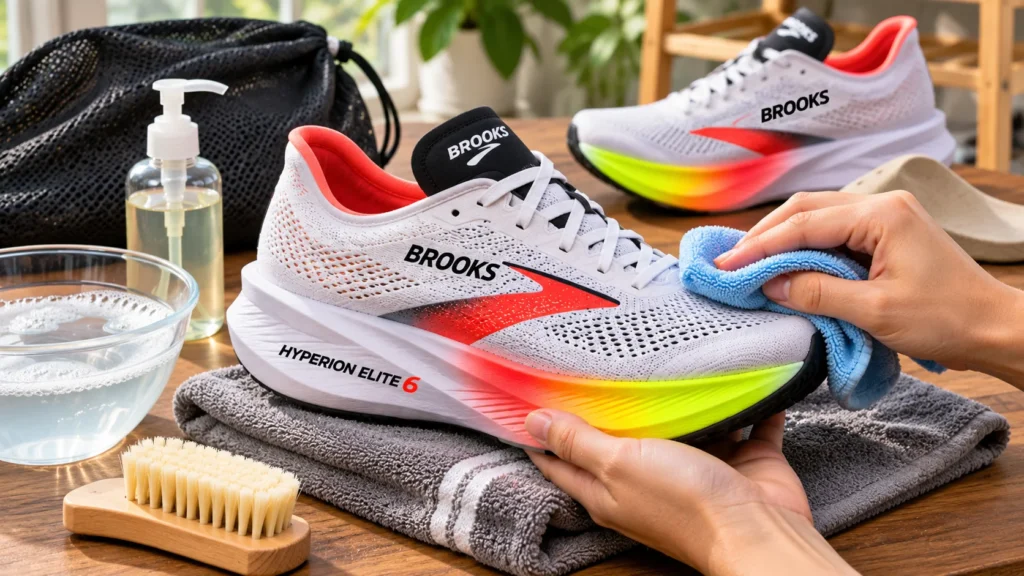
In short, keep both models clean, dry, and reserved mainly for fast runs. Their lightweight uppers, race foams, and thin rubber are not designed for careless daily wear. Simple habits help limit damage.
After each session, brush away grit with a soft cloth. Remove loose dirt from the outsole without scraping the foam. If needed, use mild soap and cool water. Avoid a washing machine, tumble dryer, and direct heat, which can stress bonded materials.
Air-dry the shoes in shade. Take out the insoles if they are removable without force, and loosen the laces. Do not store wet shoes in a closed gym bag overnight. A dry, ventilated storage place is a better choice.
Track outsole wear and changes in ride feel. If the shoe begins to feel uneven, check the midsole and plate area. Replace it when grip or structure is no longer dependable. There is no universal mileage number that applies to every runner and surface.
Race shoes also benefit from rotation. Keep a separate daily trainer for recovery miles and rough pavement. Before a key race, wear your chosen pair for several practice sessions, then inspect the heel collar, lace area, and outsole. Race day should not be the first real test.
Final Verdict: Is the Brooks Hyperion Elite 6 Worth Buying?
In short, the Brooks Hyperion Elite 6 is worth buying for an experienced road racer who wants a lively half-marathon or marathon shoe. Its higher tested energy return and thicker forefoot cushioning provide clear reasons to upgrade from the Elite 5.
The Elite 5 remains a strong alternative. It is less demanding in some circumstances, scores better for short races in RTINGS’ methodology, and currently carries a lower Brooks listed price. That makes it more than leftover stock. It is a sensible choice for runners who prefer its fit and ride.
My recommendation is to choose the Elite 6 when comfort and stable control have already been confirmed in a hard workout. Choose the Elite 5 if its sale price and familiar ride fit your needs. Do not pay a premium for lab numbers that your feet dislike.
These buttons open Amazon search results rather than unverified product listings. Check the exact model name, size, seller, and price before purchasing.
Frequently Asked Questions
Is the Brooks Hyperion Elite 6 better than the Elite 5?
Yes, the Elite 6 is the stronger pick for half-marathon and marathon racing based on RTINGS’ tests. It offers higher energy return and more forefoot cushioning. However, the Elite 5 earns better scores for short races and stability. Your best choice still depends on fit, pace, and price.
What is the biggest difference between the Hyperion Elite 6 and 5?
The biggest difference is the ride, not the advertised weight. The Elite 6 uses revised foam, a redesigned plate, and a more forceful rocker. RTINGS measured 88.4% forefoot energy return for the Elite 6 versus 83.9% for the Elite 5. The newer platform also feels less stable to some runners.
Is the Brooks Hyperion Elite 6 good for marathons?
Yes, the Elite 6 is designed for road racing, including marathons. Its light construction, tested rebound, and deeper forefoot foam support that use. It is not ideal for everyone. Test the snug upper and padded heel collar on a long workout before committing to race day.
Does the Brooks Hyperion Elite 6 fit true to size?
The Elite 6 generally matches the expected length for many testers, but its forefoot is snug and tapered. A true-to-length fit does not mean wide feet have enough room. Try the shoe in your usual race socks and check for pressure during faster running. The best size allows secure hold without toe crowding.
Should I upgrade from the Hyperion Elite 5 to the Elite 6?
Upgrade if you race longer distances, want stronger rebound, and like how the new shoe fits at speed. Keep the Elite 5 if its feel suits your stride and it remains in good condition. The Elite 6 is a real design change, but its lower stability score makes a fit test essential.
Affiliate Disclosure: As an Amazon Associate, I earn from qualifying purchases. If you click a link on this page and make a purchase, I may receive a small commission — at no extra cost to you. I only recommend products I genuinely believe will help you. This helps keep the site free and running. Thank you for your support.


