

Quick Answer
The best time to wear racing shoes is during a race and selected race-specific training sessions. Use them for tempo runs, race-pace workouts, and important speed sessions after introducing them gradually. For most easy and recovery runs, comfortable everyday running shoes are the more practical choice. Never make race day your first run in a new pair.
When should you wear racing shoes?
- Race day: Wear them for suitable road races after confirming comfort and fit.
- Tempo workouts: Use them occasionally to practice faster, controlled running.
- Race-pace sessions: Test how they feel at your intended competition pace.
- Long race rehearsals: Check comfort and stability during longer efforts.
- Easy running: Usually choose durable daily trainers instead.
Before wearing them in a race:
- Start gradually: Test the shoes on a short run before completing faster workouts.
- Check comfort: Watch for rubbing, instability, unusual soreness, or pressure.
- Practice race conditions: Use your planned socks and race pace before competition.
Knowing when to wear racing shoes can help you get more from your footwear without wasting expensive race-day mileage. The challenge is balancing speed, comfort, and proper preparation.
In this guide, I’ll explain when racing shoes make sense, how to introduce them, and when regular trainers are better.
What Are Racing Shoes, and How Do They Work?
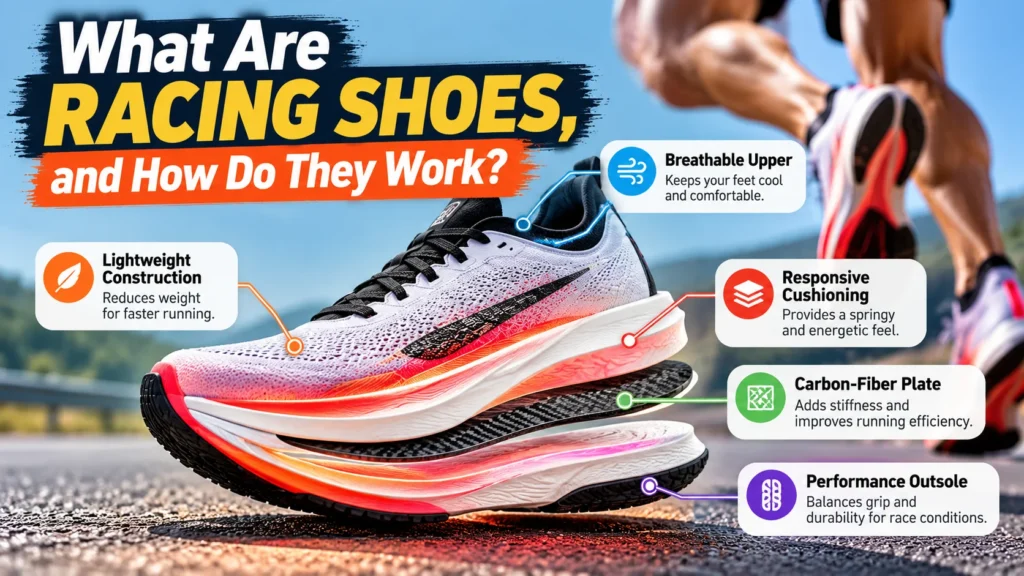
Racing shoes are running shoes designed to prioritize performance during competition. They commonly feature lightweight materials, responsive cushioning, and a fit intended for faster running.
Modern road racing shoes often combine specialized foam with a carbon-fiber plate or another stiffening structure. These designs aim to improve running efficiency, but their benefits differ between runners.
Definition: A carbon-plated racing shoe is a performance running shoe containing a carbon-fiber plate within its cushioning system, usually paired with lightweight, resilient foam.
What makes racing shoes different?
- Lightweight construction: Reduces unnecessary shoe mass during fast running.
- Responsive cushioning: Uses specialized foam to provide a springy underfoot feel.
- Stiff plate or rods: Changes how the shoe bends and rolls forward.
- Race-oriented fit: Often emphasizes secure lockdown and minimal excess material.
- Performance-focused outsole: Balances grip and weight rather than maximum everyday durability.
A 2026 systematic review of carbon-plated footwear found average reductions of approximately 2–3% in metabolic demand during controlled running tests. However, the plate alone cannot explain every benefit.
That does not mean every runner will race 2–3% faster. Running economy, actual race performance, comfort, and individual response are different outcomes.
When Should You Wear Racing Shoes?
Wear racing shoes when the session closely resembles the demands of your target competition. Race day is their primary purpose, but carefully chosen training sessions help you become familiar with them.
I recommend deciding based on workout purpose rather than simply wearing racing shoes whenever you want to run faster.
1. During road races
Road races are the clearest opportunity to use racing shoes. Depending on the model, they may suit distances from 5K through a full marathon.
Choose a pair that remains comfortable at your expected pace and distance. A faster-feeling shoe is not useful if it causes rubbing or feels unstable.
2. During race-pace workouts
Race-pace workouts help you practice your intended competition speed. Wearing racing shoes occasionally lets you assess how their cushioning and geometry behave under realistic conditions.
For example, a half-marathon runner might use them during repeated blocks at planned half-marathon pace.
3. During selected tempo runs
Tempo runs involve sustained, controlled efforts above easy-running intensity. They can provide an opportunity to become familiar with the shoe’s response and fit.
You don’t need racing shoes for every tempo workout. A responsive training shoe can handle many of these sessions.
4. During selected interval sessions
Intervals involve faster efforts separated by recovery periods. Racing shoes may work well for longer road intervals that resemble your race pace.
For sharp turns, very short repetitions, or track competitions, specialized shoes may be more appropriate.
5. During a long-run dress rehearsal
Long-distance runners can test racing shoes during a key training run. This helps reveal problems that shorter workouts might miss.
- Test your intended racing socks and lacing.
- Check toe space as your feet warm up.
- Notice any instability when tired.
- Evaluate comfort during race-pace sections.
- Check for blisters or unusual soreness afterward.
One well-planned rehearsal is often more informative than repeatedly wearing expensive racing shoes for ordinary easy miles.
Should You Wear Racing Shoes for Every Training Run?
No. Most runners do not need racing shoes for every training session.
Everyday trainers are usually more practical for easy runs, recovery days, and general mileage. They also help reserve your racing pair for workouts where its performance features matter.
| Session | Recommended footwear | Reason |
|---|---|---|
| 5K–marathon road race | Racing shoes | Performance-focused design |
| Race-pace workout | Racing shoes occasionally | Specific race preparation |
| Tempo run | Speed trainer or racer | Both can suit controlled speed |
| Easy or recovery run | Daily trainer | Comfort and routine mileage |
| Long easy run | Daily trainer | Training comfort and practicality |
| Technical trail run | Trail running shoes | Terrain-specific traction |
Hard road surfaces also influence footwear selection. Our guide to running shoes for concrete floors explores options intended for routine running on firm surfaces.
How Long Before a Race Should You Start Wearing Racing Shoes?
Start testing racing shoes several weeks before your race when possible. You need enough time to confirm the fit, complete relevant workouts, and change shoes if necessary.
There is no universal break-in distance. Some models feel comfortable immediately, while others require more gradual familiarization.
A practical three-stage preparation plan
- First test: Complete a short, comfortable run of approximately 20–30 minutes. Check the fit before attempting hard efforts.
- Second test: Try a controlled session containing short blocks at your intended race pace. Stop if discomfort develops.
- Final rehearsal: Complete a relevant longer workout with race socks, lacing, and realistic pacing before your final taper.
These are practical examples, not mandatory distances or a universal medical protocol. Adjust them to your training experience and race schedule.
New Balance’s shoe break-in guidance also recommends becoming familiar with new footwear before competition.
What should you check after each test?
- Heel lockdown: Your heel should not slip excessively.
- Toe clearance: Your toes should not hit the front during downhill running.
- Midfoot fit: Avoid painful pressure from the laces or upper.
- Stability: The shoe should feel manageable on turns and uneven pavement.
- Recovery response: Pay attention to persistent or unusual discomfort afterward.
Don’t rely on a long run to solve an obvious fit problem. Shoes that cause persistent pain need reassessment rather than forced adaptation.
When Should You Wear Racing Shoes for a 5K, 10K, Half Marathon, or Marathon?
The best racing-shoe strategy depends on the distance, course, and your running experience. Longer races usually make sustained comfort and stability more important.
For 5K and 10K races
Lightweight racing shoes can be useful for shorter road races where runners spend more time at higher intensity. Choose models suited to your speed and course.
Practice fast running in them before competition. A shoe that feels comfortable while jogging may behave differently during harder efforts.
For half marathons
Half-marathon racing shoes should balance efficiency with comfort over an extended period. Test them during controlled threshold or race-pace sessions.
Secure lockdown matters, but your toes still need adequate space. Check for rubbing before committing to the full distance.
For full marathons
Marathon footwear must remain comfortable as fatigue accumulates. Responsive cushioning can be useful, but an unstable or poorly fitting shoe may outweigh potential performance advantages.
Include at least one appropriate long-run rehearsal before race day. You don’t need to complete an entire marathon in the shoes beforehand.
What about track races and trail races?
Road racing shoes aren’t automatically suitable for every event. Track competitions may require regulation-compliant track shoes, while trail races often demand more specialized grip.
For uneven or grassy routes, see our guide to shoes for running on grass before choosing road racing footwear.
How Often Should You Wear Carbon-Plated Racing Shoes?
There is no evidence-based rule requiring a fixed number of carbon-plated sessions each week. Frequency should depend on your experience, schedule, comfort, and budget.
For many runners, occasional race-specific sessions are enough to become familiar with the shoes while preserving them for competition.
- New racing-shoe users: Start with one short trial and build exposure gradually.
- Runners preparing for competition: Include selected race-pace sessions when helpful.
- Experienced runners: Adjust use based on established comfort and training demands.
- Runners with recurring discomfort: Reassess fit and loading before increasing use.
Fleet Feet’s discussion of carbon-plated shoe use also highlights the absence of one ideal frequency for every runner.
Importantly, carbon-plated shoes have not been proven to prevent running injuries. Their altered stiffness and geometry may feel different from conventional trainers.
What Is the Difference Between Racing Shoes and Speed Training Shoes?
Racing shoes primarily target competition performance. Speed training shoes focus on faster workouts while offering practicality for more frequent use.
Some speed trainers also contain plates, so a carbon plate alone doesn’t define a racing shoe. Intended purpose and overall construction matter more.
| Feature | Racing shoes | Speed trainers |
|---|---|---|
| Main purpose | Competition | Faster workouts |
| Construction | Performance-focused | Training-focused |
| Typical use | Races and rehearsals | Tempo and interval training |
| Value priority | Race-day efficiency | Workout versatility |
My approach is to keep a comfortable daily trainer as the foundation of a shoe rotation. I would add a racing pair only when its specialized purpose justifies the cost.
How Do You Know When Racing Shoes Are Ready for Race Day?
Your racing shoes are ready when they fit securely, feel comfortable at target pace, and produce no concerning symptoms during appropriate rehearsals.
Don’t judge readiness by mileage alone. Some runners need several tests, while others become comfortable sooner.
Race-day readiness checklist
- The shoes have been tested during actual running.
- They remain comfortable during faster efforts.
- Your planned socks and lacing work well.
- The outsole provides suitable grip for the course.
- You experience no persistent rubbing or unusual pain.
- The shoes show no serious damage or abnormal wear.
For a long event, give special attention to fit during fatigue. A minor pressure point at the start can become distracting over many kilometers.
Are Carbon-Plated Racing Shoes Legal in 2026 Competitions?

Carbon-plated shoes are permitted in many competitions, but applicable technical regulations still matter. Shoe approval and permitted sole thickness depend on the event.
Under World Athletics regulations effective April 20, 2026, road running competitions covered by those rules have a maximum sole thickness of 40 mm. Covered track events generally have a 20 mm limit.
Consult World Athletics’ official technical documents and your event organizer before racing, especially in regulated competitions.
What Mistakes Should You Avoid When Wearing Racing Shoes?
Most avoidable mistakes involve poor timing, unsuitable use, or ignoring discomfort. A racing shoe should support your preparation rather than introduce unnecessary uncertainty.
- Wearing them for the first time on race day: Test the shoes before competition.
- Using them for every easy run: Choose daily trainers when specialized racing features aren’t needed.
- Ignoring poor fit: Don’t assume repeated use will fix painful pressure.
- Choosing by popularity alone: Match the shoe to your foot, event, and preferences.
- Overlooking course conditions: Road racing outsoles may not suit mud, rocks, or technical trails.
- Ignoring unusual soreness: Reduce exposure and seek professional guidance if pain persists.
Race-day confidence comes from familiarity, not simply buying the most expensive model.
Which Racing Shoes Are Worth Considering in 2026?
If you’re choosing your first dedicated racing pair, these three established models offer different performance designs. Their published specifications provide useful starting points, although personal fit still matters most.
The scores below are editorial use-case assessments, not laboratory test results or customer review averages. Check availability, sizing, and current model revisions before purchasing.
🏆 Versatile Road Racer
Nike Vaporfly 4
★★★★☆ 4.7/5 editorial fit
Uses ZoomX foam and a full-length carbon-fiber Flyplate. Nike lists approximately 190 g for men’s US size 10 and a 6 mm drop.
I’d shortlist it for runners seeking a lightweight road racing option across several distances. Confirm the fit before committing to a long race.
⚡ Smooth Race-Day Option
Saucony Endorphin Pro 4
★★★★☆ 4.6/5 editorial fit
Combines PWRRUN HG and PWRRUN PB cushioning with a carbon plate and SPEEDROLL geometry. Its published men’s weight is approximately 212 g, with an 8 mm drop.
I’d consider it for runners prioritizing a rolling transition during road racing and race-pace workouts.
🏃 Long-Distance Road Racing
Adidas Adizero Adios Pro 4
★★★★☆ 4.5/5 editorial fit
Features LIGHTSTRIKE PRO cushioning, carbon-infused ENERGYRODS 2.0, and a 6 mm drop. Adidas lists approximately 200 g in UK size 8.5.
I’d shortlist it for longer road races where responsive cushioning and race-specific geometry are priorities.
Affiliate disclosure: As an Amazon Associate, we may earn from qualifying purchases. Product availability and prices can change.
Frequently Asked Questions
Can beginners wear racing shoes?
Yes, beginners can wear racing shoes if the fit and design suit their needs. However, they aren’t necessary for starting a running routine. Most beginners should first prioritize comfortable daily training shoes, consistent training, and gradual mileage increases before investing in specialized racing footwear.
Can you wear racing shoes during regular training?
Yes, racing shoes can be used during selected training workouts, especially race-pace sessions and tempo runs. However, using them for every run is unnecessary for most runners. Daily trainers usually offer greater practicality for easy mileage, while racing shoes can be reserved for specific preparation and competition.
How many miles should you run in racing shoes before a marathon?
There is no universal minimum mileage. Instead of chasing a specific number, complete enough running to confirm comfort, fit, and stability. Include at least one relevant longer rehearsal if your training permits, and avoid introducing completely unfamiliar shoes on marathon morning.
Can you wear carbon-plated shoes for slow running?
Yes, carbon-plated shoes can be worn at slower speeds, but their performance benefits may vary with the runner and pace. Some designs feel comfortable at easy intensity, while others feel awkward. Choose footwear based on how it performs for you, rather than assuming faster shoes always make slow runs better.
Should you wear brand-new racing shoes on race day?
No, wearing completely untested racing shoes on race day is an avoidable risk. New footwear can create unexpected pressure, blisters, or stability problems. Test the exact pair beforehand with your planned socks, and make sure it feels comfortable at the pace you intend to race.
Final Takeaway: When Is the Best Time to Wear Racing Shoes?
The best time to wear racing shoes is during competition and carefully chosen race-specific workouts. Use them enough to understand their fit and performance without making them your default footwear for every easy run.
Choose a model that suits your distance, running style, and comfort needs. A familiar, well-fitting racing shoe is a better race-day choice than an expensive pair you’ve never tested.
Ready for your next race? Review your training schedule, choose a suitable racing shoe, and plan your first trial run well before the starting line.


