
Quick Answer
Heel-to-toe drop is the difference in sole height between a running shoe’s heel and forefoot, measured in millimeters. A shoe with 35mm under the heel and 27mm under the forefoot has an 8mm drop. This measurement can influence running mechanics and lower-leg loading, although running shoe biomechanics research does not establish one ideal drop for everyone.
Heel-to-Toe Drop at a Glance
- 0mm drop: The heel and forefoot sit at equal heights.
- 1–4mm drop: A small height difference creates a relatively level platform.
- 5–8mm drop: A moderate offset offers a middle ground.
- 9–12mm drop: A more elevated heel is common in traditional running shoes.
- Best choice: Consider your current shoes, comfort, training needs, and injury history.
Quick Selection Tip
- Check your current drop: Use a familiar, comfortable running shoe as your starting point before considering a significant change.
Running shoe specifications can feel confusing, especially when two shoes look equally cushioned but have different heel-to-toe drops. That small measurement deserves attention because it changes the relationship between your heel and forefoot.
I prefer treating shoe drop as one part of the fit decision, not a shortcut to finding the perfect shoe. This guide explains how it works, what different measurements mean, and how to choose without making unnecessary changes.
What Is Heel-to-Toe Drop in Running Shoes?
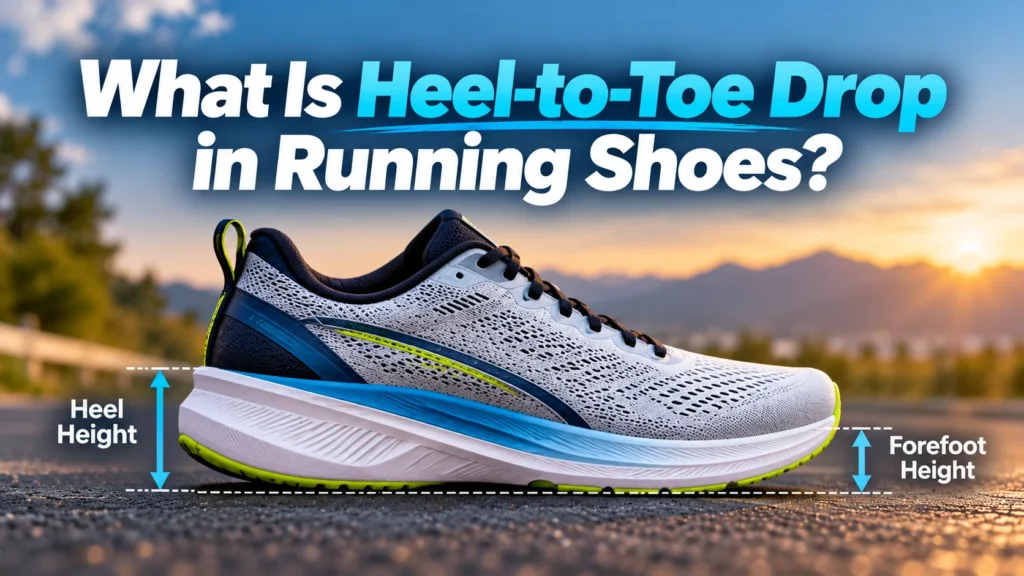
Heel-to-toe drop, also called heel drop or heel-to-toe offset, is the vertical difference between the heel and forefoot heights of a shoe.
Manufacturers usually express that difference in millimeters. The number describes the shoe’s built-in slope rather than its overall thickness.
For example, a running shoe might contain:
- Heel stack height: 36mm
- Forefoot stack height: 28mm
- Heel-to-toe drop: 8mm
The heel sits 8mm higher than the forefoot. That is the drop.
This difference influences the position of your foot inside the shoe. However, cushioning, rocker geometry, flexibility, and your running technique also affect how the shoe feels.
Why Do Running Shoes Have Different Heel Drops?
Shoe manufacturers use different offsets to create distinct running experiences. A higher heel changes the starting position of the ankle compared with a level platform.
Different designs may emphasize different priorities:
- Traditional cushioning: A raised heel can feel familiar to runners accustomed to conventional trainers.
- Lower heel elevation: A flatter platform changes ankle positioning and may increase demands on the calf–Achilles system.
- Running transitions: Heel design works alongside foam and rocker shape to influence the movement from landing to toe-off.
- Personal preference: Some runners prefer a level platform, while others feel more comfortable with heel elevation.
There is no universal reason that every runner should use the same measurement. The best option depends partly on individual adaptation.
How Is Heel-to-Toe Drop Measured?
Heel-to-toe drop is calculated by subtracting forefoot stack height from heel stack height. Both measurements are taken at designated positions along the shoe.
The basic formula is:
Heel-to-Toe Drop = Heel Stack Height − Forefoot Stack Height
Example Heel Drop Calculations
| Heel Height | Forefoot Height | Drop |
|---|---|---|
| 28mm | 28mm | 0mm |
| 32mm | 28mm | 4mm |
| 36mm | 28mm | 8mm |
| 36mm | 26mm | 10mm |
These calculations are illustrative. Actual measurements can vary depending on the manufacturer’s method, included insole, and laboratory testing procedure.
Can You Measure Running Shoe Drop at Home?
You can estimate shoe drop at home, but an accurate measurement is harder than it appears. A ruler against the outside of the midsole may not account for the insole or internal foot position.
- Check the manufacturer’s technical specifications first.
- Look for the listed heel-to-toe offset or drop.
- If both stack heights are provided, subtract the forefoot value from the heel value.
- Compare independent laboratory results when precision matters.
- Use an external ruler measurement only as a rough estimate.
I would trust a properly documented specification before estimating drop from a product photo. Visual appearance can be misleading.
What Is the Difference Between Heel Drop and Stack Height?
Stack height measures how much material sits beneath the foot. Heel drop measures the difference between the heel and forefoot stack heights.
These measurements describe different features. A zero-drop shoe can still contain substantial cushioning.
Real Running Shoe Examples in 2026
| Running Shoe | Heel / Forefoot | Advertised Drop |
|---|---|---|
| Altra Torin 9 | 28 / 28mm | 0mm |
| Saucony Ride 19 | 36 / 28mm | 8mm |
| Brooks Ghost 18 | Not listed here | 10mm |
The manufacturer’s advertised figures show how different shoes can use distinct heel offsets. They do not tell the whole story about softness or comfort.
For instance, the Altra Torin 9 has a level 28mm platform. It is not automatically equivalent to running barefoot.
What Do 0mm, 4mm, 8mm, and 12mm Heel Drops Mean?
These measurements describe increasing amounts of heel elevation. The categories below are practical descriptions rather than universally standardized classifications.
0mm Drop: A Level Platform
A zero-drop running shoe places the heel and forefoot at the same nominal height. It can have minimal cushioning or a relatively thick midsole.
Some runners enjoy the level feel. Others need time to adapt to different calf and Achilles tendon demands.
4mm Drop: A Small Heel Offset
A 4mm drop creates a modest height difference. It is commonly described as a low-drop design.
This may appeal to runners interested in a flatter platform without immediately switching to zero drop. However, the complete shoe design still matters.
8mm Drop: A Moderate Heel Offset
An 8mm drop provides noticeable heel elevation while remaining below many traditional high-drop designs. It appears in several everyday running shoes.
For a runner unfamiliar with shoe geometry, this can be a useful comparison point. It is not a medically established ideal.
10–12mm Drop: A Higher Heel Offset
Running shoes with approximately 10–12mm of drop place the heel farther above the forefoot. These measurements are familiar in traditional training footwear.
Some runners prefer that heel elevation, particularly when coming from similar shoes. It does not guarantee protection from injury.
How Does Heel-to-Toe Drop Affect Running Form?
Heel-to-toe drop can influence ankle position, joint loading, and aspects of running mechanics. Its effects vary between runners and shoe designs.
Research does not show that changing drop automatically produces a particular foot-strike pattern. Speed, experience, cushioning, and individual movement patterns also contribute.
Does Higher Heel Drop Encourage Heel Striking?
Higher-drop shoes can make rearfoot contact feel more natural for some runners. That does not mean everyone wearing them lands on the heel.
Similarly, a zero-drop shoe does not force a forefoot landing. Avoid intentionally changing your foot strike solely because the shoe has a lower offset.
Does Lower Heel Drop Increase Calf and Achilles Loading?
Lower-drop shoes can change ankle mechanics and increase demands on the calf–Achilles system. How much this matters depends on the runner and the footwear.
A review of footwear construction research identifies adaptation as important when moving toward minimalist footwear. Sudden changes can introduce unfamiliar loading.
- Calf muscles: May experience different loading during running.
- Achilles tendon: May face greater demands in some lower-drop conditions.
- Ankle: Moves and bears loads differently depending on shoe geometry.
- Knee: Joint moments may also change as loading shifts.
A lower drop does not automatically improve running technique. It changes one variable within a complex movement.
Is a Lower Heel-to-Toe Drop Better for Preventing Injuries?
There is no strong basis for claiming that lower-drop shoes prevent injuries for all runners. Evidence suggests that individual running experience and adaptation can influence outcomes.
A review discussing a randomized trial of 553 recreational runners found no significant overall injury-risk difference between shoes with 0mm, 6mm, and 10mm drops. Results differed in analyses of occasional and regular runners.
The findings are discussed in this review of running footwear and injury prevention.
Can Zero-Drop Shoes Improve Running Economy?
A 2026 study involving 20 runners examined different heel-to-toe drops in custom footwear. The researchers reported lower metabolic energy use in their zero-drop condition compared with higher-drop conditions.
However, that controlled experiment does not establish that zero drop is the best everyday choice for every runner. Comfort, training history, and injury risk remain important considerations.
You can read the 2026 running economy study for the experimental details.
What if You Already Have Achilles or Foot Pain?
Do not assume changing heel drop will cure an existing problem. Pain can have multiple causes, including training load, footwear fit, and tissue irritation.
A healthcare professional experienced in running injuries can help assess persistent symptoms. This is particularly useful before making a major footwear change.
What Heel-to-Toe Drop Is Best for Beginners?
Beginners should prioritize comfort, proper fit, and a shoe they can use consistently. There is no universally proven heel-drop number that every beginner needs.
If you already walk comfortably in conventional athletic shoes, a familiar offset may be a practical starting point. You can explore different drops once you understand your preferences.
Which Drop Might Suit Different Running Needs?
| Runner Situation | Practical Approach |
|---|---|
| Complete beginner | Prioritize fit and comfort over a specific drop. |
| Comfortable in high-drop shoes | Keep a familiar offset unless there is a reason to change. |
| Interested in zero drop | Introduce the new shoes gradually. |
| Recurring lower-leg discomfort | Seek individualized guidance rather than relying on drop alone. |
I would not recommend choosing a shoe simply because someone describes its drop as more natural. Comfortable footwear that matches your training is the stronger starting point.
How Can You Choose the Right Heel-to-Toe Drop?
Start with what already works for you, then compare shoes that meet your running needs. A thoughtful choice involves more than reading one specification.
- Identify your current shoe: Find its model name and advertised heel-to-toe drop.
- Review your comfort: Consider how your feet and lower legs feel during and after normal runs.
- Compare the whole shoe: Examine cushioning, stack height, stability, weight, and rocker shape.
- Check the fit: Ensure there is adequate toe room and secure heel and midfoot positioning.
- Try a short run: Assess the shoe under realistic conditions when possible.
- Change gradually: Avoid combining a major drop change with a sudden increase in running distance.
A comfortable 8mm shoe might suit you better than an uncomfortable 4mm model. Numbers cannot replace a proper fit.
How Do You Transition From High-Drop to Low-Drop Running Shoes?
Transitioning gradually allows your muscles and tendons to experience unfamiliar loading without immediately replacing all your usual training. There is no universal transition schedule that guarantees safety.
The following steps offer a conservative starting framework:
- Begin with walking: Wear the new shoes for short, comfortable periods.
- Add brief runs: Introduce small amounts of easy running on familiar surfaces.
- Keep your old shoes: Continue using familiar footwear for most training initially.
- Watch your recovery: Notice unusual calf tightness, tendon pain, or persistent soreness.
- Increase exposure gradually: Add time only when the previous amount feels comfortable.
- Adjust when needed: Reduce or stop exposure if symptoms develop, and seek professional advice for persistent pain.
Lower-drop footwear can be a reasonable choice, but adaptation matters. A rushed transition may create problems unrelated to the shoe’s overall quality.
For additional guidance, see this healthcare discussion of zero-drop footwear.
What Mistakes Should You Avoid When Choosing Heel Drop?
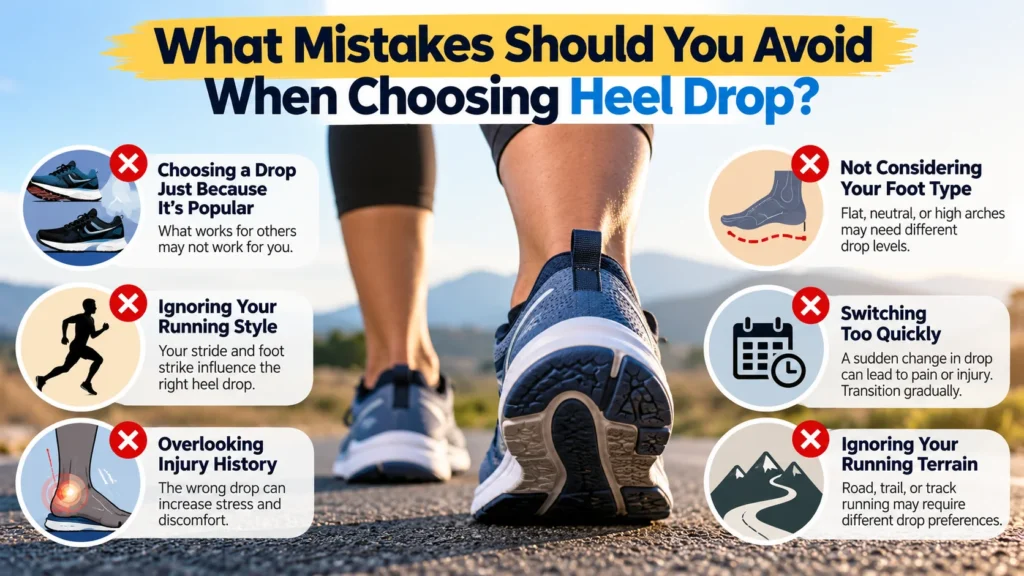
Many running shoe decisions go wrong because buyers focus on a single technical number. Several avoidable mistakes deserve attention.
- Confusing drop with cushioning: Zero drop does not mean zero cushioning.
- Assuming lower is always better: Individual comfort and biomechanics vary.
- Changing too quickly: Sudden transitions may overload tissues unaccustomed to the new design.
- Ignoring fit: An ideal-looking drop cannot compensate for a poorly fitting shoe.
- Following foot-strike myths: Heel striking is not automatically evidence of poor technique.
- Comparing different models by drop alone: Foam, flexibility, and rocker geometry also matter.
- Using shoe drop as treatment: Persistent injuries require assessment rather than guesswork.
One practical habit is to compare new shoes against a familiar model rather than an arbitrary target. That makes changes easier to understand.
Which Running Shoes Demonstrate Different Heel-to-Toe Drops?
If you want to compare real designs, these three current models illustrate zero, moderate, and higher heel-to-toe offsets. The selections are specification-based examples rather than hands-on performance test winners.
🏆 Moderate-drop daily trainer
Saucony Ride 19
★★★★½ 4.5/5 editorial fit
The Ride 19 features an 8mm offset, 36mm heel stack, 28mm forefoot stack, and PWRRUN+ cushioning. I would shortlist it for runners seeking a conventional, moderate-drop daily trainer.
Trade-off: Not a level-platform option for runners specifically seeking zero drop.
👟 Traditional higher-drop option
Brooks Ghost 18
★★★★☆ 4.0/5 editorial fit
The Ghost 18 uses a 10mm advertised drop and DNA LOFT v3 cushioning. I would consider it for runners who prefer a familiar, heel-elevated daily training design.
Trade-off: Less appealing for someone seeking a flatter shoe with minimal heel elevation.
🌿 Cushioned zero-drop option
Altra Torin 9
★★★★☆ 4.0/5 editorial fit
The Torin 9 pairs a 0mm drop with a 28mm stack, P35X dual-density foam, and a Vibram XS DURA outsole. I would shortlist it for runners specifically interested in a cushioned, level platform.
Trade-off: Runners accustomed to high-drop footwear may need a careful transition.
Editorial fit ratings are comparative judgments based on verified design characteristics and intended use, not customer ratings or claims of hands-on testing. Product availability and prices may change.
Frequently Asked Questions About Heel-to-Toe Drop
Is 8mm Heel-to-Toe Drop Good for Running?
Yes, an 8mm drop can be a good choice for many runners. It provides moderate heel elevation and appears in versatile daily trainers. However, comfort, shoe fit, training history, and individual biomechanics matter more than treating 8mm as an ideal measurement.
Is Zero Drop Better Than 10mm Drop?
Neither is universally better. Zero-drop shoes provide a level heel-to-forefoot platform, while 10mm shoes elevate the heel. Both can work for running, but they may produce different loading patterns. The better choice depends on your adaptation, comfort, and training needs.
Does Heel-to-Toe Drop Affect Walking Shoes?
Yes. Heel-to-toe drop also describes the height difference in walking shoes. It can influence how footwear feels during standing and walking, although sole flexibility, cushioning, stability, and fit remain important. A lower drop is not automatically preferable for every walker.
Does a Higher Heel Drop Reduce Achilles Tendon Stress?
Higher heel elevation may reduce certain demands on the calf–Achilles system under some conditions. However, that does not prove high-drop shoes prevent Achilles injuries. Runners experiencing tendon pain should avoid self-prescribing footwear changes without considering training load and professional guidance.
Can You Switch From 12mm to 0mm Running Shoes?
Yes, but a significant change should be introduced gradually. Start with comfortable walking and short easy runs, while maintaining familiar footwear for most training. Monitor recovery and reduce exposure if pain develops. There is no single transition timetable suitable for everyone.
Final Takeaway: Does Heel-to-Toe Drop Really Matter?
Heel-to-toe drop matters because it describes an important part of running shoe geometry. It can influence ankle position, loading patterns, and how a shoe feels during movement.
But drop is only one piece of the decision. Cushioning, stack height, flexibility, fit, and your training history also deserve attention.
My recommendation: Start with a shoe that feels comfortable, understand its current drop, and make changes only when there is a good reason. Choose the complete running shoe, not just the number printed on its specification sheet.
Before buying your next pair, compare the heel drop, cushioning, and fit of at least two models. A thoughtful comparison is more useful than chasing a supposedly perfect measurement.