
Quick Answer
Yes, this Puma Velocity Nitro 3 review finds it worth buying at a discount if you have narrow or average feet. Its PUMAGRIP outsole scored 0.60 in RunRepeat’s traction test, above the 0.53 average. The $135 daily trainer handles easy runs and faster workouts, but the narrow toe box limits comfort.
What to know before buying:
- Balanced foam cushioning for daily road miles.
- Excellent wet-road grip at a reasonable price.
- Limited toe space for wide feet.
🏆 Standout for wet-road training
Overall
Grip
Sale value
Cushioning
Ratings: OutdoorGearLab, converted to five stars.
Best for: Neutral runners with narrow to average feet.
Not ideal for: Wide feet and runners seeking plush cushioning.
Original list price: $135. Live Amazon price varies.
As an Amazon Associate, I earn from qualifying purchases.
Category Scores — OutdoorGearLab
Cushioning — 8/10
Upper comfort — 7/10
Stability — 6/10
Weight — 5.3/10
Traction — 9/10
By Steven Tyler
Finding one shoe for slow runs and quick workouts can be tough. The Velocity Nitro 3 aims to fill both roles without a premium price.
I reviewed published lab measurements and independent road tests to see where this shoe excels. The OutdoorGearLab running tests gave traction its highest category mark, but weight earned much less.
What Is the Puma Velocity Nitro 3 and Who Is It For?
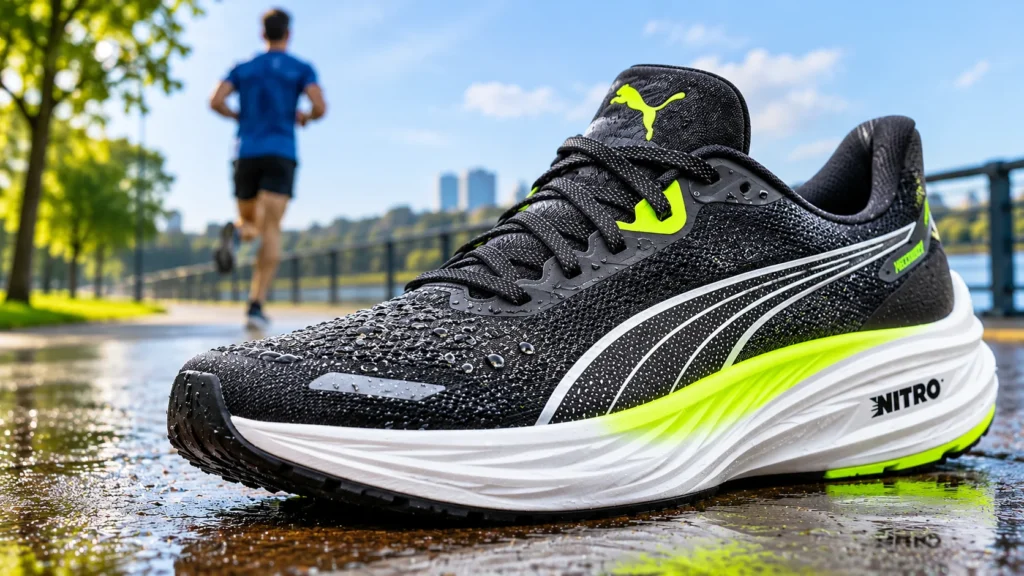
The Velocity Nitro 3 is a neutral road shoe for regular training. Puma pairs nitrogen-infused foam with an EVA base to balance comfort and support.
It works for new runners who want one reliable pair. Experienced runners can also use it between harder workouts in a shoe rotation.
- Run on roads in dry and wet weather.
- Prefer a close, secure fit.
- Want one shoe for varied training paces.
- You need more toe room.
- You prefer a low heel-to-toe drop.
- You require dedicated stability support.
Puma Velocity Nitro 3 Pros and Cons
Grip is the biggest strength, while fit is the largest concern. The snug upper can hold your foot well or squeeze it, depending on foot shape.
- Traction earned an impressive 9/10 in OutdoorGearLab’s independent assessment.
- Balanced cushioning earned 8/10 in independent running shoe tests.
- Flexible forefoot supports a smooth stride at varied speeds.
- Durable heel lining scored 4/5 in controlled abrasion testing.
- The tapered toe box offers limited space for wide feet.
- Firmer EVA reduces the lively feel of NITRO foam.
- Thin tongue padding can cause pressure under tight laces.
- Higher heel drop won’t suit every runner’s stride preferences.
Puma Velocity Nitro 3 Key Features — What Independent Tests Show
1. Is PUMAGRIP good on wet roads?
Yes, grip is a major reason to choose this shoe. RunRepeat recorded a forefoot traction result of 0.60, against a 0.53 average.
Forefoot traction — RunRepeat lab sample (higher is better)
Highest observed — 1.05
Velocity Nitro 3 — 0.60
Sample average — 0.53
Lowest observed — 0.11
Measured traction, not subjective ratings. Bars scaled to the observed maximum.
Takeaway: Grip beats the lab average, but it is not the highest measured result.
Choose this shoe for rainy road runs, not icy paths or deep mud.
2. How soft is the NITRO cushioning?
The ride feels balanced rather than pillow-soft. The dual-layer midsole combines a responsive top foam with a firmer EVA layer.
Takeaway: RunRepeat measured heel shock absorption at 127 SA, near its 131 SA average.
3. Does the shoe run narrow?
Yes, the standard upper tapers toward the toes. RunRepeat measured 70.4 mm at the big toe, below its 73.2 mm average.
Takeaway: True-to-size length does not guarantee enough width.
Don’t buy a longer size just to solve a width problem. Try a wide version if available.
4. Can it handle faster runs?
It can handle steady runs and faster training sessions without a plate. The 264 g lab weight keeps it in typical daily trainer territory.
Takeaway: Versatility matters more here than low weight.
Forefoot energy return measured 58.2%, below RunRepeat’s 61.5% average. Expect a dependable ride, not the spring of a dedicated racing shoe.
5. How breathable is the mesh upper?
The engineered mesh allows good airflow near the toes. RunRepeat awarded breathability 4/5 against a 3.6/5 test average.
Takeaway: Airflow is good overall, but the midfoot is less open.
Try the shoe with your normal running socks before removing the tags.
6. How well does the outsole hold up?
The outsole showed decent wear resistance in lab testing. Its rubber lost 1.0 mm during the abrasion test, compared with a 1.1 mm average.
Takeaway: Strong grip does not come with unusually fast lab-tested wear.
How Does the Puma Velocity Nitro 3 Perform in Real Tests?
Grip exceeds the lab average, but energy return falls short.
0.60 vs 0.53 average
4/5 vs 3.6/5 average
58.2% vs 61.5% average
1.0 mm vs 1.1 mm average
70.4 mm vs 73.2 mm average
Source: RunRepeat’s cut-in-half lab review. These are separate measured traits, not invented performance grades.
Puma Velocity Nitro 3 Full Specifications
Here are the key dimensions and design details. Official figures and independent lab measurements can differ.
| Specification | Details |
|---|---|
| Design and dimensions | |
| Shoe type | Neutral road trainer |
| Weight (lab) | 264 g / 9.3 oz |
| Heel stack (official) | 36 mm |
| Heel-to-toe drop (official) | 10 mm |
| Heel / forefoot stack (lab) | 34.8 / 25.5 mm |
| Materials and features | |
| Midsole | NITROFOAM + EVA |
| Outsole | PUMAGRIP rubber |
| Upper | Engineered mesh |
| Tongue | Fully gusseted |
| Removable insole | ✓ Yes |
| Carbon plate | ✗ No |
| Reflective elements | ✓ Yes |
| Original US list price | $135 |
How Does the Puma Velocity Nitro 3 Compare to Competitors?
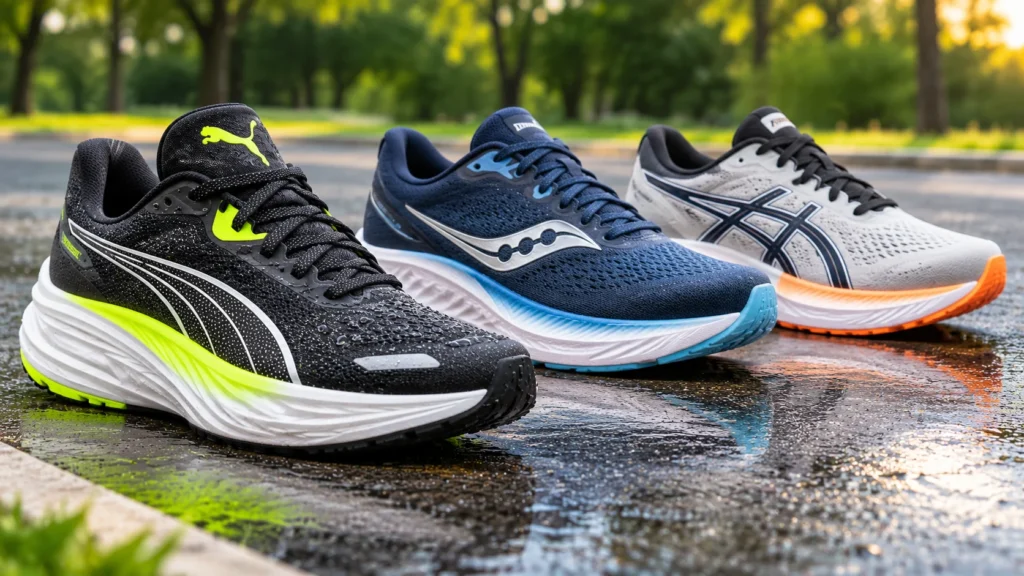
The Puma favors grip and a close fit. The Saucony Ride 17 offers more room, while the ASICS GEL-Cumulus 26 has a broader base.
Puma Velocity Nitro 3 vs Saucony Ride 17
Choose the Ride 17 for a roomier upper and softer feel. Its PWRRUN+ midsole and 8 mm drop suit relaxed daily miles.
Puma Velocity Nitro 3 vs ASICS GEL-Cumulus 26
The Cumulus 26 has a wider platform and more stack height. Its stiffer sole creates a different rolling feel.
| Feature | Velocity Nitro 3 | Ride 17 | Cumulus 26 |
|---|---|---|---|
| List price | $135 | $140 | $140 |
| Drop | 10 mm | 8 mm | 8 mm |
| Fit | Snug | Roomier | Moderate |
| Ride | Balanced | Soft | Stiffer |
| Best for | Wet roads | Easy miles | Broad platform |
The table shows original list prices. The Road Trail Run comparison supports these differences. Fit should guide your final choice.
Puma Velocity Nitro 3 Pricing — Is It Worth the Price?
At its original $135 list price, the Puma was competitive. As an older model, it makes more sense at a meaningful discount.
A third-party listing showed $101.40, but live Amazon pricing and the all-time Amazon low remain unverified. Prices vary by size and color.
Puma Velocity Nitro 3 Neutral Daily Road Running Shoes
Check available sizes and compare the cost with newer Velocity models.
Who Should Buy the Puma Velocity Nitro 3?
- Beginners building a steady running habit.
- Regular road runners seeking versatile training shoes.
- Runners with narrow feet who like secure uppers.
- Wide-footed runners who need extra toe room.
- Runners seeking maximum rebound for speed sessions.
- Anyone needing a dedicated stability shoe.
What Are Real Buyers Saying About the Puma Velocity Nitro 3?
Public running community reports highlight strong grip and a secure upper. A recurring complaint is the tight fit, though individual experiences differ.
Amazon rating and review count: Not independently verified.
Reported positives
- Grippy rubber feels reassuring on damp roads and paths.
- Balanced cushioning works for both slower and faster miles.
Reported drawbacks
- The toe box can squeeze feet with wider forefeet.
- Some runners find the close-fitting upper warm in summer.
Final Verdict — Is the Snug Fit Worth It?
The Puma Velocity Nitro 3 is worth buying on sale if its fit matches your foot. Its best feature is dependable grip, which benefits runners who train through wet weather.
The main reason to skip it is that narrow upper. Compare newer Velocity models if their prices are similar.
Puma Velocity Nitro 3 Running Shoes for Daily Training
A practical choice for runners who value road grip and a close fit.
Frequently Asked Questions
Is the Puma Velocity Nitro 3 good for beginners?
Yes, it suits new runners who want one pair for regular road runs. Its balanced foam handles easy efforts and faster sessions. Check the toe box before buying, especially if ordinary running shoes often squeeze your feet.
Does the Puma Velocity Nitro 3 run true to size?
Independent testers generally find its length true to size, but the upper fits snugly. Start with your normal running shoe size and check toe space. If the sides press against your foot, look for a wider option rather than simply sizing up.
Is the Puma Velocity Nitro 3 good for long runs?
Yes, it has enough cushioning for many runners’ long training runs. The balanced ride works well at steady paces. Runners who need extra toe space as their feet swell should try it carefully, since the tapered upper may limit comfort over longer distances.
Is the Puma Velocity Nitro 3 waterproof?
The standard mesh model is not waterproof. Its grippy rubber sole works well on damp roads, but water can still enter through the upper. Choose footwear designed for wet conditions if keeping water out matters more to you than airflow.
Is the Puma Velocity Nitro 3 a stability shoe?
No, it is a neutral running shoe. The firmer EVA base provides some structure, but it does not offer dedicated stability features. If you already prefer a supportive running shoe, compare it with a stability model before making a switch.
Is the Velocity Nitro 3 still worth buying?
Yes, provided the price is low enough and the fit works for you. Newer Velocity trainers offer updated midsole designs, so compare their prices before buying. The older model remains useful for daily road running when you find a good discount.