
Quick Answer
Yes, carbon-plated running shoes can be good for beginners, but they’re usually unnecessary for someone just starting to run. These shoes may improve running efficiency, yet their stiff construction, specialized cushioning, and higher prices aren’t ideal for everyone. Most new runners should start with comfortable daily trainers and consider carbon-plated models when preparing for faster workouts or races. Understanding the differences between neutral and stability running shoes can help you choose a suitable starting point.
What Beginners Should Know
- Beginner suitability: You don’t need to reach a particular speed before trying carbon-plated shoes.
- Performance benefits: Some models reduce the energy needed to maintain a running pace.
- Comfort matters: A stiff plate or aggressive rocker can feel unnatural to some beginners.
- Training priorities: Consistency, gradual progression, and suitable footwear matter more than racing technology.
- Best first choice: A comfortable daily trainer is generally more practical for learning to run.
Simple Buying Rule
- New to running: Build consistency in a comfortable everyday shoe first.
- Training for a race: Consider a less aggressive carbon-plated trainer after testing its fit and running feel.
Carbon-plated running shoes are everywhere in 2026, and their performance claims can be tempting. If you’re beginning your running journey, you might wonder whether these shoes will make running easier.
I prefer to separate useful shoe technology from marketing promises. This guide explains how carbon plates work, what research shows, and when buying a plated shoe makes sense.
What Are Carbon-Plated Running Shoes?
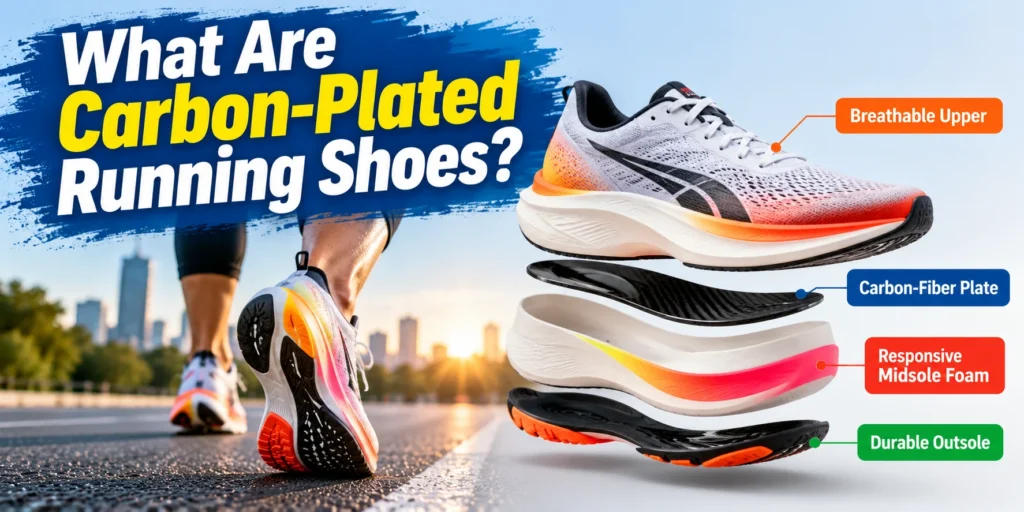
Carbon-plated running shoes contain a stiff carbon-fiber plate within the midsole, usually combined with lightweight, responsive cushioning. Their design aims to improve the mechanical efficiency of running.
The midsole is the cushioning layer between your foot and the ground. Many performance models also use a curved sole called a rocker, which helps guide your foot forward.
How Does the Carbon Plate Work?
The plate increases the shoe’s lengthwise stiffness and helps influence how the foot moves through each stride. However, the plate alone doesn’t generate free energy or automatically make you faster.
- Carbon-fiber plate: Adds stiffness and changes how the shoe bends during toe-off.
- Responsive foam: Compresses under load and returns some stored energy.
- Rocker geometry: Helps guide the transition from landing to push-off.
- Lightweight construction: May reduce the effort associated with moving the shoes.
These features work together. A carbon plate placed inside an ordinary shoe won’t necessarily deliver the same benefits as a carefully designed racing model.
Are All Plated Running Shoes the Same?
No. Carbon-fiber racing shoes, carbon-plated training shoes, and nylon-plated models can feel noticeably different.
Racing models usually prioritize speed and low weight. Training-oriented plated shoes often balance responsiveness with greater comfort, traction, and practical durability.
What Are the Benefits of Carbon-Plated Shoes for Beginners?
Beginners can experience some of the same performance benefits as experienced runners. The important question is whether those benefits justify the cost and trade-offs.
1. They May Improve Running Economy
Running economy describes how much energy your body needs to run at a particular speed. Better running economy means using less energy while maintaining that pace.
A 2026 systematic review and meta-analysis found that carbon-plated footwear reduced metabolic demand by approximately 2–3% across measured outcomes.
However, that percentage isn’t a guaranteed improvement in race time. The researchers also noted that foam and shoe geometry contribute to the combined effect.
2. They Can Make Faster Running Feel Smoother
Some runners enjoy the rolling sensation created by responsive foam and a curved plate. This design may make the transition through toe-off feel more fluid.
That sensation varies across models and runners. An aggressive racing shoe might feel exciting during intervals but awkward during an easy jog.
3. They Can Support Race-Day Goals
Carbon-plated shoes may appeal to beginners preparing for their first organized 5K, 10K, or half marathon. A suitable model can offer a responsive option for faster training and racing.
However, a new shoe won’t replace endurance training. Your fitness and pacing strategy remain central to completing a successful race.
Can Beginners Benefit From Carbon-Plated Shoes at Slow Speeds?
Yes. Research indicates that some advanced running shoes provide measurable efficiency benefits even at slower recreational running speeds.
A 2026 crossover study of 14 moderately trained runners compared advanced footwear with traditional running shoes at speeds between 7.5 and 12 km/h.
The advanced shoe improved running economy throughout the tested speed range. However, the participants already had running experience, so the results don’t prove identical benefits for complete beginners.
Do You Need to Run Fast to Use Carbon Plates?
No minimum speed is required for ordinary recreational use. A beginner running at an easy pace can wear carbon-plated shoes if they fit comfortably.
Still, the efficiency benefit varies by shoe design and individual runner. Faster runners aren’t the only potential beneficiaries, and slower runners aren’t guaranteed the same results.
My practical rule: Judge a shoe at the pace you actually run, not the pace shown in a product advertisement.
What Are the Disadvantages of Carbon-Plated Shoes for New Runners?
The main disadvantages are cost, specialized running feel, and potentially limited suitability for everyday training. These trade-offs matter when you’re still developing running habits.
1. The Stiff Design May Feel Unnatural
A carbon plate makes the midsole resist bending. Some runners enjoy that firm, rolling sensation, while others prefer a more flexible shoe.
A steep rocker can also change how your foot moves through a stride. Try the shoe while jogging instead of judging it only while standing.
2. Some Models Feel Less Stable
Highly cushioned racing shoes can have soft midsoles or narrow platforms. Depending on their geometry, certain models may feel less secure during turns or uneven landings.
This doesn’t mean every carbon-plated shoe is unstable. Many training-oriented versions have broader bases and more controlled cushioning.
3. They May Cost More Than Necessary
Carbon-plated footwear often uses specialized foam, plates, and lightweight materials. Those technologies can increase the purchase price.
If you’re running short, comfortable sessions several times weekly, you might gain more practical value from a conventional daily trainer.
4. Not Every Model Is Designed for Daily Training
Some premium racing shoes prioritize speed over outsole coverage and long-term training versatility. Their lightweight construction may involve durability trade-offs.
Other carbon-plated models are specifically designed for regular workouts. Check the manufacturer’s intended use before buying.
Carbon-Plated vs Regular Running Shoes: Which Is Better for Beginners?
Regular daily trainers are generally the more versatile starting point. Carbon-plated shoes become more appealing when you want a specialized option for faster sessions.
| Feature | Regular Daily Trainer | Carbon-Plated Shoe |
|---|---|---|
| Main purpose | Everyday mileage | Responsive workouts or racing |
| Plate | Usually none | Carbon-based stiffening plate |
| Flexibility | Often more flexible | Usually stiffer lengthwise |
| Running feel | Often familiar and versatile | Often springy or rolling |
| Stability | Varies by construction | Varies; some racing designs feel less stable |
| Typical value | Practical for regular training | More specialized performance features |
| Beginner recommendation | Best default choice | Optional second shoe |
These are category-level differences, not universal rules. Some modern plated trainers feel comfortable enough for daily use.
Who Should Consider Carbon-Plated Running Shoes?
Carbon-plated shoes make the most sense for beginners who already run comfortably and have a specific performance goal. They’re less necessary for someone building their first consistent routine.
Beginners Who May Benefit
- First-time racers: Runners preparing for an organized event and looking for a responsive race-day option.
- Consistent new runners: People who already complete regular runs without discomfort.
- Speed-work beginners: Runners beginning controlled tempo sessions or intervals.
- Comfortable plated-shoe users: People who find a particular model supportive and natural during jogging.
Beginners Who Should Probably Wait
- Brand-new runners: Those still developing a sustainable walk-run routine.
- Budget-focused buyers: Anyone needing one dependable pair for most workouts.
- Runners with uncertain fit: Those who haven’t found a comfortable shoe size and width.
- Runners with recurring pain: Those who need professional assessment rather than performance-focused footwear experiments.
How Should Beginners Choose Their First Carbon-Plated Shoes?
Start with fit, intended use, and stability rather than the stiffness of the carbon plate. A suitable model should feel comfortable and predictable at your normal pace.
1. Get the Fit Right
Your toes need space to move without your heel slipping excessively. Check length, width, and pressure around the midfoot.
Our guide on how much toe room running shoes need explains how to evaluate front-foot space.
2. Check the Shoe’s Width
Some performance shoes use close-fitting uppers to reduce movement. That design isn’t comfortable for every foot shape.
Compare the midsole platform with your forefoot width. The guide to running shoe width and sizing provides additional fit checks.
3. Consider Heel-to-Toe Drop
Heel-to-toe drop measures the height difference between the shoe’s heel and forefoot. An 8 mm drop means the heel sits 8 mm higher than the forefoot.
Different drops can influence running feel and lower-limb loading. If your current shoes are comfortable, avoid changing multiple design features unnecessarily.
4. Test Stability and Comfort
A shoe should feel secure when moving straight ahead and making gentle turns. Pay attention to sideways wobbling or excessive pressure.
The American Orthopaedic Society for Sports Medicine emphasizes choosing comfortable shoes that accommodate your foot anatomy.
You can also explore whether running shoes need additional arch support before selecting a specialized design.
How Can Beginners Start Running in Carbon-Plated Shoes Safely?
Introduce carbon-plated shoes gradually rather than replacing every training run immediately. This gives you an opportunity to assess how your feet and legs respond.
I recommend a simple two-pace comparison instead of an aggressive break-in schedule. First test comfortable jogging, then assess a slightly faster effort on another suitable run.
A Practical Four-Step Introduction
- Start with an easy trial: Try approximately 10–15 minutes of relaxed running, provided you’re already comfortable covering that duration.
- Check the response: Notice unusual foot pressure, instability, blisters, or discomfort during and after running.
- Add a controlled workout: On another day, try a few short, comfortable faster efforts if your fitness allows.
- Increase use gradually: Keep your regular trainers available and expand plated-shoe use only when comfortable.
These durations are practical starting suggestions, not medically validated requirements. Adjust them to your current ability and running experience.
Should You Wear Carbon-Plated Shoes Every Day?
You can wear training-oriented plated shoes regularly if they’re comfortable and designed for that purpose. However, beginners don’t need to depend on them for every session.
Using conventional trainers for easy runs and plated shoes for selected workouts is a practical option. It also reduces the need to use premium racing footwear for every mile.
Do Carbon-Plated Running Shoes Increase Injury Risk?
Current evidence doesn’t establish that carbon-plated shoes inherently increase injury rates. However, long-term injury research specific to these shoes remains limited.
A 2026 biomechanical systematic review found no consistent differences in several joint-power measures or leg stiffness between carbon-plated and non-plated shoes.
Those findings concern biomechanics, not long-term injury outcomes. They cannot prove that either category prevents injuries.
What Should Beginners Watch For?
- Persistent calf or Achilles discomfort: Reassess the shoe and training load.
- Forefoot pressure: Check whether the fit, plate geometry, or cushioning causes discomfort.
- Unstable landings: Avoid models that feel difficult to control.
- Recurring pain: Stop aggravating activity and seek qualified medical advice.
A Cochrane review on running shoes and injuries also found limited evidence that shoe categories consistently prevent lower-limb injuries.
That review wasn’t a dedicated carbon-plate injury trial. Its findings reinforce the importance of avoiding broad injury-prevention promises.
What Mistakes Should Beginners Avoid When Buying Carbon-Plated Shoes?
The biggest mistake is assuming expensive racing technology guarantees better running. The wrong shoe can feel uncomfortable regardless of its advertised performance.
- Buying only for speed: Choose shoes that feel suitable at your current running pace.
- Ignoring comfort: Don’t accept painful pressure because a shoe has premium technology.
- Choosing an extreme design: Highly aggressive racing geometry may be unnecessary for ordinary beginner workouts.
- Changing footwear suddenly: Introduce unfamiliar shoes gradually and monitor your response.
- Expecting injury protection: Carbon plates aren’t medical support devices.
- Ignoring intended use: A racing model and an everyday plated trainer may have different practical strengths.
- Buying the wrong width: A cramped performance upper can cause discomfort even when shoe length is correct.
My preferred buying question is simple: Would this shoe still feel useful without the promised speed advantage?
If the answer is no, a comfortable conventional trainer is probably a better investment.
Which Carbon-Plated Running Shoes Are Worth Comparing in 2026?
For beginners interested in plated footwear, I would compare training-oriented models before aggressive premium racers. The following shoes have manufacturer-confirmed carbon-based plate technology.
| Model | Plate | Listed Drop | Main Use |
|---|---|---|---|
| PUMA Deviate NITRO 4 | Carbon-fiber PWRPLATE | 8 mm | Responsive road training |
| Nike Zoom Fly 6 | Full-length carbon Flyplate | 8 mm | Training and racing |
| ASICS Magic Speed 5 | Full-length carbon-infused TPU plate | 7 mm | Speed sessions and racing |
Specifications reflect manufacturer-published model information. Availability and product variations may differ by market.
Recommended Carbon-Plated Running Shoes for Beginners
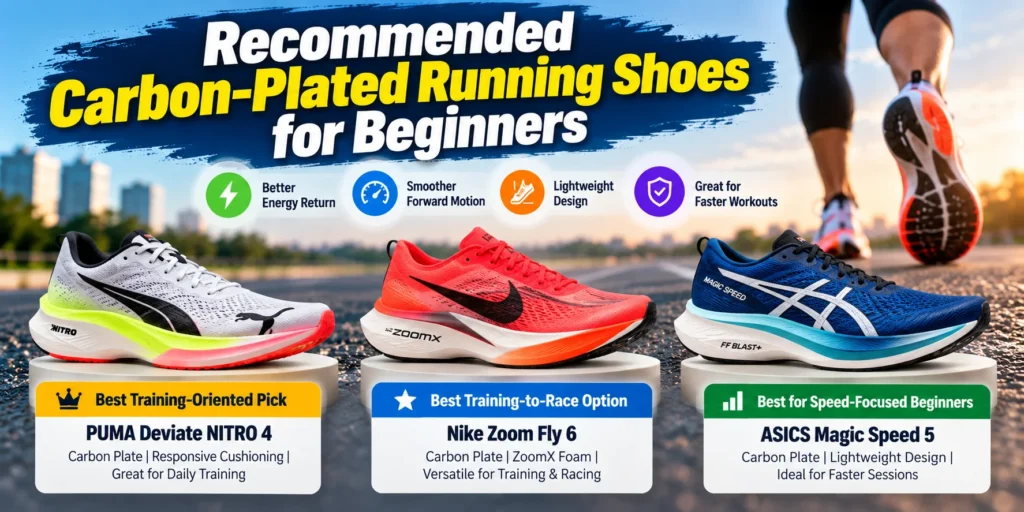
If you’ve decided to try carbon plates, these three models offer different approaches. My ratings assess beginner suitability from verified design features, intended use, and trade-offs rather than personal wear tests or customer-review scores.
🏆 Best Training-Oriented Pick
PUMA Deviate NITRO 4
★★★★½ 4.5/5
PUMA combines a carbon-fiber PWRPLATE, NITROFOAM cushioning, an 8 mm drop, and a rubber outsole. I consider its everyday-training focus particularly relevant for beginners seeking versatility. Fit and stability still require an individual trial.
⚡ Best Training-to-Race Option
Nike Zoom Fly 6
★★★★☆ 4.0/5
The Zoom Fly 6 combines responsive ZoomX foam with a full-length carbon-fiber Flyplate and an 8 mm drop. Its training-and-racing positioning makes it a useful comparison for developing runners. The stiff ride may not suit everyone.
🚀 Best for Speed-Focused Beginners
ASICS Magic Speed 5
★★★½☆ 3.5/5
ASICS uses FF LEAP and FF BLAST PLUS cushioning with a full-length carbon-infused TPU plate. Its lighter, more speed-focused construction appeals to runners emphasizing faster sessions. I would prioritize it below versatile daily trainers for complete beginners.
Product note: These are editorial comparisons, not claims of hands-on testing. Amazon links open product searches, so confirm the exact model, size, seller, and current price before purchasing.
Frequently Asked Questions
Are Carbon-Plated Running Shoes Worth It for Beginners?
Carbon-plated shoes can be worth buying if you’re consistently running, preparing for races, and comfortable with their design. However, most complete beginners don’t need them. A well-fitting daily trainer usually offers better versatility while you develop endurance, running technique, and consistent training habits.
Can Beginners Wear Carbon-Plated Shoes for a 5K?
Yes. Beginners can use carbon-plated shoes for a 5K if the shoes fit comfortably and have already been tested during training. There’s no minimum racing distance or speed required. However, don’t introduce an unfamiliar pair on race day, and don’t expect technology to replace preparation.
Are Carbon-Plated Shoes Good for Slow Runners?
Some carbon-plated shoes can improve running economy at slower speeds. A 2026 study found benefits between 7.5 and 12 km/h in moderately trained recreational runners. Results differ among individuals and models, so comfort and overall suitability should guide the final decision.
Do Carbon-Plated Shoes Make Beginners Run Faster?
They may improve efficiency and help some beginners maintain a faster pace at a given effort. However, better running economy doesn’t guarantee a specific improvement in race time. Fitness, pacing, weather, course conditions, and individual response still affect performance.
Can You Use Carbon-Plated Shoes for Everyday Running?
Yes, some carbon-plated trainers are designed for frequent use. Others focus primarily on racing and faster workouts. Check the manufacturer’s intended purpose and evaluate comfort, stability, and outsole construction. For many beginners, alternating a daily trainer with a plated shoe is a practical approach.
Final Verdict: Should Beginners Buy Carbon-Plated Running Shoes?
Carbon-plated shoes can be good for beginners, but they’re optional rather than essential. Their main appeal is improved running efficiency and responsive performance, not guaranteed comfort or injury prevention.
If you’re just beginning, I recommend choosing a dependable daily trainer first. Once you’re running regularly, consider a training-oriented carbon-plated model if it supports your goals and feels comfortable.
The best running shoe isn’t necessarily the most advanced one. It’s the shoe that helps you run consistently, comfortably, and confidently.