
Quick Answer
To choose arch support for running shoes, start by identifying your arch height, then evaluate comfort, stability, and fit while moving. Low arches may benefit from stability features, while high arches often feel better with comfortable cushioning. However, arch shape alone cannot determine the right shoe. The American Podiatric Medical Association provides useful starting recommendations for different foot types.
5 Steps to Choose the Right Arch Support
- 1. Identify your arch: Check whether your feet appear low, medium, or high when standing.
- 2. Consider foot movement: Notice how comfortably your feet move while walking and running.
- 3. Choose a shoe category: Compare neutral cushioned shoes with stability models.
- 4. Check arch comfort: Avoid concentrated pressure, pinching, or uncomfortable rubbing beneath your arch.
- 5. Test the complete fit: Jog briefly and confirm that your heel, midfoot, and toes feel secure.
Best rule: Choose support that feels comfortable during running, not simply the firmest or highest arch support available.
Choosing arch support for running shoes can get confusing fast. Shoe labels promise stability, cushioning, and motion control, but they rarely explain what your feet actually need.
I prefer a practical approach: understand your foot shape, compare how shoes feel, and test them in motion. This guide explains each step, including when additional insoles may help.
What Is Arch Support in Running Shoes?
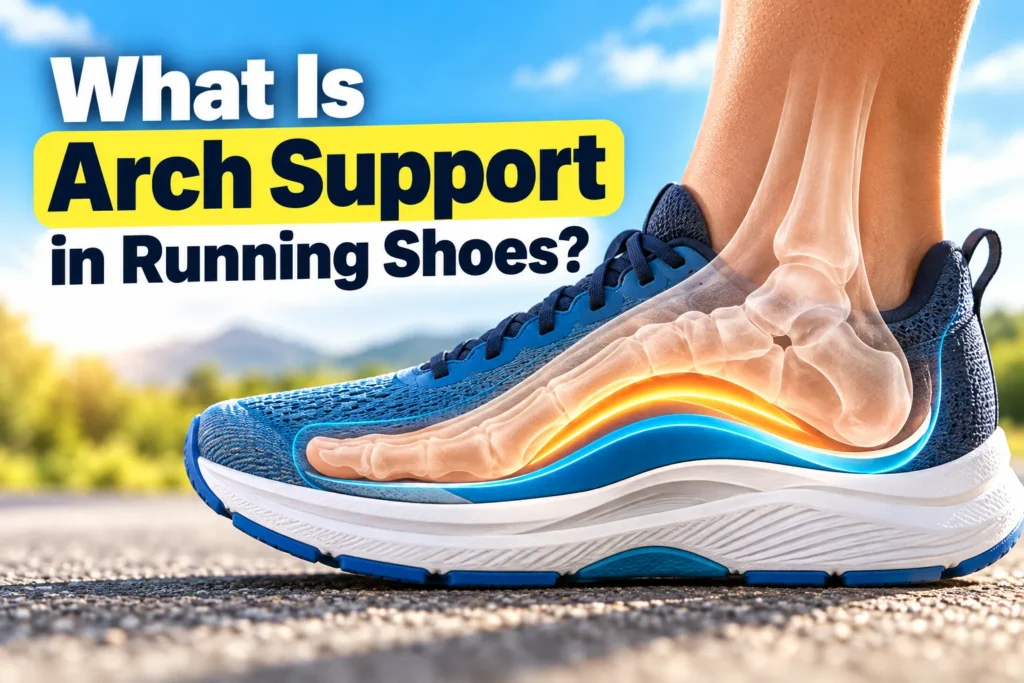
Arch support refers to shoe features that help accommodate the curved middle section of your foot. These may include a shaped footbed, midsole geometry, or supportive materials beneath the arch.
Good support should feel comfortable and work with your natural movement. It shouldn’t force your foot into an uncomfortable position.
How does arch support work?
Your foot arch helps manage forces as you walk and run. It changes shape slightly as your foot accepts weight and prepares to push forward.
Running shoe support can influence how pressure feels beneath the foot. Stability features may also change how the foot moves within the shoe.
- Contoured footbeds: Provide a shaped surface beneath the arch.
- Midsole cushioning: Compresses under load and affects underfoot comfort.
- Stable platforms: Use wider bases or supportive sidewalls to improve the feeling of steadiness.
- Guidance technologies: Influence movement through specific midsole structures.
- Removable insoles: Allow replacement with compatible inserts when additional support is needed.
Arch support and stability are related, but they’re not identical. A shoe can feel stable without having a prominent arch bump.
How Do You Know Whether You Have Low, Normal, or High Arches?
You can estimate your arch height using a simple footprint test and visual inspection. These methods provide clues, not a medical diagnosis or a complete running-shoe prescription.
Step 1: Try the wet footprint test
- Wet the bottom of one foot lightly.
- Stand normally on a piece of paper that shows a clear footprint.
- Step away and examine the middle section.
- Repeat with your other foot.
- Compare the prints with the descriptions below.
| Arch Type | Footprint Appearance | Starting Shoe Choice |
|---|---|---|
| Low arch | Much of the middle foot contacts the paper | Comfortable neutral or stability shoes |
| Medium arch | A moderate curved gap appears inside the footprint | Neutral cushioned shoes first |
| High arch | Only a narrow middle strip may appear | Comfortable, cushioned neutral shoes |
Important: A footprint records contact while standing, not how your foot behaves during running. Moisture, paper type, and body position also affect the result.
Step 2: Observe your feet while standing
Stand barefoot with your weight distributed evenly. Look at your arches from the inside of each foot.
Notice whether the arch remains visible, lowers toward the floor, or appears unusually pronounced. Check both feet because they may differ.
Step 3: Watch your running movement
Ask someone to record a short video from behind while you run comfortably. Look for large differences between your feet, but avoid diagnosing overpronation from video alone.
The American Academy of Podiatric Sports Medicine explains that footwear selection involves more than arch height. Running history, biomechanics, comfort, and individual needs also matter.
How Much Arch Support Do Running Shoes Need?
The right amount depends on how the shoe fits and responds to your movement. More arch support does not automatically mean better comfort or protection.
Low arches and flat feet
Low arches may be flexible, rigid, comfortable, or painful. Having flat feet does not automatically mean you need corrective footwear.
Try a stable neutral shoe first if you currently run without problems. Compare a stability model if you feel uncomfortable movement or prefer more guidance.
- Look for a secure midfoot fit without arch pressure.
- Consider a stable platform and supportive heel structure.
- Avoid assuming every flat-footed runner overpronates excessively.
- Seek professional guidance for persistent pain or significant foot deformity.
Medium or normal arches
Runners with medium arches often have several suitable options. Neutral running shoes make a sensible starting point when no extra support is needed.
Compare cushioning firmness, shoe width, and heel security. The most comfortable model may have very little noticeable arch contour.
High arches
High arches sometimes distribute pressure differently because less of the middle foot contacts the ground. Comfortable cushioning may help improve the underfoot feel.
Start with a neutral cushioned model, but assess the entire fit. A prominent, rigid arch insert can be uncomfortable if it doesn’t match your foot.
- Prioritize comfortable cushioning under the heel and forefoot.
- Check for tightness across the top of the midfoot.
- Consider models with suitable upper volume.
- Don’t select rigid arch support based on arch height alone.
Neutral vs. Stability Running Shoes: Which Is Better for Arch Support?
Neutral shoes primarily emphasize cushioning and natural-feeling movement. Stability shoes add design features intended to provide extra guidance or limit unwanted movement.
Neither category is universally better. Both can work for different arch shapes depending on fit and comfort.
| Feature | Neutral Shoes | Stability Shoes |
|---|---|---|
| Main approach | Cushioning and movement comfort | Cushioning plus supportive guidance |
| Typical features | Foam cushioning, flexible or rocker geometry | Sidewalls, guidance systems, or structured midsoles |
| Possible users | Runners comfortable without added guidance | Runners who prefer additional movement support |
| Potential drawback | May feel insufficiently supportive for some runners | Guidance may feel restrictive or uncomfortable |
| Example | Brooks Ghost 18 | Brooks Adrenaline GTS 25 |
Research does not consistently show that selecting stability shoes solely from arch height prevents injuries. A 2022 scientific review of running footwear supports individualized selection rather than relying exclusively on traditional pronation categories.
My practical rule is simple: don’t buy correction unless you have a reason to prefer it. Start with comfortable footwear and compare extra guidance when needed.
How to Choose Arch Support for Running Shoes: 7 Practical Steps
A structured fitting process helps you compare shoes without relying on advertising claims. Use the same running socks and similar test conditions for each pair.
Step 1: Start with your arch and comfort history
Identify your approximate arch type, but also consider your previous shoes. A comfortable running history provides useful information about what already works.
- Record whether your current shoes are neutral or stability models.
- Notice where pressure or rubbing occurs.
- Consider whether problems began after changing footwear.
- Separate ordinary fatigue from recurring or localized pain.
Step 2: Choose the shoe category
Select neutral cushioned shoes as an initial comparison when you have no specific support problem. Add stability models to your shortlist when you prefer more guidance.
A shoe’s marketing category should narrow your search, not make the final decision.
Step 3: Check the arch-contact feeling
Stand and walk in both shoes. The arch area should feel naturally supported without a sharp ridge pressing into your foot.
If you notice concentrated pressure, try a different shape or model. Don’t assume that painful arch pressure means the support is working.
Step 4: Evaluate midsole firmness
Pressing the midsole with your thumb can reveal some differences, but running gives better feedback. Cushioning should feel predictable rather than unstable or harsh.
Very soft foam isn’t automatically better for high arches. Likewise, firm foam doesn’t guarantee sufficient support for low arches.
Step 5: Check width, toe space, and heel fit
Arch support cannot compensate for the wrong shoe size. A cramped toe box or slipping heel can ruin an otherwise comfortable design.
- Allow approximately a thumb’s width of space in front of your longest toe.
- Choose enough forefoot width for natural toe movement.
- Keep your heel secure without excessive pressure.
- Check that the upper doesn’t press painfully across the midfoot.
- Try both shoes, especially if your feet differ in size.
The REI running shoe fitting guide provides additional advice about toe room, heel security, and common fitting problems.
Step 6: Test the shoes while running
Walk briefly, then jog if the store or retailer allows it. A short movement test often reveals problems that standing cannot.
As a practical comparison method, spend several minutes in each model. Notice pressure changes, heel movement, and whether the shoes feel natural.
Step 7: Confirm comfort after a short run
Use the retailer’s permitted trial period or indoor fitting policy before committing. Check whether discomfort appears during movement or afterward.
Stop testing footwear that causes pain, numbness, or significant rubbing. Persistent symptoms deserve professional evaluation rather than repeated shoe experiments.
Do You Need Arch Support Insoles in Running Shoes?
Not every runner needs separate arch-support insoles. Modern running shoes already include cushioning and structural features that may feel comfortable without modification.
Additional inserts can help some runners manage specific comfort needs. However, inserts shouldn’t replace evaluation of an ongoing foot problem.
When might insoles help?
- Your running shoes fit well, but the existing footbed feels uncomfortable.
- You need a different arch contour or pressure distribution.
- A healthcare professional recommends an insert for a specific concern.
- You already use prescribed orthotics and need compatible running shoes.
How should you choose an insole?
Start with your specific problem rather than choosing the tallest arch. Compare the insert’s shape, firmness, heel cup, and compatibility with your shoe.
The APMA’s guidance on orthotics and shoe inserts explains the difference between ordinary shoe inserts and prescription orthotic devices.
Fitting tip: If your shoes have removable insoles, check whether the replacement should take their place. Stacking insoles can reduce space and create unwanted pressure.
What Are the Most Common Arch Support Mistakes?
The biggest mistake is treating arch height as a complete diagnosis. Your comfort, running history, and shoe fit matter just as much.
- Buying the highest arch: Excessive contour can cause painful pressure.
- Assuming flat feet require stability shoes: Many flat-footed runners are comfortable in neutral footwear.
- Ignoring width: A narrow midfoot can create pressure that resembles an arch-support problem.
- Choosing only by cushioning softness: Soft foam doesn’t automatically provide the movement feel you prefer.
- Trusting old outsole wear alone: Wear patterns don’t reliably diagnose running biomechanics.
- Switching abruptly to unfamiliar footwear: Significant changes may require a gradual adjustment.
- Ignoring persistent pain: Continuing to run through worsening symptoms can delay appropriate care.
Another mistake is selecting expensive custom orthotics without evaluating the reason for discomfort. Some problems improve with simpler fitting changes.
How Can You Tell if Your Running Shoes Have the Wrong Arch Support?
Uncomfortable arch support may produce localized pressure, rubbing, or a feeling that your foot sits unnaturally inside the shoe. These signs suggest the footwear deserves another look.
| Warning Sign | Possible Fit Issue | Next Step |
|---|---|---|
| Pressure beneath the arch | Arch contour may not match your foot | Try another footbed shape |
| Midfoot numbness | Possible tightness or excessive pressure | Stop use and reassess fit |
| Heel slipping | Heel shape, size, or lacing mismatch | Adjust lacing or compare models |
| Recurring foot pain | Could involve footwear or an underlying condition | Seek a clinical assessment |
Foot pain has many potential causes, including training changes and medical conditions. Shoes alone cannot diagnose or treat those problems.
Which Running Shoes Are Worth Considering for Arch Support in 2026?
These three models provide useful starting points across neutral and stability categories. The recommendations reflect published design features and intended uses, not personal wear-testing or guaranteed results.
The suitability scores below are editorial shortlist ratings, not customer-review averages or laboratory performance scores.
🏆 Neutral Daily Running Pick
Brooks Ghost 18
★★★★☆ 4/5 Editorial Suitability
The Ghost 18 offers balanced cushioning, a secure-fitting design, and a 10 mm heel-to-toe drop. I’d shortlist it for runners who want dependable daily cushioning without pronounced motion-control features. Check the arch and forefoot fit before buying.
🛡️ Structured Stability Pick
Brooks Adrenaline GTS 25
★★★★☆ 4/5 Editorial Suitability
This stability trainer combines GuideRails technology with cushioned construction and a 10 mm drop. It deserves consideration when you prefer a more guided ride. I’d compare its midfoot feel directly against a neutral shoe.
☁️ Cushioned Stability Pick
ASICS GEL-KAYANO 33
★★★★☆ 4/5 Editorial Suitability
The GEL-KAYANO 33 introduces FLUIDSUPPORT technology and dual-layer cushioning for a softer stability-focused ride. I’d include it when comparing cushioned support shoes, especially for daily training. Make sure its guidance system feels comfortable.
Buying tip: Compare return policies, available widths, and the exact model number. A highly regarded shoe is still a poor purchase when its shape doesn’t fit your foot.
Frequently Asked Questions About Running Shoe Arch Support
Do flat feet always need arch support for running?
No. Some flat-footed runners remain comfortable in neutral shoes, while others prefer stability features or inserts. Flat feet alone do not establish a need for correction. Choose based on comfort, running history, and any medical recommendations related to existing symptoms.
Is more arch support better for high arches?
Not necessarily. High arches may feel comfortable with cushioning, but a tall or rigid arch contour can create pressure if it doesn’t match your foot. Start by checking fit and cushioning. Consider specialized support when a qualified professional identifies a specific need.
Can the wrong arch support cause foot pain?
Yes. Poorly matched contours, tight footwear, or excessive localized pressure can contribute to discomfort. However, foot pain can also result from injuries and medical conditions. Stop using painful footwear and seek professional assessment if symptoms persist or worsen.
Are expensive arch support insoles worth buying?
They may help when they solve a clearly identified comfort or support problem. Higher prices do not guarantee better results for every runner. Test fit carefully, check compatibility with your shoes, and consider professional guidance before purchasing expensive custom devices.
Should beginners choose neutral or stability running shoes?
Beginners can start by comparing comfortable neutral running shoes with appropriate cushioning and fit. Stability models are worth trying when additional guidance feels helpful. Neither category guarantees injury prevention, so prioritize a comfortable fit and increase running volume gradually.
Final Takeaway: Choose Comfortable Support, Not Maximum Support
Learning how to choose arch support for running shoes starts with understanding your feet. Arch shape provides a starting point, but comfort and movement should guide the final choice.
Compare neutral and stability models, test arch pressure carefully, and confirm the fit during a short jog. Avoid adding rigid support simply because a product promises better alignment.
Your next step: Try two or three suitable running shoes, record how each feels, and choose the one that provides secure, comfortable support without unnecessary pressure.
If you experience persistent arch pain, numbness, swelling, or worsening symptoms, consult a podiatrist or qualified healthcare professional before continuing your running routine.