

Quick Answer
The HOKA Mach 6 is the better choice for daily running and overall value. The Nike Vaporfly 3 wins for competitive road racing with its ZoomX foam and carbon plate. At original retail prices of $140 and $250, the Mach 6 costs $110 less while offering greater training versatility.
Which shoe makes more sense for your running goals?
- Best for racing: Nike Vaporfly 3 with its full-length carbon plate.
- Best for daily training: HOKA Mach 6.
- Best overall value: HOKA Mach 6 for most recreational runners.
⚡ Quick Verdict — Nike Vaporfly 3 vs HOKA Mach 6
Nike Vaporfly 3
$250 original retail price
Best for:
Competitive runners targeting personal records in road races.
HOKA Mach 6
$140 original retail price
Best for:
Runners seeking one light shoe for daily miles and faster workouts.
| Category | Vaporfly 3 | Mach 6 |
|---|---|---|
| Overall Winner | — | 🏆 |
| Best Value | — | ✅ |
| Race-Day Performance | ✅ | — |
| Daily Training | — | ✅ |
| Training Versatility | — | ✅ |
Bottom line: The Mach 6 wins for everyday running, while the Vaporfly 3 makes more sense for dedicated race-day performance.
- The HOKA Mach 6 offers greater versatility for regular training.
- The Mach 6 originally costs $110 less than the Vaporfly 3.
- The Vaporfly 3 combines ZoomX foam with a carbon-fiber plate.
- The Mach 6 suits beginners seeking a light, responsive neutral trainer.
- The biggest difference is specialized racing performance versus everyday usefulness.
Buying a fast running shoe sounds simple until you compare these two models. Both feel light on paper, but they serve different goals.
The Nike Vaporfly 3 aims to help runners perform on race day. The HOKA Mach 6 balances speed, comfort, and regular training needs.
I’m Steven Tyler, writing for Footwear Hiker. This Nike Vaporfly 3 review draws on published specifications and independent shoe testing.
I have not completed a separate hands-on mileage test of these shoes. The performance findings come from independent laboratory tests and published running reviews.
That distinction matters because a fast shoe isn’t always a better shoe. Your weekly training needs should guide your choice.
A runner preparing for a marathon personal record has different needs from a beginner. Spending more money does not automatically solve both problems.
The real question is whether the Vaporfly’s racing technology justifies its higher price. Let’s examine where each shoe performs best and where it falls short.
What Is the Nike Vaporfly 3 Designed to Do?

Category: Premium carbon-plated road racing shoe
Best for: Competitive 5K, 10K, half-marathon and marathon racing.
Biggest strength: Lightweight, responsive racing construction.
Biggest weakness: Limited everyday versatility and a narrow heel platform.
Original retail price: $250.
The Nike Vaporfly 3 is a specialized shoe for fast road racing. It combines lightweight ZoomX cushioning with a full-length carbon-fiber Flyplate.
ZoomX uses a responsive foam designed to provide high energy return. The carbon plate adds stiffness and works with the curved sole shape.
Its Flyknit upper keeps the shoe light while allowing airflow. Nike also reduces material around the heel and outsole to save weight.
The shoe has an official 8 mm heel-to-toe drop. Men’s sample weights vary, but many fall near 200 grams.
Independent testing highlights its strong racing performance alongside limited rearfoot stability. Our dedicated Nike Vaporfly 3 review examines that narrow heel platform in greater detail.
The Vaporfly 3 suits runners who already own a dependable daily trainer. Its original $250 price becomes harder to justify as an everyday shoe.
- Lightweight racing design.
- Responsive ZoomX foam.
- Full-length carbon-fiber plate.
- Breathable Flyknit upper.
- Strong potential for fast road races.
- Suitable for several race distances.
- High original retail price.
- Narrow rearfoot platform.
- Delicate upper construction.
- Less suitable for routine easy runs.
- Limited outsole coverage.
- Not designed as a stability shoe.
Nike Vaporfly 3 Road Racing Shoes
Premium ZoomX cushioning, carbon-fiber Flyplate and lightweight racing construction.
Original retail price: $250. Current prices and available sizes may differ.
What Is the HOKA Mach 6 Designed to Do?
Category: Lightweight neutral road trainer
Best for: Daily running, tempo workouts and mixed training sessions.
Biggest strength: Versatile performance without a carbon plate.
Biggest weakness: A snug fit in the standard-width version.
Original retail price: $140.
The HOKA Mach 6 is a lightweight daily trainer built for varied running speeds. It delivers responsive cushioning without using a rigid carbon plate.
HOKA uses a single layer of supercritical EVA foam in the midsole. This construction provides a lively feel without excessive shoe weight.
Its curved sole shape helps guide the foot through each stride. Strategic rubber coverage adds protection to high-wear outsole areas.
The Mach 6 has a 5 mm heel-to-toe drop. A men’s sample weighs around 232 grams, depending on shoe size.
That weight keeps the Mach 6 competitive among versatile daily trainers. It also works well during intervals, tempo runs and steady road miles.
However, the standard toe box can feel restrictive for broader feet. Our detailed HOKA Mach 6 review covers this fit concern and wide-size options.
At its original $140 price, the Mach 6 offers a practical training option. Its greatest strength is handling different workouts within the same week.
- Lightweight daily training design.
- Responsive supercritical foam.
- Suitable for multiple running speeds.
- Strategic rubber outsole coverage.
- Lower original retail price.
- Wide sizes available.
- Standard toe box can feel narrow.
- Not a dedicated carbon-plated racer.
- Lower drop may require adjustment.
- Less specialized racing construction.
- Not ideal for technical trails.
- Limited support for runners needing stability features.
HOKA Mach 6 Road Running Shoes
Lightweight supercritical cushioning, responsive ride and versatile daily training performance.
Original retail price: $140. Check current size availability and pricing.
Nike Vaporfly 3 vs HOKA Mach 6: Full Specifications
The Vaporfly 3 wins on racing-specific technology and low weight. The Mach 6 leads on affordability and everyday training versatility.
| Feature | Nike Vaporfly 3 | HOKA Mach 6 | Winner |
|---|---|---|---|
| Original US retail price | $250 | $140 | Mach 6 |
| Shoe category | Road racer | Daily trainer | Use dependent |
| Approximate men’s weight | 200 g | 232 g | Vaporfly 3 |
| Heel-to-toe drop | 8 mm | 5 mm | Preference |
| Midsole foam | ZoomX | Supercritical EVA | Use dependent |
| Carbon plate | Full-length | None | Vaporfly 3 for racing |
| Upper material | Flyknit | Creel jacquard mesh | Preference |
| Outsole | Lightweight rubber | Strategic rubber coverage | Mach 6 for training |
| Support category | Neutral | Neutral | Tie |
| Wide-size options | Limited | Available | Mach 6 |
| Daily running | Secondary use | Primary use | Mach 6 |
| Tempo workouts | Excellent potential | Strong versatility | Mach 6 for regular use |
| Competitive marathon racing | Primary use | Possible | Vaporfly 3 |
| Overall versatility | Specialized | High | Mach 6 |
Specification note: Shoe weights vary by size, gender and measurement method. Prices represent original US retail pricing rather than verified live Amazon offers.
Which Shoe Offers Better Running and Racing Performance?
The Nike Vaporfly 3 wins for competitive road racing. The HOKA Mach 6 wins for runners who need dependable performance across several workouts.
The difference begins with the midsole and plate construction. Each shoe handles running effort in a different way.
Which Shoe Has More Responsive Cushioning?
The Vaporfly 3 offers a more specialized racing feel through ZoomX foam. Its lightweight midsole works alongside the full-length carbon plate.
This combination aims to support efficient movement at sustained race speeds. Individual results depend on the runner’s mechanics and pace.
The Mach 6 takes a different approach. Supercritical EVA foam supplies a responsive ride without a rigid plate.
That construction allows more natural flexibility during varied training sessions. Runners can change speed without relying on a racing-specific platform.
Consider a runner alternating easy miles with short tempo efforts. The Mach 6 can handle both tasks within one session.
The Vaporfly becomes more attractive when the entire session targets race performance. Neither foam guarantees faster times for every runner.
Winner: Nike Vaporfly 3 for racing; HOKA Mach 6 for mixed training.
Does the Carbon Plate Make the Vaporfly 3 Faster?
The carbon plate helps create the Vaporfly 3’s stiff racing structure. However, the plate alone does not guarantee faster running.
Foam properties, sole shape, shoe weight and runner mechanics all contribute. The Vaporfly combines these elements within a dedicated racing design.
For a runner targeting a marathon personal record, that construction can be valuable. The benefit varies across different runners and race conditions.
The Mach 6 lacks a carbon plate, but it remains a capable fast trainer. Its responsive foam supports intervals and sustained tempo running.
A carbon plate is therefore not essential for improving your pace. Training quality and a suitable fit remain central to performance.
Which Shoe Is Better for Long-Distance Running?
The Vaporfly 3 is better suited to competitive long-distance racing. The Mach 6 makes more sense for routine long training runs.
A marathon race demands sustained effort over 26.2 miles. Nike’s racing design prioritizes low weight and efficient movement at speed.
Long training runs involve a broader range of efforts and conditions. The Mach 6 offers a more practical choice for repeated weekly use.
Some runners prefer softer shoes during relaxed, high-mileage sessions. Neither model is automatically the best recovery shoe for every foot shape.
Test comfort over progressively longer distances before choosing a marathon shoe. A comfortable short run does not guarantee comfort after several hours.
Which Shoe Is More Comfortable and Stable?
The HOKA Mach 6 offers the more practical platform for general training. The Vaporfly 3 sacrifices some everyday stability to achieve its racing design.
How Does the Upper Fit Compare?
The Vaporfly 3 uses a lightweight Flyknit upper designed around race-day performance. Its thin construction supports ventilation while keeping weight low.
The Mach 6 uses creel jacquard mesh with a training-oriented fit. Its standard forefoot can still feel snug for broader feet.
Runners should check toe space rather than depend on familiar brand sizing. A comfortable fit in another Nike or HOKA model proves little.
Try shoes with the socks you normally wear for longer runs. Your toes need room to move when your feet swell during exercise.
The Mach 6 has wide-size options for runners needing more space. Availability depends on the retailer, size and color.
Winner: HOKA Mach 6 for available width options.
Which Shoe Offers Better Rearfoot Stability?
The Mach 6 is generally the more practical option for everyday rearfoot stability. The Vaporfly 3 has a narrow heel platform that can challenge some runners.
Independent laboratory testing identifies rearfoot width as a Vaporfly limitation. This matters when runners land heavily toward the outside of the heel.
Fatigue can also change running mechanics during long sessions. A shoe that feels controlled early can become harder to manage later.
The Mach 6 remains a neutral running shoe rather than a stability model. Runners who need added guidance should consider dedicated stability shoes.
Neither model should replace a professional assessment when persistent discomfort occurs. Choose secure footing over racing technology when stability is a concern.
How Does the Heel-to-Toe Drop Affect Running Comfort?
The Vaporfly 3 has an 8 mm drop, compared with 5 mm in the Mach 6. Neither measurement is universally better.
Heel-to-toe drop describes the height difference between the heel and forefoot. Changing this measurement can alter how running loads affect the lower leg.
Runners accustomed to higher-drop shoes may need time to adjust to the Mach 6. Some runners find lower-drop designs comfortable from the start.
The plate and sole shape also influence the Vaporfly’s running feel. Drop alone cannot explain the complete ride.
Which Running Shoe Offers Better Price-to-Value?
The HOKA Mach 6 offers better overall value for most runners. Its original retail price is $110 lower than the Vaporfly 3.
The Vaporfly 3’s higher price reflects specialized racing materials and design. Those features have less practical value during relaxed everyday runs.
The Mach 6 covers daily training, tempo sessions and recreational races. That flexibility reduces the need to buy several specialized shoes immediately.
Imagine a runner training four days per week with only two annual races. A dedicated racer would spend much of the year unused.
Another runner may compete frequently and already own reliable training shoes. For that runner, the Vaporfly’s specialized construction makes greater sense.
Both models have newer successors, so compare actual available prices carefully. An older shoe should offer meaningful savings if newer options fit equally well.
How Much Does Each Shoe Cost Per Mile?
The Mach 6 can deliver lower ownership costs because of its lower purchase price. Actual cost per mile depends on usable lifespan.
| Illustrative Usage | Vaporfly 3 | Mach 6 |
|---|---|---|
| Purchase price | $250 | $140 |
| 200 miles | $1.25/mile | $0.70/mile |
| 300 miles | $0.83/mile | $0.47/mile |
| 400 miles | $0.63/mile | $0.35/mile |
These figures illustrate purchase cost divided by mileage. They are not measured durability results or guaranteed shoe lifespans.
A race shoe can lose its preferred racing feel before becoming unusable. A daily trainer may remain useful under different performance expectations.
Which Shoe Has Better Durability and Unique Features?
The Mach 6 has the more practical design for frequent training. The Vaporfly 3 prioritizes racing performance and low weight over extensive material coverage.
Which Shoe Has the Better Outsole?
The Mach 6 uses strategically placed rubber to protect high-wear areas. This supports the repeated road use expected from a daily trainer.
The Vaporfly 3 reduces outsole material to help limit shoe weight. Its construction makes more sense when racing efficiency takes priority.
Neither outsole offers the deep tread needed for technical trails. Both work best on suitable paved running surfaces.
Inspect the outsole regularly if you drag your heels or toes. Localized wear can reduce grip before other areas look worn.
Wet pavement requires extra care in either shoe. Avoid judging traction solely from the amount of visible rubber.
Which Upper Is More Suitable for Frequent Use?
The Mach 6 has a more training-focused upper design. The Vaporfly’s thin Flyknit construction favors ventilation and lower weight.
Independent laboratory testing identifies upper durability as a Vaporfly concern. Lightweight racing materials require different expectations from standard training shoes.
Repeated contact with rough surfaces can damage thin upper fabric. Avoid wearing expensive race shoes during unrelated daily activities.
The Mach 6 is not indestructible either. Poor fit can create unwanted friction around the toes and upper.
What Unique Features Separate These Shoes?
The Vaporfly 3 stands out for its ZoomX foam and full-length carbon Flyplate. The Mach 6 uses supercritical EVA without a stiff plate.
- Vaporfly 3: Dedicated carbon-plated racing architecture.
- Vaporfly 3: Lightweight Flyknit upper and weight-saving midsole geometry.
- Mach 6: Responsive single-density supercritical foam.
- Mach 6: Training-focused outsole rubber coverage.
- Mach 6: Available wide versions.
These differences reflect two distinct design goals rather than simple quality rankings. Choose the construction that matches your main running activity.
Which Shoe Wins in Real-World Running Situations?
The Mach 6 wins most general training situations. The Vaporfly 3 wins when competitive race performance becomes the main goal.
| Running Situation | Recommended Shoe | Reason |
|---|---|---|
| Daily 5K training | Mach 6 | Greater versatility |
| Competitive 10K | Vaporfly 3 | Racing design |
| Weekly tempo sessions | Mach 6 | Practical repeat use |
| Marathon personal record attempt | Vaporfly 3 | Carbon plate and responsive foam |
| Cold-weather road training | Mach 6 | Daily training role |
| Running club training sessions | Mach 6 | Works across varied efforts |
Which Shoe Should Beginners Choose?
Most beginners should choose the Mach 6 over the Vaporfly 3. It offers a useful balance between cushioning, low weight and training flexibility.
New runners benefit from developing consistent training habits before buying specialized racing equipment. An expensive race shoe cannot replace gradual fitness development.
The Mach 6 can support relaxed runs as well as faster sessions. However, beginners should prioritize comfort and fit above its low weight.
Can You Use Both Shoes in a Running Rotation?
Yes. The Mach 6 and Vaporfly 3 serve complementary roles in a running shoe rotation.
The Mach 6 can handle routine mileage and most speed workouts. The Vaporfly 3 can remain reserved for races and selected race-specific sessions.
A runner following a four-day training schedule can use the following example. Adjust the distances and intensity to match personal fitness.
| Day | Workout | Shoe |
|---|---|---|
| Monday | Easy run | Mach 6 |
| Wednesday | Tempo workout | Mach 6 |
| Friday | Race-specific session | Vaporfly 3 |
| Sunday | Long training run | Mach 6 |
Learning how to rotate running shoes helps you assign each pair a clear purpose.
Is the Nike Vaporfly 3 Worth Paying $110 More?
The Vaporfly 3 is worth the additional cost for runners prioritizing competitive racing. It offers less convincing value as an only running shoe.
At original retail prices, purchasing both models would cost $390. Choosing the Mach 6 alone leaves $250 available for other needs.
That extra budget could cover race entries, suitable socks or future shoe replacements. The best choice depends on the runner’s priorities.
A dedicated race shoe becomes easier to justify when you already train consistently. It also needs to fit comfortably at your intended race pace.
Discounts can change the comparison substantially. Check actual prices, product condition and return policies before making the final decision.
Who Should Buy the Nike Vaporfly 3 or HOKA Mach 6?
Buy the Vaporfly 3 for specialized racing performance. Choose the Mach 6 if regular training and overall value matter more.
Buy if:
- You regularly compete in road races.
- You want a dedicated carbon-plated racer.
- You already own daily training shoes.
- You feel comfortable on its narrow rearfoot platform.
Skip if:
- You need one shoe for every workout.
- You require added stability features.
- You have a limited running shoe budget.
Buy if:
- You run several times each week.
- You want a lightweight daily trainer.
- You enjoy both easy and fast workouts.
- You prefer a non-plated running shoe.
Skip if:
- You specifically want a carbon-plated racer.
- The available widths feel too restrictive.
- You need a dedicated stability shoe.
Choose another model if neither shoe fits your foot shape comfortably. Runners needing a traditional daily trainer can consider our Nike Pegasus 41 review as a starting point. Dedicated stability or trail shoes make more sense for those specific needs.
What Are Reviewers Saying About Both Running Shoes?
Published running reviews generally favor the Vaporfly 3 for competitive racing. Reviews of the Mach 6 emphasize its broader training usefulness.
Common strengths
- Lightweight feel.
- Responsive racing cushioning.
- Strong suitability for race efforts.
Common limitations
- Narrow rearfoot geometry.
- Upper durability concerns.
- Premium pricing.
Common strengths
- Low weight for daily training.
- Responsive foam.
- Useful performance across different speeds.
Common limitations
- Snug standard-width fit.
- Lower drop requires individual adjustment.
- Less specialized race-day construction.
These themes summarize independent published reviews rather than verified Amazon customer testimonials. Direct Amazon review data was unavailable during this research.
How Was This Nike Vaporfly 3 vs HOKA Mach 6 Comparison Researched?
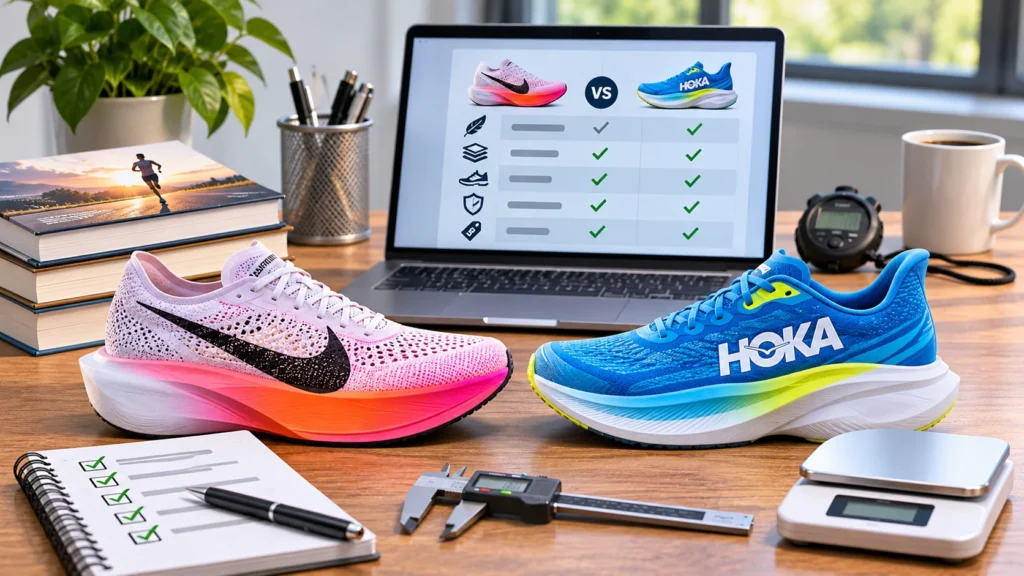
This comparison uses published specifications, independent laboratory measurements and running shoe reviews. It separates documented findings from editorial recommendations.
The research focuses on shoe weight, foam construction, fit, outsole design and intended use. Each factor helps explain differences in practical running situations.
- RunRepeat Nike Vaporfly 3 laboratory review
- RunRepeat HOKA Mach 6 laboratory review
- RTINGS Nike Vaporfly 3 review
- RTINGS HOKA Mach 6 review
- Solereview Nike Vaporfly 3 analysis
- Solereview HOKA Mach 6 analysis
No separate hands-on testing took place for this article. The recommendations represent an editorial assessment of available evidence.
Laboratory results do not predict an individual runner’s experience perfectly. Foot shape, running mechanics and personal comfort remain important.
Original US retail prices provide a consistent comparison baseline. Live retailer prices can differ based on size, color and availability.
How Should You Clean and Maintain These Running Shoes?
Gentle cleaning, proper drying and regular inspections help protect both running shoes. Avoid excessive heat and harsh cleaning methods.
How Should You Clean the Upper and Outsole?
Use a soft brush or damp cloth with mild soap. Remove loose dirt before cleaning the upper fabric.
Pay extra attention to the Vaporfly’s thin Flyknit upper. Avoid aggressive scrubbing around delicate mesh and bonded areas.
Clean dirt from outsole grooves without using sharp tools. Let both shoes dry naturally at room temperature.
How Should You Store Running Shoes?
Store running shoes in a dry, ventilated place away from direct heat. Do not leave wet shoes inside sealed gym bags.
Loosen the laces and allow air to circulate after each run. Avoid radiators, dryers and prolonged exposure to hot vehicles.
Keep the Vaporfly 3 reserved for its intended racing purpose when possible. This reduces unnecessary exposure to abrasive surfaces.
When Should You Replace the Vaporfly 3 or Mach 6?
Replace either shoe when its cushioning, grip or structural condition becomes unsuitable. Mileage alone does not determine the replacement date.
Check for uneven outsole wear, damaged upper material and changes in ride quality. Persistent discomfort also deserves attention.
Our guide to running shoe lifespan explains how different usage patterns affect replacement needs.
- Remove dirt after wet or muddy runs.
- Air-dry shoes before storing them.
- Inspect outsole wear regularly.
- Avoid machine washing and direct heat.
- Track mileage for each running shoe.
- Replace shoes when their performance becomes unsuitable.
Final Verdict: Nike Vaporfly 3 vs HOKA Mach 6
The HOKA Mach 6 is the overall winner for most recreational runners. It combines low weight, responsive cushioning and useful daily training versatility.
The Nike Vaporfly 3 remains the stronger dedicated racing choice. Its ZoomX foam and carbon-fiber plate serve a clear competitive purpose.
At their original retail prices, the Mach 6 saves $110. That saving matters if you need a reliable shoe for regular training.
Competitive runners can benefit from owning both models for different tasks. Use the Mach 6 for weekly mileage and the Vaporfly for selected races.
The best running shoe is the one that fits your goals and feet. Don’t pay for racing technology unless you have a meaningful reason to use it.
🏆 Overall Winner: HOKA Mach 6
Recommended for runners seeking a versatile, lightweight daily trainer with strong overall value.
Best Racing Shoe: Nike Vaporfly 3
Recommended for competitive road runners seeking a lightweight carbon-plated race shoe.
Frequently Asked Questions
Which is better, Nike Vaporfly 3 or HOKA Mach 6?
The HOKA Mach 6 is better for daily running and general training value. The Nike Vaporfly 3 is better suited to competitive road racing because of its ZoomX foam and carbon plate. Choose the Mach 6 for versatility or the Vaporfly 3 for dedicated race-day performance.
What is the difference between Vaporfly 3 and Mach 6?
The Vaporfly 3 uses ZoomX foam and a full-length carbon plate for road racing. The Mach 6 uses supercritical EVA foam without a carbon plate. The Vaporfly prioritizes racing performance, while the Mach 6 balances responsiveness, training versatility and a lower original purchase price.
Can you use Nike Vaporfly 3 for daily training?
You can use the Nike Vaporfly 3 for daily training, but it is not the most practical choice. Its specialized construction, high purchase price and limited rearfoot stability make regular use less attractive. A dedicated daily trainer offers better overall usefulness for repeated weekly running sessions.
Is the HOKA Mach 6 good for marathon running?
Yes, the HOKA Mach 6 can work for marathon running if it fits comfortably over long distances. It offers responsive cushioning and low weight without a carbon plate. Competitive runners seeking specialized racing technology can consider the Vaporfly 3, while recreational marathon runners may prefer the Mach 6.
Which shoe is better for wide feet?
The HOKA Mach 6 is generally the better starting point for wide feet because wide versions are available. Its standard-width model can still feel snug. The Nike Vaporfly 3 has a racing-oriented fit, so runners should test toe room and rearfoot security before buying either model.
Affiliate Disclosure: As an Amazon Associate, I earn from qualifying purchases. This article contains affiliate links. If you purchase through these links, I may earn a commission at no additional cost to you.


