

Quick Answer
Yes, running shoes can stretch slightly over time, especially around flexible mesh or knit uppers. However, most modern running shoes won’t stretch enough to correct an unsuitable size. Their soles retain approximately the same length and width, so you should buy shoes that fit comfortably from the start. Check our running shoe toe room guide before deciding whether your shoes need replacing.
What changes as running shoes break in?
- Mesh uppers: May relax slightly around your forefoot.
- Knit uppers: Often provide immediate flexibility and elastic give.
- Shoe length: Remains essentially unchanged during normal use.
- Midsole cushioning: May soften initially and compress with wear.
- Heel structure: Should maintain enough shape to secure your foot.
The safest approach
- Check the fit: Allow approximately a thumb’s width of space beyond your longest toe.
- Test gradually: Wear new shoes briefly before increasing running distance.
- Never force it: Exchange shoes that cause persistent pinching, numbness, or toe pressure.
New running shoes sometimes feel different after several runs. The upper becomes more comfortable, the cushioning settles, and the shoe may seem less restrictive.
But does that mean running shoes actually get bigger? I think the important distinction is between materials becoming flexible and shoes changing size.
In this guide, I’ll explain what stretches, how long break-in takes, and when waiting for a better fit is a mistake.
What Does It Mean When Running Shoes Stretch Over Time?

Running shoe stretching means the upper materials become slightly more flexible or change shape under repeated pressure. It doesn’t necessarily mean the shoe becomes longer or permanently wider.
The upper is the fabric and supportive structure covering your foot. Most modern running shoes combine engineered mesh, synthetic fibers, reinforcing overlays, and foam cushioning.
These components behave differently when subjected to repeated movement.
- Elastic stretch: Fabric expands under pressure and returns toward its original shape afterward.
- Material relaxation: Fibers and padding gradually become more flexible.
- Permanent deformation: Repeated stress changes the original shape of a material.
- Foam compression: Cushioning becomes thinner or less responsive with accumulated wear.
A shoe can feel roomier without gaining meaningful internal length. That’s why I don’t treat a more relaxed upper as proof that a previously tight shoe now fits properly.
Which Parts of Running Shoes Stretch?
The amount of give depends on material, construction, reinforcement, and location. Two shoes made with mesh can still behave differently.
| Shoe Component | Expected Change | Can It Fix Tight Shoes? |
|---|---|---|
| Engineered mesh | Slight flexibility and relaxation | Only minor pressure issues |
| Stretch knit | Elastic give and possible relaxation | Sometimes mild upper tightness |
| Synthetic overlays | Usually limited movement | Unlikely |
| Heel counter | Designed to retain shape | No |
| Foam midsole | Softening and gradual compression | No reliable size increase |
| Rubber outsole | Flexing and tread wear | No |
These are qualitative material behaviors, not guaranteed measurements. Manufacturers don’t provide one universal stretching allowance for all running shoes.
How Much Do Running Shoes Actually Stretch?
Most running shoes stretch only modestly in their uppers. There is no dependable increase in shoe size that runners should expect after wearing them.
A flexible upper may accommodate small changes in foot volume. However, its rigid or semi-rigid components continue limiting the shoe’s overall shape.
Do Running Shoes Stretch in Length?
No, running shoes generally don’t become meaningfully longer through regular use. Their outsole, midsole, and internal construction largely determine their length.
If your longest toe repeatedly touches the front, waiting for the shoe to stretch is unlikely to help.
Running requires space for foot movement, particularly on downhill sections. The American Academy of Orthopaedic Surgeons’ athletic shoe guidance recommends at least half an inch between your longest toe and the shoe tip.
Do Running Shoes Stretch in Width?
Running shoes can become slightly more accommodating across the forefoot when their uppers relax. The actual amount depends on the shoe’s materials and design.
A flexible upper cannot reliably compensate for a narrow sole platform. Your foot still needs adequate room underneath it.
If pressure concentrates along your little toe or the ball of your foot, review how wide running shoes should be before assuming they’ll loosen.
How Long Does It Take Running Shoes to Stretch or Break In?
Some running shoes feel more comfortable after a few short wears, while others require a gradual adjustment period. There is no fixed timeline for material stretching.
ASICS discusses a typical break-in period of approximately two to four weeks, depending on the shoe and how frequently it’s worn. However, that describes becoming accustomed to the shoe, not correcting an unsuitable size.
You can read the manufacturer’s running shoe break-in advice for additional context.
What Should You Expect During the First Few Runs?
- First wear: Check immediate comfort, toe clearance, and heel security.
- Early short runs: Notice whether upper stiffness decreases without producing rubbing.
- Repeated use: Reassess fit as padding settles and the shoe begins feeling familiar.
- Continued discomfort: Stop using the shoe if pressure, blisters, or numbness persist.
I recommend separating an unfamiliar sensation from genuine pain. New cushioning may feel different, but pinched toes aren’t something you need to tolerate.
Do Mesh, Knit, and Leather Running Shoes Stretch Differently?
Yes. Materials differ in flexibility, recovery, and resistance to permanent deformation.
Mesh Running Shoes
Engineered mesh is common in everyday road-running shoes because it can combine breathability with targeted support. Some sections flex easily, while reinforced areas resist stretching.
With repeated use, certain mesh uppers may feel softer around the toes. That doesn’t mean the shoe’s underlying width has increased.
Knit Running Shoes
Knit uppers often have greater elastic give than tightly woven synthetic panels. They may accommodate small changes in foot volume while remaining comfortable against the skin.
However, a snug knit design can still squeeze your forefoot. A stretchy material isn’t automatically a proper fit.
Leather and Structured Synthetic Shoes
Leather may gradually conform to foot shape, although leather is less common in modern performance running shoes. Structured synthetic materials often resist that type of molding.
Stiff overlays and internal reinforcements can restrict stretching even when the surrounding fabric feels soft.
How Can You Tell Whether Your Running Shoes Are Too Tight?
Running shoes are too tight when they compress your feet, restrict toe movement, or create repeated pressure during normal running. Temporary unfamiliarity shouldn’t cause worsening symptoms.
Look for these signs:
- Toe pressure: Your toes hit the front, particularly when running downhill.
- Forefoot squeezing: The sides press against your little toe or big-toe joint.
- Numbness: Your toes tingle or lose sensation during running.
- Blisters: Friction repeatedly develops in the same location.
- Visible bulging: Your forefoot pushes forcefully against the upper or beyond the supportive platform.
- Instep discomfort: The laces create concentrated pressure across the top of your foot.
Not every tight feeling means you need larger shoes. Incorrect lacing or unusually thick socks may also cause discomfort.
According to REI’s running shoe fitting guide, persistent numbness, toe blisters, bruised toenails, and heel irritation can indicate specific fit problems.
What If the Shoes Feel Tight Around Your Arches?
Arch discomfort isn’t always caused by insufficient upper stretch. The shoe’s internal shape, support design, or an insert may be responsible.
Before changing sizes, consider whether the pressure comes from beneath your foot or across your instep. Our guide to running shoe arch support explains the differences.
Can You Safely Stretch Running Shoes That Feel Tight?
You may improve minor upper tightness through ordinary wear and fit adjustments. However, deliberately forcing the entire shoe to become larger can damage its construction.
I would try reversible adjustments before attempting any physical stretching technique.
Five Safer Ways to Improve the Fit
- Loosen and redistribute lace tension. Start near the toes and adjust upward to reduce excessive pressure.
- Try window lacing. This technique skips direct lace pressure across a sensitive instep area.
- Wear your normal running socks. Avoid unusually thick socks when evaluating whether a shoe fits.
- Test the shoes briefly indoors. Walk on a clean surface while checking toe movement and pressure points.
- Exchange the shoe when necessary. Choose a wider width or different model if the problem persists.
If the forefoot is cramped but the length feels correct, try the same shoe in a wider fitting. Increasing length doesn’t always solve a width problem.
Should You Use Heat, Ice, or a Shoe Stretcher?
I don’t recommend hair dryers, freezers, boiling water, or aggressive mechanical stretching for modern performance running shoes. Heat and force can affect adhesives, foam, and synthetic materials.
ASICS specifically cautions that heat and freezing methods may damage certain running shoe components. A replacement or properly fitted alternative is usually safer.
Don’t continue running through numbness or painful rubbing simply to break in new shoes.
Do Running Shoes Become Loose After Months of Use?
Yes, running shoes can feel looser as their uppers, collars, and cushioning wear. That change is different from the controlled flexibility of a new shoe.
Repeated compression can reduce the cushioning’s original feel. Heel padding may flatten, and fabric can lose some of its ability to recover its shape.
What Are the Signs of Excessive Stretching or Wear?
- Heel movement: Your heel slips despite appropriate lacing.
- Loose upper: The fabric no longer holds your midfoot securely.
- Damaged lining: Interior heel padding has become thin or torn.
- Flattened cushioning: The midsole feels noticeably less supportive.
- Upper deterioration: Fabric stretches unevenly, frays, or develops holes.
Brooks notes that performance running shoes commonly last approximately 300–500 miles, although actual durability varies. Its running shoe replacement guidance also identifies material wear and reduced support as important warning signs.
Mileage isn’t the only consideration. Replace shoes when their fit, cushioning, or structural condition no longer suits your running needs.
How Should Running Shoes Fit Before You Start Breaking Them In?
New running shoes should feel comfortable immediately, with secure heels and adequate toe space. A proper fit shouldn’t depend on future stretching.
Here’s the fitting routine I recommend:
- Measure both feet: Base sizing on your larger foot rather than an old shoe label.
- Shop later in the day: Feet can swell after standing, walking, and exercise.
- Wear running socks: Use the same thickness you normally train in.
- Check toe clearance: Aim for approximately half an inch beyond your longest toe.
- Check forefoot width: Your toes should spread comfortably without rubbing.
- Secure your heel: The rear of the shoe should hold your foot without painful pressure.
- Walk and jog: Test normal movement before committing to longer distances.
One practical check is to remove the insole and stand on it. If your foot extends substantially beyond its sides, investigate whether the shoe’s platform is too narrow.
That test isn’t a complete measurement of internal shoe volume. It simply provides another clue when combined with actual on-foot comfort.
Should You Buy Running Shoes Half a Size Bigger?
Not automatically. Running shoes need appropriate clearance, but the correct size depends on the brand, model, and your foot measurements.
Many runners find their running shoe size differs from their everyday shoe size. Nevertheless, blindly moving up half a size can create excessive heel movement.
Choose length and width separately wherever possible.
- Toes touch the front: Try a longer size.
- Forefoot feels squeezed: Try a wider fitting or different toe-box shape.
- Heel slips: Adjust lacing and evaluate the heel shape.
- Instep feels compressed: Adjust the lacing or try a higher-volume model.
My preferred approach is to start with measured fit rather than assuming every brand follows the same sizing pattern.
When Should You Exchange Running Shoes Instead of Waiting?
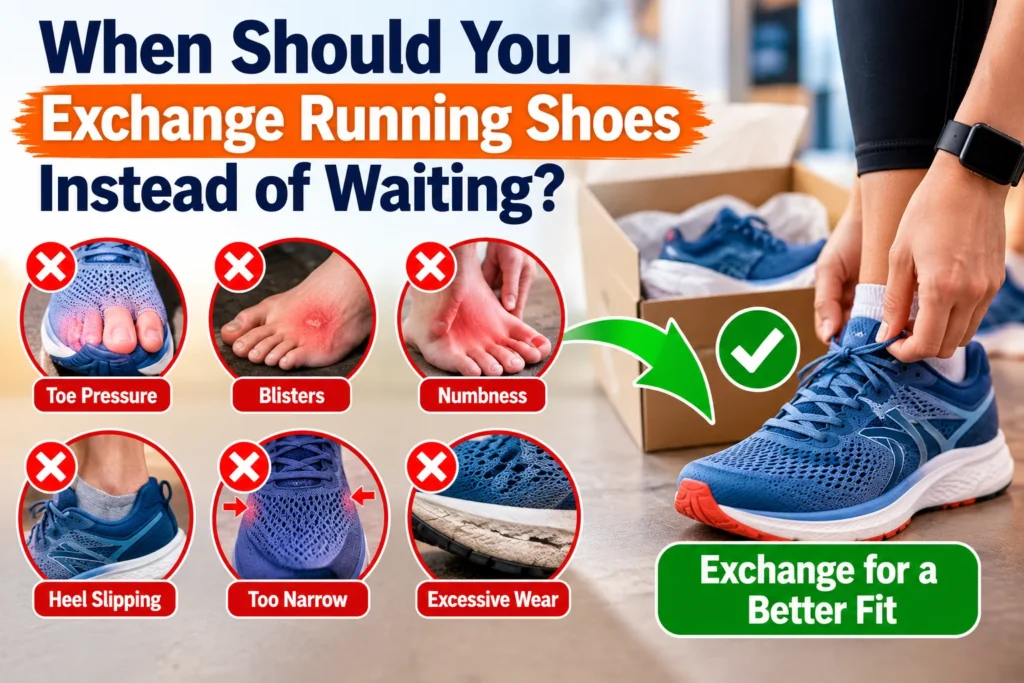
Exchange running shoes when they remain uncomfortable because of inadequate length, width, or structural shape. Waiting for substantial stretching rarely solves these problems.
Consider replacing or returning the shoes when:
- Your longest toe repeatedly strikes the front.
- Your forefoot becomes numb despite appropriate lacing.
- Pressure creates recurring blisters or irritated skin.
- The shoe’s arch or heel structure causes persistent discomfort.
- You need to force your foot into the shoe to wear it.
Try shoes indoors before outdoor use whenever possible. Check the retailer’s return policy because running outdoors may affect exchange eligibility.
If foot pain, numbness, or swelling continues after changing footwear, seek guidance from a qualified healthcare professional.
Which Running Shoes Are Worth Considering for a Better Fit?
If your current shoes are too narrow or restrictive, changing the model may be more effective than stretching them. These three options offer different approaches to fit.
Product note: The following ratings are editorial assessments of suitability for each stated use case, not verified customer averages or claims of personal wear testing. Exact fit, width availability, and comfort vary by runner.
Affiliate disclosure: As an Amazon Associate, we may earn from qualifying purchases at no additional cost to you.
🏆 Best for Multiple Width Options
New Balance Fresh Foam X 880v15
★★★★☆ 4/5 — Editorial Fit Score
The 880v15 combines Fresh Foam X cushioning, a structured engineered-mesh upper, and a manufacturer-listed 6 mm heel-to-toe drop. Men’s versions offer widths up to 4E, making this one of my starting recommendations when a standard-width shoe feels restrictive.
👟 Best Versatile Daily Trainer
Brooks Ghost 17
★★★★☆ 4/5 — Editorial Fit Score
The Ghost 17 features DNA LOFT v3 cushioning, an engineered Air Mesh upper, and multiple width options. I’d consider it for runners seeking a conventional neutral daily trainer with a comfortable upper and secure overall fit.
🦶 Best for Toe-Box Freedom
Altra Torin 8
★★★☆☆ 3/5 — Editorial Fit Score
The Torin 8 uses a FootShape Standard toe box, Altra EGO MAX cushioning, and a 0 mm heel-to-toe drop. I’d consider it for runners seeking extra toe freedom, although its zero-drop geometry may require gradual adaptation.
Frequently Asked Questions
Do Running Shoes Stretch After a Few Runs?
Some running shoes become more flexible after a few short runs, especially around mesh or knit uppers. However, the change is usually subtle and doesn’t reliably increase shoe length. If your shoes cause toe pressure or numbness, don’t count on breaking them in to solve the problem.
Will Tight Running Shoes Eventually Become Comfortable?
Running shoes that feel slightly stiff may become more comfortable as their materials soften. Shoes that squeeze your toes, compress your forefoot, or create persistent pain are unlikely to become suitable through normal wear. It’s generally better to exchange them for a properly fitting size or model.
Do Running Shoes Stretch More When They Get Wet?
Some upper materials may temporarily feel different when wet, but water doesn’t provide a reliable or safe way to resize running shoes. Moisture can affect materials and adhesives, especially with repeated exposure. Allow wet shoes to air-dry according to the manufacturer’s care instructions rather than forcing them to stretch.
Do Running Shoes Get Wider as They Wear Out?
Running shoes may feel wider or looser as their uppers relax and supporting components deteriorate. However, that doesn’t mean the outsole or midsole becomes significantly wider. Excessive looseness can reduce stability and contribute to rubbing, making shoe replacement more appropriate than continued use.
Should Running Shoes Feel Tight When New?
New running shoes should feel comfortably secure around the heel and midfoot without squeezing your toes. Some unfamiliar stiffness is normal, but painful tightness isn’t. Your toes should move freely, and you should have approximately a thumb’s width of clearance beyond your longest toe.
Final Verdict: Do Running Shoes Stretch Over Time?
Running shoes can stretch slightly, particularly in flexible mesh and knit uppers. But they shouldn’t need major stretching to become comfortable enough for running.
The biggest mistake is confusing a break-in period with correcting a poor fit. Softer fabric cannot reliably fix inadequate length, a narrow platform, or an unsuitable heel shape.
My recommendation is simple: prioritize a comfortable fit from day one. Choose the correct length and width, test your shoes gradually, and don’t ignore persistent discomfort.
Before your next run: Put on your usual running socks, check your toe clearance, and jog briefly. If your shoes squeeze or rub, address the fit instead of waiting for them to stretch.


Steven is a former sportsperson and now a full-time businessman and research writer. He is the mastermind of this site, and he created this site to help people who need specialized shoes for different activities. When he was a sportsperson, he was very passionate about different types of shoes for his sports purpose. The passion he had for shoes at that time now turned into his profession. Besides his shoe business, he loves sharing his knowledge and experience with people and helping them maintain healthy feet.
More Posts
