
Quick Answer
Running shoes should feel comfortably snug around your heel and midfoot, but never painfully tight. Your toes should move freely, with roughly a thumb’s width of space beyond your longest toe. Your heel should stay secure without excessive slipping. This balance matches REI’s running shoe fit guidance.
Five signs your running shoes fit correctly
- Toe room: Your longest toe has about a thumb’s width of clearance.
- Midfoot security: The shoe holds your foot without squeezing its sides or top.
- Heel stability: Your heel stays mostly in place while walking or running.
- Natural movement: Your toes can spread without rubbing or overlapping.
- No warning signs: You don’t experience numbness, sharp pressure, or persistent rubbing.
Quick fit check
- Stand and check: Test toe clearance while standing, then walk or jog briefly to check movement.
- Adjust carefully: Try changing lace tension before deciding whether the shoe is too small.
A running shoe can feel secure in the store yet become uncomfortable after a few miles. That’s why I prefer checking how each part of the shoe fits instead of judging tightness alone.
In this 2026 guide, I’ll explain the right amount of snugness, warning signs, fitting techniques, and simple ways to improve comfort.
What Does a Properly Snug Running Shoe Fit Mean?
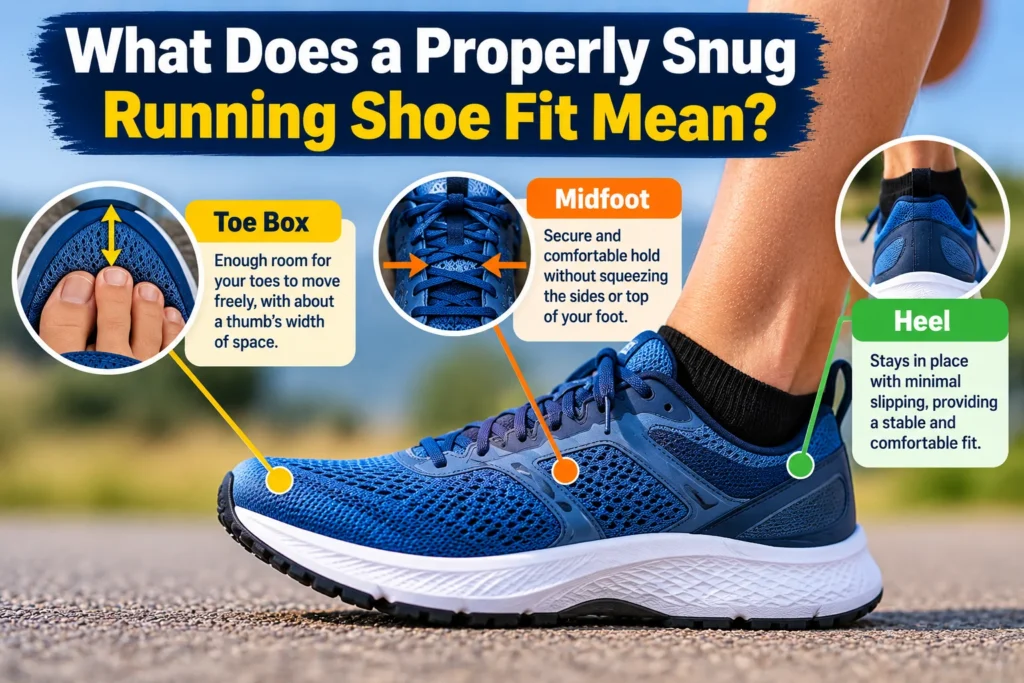
A snug running shoe fit means the shoe holds your foot securely without restricting natural movement. It should feel supportive rather than compressed.
I use a simple three-zone approach when evaluating running shoe fit:
- Front: Enough length and width for comfortable toe movement.
- Middle: Gentle, even contact that keeps the foot centered.
- Back: A secure heel that doesn’t lift excessively.
These areas work together. A tight midfoot cannot compensate for a shoe that’s too short.
Your feet also change shape slightly when you stand and move. That makes a little extra space important for running comfort.
Why Does Running Shoe Tightness Matter?
Too much pressure can irritate your toes, nerves, or skin. Too little security can allow excessive movement and friction.
Both problems may interfere with comfortable running.
- Excessive tightness: May cause tingling, numbness, rubbing, or painful pressure points.
- Excessive looseness: May allow heel movement, sliding, or friction-related blisters.
- Balanced fit: Allows foot movement while keeping the shoe stable during each stride.
The goal isn’t maximum tightness. It’s enough security to run without constantly noticing your shoes.
How Tight Should Running Shoes Feel in Different Areas?
Running shoes shouldn’t feel equally tight everywhere. Different parts of your foot need different amounts of room.
1. Toe Box: Roomy but Not Excessively Loose
The toe box is the front section surrounding your toes. It should provide enough space for natural toe movement.
A common fitting guideline is approximately a thumb’s width between your longest toe and the shoe’s front.
- Your toes should wiggle comfortably.
- Your longest toe shouldn’t touch the front.
- Your little toe shouldn’t press painfully against the side.
- Your toes shouldn’t overlap or curl because of limited space.
The American Academy of Orthopaedic Surgeons recommends roughly half an inch of toe clearance in athletic footwear.
Use this measurement as a starting point, not an absolute rule. Your foot shape and the shoe’s construction also matter.
2. Midfoot: Secure Without Squeezing
Your midfoot sits between your forefoot and heel. This area should feel gently held by the shoe’s upper and lacing system.
You shouldn’t feel concentrated pressure across the top of your foot.
- Correct fit: Even contact without pain or excessive movement.
- Too tight: Pressure across the arch or top of the foot.
- Too loose: Noticeable shifting during turns or faster movements.
Lacing adjustments can sometimes improve midfoot pressure. However, they cannot correct a fundamentally unsuitable shoe shape.
3. Heel: Secure With Minimal Slipping
Your heel should remain stable when you walk or run. Significant up-and-down movement can create friction.
A small amount of movement isn’t automatically a problem, but repeated rubbing deserves attention.
- Your heel shouldn’t repeatedly lift out of the heel cup.
- The collar shouldn’t dig into your Achilles tendon.
- The heel counter should hold comfortably without pinching.
If the heel moves too much, try a runner’s loop lacing pattern. If slipping continues, the shoe’s heel shape may not suit your foot.
4. Width: Comfortable Across the Entire Forefoot
Running shoe width matters as much as length. A shoe can have enough toe clearance and still squeeze your forefoot.
Pay special attention to the ball of your foot and your smallest toe.
- The upper shouldn’t press painfully into your foot’s sides.
- Your forefoot shouldn’t spill noticeably over the sole’s supporting platform.
- You shouldn’t need extremely loose laces to tolerate the shoe’s width.
Many running shoe models offer standard and wide versions. Choosing the correct width is often better than adding unnecessary length.
How Can You Test Whether Running Shoes Are Too Tight?
The best test combines standing measurements with actual movement. A shoe that feels comfortable while sitting may behave differently during running.
Here’s the fitting process I recommend.
Step 1: Wear Your Normal Running Socks
Put on the socks you normally use for training. Sock thickness can change the available space inside your shoes.
If you use orthotic insoles, bring them too. They can affect interior volume and fit.
Step 2: Try Shoes Later in the Day
Feet often become larger after extended standing and activity. Testing shoes later in the day can help reveal a potentially tight fit.
The American Orthopaedic Foot & Ankle Society recommends trying athletic footwear when your feet are at their largest.
Step 3: Loosen and Retie the Laces
Loosen the laces before putting on the shoes. Then tighten them gradually, starting near the toes.
Avoid pulling every section as tightly as possible.
Step 4: Check Your Toe Clearance
Stand with your weight distributed naturally across both feet. Find your longest toe and check the space ahead of it.
Remember that your second toe may be longer than your big toe.
Step 5: Walk, Jog, and Change Direction
Movement reveals problems that standing measurements may miss. If possible, test the shoes on a safe indoor surface.
- Walk for about one minute.
- Jog gently for another minute.
- Make a few controlled turns.
- Notice heel movement and forefoot pressure.
- Check whether your toes contact the front.
These times are practical fitting suggestions, not clinical testing standards. Stop immediately if the shoes cause pain.
Step 6: Check for Pressure After Removing the Shoes
Look for unusually deep pressure marks, persistent redness, or painful rubbing. These can indicate unsuitable fit or lacing tension.
Brief sock impressions alone don’t prove that a shoe is too tight.
Running Shoes Too Tight vs Too Loose: What’s the Difference?
Tight and loose running shoes create different problems. Identifying the pattern helps you choose the correct adjustment.
| Fit Area | Too Tight | Too Loose | Ideal Fit |
|---|---|---|---|
| Toes | Pinched or cramped | Slide excessively | Wiggle freely |
| Toe clearance | Toes reach the front | Excessive front space | About a thumb’s width |
| Midfoot | Painful compression | Foot shifts sideways | Comfortably secure |
| Heel | Pinching or rubbing | Repeated heel lifting | Stable without painful pressure |
| During running | Numbness or pressure | Sliding or friction | Comfortable movement |
These signs are useful clues rather than guaranteed diagnoses. Sock seams, lacing, foot shape, and running technique can also affect comfort.
What Are the Warning Signs That Running Shoes Are Too Tight?
Running shoes are probably too tight when they create recurring pressure, numbness, or painful contact. Don’t ignore symptoms simply because the labeled size looks correct.
- Numb toes: Tightness may compress sensitive areas or restrict comfortable movement.
- Forefoot pain: Insufficient width or volume may place pressure around the ball of the foot.
- Toenail discomfort: Repeated contact with the front can irritate or bruise toenails.
- Side rubbing: A narrow toe box may press against your smallest toe or bunion.
- Top-of-foot pressure: Tight laces or limited shoe volume may create discomfort.
If symptoms occur, stop and assess the fit. Don’t continue running through persistent numbness or pain.
Seek medical advice if symptoms are severe, recurrent, or persist after removing the shoes. A footwear adjustment cannot address every cause of foot discomfort.
Should Running Shoes Feel Tight When You First Buy Them?
New running shoes should feel comfortable immediately. They shouldn’t require painful runs to become wearable.
Some upper materials may soften with use. However, that doesn’t mean a shoe will become longer or wide enough for an unsuitable foot shape.
- Acceptable: A new, structured feel without pressure or pain.
- Concerning: Toes touching the front or persistent side compression.
- Unacceptable: Numbness, sharp pain, or pressure that worsens while moving.
The important distinction is between a supportive upper and a restricted foot. Comfort should guide the decision.
Do Running Shoes Loosen Up After a Few Runs?
Some running shoes become more flexible as their uppers soften. But don’t expect meaningful increases in length or width.
If your toes already contact the front, breaking in the shoes won’t reliably solve that problem.
A well-fitting shoe should allow comfortable walking and jogging from the beginning.
- Soft mesh may gradually conform to foot movement.
- Stiffer overlays may retain their shape.
- Foam cushioning can change with wear.
- The shoe’s basic size and shape remain important.
When shopping, I would choose immediate comfort over a promise that tight shoes will stretch later.
How Can You Fix Running Shoes That Feel Too Tight?
The correct solution depends on where the pressure occurs. Sometimes adjusting the laces works; sometimes you need a different shoe.
1. Adjust Lace Tension
Try loosening the section that feels restrictive. Tightness across the top of your foot may improve without sacrificing heel security.
A window-lacing pattern can reduce pressure over a sensitive spot.
2. Try a Runner’s Loop for Heel Security
A runner’s loop uses the extra top eyelets to improve heel hold. It’s particularly useful when your forefoot feels comfortable but your heel slips.
- Thread each lace through the extra eyelet on the same side to create a small loop.
- Pass each lace end through the opposite loop.
- Pull gently to secure the heel.
- Tie normally without overtightening.
Test the result while walking. If you feel pressure around your ankle or foot, loosen the laces.
3. Reconsider Sock Thickness
Thick socks take up more interior shoe space. Switching to suitable lightweight running socks may improve a borderline fit.
However, thinner socks won’t correct shoes that are too short or structurally too narrow.
4. Try a Wider Size
If the pressure concentrates around your forefoot, try the same shoe in a wider width. Keep the length appropriate for your larger foot.
This can reduce unwanted compression without introducing unnecessary toe clearance.
5. Replace Shoes That Don’t Match Your Foot Shape
Not every model fits every runner. Shoe brands use different shapes, heel cups, and upper designs.
Changing to a better-shaped shoe is often more effective than repeatedly adjusting an unsuitable pair.
Should You Size Up If Your Running Shoes Feel Tight?
Not automatically. Increasing shoe length only makes sense when your toes lack adequate front clearance.
Width-related pressure usually calls for a wider shoe or a different model.
- Toes touch the front: Try a longer size.
- Forefoot feels squeezed: Compare wider widths.
- Heel slips: Check lacing and heel shape.
- Top of foot hurts: Adjust the laces and check shoe volume.
Some runners wear running shoes half a size larger than their everyday footwear. But this isn’t a universal sizing rule.
The 2026 NHS athletic footwear guidance also emphasizes adequate front clearance and adjustable midfoot support.
Always judge the actual fit, not the number printed inside the shoe.
Does Running Shoe Tightness Change With Running Distance?
Running shoes should remain comfortable throughout your intended activity. Longer sessions may reveal fit problems that shorter tests miss.
Short Runs and Daily Training
For easy training, prioritize a comfortable midfoot hold and sufficient toe room. You shouldn’t need aggressive lacing to maintain stability.
Long-Distance Running
Extended activity may increase foot swelling and sensitivity. Shoes that start borderline tight can become uncomfortable later.
I recommend testing long-run shoes during shorter sessions before relying on them for extended distances.
Trail Running and Downhill Movement
Trail runners need dependable heel and midfoot security, particularly on descents. Too much forward movement may cause toes to hit the shoe’s front.
Don’t solve this by choosing a painfully tight toe box. Instead, balance adequate length with good heel retention.
Racing and Faster Running
Faster running can make secure lockdown feel especially important. Even so, a racing shoe shouldn’t cause numbness or painful squeezing.
A tighter sensation isn’t proof that a shoe will improve your performance.
What Mistakes Should You Avoid When Checking Running Shoe Tightness?
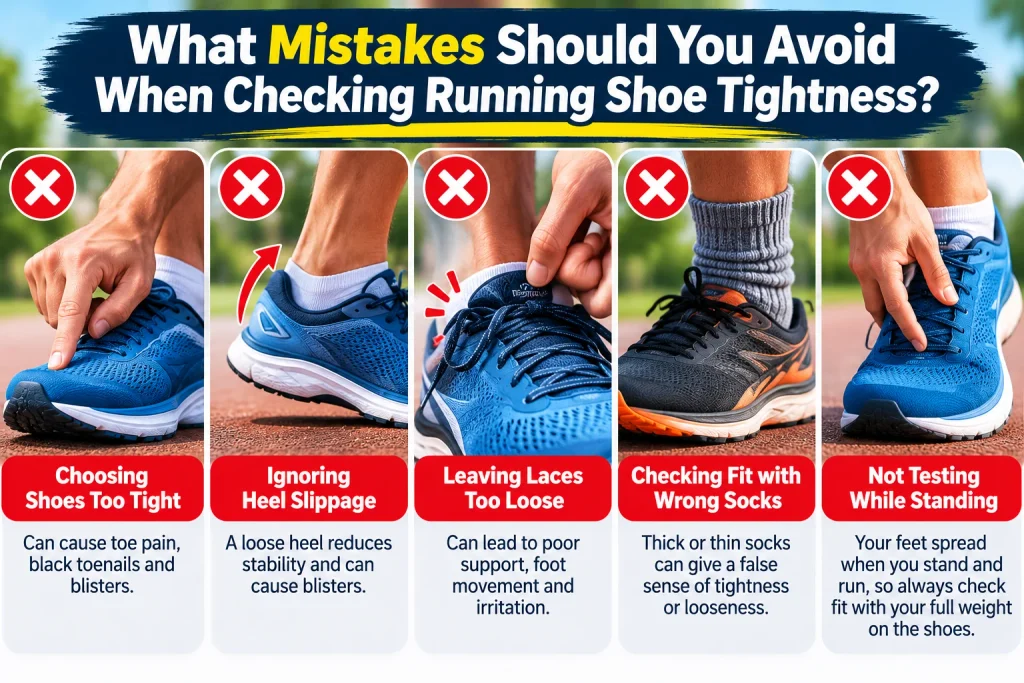
Small fitting mistakes can lead to buying the wrong size. I would check these before blaming the shoe itself.
- Testing while sitting: Stand when checking toe clearance and width.
- Ignoring the larger foot: Fit the shoe to your larger foot.
- Buying by size alone: Sizes and shapes differ across models.
- Pulling laces too tight: More lace tension doesn’t automatically provide better support.
- Confusing width with length: A longer shoe may still fit poorly around the heel.
- Expecting a break-in miracle: Persistent pressure is a reason to reconsider the fit.
Good fitting starts with the shoe’s shape. Lacing and socks provide adjustments, not complete solutions.
Which Products Can Help You Check and Improve Running Shoe Fit?
You don’t need expensive accessories to achieve a comfortable fit. Still, a measuring tool, suitable socks, or adjustable laces may help with specific problems.
These three products address different fitting needs. The ratings below are editorial usefulness assessments, not verified customer-review scores.
🏆 Best for Measuring
Genuine Brannock Device
★★★★½ 4.5/5
The Brannock Device measures foot length, arch length, and width. I consider it useful for consistent sizing, although most runners can use one at a specialist store instead of purchasing it.
🧦 Best for Sock Fit
Feetures Elite Light Cushion No Show Tab
★★★★½ 4.5/5
These running socks have targeted arch compression, light cushioning, and a low-profile heel tab. I’d consider them when bulky socks make an otherwise well-fitting shoe feel crowded.
👟 Best for Adjustable Lacing
Lock Laces Original No-Tie Shoelaces
★★★★☆ 4.0/5
This system uses elastic 48-inch laces and adjustable locking hardware. I see it as an option for convenient tension adjustments, but traditional laces may provide more precise control for some runners.
Affiliate disclosure: Some product links may earn a commission from qualifying purchases without adding to your purchase price.
Accessories can improve minor fitting issues. They won’t correct a shoe that’s fundamentally the wrong size or shape.
Frequently Asked Questions
Should running shoes feel tight around the sides?
Running shoes should feel gently secure around your sides without painful squeezing. Your forefoot needs enough space to move naturally, particularly around the ball of your foot. If the sides press uncomfortably despite reasonable lace tension, try a wider width or a different shoe shape.
Is it normal for running shoes to feel tight at first?
A new shoe may feel structured or unfamiliar, but it shouldn’t create pain, numbness, or concentrated pressure. Some materials may soften with wear, although they won’t reliably correct poor sizing. Choose shoes that feel comfortable during your initial fitting test.
How much space should be between your toes and running shoes?
A useful starting point is approximately a thumb’s width, often described as about half an inch, beyond your longest toe. Check this while standing. Your toes should move freely without excessive foot sliding. The correct amount may vary slightly with foot shape and shoe design.
Should running shoes be tighter for running than walking?
Running shoes generally need dependable heel and midfoot security because running involves repeated impacts. However, tighter doesn’t mean better. Your toes still need room, and the shoes shouldn’t create numbness or pain. Choose a stable, comfortable fit rather than aggressively tightening the laces.
Can tight running shoes cause numb toes?
Yes. Shoes that are too short, narrow, or restrictive can contribute to toe numbness or tingling. Excessive lace pressure may also cause discomfort. Stop running, loosen the shoes, and reassess the fit. Seek medical advice if numbness persists, recurs, or occurs without tight footwear.
Final Takeaway: How Tight Should Your Running Shoes Be?
The right running shoe fit is secure without feeling restrictive. Your heel and midfoot should stay supported while your toes have enough freedom to move.
Use three checks before choosing your next pair:
- Check the toes: Aim for roughly a thumb’s width of front clearance.
- Check the midfoot: Look for gentle, even security without painful pressure.
- Check the heel: Make sure it stays stable during walking and running.
Above all, trust comfort during movement rather than the shoe size printed on the label. The right pair should let you focus on running, not adjusting your footwear.
Next step: Try your running shoes with your usual socks, perform the standing and movement checks, and compare another width or model if anything feels wrong.


Steven is a former sportsperson and now a full-time businessman and research writer. He is the mastermind of this site, and he created this site to help people who need specialized shoes for different activities. When he was a sportsperson, he was very passionate about different types of shoes for his sports purpose. The passion he had for shoes at that time now turned into his profession. Besides his shoe business, he loves sharing his knowledge and experience with people and helping them maintain healthy feet.
More Posts