

Quick Answer
To prevent heel slip in running shoes, try a runner’s loop (heel-lock lacing), adjust your midfoot fit, and wear well-fitting running socks. Your heel should remain secure without painful pressure, while your toes have room to move. If slipping continues, check whether your running shoes are too big or have the wrong heel shape.
5 Quick Steps to Stop Heel Slipping
- Seat your heel: Push your heel gently against the back of the shoe before tightening.
- Use heel-lock lacing: Create loops with the top eyelets to improve heel security.
- Adjust lace tension: Secure your midfoot without squeezing the top of your foot.
- Check your socks: Choose fitted, moisture-wicking running socks that do not bunch.
- Retest the fit: Walk and jog briefly, then change shoes if your heel still slips excessively.
Important Fit Check
- Check toe clearance: Aim for roughly a thumb’s width beyond your longest toe, with no painful heel rubbing.
Your running shoe feels comfortable until you pick up the pace. Then your heel starts lifting, your sock rubs, and every stride feels less secure.
My first recommendation is to check fit before buying accessories. This guide explains the practical fixes, how to test them, and when a different shoe makes more sense.
What Is Heel Slip in Running Shoes?

Heel slip is unwanted upward or forward movement of your heel inside a running shoe. It occurs when the shoe cannot hold your heel securely throughout your stride.
Small amounts of movement may occur with certain shoe designs. Repeated lifting, rubbing, or a sensation that your heel might escape the shoe deserves attention.
What Are the Signs of Excessive Heel Slip?
- Repeated lifting: Your heel rises noticeably during walking or running.
- Heel rubbing: Friction develops where your heel meets the shoe’s rear lining.
- Loose lockdown: Your foot moves despite comfortably tightened laces.
- Blisters or hot spots: Irritation repeatedly develops around the back of your foot.
- Forward sliding: Your foot shifts toward the toe box, particularly on descents.
- Excessive collar wear: The fabric behind your heel deteriorates from repeated friction.
Heel slipping is not always proof that your shoes are too long. Width, internal volume, and heel-collar shape can also cause the problem.
Why Does Your Heel Slip While Running?
Heel slipping usually occurs because the shoe does not hold your foot securely enough. Several different fit problems can produce the same symptom.
1. Your Shoes Have Too Much Internal Space
Running shoes that are too long, wide, or high-volume can allow unwanted movement. A large amount of empty space makes your heel harder to stabilize.
2. Your Laces Are Too Loose
Loose lacing can allow the midfoot to move forward. Your heel may lift because the upper is not holding your foot effectively.
3. The Heel Cup Does Not Match Your Foot
The heel cup is the rear part of a shoe that surrounds and supports your heel. Some runners have relatively narrow heels even when their forefeet are wide.
A roomy heel cup may slip regardless of the shoe’s labeled size. Choosing a different shoe shape can work better than downsizing.
4. Your Socks Are Slipping or Bunching
Loose socks can slide against your skin or gather underneath your heel. Moisture may increase irritation from repeated movement.
5. Your Shoe’s Rear Structure Has Worn Down
Worn heel lining, damaged padding, or a collapsed heel counter may reduce comfort and security. Check older shoes for visible deterioration.
6. Downhill Running Exposes a Loose Fit
Descending can encourage your foot to move toward the front of the shoe. Insufficient midfoot hold may make heel movement more noticeable.
The ASICS running shoe lacing guide describes heel-lock techniques for reducing unwanted heel movement.
How Do You Stop Heel Slip With Heel-Lock Lacing?
Heel-lock lacing, also called a runner’s loop, is one of the simplest ways to improve heel security. It uses the extra eyelets near the top of many running shoes.
This technique focuses lace tension around the upper foot and heel. It should feel secure without causing pressure near your ankle or Achilles tendon.
Step-by-Step Runner’s Loop Instructions
- Start with normal lacing. Lace your shoes in a crisscross pattern until you reach the second-to-last eyelets.
- Create the first loop. Feed the left lace through the final eyelet on the same side, leaving a small loop.
- Create the second loop. Repeat on the right side using its upper eyelet.
- Cross the lace ends. Pass the left lace through the right loop and the right lace through the left loop.
- Tighten gently. Pull both lace ends to reduce the loops and secure the heel area.
- Tie and test. Finish with a normal knot, then walk and jog briefly to check movement.
The REI running shoe lacing guide explains the same basic runner’s-loop method.
How Tight Should You Pull a Runner’s Loop?
Tighten until your heel feels secure, not trapped. Stop tightening if you notice pressure, tingling, numbness, or discomfort across your ankle.
My preferred approach is to adjust one small amount at a time. A shoe that only feels secure when painfully tight probably needs a different fit.
What If Your Shoes Do Not Have Extra Eyelets?
You can first try adjusting your normal crisscross lacing, including the uppermost eyelets. Make sure your heel is seated before tightening the midfoot.
Do not cut new holes into your shoes. If conventional lacing cannot achieve a comfortable hold, compare another model.
What Should You Check Before Tightening Your Laces?
Check the shoe’s length, width, and volume before increasing lace tension. Overtightening can conceal an unsuitable fit without solving the underlying problem.
Check 1: Is There Enough Toe Room?
Most running shoes should provide approximately 10–15 mm of space beyond the longest toe. Your toes should move comfortably without striking the front during running.
Our running shoe toe-space guide explains how to check this clearance while standing.
Check 2: Is Your Midfoot Secure?
The midfoot should feel supported without uncomfortable squeezing. You should not need extreme lace tension to stop your foot moving.
For a complete fitting check, read how tight running shoes should be before making further adjustments.
Check 3: Are You Wearing the Correct Size?
Running shoe sizes vary between brands and models. A familiar size number does not guarantee a secure heel.
Measure both feet and evaluate the larger foot first. Our step-by-step running shoe sizing guide provides additional measurement instructions.
The REI running shoe fit guide also recommends sufficient toe space with a comfortably snug heel and midfoot.
Which Heel-Slip Fix Works Best for Each Problem?
The best solution depends on why your heel moves. Use this comparison to choose a starting point rather than trying every accessory.
| Problem | First Fix | When to Change Shoes |
|---|---|---|
| Loose upper lacing | Runner’s loop | Persistent slip after comfortable adjustment |
| Loose or bunching socks | Fitted running socks | Heel still moves despite correct socks |
| Excessive shoe length | Compare a shorter size | Immediately if toe room and movement confirm poor fit |
| Wide heel cup | Try a different heel shape | When lacing cannot secure the heel |
| Worn heel lining | Inspect shoe condition | When damage affects comfort or secure fit |
These are practical fitting recommendations, not measured success rates. A comfortable, secure fit matters more than any individual technique.
Can Running Socks Help Prevent Heel Slip?
Well-fitting running socks can reduce bunching and help manage friction. However, socks cannot reliably correct shoes that are significantly oversized.
What Features Should Running Socks Have?
- Snug heel shape: Helps the sock remain aligned with your foot.
- Moisture-wicking fabric: Helps manage sweat during longer runs.
- Minimal bunching: Reduces unwanted folds inside the shoe.
- Appropriate cushioning: Adds comfort without overcrowding the shoe.
- Protective heel tab: Can provide a barrier against rubbing near the collar.
Try the socks you intend to wear during actual training. Even a change in sock thickness can alter how your heel fits.
Should You Wear Thick Socks to Stop Heel Slip?
Slightly thicker running socks may improve the feel of a marginally loose shoe. However, very thick socks can crowd your toes or increase pressure.
Choose thickness based on overall comfort, not heel movement alone. Avoid stacking several bulky pairs just to compensate for a poor fit.
Do Heel Grips and Insoles Work for Running Shoes?
Heel grips and replacement insoles may improve minor fit problems in certain shoes. Neither solution reliably fixes a shoe that is substantially too long or wide.
When Might Heel Grips Help?
Adhesive heel grips add material to the inside rear of a shoe. They may fill a small gap and reduce movement in some footwear.
Running creates repeated movement and friction, so a grip that works for walking may not remain comfortable during faster activity.
- Use grips only for a small, localized heel gap.
- Choose a product that does not create sharp edges or pressure.
- Test attachment and comfort during walking first.
- Remove the grip if it shifts, rubs, or increases discomfort.
- Do not use heel grips to hide a major sizing problem.
Can Replacement Insoles Reduce Heel Movement?
An appropriately fitted insole may take up some internal volume. This can help certain shoes feel more secure around the foot.
However, extra thickness may raise your heel or crowd your forefoot. Recheck the full fit after installing an insole.
How Can You Prevent Heel Blisters While Fixing Slipping?
Reducing heel movement is the priority, but friction management also matters. Repeated rubbing can create painful hot spots and blisters.
The American Academy of Dermatology’s blister-prevention guidance recommends properly fitting shoes, moisture-wicking socks, and protection for friction-prone areas.
Practical Ways to Reduce Heel Rubbing
- Keep socks clean, dry, and free from folds.
- Stop running when rubbing becomes painful.
- Use suitable blister-protection dressings on vulnerable skin.
- Check for rough stitching or damaged heel lining.
- Do not continue a run to test whether a painful shoe will improve.
If a blister develops, protect the affected skin and avoid further rubbing. Seek medical advice for signs of infection or persistent pain.
How Do You Test Whether Your Heel-Slip Fix Works?
A short indoor movement test can reveal whether an adjustment helps. Start slowly rather than testing new lacing during a demanding run.
5-Step Heel Security Test
- Prepare the shoes: Put on your normal running socks and seat your heels against the back.
- Adjust the laces: Apply comfortable tension using your chosen lacing method.
- Walk for one minute: Notice whether either heel rises repeatedly.
- Jog briefly: Test gentle running on a safe surface if walking feels comfortable.
- Check afterward: Look for pressure, redness, rubbing, or numbness.
For example, imagine a shoe that slips during walking but feels secure after heel-lock lacing. That is a reasonable candidate for a short, easy running test.
If the shoe still moves excessively, further tightening is not automatically the answer. Evaluate the heel shape and overall size instead.
Should You Size Down to Prevent Heel Slip?
Size down only when excessive shoe length contributes to the problem. A narrower heel design may be better when your existing toe clearance is correct.
When a Smaller Size May Help
- Your longest toe has substantially more than a thumb’s width of clearance.
- Your entire foot slides forward despite reasonable lacing.
- A smaller size provides secure heel and midfoot support.
- Your toes remain comfortable when standing and jogging.
When You Should Keep the Length
- Your toe clearance is already appropriate.
- Your forefoot needs the shoe’s current width.
- Only the heel feels excessively roomy.
- A smaller size makes your toes hit the front.
My rule is simple: never sacrifice comfortable toe space just to tighten the heel. Try another model when the shoe’s proportions do not match your foot.
How Can You Prevent Heel Slip When Buying New Running Shoes?
Choosing the correct shoe shape is the most reliable long-term approach. A suitable running shoe should feel comfortable and reasonably secure from the beginning.
6 Checks Before Buying Your Next Pair
- Measure both feet: Check length and width while standing, preferably later in the day.
- Bring your running socks: Use the same socks you plan to wear during training.
- Check the heel cup: Look for a secure fit without painful pressure.
- Test your midfoot: Confirm that normal lacing holds your foot comfortably.
- Walk and jog: Try the shoes on a safe surface before committing.
- Compare different models: Shoe shapes vary even within the same brand.
Check the retailer’s return policy before testing shoes outdoors. Indoor trials are particularly useful when a new pair may need exchanging.
What Mistakes Should You Avoid When Fixing Heel Slip?
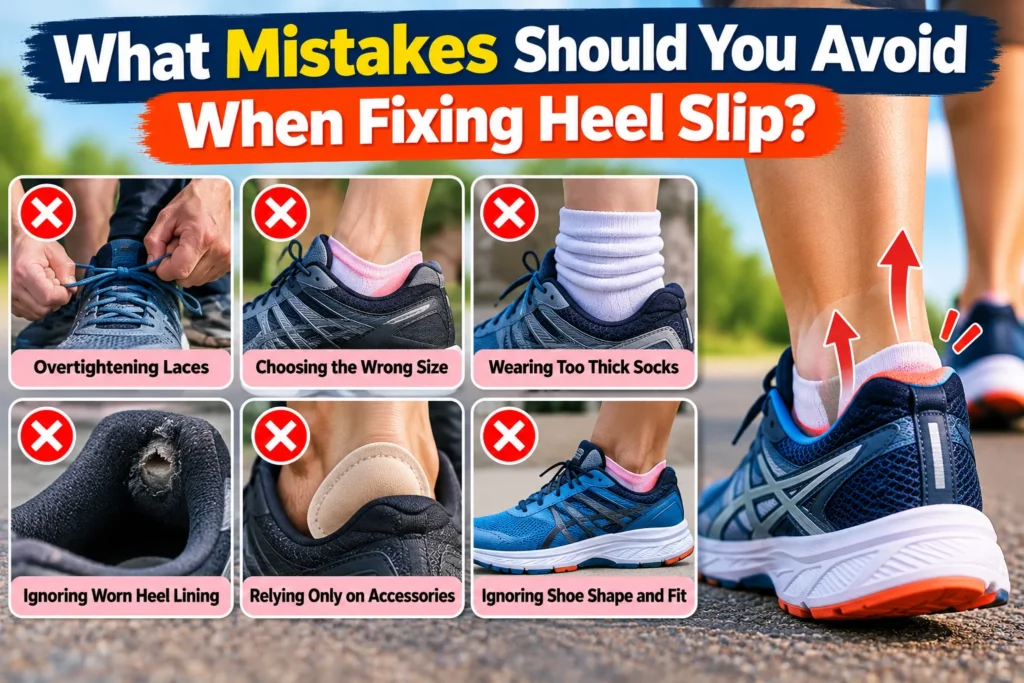
Several common mistakes can turn a manageable fit problem into uncomfortable running. Avoid these shortcuts when adjusting your shoes.
- Overtightening laces: Excessive pressure may cause numbness or discomfort.
- Automatically sizing down: You may remove essential toe clearance.
- Ignoring shoe width: A correct length can still have an unsuitable heel shape.
- Using bulky sock layers: Extra thickness may crowd your forefoot.
- Ignoring damaged lining: Worn heel materials can continue irritating your skin.
- Running through blisters: Continued friction may worsen an existing injury.
- Expecting accessories to fix everything: Laces and grips cannot transform a badly fitting shoe.
The best adjustment should feel natural while you move. If you must constantly think about keeping the shoes on, reassess the fit.
Helpful Products for Heel Slip and Running Shoe Comfort
Start with the free lacing adjustment before purchasing accessories. These three products address different needs: adjustable lacing, sock comfort, and minor heel gaps.
The scores below are editorial suitability estimates for these uses, not laboratory results or verified customer review averages.
🏆 Best for Adjustable Lacing
Lock Laces Original Elastic No-Tie Shoelaces
★★★★☆ 4/5
These 48-inch elastic laces use adjustable locking devices to control tension. I would consider them when convenient, repeatable adjustment is more important than traditional knots.
🧦 Best for Heel Comfort
Feetures Elite Light Cushion No-Show Tab Socks
★★★★☆ 4/5
These running socks feature moisture-wicking fibers, targeted compression, and a protective heel tab. I recommend considering them for sock movement or rubbing rather than using them to correct an oversized shoe.
👟 Best for a Minor Heel Gap
Pedag Stop Suede Leather Heel Grips
★★★☆☆ 3/5
These self-adhesive suede grips add material behind the heel in slightly loose shoes. I would treat them as a cautious option for minor gaps, since running comfort and grip retention need testing.
Remember that accessories solve specific comfort problems, not every fitting issue. Verify product compatibility and test any adjustment before longer runs.
Frequently Asked Questions
Is a Little Heel Slip Normal in Running Shoes?
Minor heel movement can occur with certain running shoe designs. However, repeated lifting, rubbing, or a feeling that your heel is escaping suggests inadequate heel security. Try a runner’s loop and check your overall fit if the movement becomes noticeable or uncomfortable.
Can Heel-Lock Lacing Prevent Blisters?
Heel-lock lacing may help reduce blisters caused by excessive heel movement. It improves heel security in some otherwise well-fitting shoes, which can reduce repeated rubbing. However, sock fit, moisture, shoe shape, and existing skin irritation also affect blister development.
Why Do My Heels Slip Even When My Running Shoes Fit?
Your heel cup may be too wide or shaped differently from your foot, even when the shoe length is correct. Loose lacing, excessive internal volume, or worn heel padding can also contribute. Test the fit while moving rather than relying on standing comfort alone.
Should I Buy Heel Grips or New Running Shoes?
Try heel grips only when the shoe has a small heel gap and otherwise fits correctly. If your foot slides excessively, the heel remains unstable, or the fit requires painful tightening, another shoe model is usually the more sensible solution.
Will My Running Shoes Stop Slipping After Breaking In?
Do not rely on breaking in running shoes to fix persistent heel slipping. Some materials may soften with wear, but that does not guarantee improved heel security. Running shoes should feel comfortable and reasonably stable when new, without requiring substantial changes in shape.
Final Takeaway: How Can You Prevent Heel Slip in Running Shoes?
To prevent heel slip in running shoes, start by checking your shoe fit and trying a runner’s loop. Next, evaluate your running socks, midfoot hold, and heel-cup shape.
Small adjustments may solve minor slipping. Persistent movement, painful friction, or excessive internal space usually means it is time to compare another size or model.
My final recommendation is to prioritize a secure heel without sacrificing natural toe movement. Test your adjustments during short, comfortable sessions before returning to longer runs.


