
Quick Answer
To find your running shoe size, measure both feet while standing, preferably late in the day. Compare your longer foot’s measurement with the shoe manufacturer’s size chart, then check width and fit. Your toes should have approximately a thumb’s width of clearance, as explained in our running shoe toe room guide.
5 Quick Steps to Find Your Size
- 1. Prepare your feet: Wear your normal running socks and stand on a firm surface.
- 2. Measure both feet: Record heel-to-longest-toe length in millimeters or centimeters.
- 3. Check your width: Measure across the widest part of each forefoot.
- 4. Read the size chart: Match your measurements with the specific brand’s chart.
- 5. Test the shoes: Check toe clearance, heel security, and comfort while walking or jogging.
Important Sizing Tip
- Fit matters most: Don’t automatically order a half-size larger. Use your actual measurements and how the shoe fits.
Finding the right running shoe size sounds easy until two shoes with identical size labels fit differently. A comfortable size in one brand might squeeze your toes in another.
I recommend starting with measurements rather than guessing from your everyday sneakers. This guide explains home measuring, size charts, shoe width, and the fit checks that matter when running.
What Does Running Shoe Size Actually Mean?
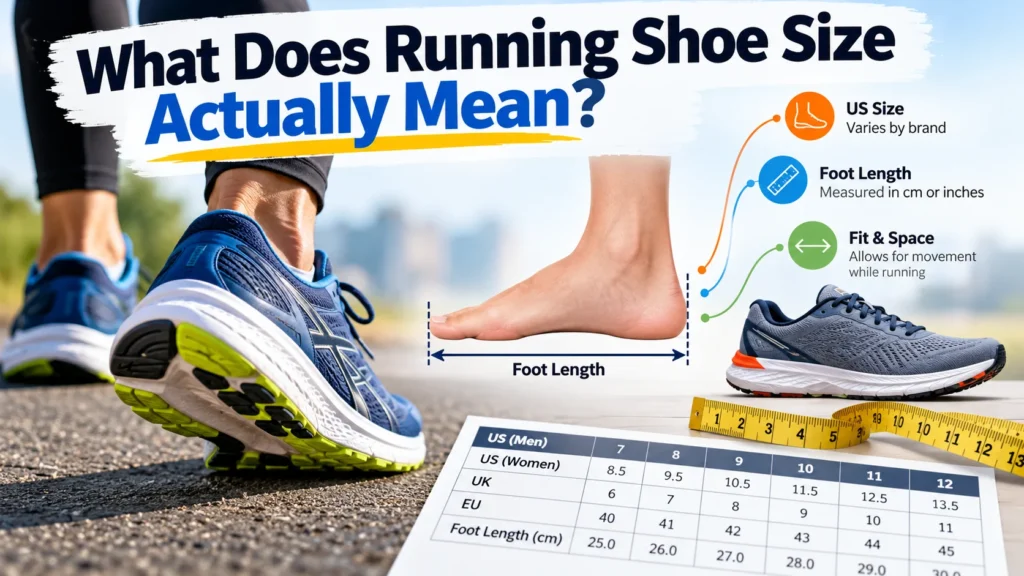
Running shoe size is a manufacturer’s numbered fit designation based mainly on foot length. However, your ideal running shoe also needs appropriate width, depth, and shape.
Two people with equally long feet may need different shoes because their forefeet or insteps differ. That’s why a size label alone cannot guarantee comfort.
Simple definition: Your running shoe size is the size designation that provides enough length while allowing your foot to sit securely and comfortably inside a particular shoe model.
Which Measurements Matter Most?
- Foot length: Distance from the back of your heel to your longest toe.
- Foot width: Distance across the widest part of your forefoot.
- Arch length: Distance from your heel to the ball joint of your foot.
- Foot volume: The overall space your foot occupies, including its height and instep.
- Toe clearance: Free space between your longest toe and the shoe’s front interior.
A professional fitting device can measure heel-to-ball length alongside overall foot length and width. These measurements provide a better starting point than length alone.
However, they still don’t account for every shoe’s shape. The final decision requires trying the footwear.
How Do You Measure Your Feet for Running Shoes at Home?
You can measure your feet using paper, a pencil, and a ruler. The most important details are standing upright, measuring both feet, and keeping your markings accurate.
Choose the afternoon or evening when possible. Your feet can become larger after hours of standing and moving.
Step 1: Gather Your Measuring Tools
You don’t need expensive equipment for an initial measurement. A simple home setup works well enough to identify a starting size.
- Two sheets of paper larger than your feet
- A pencil with a reasonably fine tip
- A ruler or measuring tape marked in millimeters
- A wall and a hard, level floor
- Your usual running socks
- Someone to help mark your feet, if available
Step 2: Position Your Foot Correctly
Place a sheet of paper on the floor against a wall. Stand with your heel lightly touching the wall and your weight balanced naturally.
Keep your toes relaxed rather than curling them. A helper can make the markings more accurate.
Step 3: Mark Your Longest Toe
Mark the paper at the tip of your longest toe while holding the pencil vertically. Your second toe might extend farther than your big toe.
Next, mark the heel position using the wall as your reference. Avoid tilting the pencil underneath your toe.
Step 4: Measure the Length
Step away and measure from the heel reference line to your longest-toe mark. Record the distance in millimeters for easier comparison with international sizing charts.
For example, a foot measuring 268 millimeters has a length of 26.8 centimeters. That is your foot measurement, not automatically your shoe’s labeled centimeter size.
Step 5: Measure Foot Width
Stand on another sheet and have someone trace around your foot with the pencil upright. Measure straight across the widest part of the forefoot outline.
Write down your width in millimeters. This measurement can help you compare width options within the correct length category.
Step 6: Repeat for Your Other Foot
Measure your second foot using the same method. Small differences between left and right feet are common.
Use the longer foot to establish your starting length. Make sure the chosen shoe also accommodates your wider foot.
Step 7: Repeat the Measurements
Check each measurement again before ordering. If two readings differ, repeat the process until you have a consistent result.
I prefer recording millimeters rather than rounding to whole centimeters. Small differences can matter when you fall between adjacent shoe sizes.
Practical tip: Write down both feet’s length and width, the measuring date, and your usual running sock thickness. Keep these details available when comparing brands.
How Do You Convert Foot Length Into Running Shoe Size?
To convert foot length into running shoe size, use the manufacturer’s official size chart. Avoid assuming that one universal conversion table works for every brand.
For example, Nike’s men’s footwear size chart lists foot-length measurements separately from shoe-label centimeter values.
Example: Nike Men’s US Running Shoe Sizes
The following values illustrate how measured foot length connects to selected US size labels. They are examples from Nike’s chart, not universal running shoe conversions.
| US Men’s Size | Nike Chart Foot Length | Approx. Centimeters |
|---|---|---|
| 8 | 10 inches | 25.4 cm |
| 9 | 10 5/16 inches | 26.2 cm |
| 10 | 10 11/16 inches | 27.1 cm |
| 11 | 11 inches | 27.9 cm |
Important: These centimeter figures convert the listed inch measurements and are rounded. They aren’t the same as Nike’s printed CM size labels.
If your measurement falls between chart entries, check the manufacturer’s rounding guidance. Ordering the larger listed size may be appropriate, but fit still decides.
Why Do US, UK, and EU Shoe Sizes Differ?
US, UK, and European systems use different numbering conventions. Their conversions also vary among brands, especially when comparing men’s, women’s, and unisex shoes.
- US sizing: Uses separate men’s and women’s numbering scales.
- UK sizing: Uses a different numbering system from US sizes.
- EU sizing: Commonly uses numbers such as 40, 42, and 44.
- CM or JP labels: Often appear on shoe labels, but may not equal measured foot length.
For online purchases, I would compare your actual foot measurement with the brand’s foot-length guidance first. Use international conversions as supporting information.
How Do You Find the Right Running Shoe Width?
Running shoe width determines how much lateral space your foot has inside the shoe. Correct length cannot compensate for a shoe that squeezes your forefoot.
If your little toe rubs against the upper, consider a wider fit. For a closer explanation, see our running shoe width and sizing guide.
Running Shoe Width Codes Explained
Many brands use letters such as B, D, 2E, and 4E. The standard category often differs between men’s and women’s footwear.
| Width Category | Women’s Typical Code | Men’s Typical Code |
|---|---|---|
| Narrow | 2A | B |
| Standard | B | D |
| Wide | D | 2E |
| Extra-wide | 2E | 4E |
These are common width categories rather than identical physical measurements across brands. The Brooks running shoe sizing guidance explains these width codes and why model shape matters.
Should You Size Up Instead of Buying Wide Shoes?
Not necessarily. A longer shoe can create unwanted space around your heel without solving the forefoot problem.
If length feels correct but your foot feels compressed sideways, try the same length in a wider version. Compare both while standing and moving.
How Should Running Shoes Fit When You Try Them On?
Properly fitted running shoes should feel secure around the heel and midfoot while giving your toes room. Your feet shouldn’t slide excessively or press against painful seams.
The REI running shoe fitting guide also recommends bringing your running socks and any orthotics you use.
1. Check the Toe Clearance
Stand with both shoes laced comfortably. Look for approximately one thumb-width of space beyond your longest toe.
Your toes should move freely without hitting the shoe’s front. Excessive space can also create slipping.
2. Check Heel Security
Walk briskly and pay attention to the back of each shoe. Your heel should remain comfortably supported rather than lifting repeatedly.
Small adjustments to lacing may improve security. However, substantial heel slipping can indicate the wrong shoe shape or size.
3. Check Your Midfoot
Your midfoot should feel comfortably held without painful pressure across the top. An overly tight fit may create rubbing or numbness.
The shoe’s arch shape matters too. Our guide on whether running shoes need arch support explains why more support isn’t automatically better.
4. Walk and Jog Before Deciding
Take several steps, turn, and jog briefly if the store allows it. Notice how the shoe behaves when your weight shifts forward.
The American Academy of Orthopaedic Surgeons’ athletic shoe guidance emphasizes adequate toe space, secure heels, and testing both shoes.
- Good fit: Toes move freely without hitting the front.
- Good fit: Heel stays secure during walking.
- Good fit: Forefoot feels comfortable when standing.
- Too small: Toes touch the front or feel crowded.
- Too narrow: Side pressure increases around the forefoot.
- Too large: Feet slide noticeably despite normal lacing.
Should Running Shoes Be Half a Size Bigger?
Some runners wear running shoes a half-size larger than their everyday footwear. However, this isn’t a universal rule.
Your casual shoes may already provide sufficient room. Another running shoe model might fit correctly in the same labeled size.
When Might a Larger Size Help?
- Your longest toe touches the front when standing.
- Your toes hit the shoe’s front during downhill running.
- Your measured foot length falls between manufacturer chart entries.
- Your feet feel crowded after exercise despite a suitable width.
Before sizing up, check whether the shoe is simply too narrow. A wider model may solve the problem without introducing unwanted length.
A good fit should feel comfortable immediately. Don’t depend on a painful shoe stretching enough to become suitable.
What Is the Most Accurate Way to Measure Running Shoe Size?
A professional foot measurement combined with an in-store fitting is a strong starting point. A specialist can examine dimensions that basic paper tracing misses.
The Genuine Brannock Device measures heel-to-toe length, heel-to-ball length, and width. Its official fitting instructions explain why arch length matters.
Home Measurement vs Professional Measurement
| Method | What It Measures | Main Limitation |
|---|---|---|
| Paper and ruler | Foot length and traced width in millimeters | Marking errors and limited information about foot volume |
| Brannock Device | Overall length, arch length, and width | Doesn’t guarantee an exact fit in every shoe model |
| In-store shoe fitting | Dynamic comfort, toe room, heel security, and shoe shape | A brief test cannot reproduce every running condition |
My preferred approach is to combine measurements with actual movement in the shoe. Numbers narrow the options, but comfort determines the final choice.
How Do You Choose Running Shoe Size When Shopping Online?
Start with the product’s official size chart and your longer foot measurement. Check whether the specific model is offered in different widths.
Online shopping adds uncertainty because you can’t test the fit before purchasing. A clear return policy becomes especially useful.
- Read the manufacturer’s chart: Find the section for measured foot length, not only shoe-label conversions.
- Check model-specific fit notes: Look for information about toe box shape and width availability.
- Compare a familiar model: Use a shoe that already fits well as a reference.
- Check return conditions: Understand whether indoor fit testing is allowed.
- Test indoors first: Walk on a clean surface before deciding to keep the shoes.
Remember that shoe size is separate from shoe support technology. Our neutral vs stability running shoes comparison explains the difference between those categories.
What Mistakes Should You Avoid When Finding Running Shoe Size?
The biggest mistake is treating your old shoe size as a permanent measurement. Feet and footwear designs can change over time.
A few small measuring errors can also lead to a frustrating purchase. Watch for these common problems.
- Measuring while sitting: Your foot may have different dimensions without full body weight.
- Measuring only one foot: The other foot might be longer or wider.
- Ignoring sock thickness: Different running socks can change how securely shoes fit.
- Using generic conversion charts: Manufacturer sizing systems can differ.
- Confusing width with length: Bigger sizes don’t always solve forefoot pressure.
- Ignoring heel movement: Extra length may create slipping or rubbing.
- Expecting shoes to break in: Painful footwear shouldn’t be treated as an acceptable starting fit.
Another mistake is judging shoes while standing still for only a few seconds. Walking and light jogging reveal fit problems that static measurements miss.
Do Running Shoe Size Needs Change Over Time?
Yes. Foot dimensions may change with age, body-weight changes, pregnancy, injuries, or other physical changes.
Even without a noticeable change, measuring again before replacing running shoes is sensible. Don’t assume your previous size must remain correct.
Does Running Distance Affect Fit?
Longer runs may involve changes in foot volume and more repeated contact inside the shoe. A secure but roomy fit helps accommodate these conditions.
Use the type of socks you wear during your regular runs. If you frequently run downhill, pay particular attention to toe contact.
What If You Wear Orthotics?
Orthotic inserts can change the available space and support inside a shoe. Bring them when trying on footwear.
Check whether the original insole can be removed and whether the replacement sits properly. Seek professional fitting advice if inserts create new pressure or discomfort.
Useful Products for Measuring and Checking Running Shoe Fit
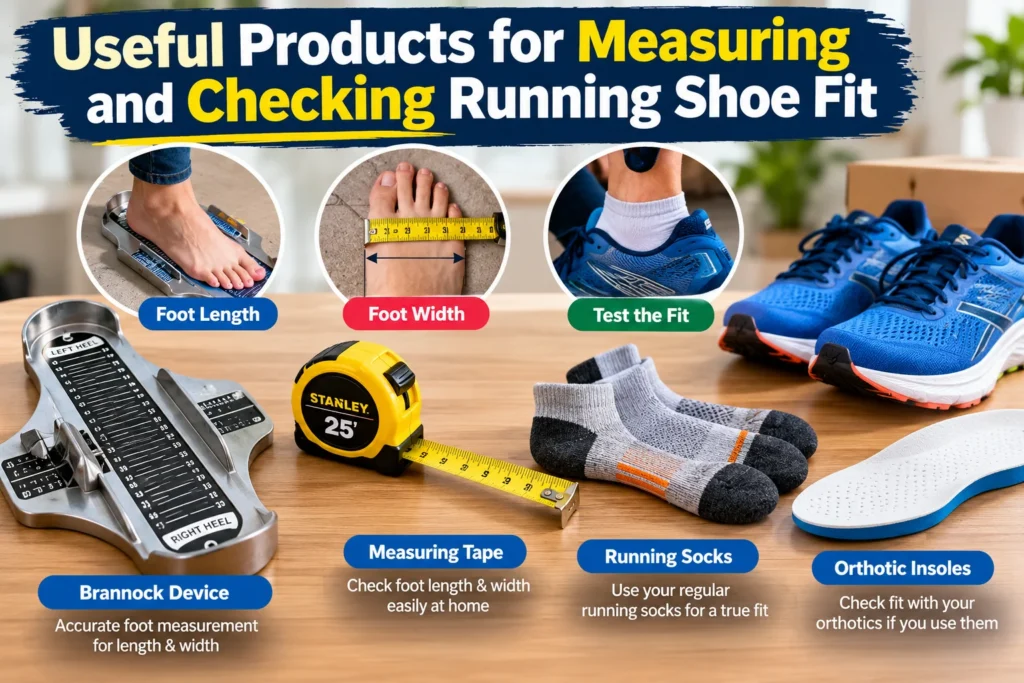
You can start with tools already at home. However, a dedicated measuring device, flexible tape, or consistent pair of running socks may make the process easier.
These products serve different purposes rather than competing as alternatives. The ratings below are editorial usefulness assessments, not verified customer-review scores or hands-on test results.
🏆 Best for Detailed Measurements
Genuine Brannock Combination Foot Measuring Device
★★★★½ 4.5/5 Editorial
This professional device measures foot length, arch length, and width using men’s and women’s US sizing scales. I’d recommend it for frequent shoe fitting rather than occasional home measuring because it costs considerably more than a simple ruler.
💰 Best Budget Measuring Tool
SINGER 60-Inch Tape Measure (S00218)
★★★★☆ 4/5 Editorial
This flexible 60-inch tape has inch and centimeter markings. It is useful for checking marked foot dimensions, although a rigid ruler is preferable when measuring the straight heel-to-toe distance.
👟 Best for Consistent Fit Testing
Feetures Elite Light Cushion Tab Running Socks
★★★★½ 4.5/5 Editorial
These running socks feature light cushioning, a seamless-toe design, and a protective heel tab. I would use the same pair consistently during fittings to make shoe comparisons more meaningful.
Affiliate disclosure: As an Amazon Associate, we earn from qualifying purchases. Product availability, specifications, and prices may change.
Frequently Asked Questions
How can I find my running shoe size without a measuring device?
Stand on paper, mark your heel and longest toe, then measure the distance with a ruler. Repeat on the other foot and compare the longer measurement with the manufacturer’s chart. Check shoe width and walking comfort before deciding on a size.
Should running shoes feel tight when you first buy them?
No. Running shoes should feel secure without painful tightness. Your toes need space to move, your forefoot shouldn’t feel squeezed, and your heel should stay comfortably supported. A shoe that causes immediate discomfort is unlikely to become a better choice through repeated wear.
Is running shoe size the same as regular shoe size?
Sometimes, but not always. Running shoes may require a different size because of their shape, intended use, and the space needed around your toes. Measure your feet and compare individual brand charts instead of automatically choosing your everyday sneaker size.
What should you do if you’re between running shoe sizes?
Start with the manufacturer’s recommendation for measurements between chart entries. Try both adjacent sizes when possible, checking toe clearance, forefoot comfort, and heel movement. Choose the size that fits securely without pressure rather than selecting the larger number automatically.
How often should you measure your running shoe size?
Measure your feet whenever you’re buying new running shoes, especially if your current pair feels different. Foot dimensions can change with age and physical circumstances. Rechecking both feet takes little time and may prevent an uncomfortable purchase.
Final Takeaway: Find Your Size, Then Confirm the Fit
The best way to find running shoe size is to combine accurate foot measurements with the manufacturer’s chart and a practical fit test. No single number replaces checking the shoe on your feet.
Start with these essentials:
- Measure both feet while standing.
- Use the longer foot as your length reference.
- Check width instead of focusing only on shoe length.
- Compare measurements with the brand’s official chart.
- Confirm toe room, heel security, and comfort during movement.
Before your next purchase, measure your feet and record the results. Then compare two suitable sizes or widths whenever possible.
Your goal isn’t to find a particular number. It’s to find running shoes that fit comfortably from the first run.


Steven is a former sportsperson and now a full-time businessman and research writer. He is the mastermind of this site, and he created this site to help people who need specialized shoes for different activities. When he was a sportsperson, he was very passionate about different types of shoes for his sports purpose. The passion he had for shoes at that time now turned into his profession. Besides his shoe business, he loves sharing his knowledge and experience with people and helping them maintain healthy feet.
More Posts