
Quick Answer
A running shoe rocker is a curved sole shape that helps your foot roll from landing toward push-off. It can change how your ankle and forefoot move, but it does not guarantee faster running or fewer injuries, as explained in a 2026 review of rocker geometry.
Five things to know
- Curved profile: The heel, forefoot, or both curve upward from the ground.
- Rolling transition: The shoe can guide movement from contact to toe-off.
- Different designs: Some rockers feel subtle; others feel strongly rounded.
- Not a plate: A rocker is a shape, not necessarily a carbon or nylon plate.
- Personal fit matters: Test the shoe at your normal pace before buying.
When a running shoe feels as though it gently tips you forward, its curved sole may be part of the reason. I look at rocker shape alongside fit, cushioning, and stability rather than judging it as a performance upgrade by itself.
This guide explains how rockers work, which designs exist, and how to decide whether one suits your running.
What Is a Rocker in Running Shoes?
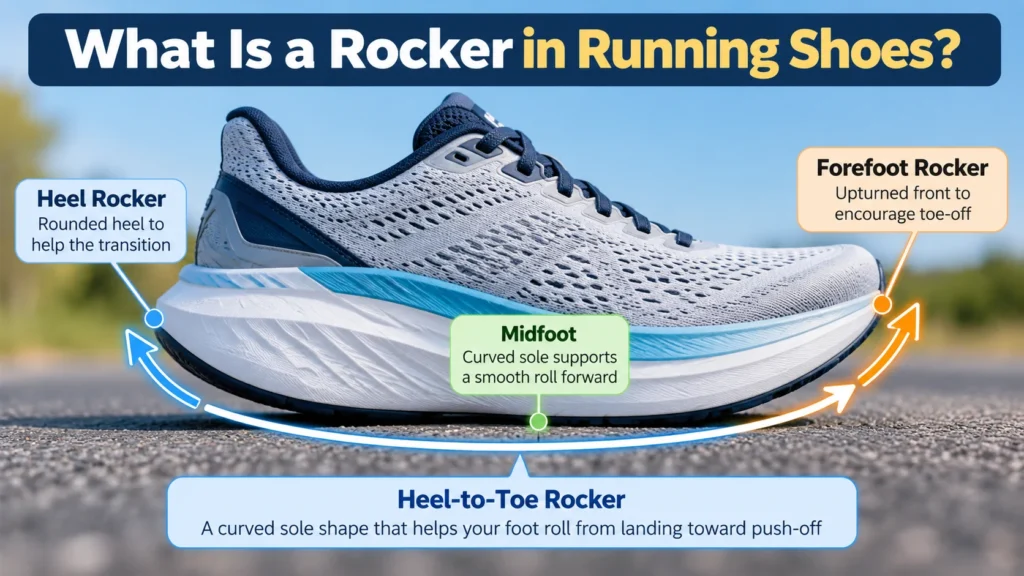
A rocker is a curved section of the shoe’s bottom profile that changes how the sole contacts the ground. Instead of remaining relatively flat, part of the shoe rolls over its curved shape as you move forward.
Simple definition: A running shoe rocker is sole geometry designed to influence the transition through the stance phase of running.
The effect depends on much more than appearance. The position of the curve, stiffness of the sole, foam, speed, and your stride all influence what you feel.
- Heel: A rounded rear edge can shape initial ground contact.
- Midfoot: The sole supports your weight as your body travels forward.
- Forefoot: An upturned front can change how you move toward toe-off.
Not every shoe with a raised toe has a pronounced rocker. There is also no universal numerical cutoff that makes one model a rocker shoe and another a non-rocker.
How Does a Running Shoe Rocker Work?
A rocker changes the rolling path beneath your foot while you run. Depending on the design, your body can move over the sole with different amounts of ankle motion and toe bending.
What Happens During a Running Stride?
- Initial contact: The heel or midfoot meets the ground, depending on your strike pattern.
- Loading: The cushioning compresses while your body moves above the foot.
- Forward roll: The curved profile can help the contact point travel toward the toes.
- Push-off: The forefoot rolls over the curve as you leave the ground.
A stiff, curved sole may require less bending at the toe joints than a flexible, flatter shoe. That does not mean it eliminates effort or propels you forward without muscle work.
I use the image of a gently rounded chair rocker: its shape changes the path of movement. A running shoe works differently under load, but the analogy explains the basic idea.
What Types of Running Shoe Rockers Are There?
The three most useful categories are heel, forefoot, and heel-to-toe rockers. Real shoes often combine these features, so the boundaries are not strict.
- Heel rocker: A beveled or rounded rearfoot that can influence heel landings and the early transition.
- Forefoot rocker: An upward curve near the front that influences the late stance and toe-off phase.
- Heel-to-toe rocker: A more continuous curved profile extending across much of the sole.
What Is an Early-Stage vs. Late-Stage Rocker?
These names usually describe where the forefoot begins to curve upward. An earlier-starting curve can create a longer rolling section; a later-starting curve leaves more of the front relatively flat.
Brand terminology is not standardized. Compare actual side profiles and running feel rather than assuming two brands use identical definitions.
What Do Rocker Apex, Rocker Angle, and Toe Spring Mean?
These terms describe different pieces of the sole’s geometry. They help explain why two visibly curved shoes can feel completely different.
- Rocker apex: The location where the rolling curve is positioned, measured in relation to shoe length.
- Rocker angle: How steeply part of the sole rises relative to the ground.
- Curvature radius: A measure of how sharply or gently the profile curves.
- Toe spring: How high the toe end rises above the ground when the shoe rests flat.
- Longitudinal stiffness: How much the shoe resists bending from heel to toe.
A tall toe spring does not tell you the entire rocker shape. The location and stiffness of the curve matter as well.
Rocker vs. Heel Drop vs. Stack Height: What Is the Difference?
Rocker, drop, and stack height describe separate features. A shoe may have a high stack without a strong rocker, or a prominent rocker without a carbon plate.
| Feature | What it measures | Why it matters |
|---|---|---|
| Rocker geometry | Sole curvature and where it begins | Changes rollover and loading |
| Heel-to-toe drop | Heel stack minus forefoot stack, in mm | Changes the relative height of heel and forefoot |
| Stack height | Amount of material beneath the foot, in mm | Influences platform height and cushioning space |
| Toe spring | Vertical lift at the front of the shoe | Describes one aspect of front-end shape |
| Plate | Carbon, nylon, or other stiff insert | Alters bending stiffness and ride feel |
For example, the HOKA Clifton 10 and Saucony Endorphin Speed 5 both have manufacturer-listed 8 mm drops. Their different midsoles and structures still create distinct running experiences.
Do Rocker Running Shoes Make You Faster or More Efficient?
They might benefit some runners, but a rocker alone cannot promise better pace or running economy. Efficiency depends on the complete shoe and how an individual runner responds.
A study testing individualized rocker profiles shows why the curve’s design matters. Results from optimized experimental shoes cannot automatically be applied to every retail model.
Why Can Rockers Feel Propulsive?
A curved, relatively stiff sole can make the transition toward toe-off feel continuous. Responsive foam and a plate may add to that sensation without being the same feature as the rocker.
- Easy daily runs: A gentle rocker may feel smooth and less intrusive.
- Tempo sessions: Some runners prefer a stronger rolling sensation as pace increases.
- Racing: Rocker shape interacts with foam, stiffness, weight, and running mechanics.
When comparing shoes, I focus on how naturally the transition matches a runner’s pace. A dramatic shape is not useful if it feels awkward after several minutes.
Can Rocker Shoes Reduce Pressure on Your Feet or Ankles?
Some rocker designs can redistribute pressure under the forefoot and change ankle mechanics. Those effects depend on the precise shoe and do not amount to an injury-prevention guarantee.
In a study of 16 female endurance runners, rocker shoes reduced measured ankle work but increased some knee-loading measures. That trade-off is important when evaluating claims about reducing stress.
Other running plantar-pressure research found reduced loading in some forefoot regions with stiff rocker footwear. Results from a specific test shoe should not be treated as a prescription for everyone.
Are Rockers Helpful for Toe Stiffness or Forefoot Pain?
A stiff rocker can reduce how much the forefoot bends during rollover, which may be useful in some clinical situations. However, location of pain, diagnosis, and shoe geometry all matter.
Do not use a rocker shoe to self-treat persistent toe, arch, Achilles, or knee pain. A sports podiatrist or physical therapist can help match footwear to the underlying problem.
Who Might Like Rocker Running Shoes—and Who Might Not?
Runners who enjoy a guided, continuous transition may appreciate a rocker. Others prefer a flexible forefoot that lets their feet control more of the bending motion.
Runners Who May Want to Try One
- Road runners: A rolling sole can feel consistent on predictable pavement.
- Long-run enthusiasts: Some prefer a smooth transition as fatigue builds.
- Stiff-shoe fans: Rocker geometry can complement a less flexible forefoot.
- Runners comparing load: A clinician may suggest a particular design for a specific mechanical goal.
Runners Who Should Compare Carefully
- Uneven-terrain runners: High or strongly curved soles may feel less predictable on technical ground.
- Balance-sensitive runners: A pronounced roll can feel unfamiliar when standing or turning.
- Flexible-shoe fans: A stiff rocker may limit the forefoot flex they enjoy.
- Anyone with recurring pain: Footwear changes deserve individual assessment when symptoms continue.
Rockers do not automatically provide stability against inward rolling. If movement guidance is your main concern, compare neutral and stability running shoes separately.
How Can You Tell if a Running Shoe Has a Rocker?
Start by viewing the shoe from the side while it stands on a flat surface. Look for a raised toe, a rounded heel, or a smooth curve under much of the outsole.
- Check the profile: Observe which parts of the outsole lift away from the ground.
- Read the description: Look for terms such as rocker, MetaRocker, GUIDESOLE, or SPEEDROLL.
- Check flexibility gently: A stiff forefoot may strengthen the rolling sensation, but stiffness alone proves nothing.
- Try moving: Walk and jog at a comfortable pace where store policies and space allow.
How Should Beginners Choose Their First Rocker Running Shoes?
Start with a moderate rocker and a comfortable, secure fit. More curvature is not automatically better for a new runner.
A Practical Six-Step Fitting Test
- Match the purpose: Choose a daily trainer for ordinary road mileage before exploring aggressive racing designs.
- Check toe space: Follow a sensible running-shoe toe-room guide; the curved sole should not push toes into the front.
- Check width: Use a shoe-width fit checklist to avoid pressure across the forefoot.
- Walk first: Notice whether the rocker feels natural or forces your body forward unexpectedly.
- Jog briefly: Compare transitions at your actual easy pace, not just a quick sprint.
- Build gradually: Start with shorter runs and monitor how your feet and legs respond.
My preferred comparison is simple: use two shoes intended for the same type of run. The better option is the one that feels consistent, comfortable, and easy to control.
Should You Change Your Running Form?
Do not force a forefoot strike just because the shoe has a forefoot rocker. Let your familiar stride guide the initial test and make gradual adjustments only when they serve a clear purpose.
On concrete, I prioritize fit, outsole traction, and predictable cushioning alongside curvature. For more surface-specific guidance, see the site’s running shoes for concrete floors comparison.
What Mistakes Should You Avoid When Choosing Rocker Shoes?
The biggest mistake is treating the word “rocker” as a guarantee of comfort or speed. It describes geometry, not a standardized performance rating.
- Confusing rocker and drop: An 8 mm drop does not specify rocker shape.
- Assuming a carbon plate: Many rockered shoes do not contain carbon plates.
- Choosing only by appearance: A curved silhouette cannot show how the shoe behaves under load.
- Ignoring fit: An excellent rocker cannot compensate for cramped toes or heel slipping.
- Switching abruptly: A different rolling pattern can change the demands on your legs.
- Buying for medical relief: Reduced pressure in one area may mean more loading somewhere else.
Which Running Shoes Have Rocker Designs in 2026?
These three shoes demonstrate different rocker approaches in current road-running models. Specifications are manufacturer-listed, generally for men’s versions, and may vary by size or region.
| Model | Rocker approach | Drop | Main use |
|---|---|---|---|
| HOKA Clifton 10 | Smooth MetaRocker | 8 mm | Daily road running |
| ASICS GlideRide Max 2 | GUIDESOLE and rockered EVA plate | 6 mm | Cushioned longer runs |
| Saucony Endorphin Speed 5 | SPEEDROLL and nylon plate | 8 mm | Faster training |
The table describes design, not measured superiority. Choose based on the pace you run most often and how the sole feels when you move.
Three Rocker Running Shoes Worth Comparing
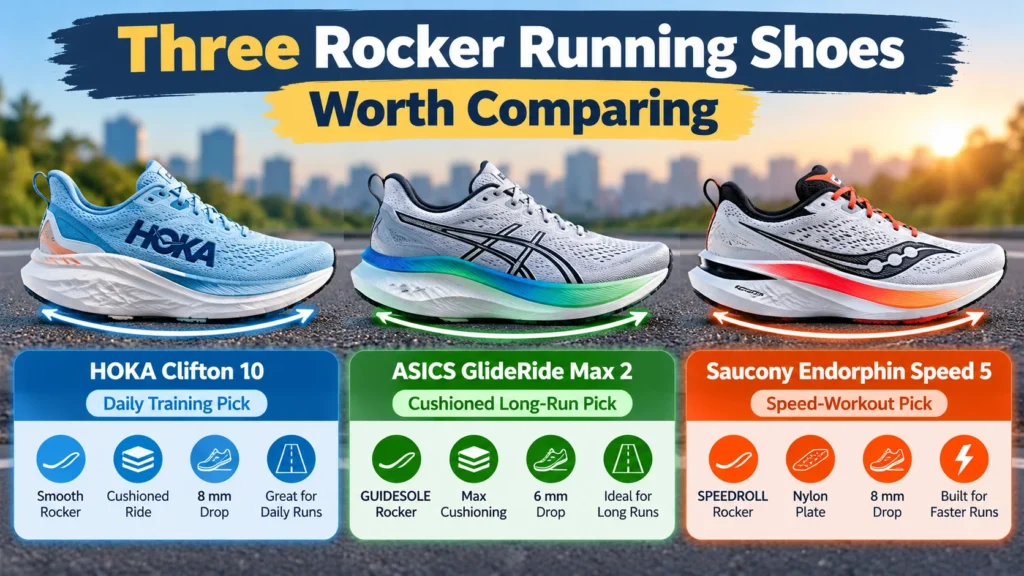
If you want to try a rocker, these are useful reference points with distinct training purposes. My ratings below describe editorial fit for each stated use, not customer review averages or results from personal laboratory testing.
🏆 Daily Training Pick
HOKA Clifton 10
★★★★½ — 4.5/5 editorial fit
Smooth MetaRocker geometry, CMEVA cushioning, and an 8 mm drop suit daily road running. I’d shortlist it for runners wanting a noticeable but approachable rolling transition.
☁️ Cushioned Long-Run Pick
ASICS GlideRide Max 2
★★★★½ — 4.5/5 editorial fit
GUIDESOLE curvature, a rockered EVA plate, and a 6 mm drop emphasize smooth transitions. I’d compare it for easy long-distance runs when cushioning is the priority.
⚡ Speed-Workout Pick
Saucony Endorphin Speed 5
★★★★☆ — 4/5 editorial fit
SPEEDROLL geometry combines with a semi-rigid nylon plate, PWRRUN PB foam, and an 8 mm drop. I’d consider it for faster workouts rather than choosing it purely to learn what a rocker feels like.
Affiliate disclosure: As an Amazon Associate, we may earn from qualifying purchases. Search results, prices, stock, and available sizes can change.
Frequently Asked Questions
Are Rocker Running Shoes Good for Beginners?
Yes, some rockered daily trainers can work well for beginners when they fit comfortably and feel controlled. Start with a moderate design, test it at an easy pace, and introduce it gradually rather than choosing the most aggressive shape.
Do Rocker Shoes Have Carbon Plates?
No. A rocker describes the sole’s curvature, while a carbon plate is a stiff internal component. Some shoes combine both, others use nylon or EVA plates, and many cushioned rocker shoes do not need a plate at all.
Are Rocker Shoes Better for Heel Strikers?
Not automatically. A rounded heel can influence the early landing transition for heel strikers, but the shoe’s front curvature also affects later stance. Comfort and biomechanics vary, so compare models at your normal running pace instead of choosing by foot strike alone.
Do Rocker Soles Help With Achilles Tendon Pain?
Some rocker designs reduce measured ankle loading during controlled tests, but that does not prove they treat Achilles tendinopathy. Effects can shift to other joints, and symptoms have many causes; seek professional guidance for persistent tendon pain.
Can You Walk in Rocker Running Shoes?
Yes, many rocker running shoes are also comfortable for walking, particularly on predictable surfaces. However, a strong curve can feel unfamiliar when standing, turning, or using stairs, so test those movements before making the shoes your everyday pair.
Final Verdict: Is a Running Shoe Rocker Worth Trying?
A rocker is a curved sole design that influences how your shoe rolls forward. It may make transitions feel smoother or change local loading, but it is not an automatic advantage.
For your first pair, I recommend a comfortable daily trainer with a manageable rocker rather than the most dramatic design. Compare two suitable models, take a short test run, and let your own experience guide the decision.
Next step: Check the fit, choose a shoe that matches your usual training, and build up gradually if its rolling feel is new to you.


Steven is a former sportsperson and now a full-time businessman and research writer. He is the mastermind of this site, and he created this site to help people who need specialized shoes for different activities. When he was a sportsperson, he was very passionate about different types of shoes for his sports purpose. The passion he had for shoes at that time now turned into his profession. Besides his shoe business, he loves sharing his knowledge and experience with people and helping them maintain healthy feet.
More Posts