
Quick Answer
Stack height in running shoes is the total thickness of material between your foot and the ground, measured in millimeters (mm). Higher stack heights generally provide more underfoot cushioning and less ground feel, while lower stacks bring your foot closer to the surface. The Running Warehouse stack-height guide explains how these measurements influence shoe feel.
Five things to know about stack height:
- Heel stack height: The material thickness beneath your heel.
- Forefoot stack height: The material thickness beneath the ball of your foot.
- Lower stack: Usually offers greater ground feel and a less elevated ride.
- Higher stack: Provides more space for cushioning materials and impact management.
- Heel-to-toe drop: The difference between heel and forefoot stack heights.
How to evaluate your shoes:
- Check both measurements: Compare heel and forefoot heights, not just the advertised heel stack.
- Test the actual ride: Cushioning softness, stability, and comfort matter more than stack height alone.
If you’ve compared running shoes recently, you’ve probably noticed how dramatically their soles differ in thickness. Some look almost flat, while others have thick foam platforms that raise your feet well above the road.
I find stack height one of the most useful specifications for understanding these differences. This guide explains what the numbers mean, how they affect running, and how to choose a comfortable height in 2026.
What Does Stack Height Mean in Running Shoes?
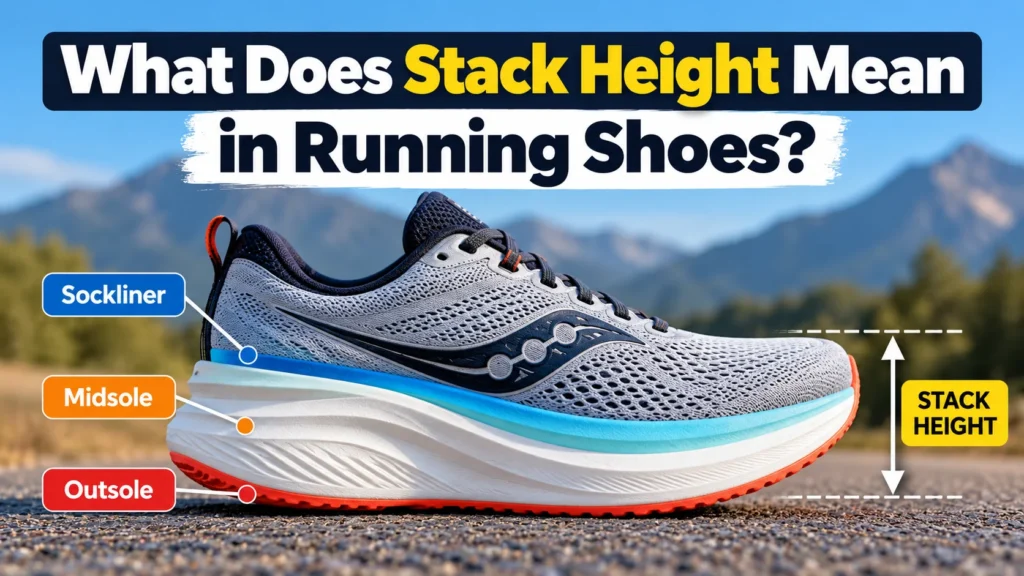
Running shoe stack height is the vertical distance between the ground and the surface supporting your foot inside the shoe. It describes how much shoe material separates your foot from the running surface.
The measurement generally includes the outsole, midsole, and sockliner or insole, depending on the measurement method. It isn’t simply the thickness of the visible foam.
Which Parts of a Shoe Contribute to Stack Height?
- Outsole: The rubber or other material contacting the ground and providing traction.
- Midsole: The main cushioning structure, commonly made from EVA, PEBA, or other foam compounds.
- Sockliner: The removable or fixed layer directly beneath your foot.
- Additional structures: Plates and embedded components may sit within the measured sole thickness.
For example, a shoe might have 36 mm of material under its heel and 26 mm under its forefoot. Those measurements describe two different locations within the same shoe.
One important detail is that the visible sidewall doesn’t always match the amount of material underfoot. Some designs wrap foam upward around the foot, making the sole appear taller.
Why Is Stack Height Measured in Millimeters?
Millimeters provide a precise way to describe small differences in shoe geometry. A change of just a few millimeters can alter the construction and perceived ride.
However, a 3 mm difference doesn’t guarantee a noticeable improvement in comfort. Foam formulation and shape can have a greater influence.
How Is Running Shoe Stack Height Measured?
Stack height is measured from the ground-contacting surface to the foot-supporting surface at specific locations. Measurements are usually reported separately for the heel and forefoot.
Professional measurements use specialized tools and controlled reference points. The exact method may differ between manufacturers, laboratories, and retailers.
Understanding Heel and Forefoot Measurements
- Heel stack: Measure the shoe’s total thickness beneath the central heel area.
- Forefoot stack: Measure the thickness beneath the ball of the foot.
- Heel-to-toe drop: Subtract forefoot stack height from heel stack height.
- Compare consistently: Use the same measurement source when possible.
Suppose a running shoe has a 38 mm heel stack and a 30 mm forefoot stack. Its heel-to-toe drop is 8 mm.
That’s a useful calculation, but it doesn’t describe the foam’s firmness or energy return. Those require separate evaluation.
What Is the Difference Between Stack Height and Heel-to-Toe Drop?
Stack height measures how much material sits beneath your foot, while heel-to-toe drop measures the height difference between the heel and forefoot. They’re related measurements, but they answer different questions.
A shoe can have a thick sole and a small drop. Another can have much less material underfoot yet the same drop.
| Feature | Stack Height | Heel-to-Toe Drop |
|---|---|---|
| Definition | Thickness underfoot | Heel minus forefoot height |
| Primary influence | Ground feel and available cushioning | Foot position and loading distribution |
| Example | 36 mm heel, 26 mm forefoot | 10 mm drop |
| What to compare | Heel and forefoot thickness | Difference between those heights |
The ASICS heel-drop explanation provides another useful example of these independent measurements.
My practical rule is to compare stack height and drop together. Looking at only one number can create a misleading impression of the shoe.
What Are Low, Medium, and High Stack Running Shoes?
Running shoes span a wide range of sole thicknesses, from minimalist designs to maximal-cushion trainers. There’s no universally accepted classification system across all brands.
One useful approach is to classify shoes by their forefoot stack height, as Running Warehouse does. The following ranges are category guidelines rather than industry-wide standards.
| Category | Forefoot Stack | Typical Feel |
|---|---|---|
| Barefoot-style | 0–13 mm | Very close ground contact |
| Minimal | 14–18 mm | Limited cushioning |
| Low | 19–23 mm | Noticeable ground feel |
| Medium | 24–28 mm | Balanced underfoot protection |
| High | 29–34 mm | Substantial cushioning |
| Maximal | 35 mm or more | Thick cushioning platform |
These forefoot-based categories explain why a 36 mm heel stack doesn’t automatically classify a shoe as maximal. The matching forefoot measurement matters.
How Does Stack Height Affect Running Performance and Comfort?
Stack height influences ground feel, cushioning capacity, and shoe geometry. It can affect the running experience, but it doesn’t independently determine speed, comfort, or injury risk.
1. Impact Cushioning and Underfoot Protection
A higher stack gives designers more room for cushioning materials. This can make repeated landings feel less harsh, especially on hard pavement.
However, thicker foam isn’t automatically softer. Foam density, resilience, and compression behavior influence how a shoe responds.
2. Ground Feel and Surface Feedback
Lower-stack shoes generally transmit more information about the running surface. Some runners prefer this direct connection during faster workouts.
Higher stacks create greater separation from the ground. This may feel comfortable on smooth roads but less connected on irregular surfaces.
3. Stability and Platform Geometry
A taller shoe may create a more elevated feeling during cornering or uneven landings. However, stack height alone doesn’t establish whether the shoe is unstable.
Other design features can influence how secure it feels:
- Platform width: A broad outsole provides a larger supporting base.
- Sidewalls: Raised foam surrounding the foot can improve the feeling of containment.
- Foam firmness: Firmer materials may resist excessive compression.
- Rocker geometry: A curved sole can encourage a rolling transition through the stride.
- Upper fit: A secure upper helps keep the foot positioned over the platform.
This is why I wouldn’t reject a high-stack shoe simply because it looks tall. I’d check the complete design and how it feels during movement.
For a closer look at support features, see our guide to neutral vs stability running shoes.
4. Shoe Weight and Running Efficiency
Extra material can increase shoe weight, but modern lightweight foams complicate that relationship. Some thick-soled performance shoes remain surprisingly light.
Energy return also depends on foam technology and structural design. A higher stack alone doesn’t guarantee faster running or better efficiency.
What Are Some Real Running Shoe Stack Height Examples in 2026?
Real product specifications make stack height easier to understand. The following shoes demonstrate different levels of sole thickness and cushioning.
| Running Shoe | Heel | Forefoot | Drop |
|---|---|---|---|
| Saucony Kinvara 16 | 28 mm | 24 mm | 4 mm |
| Brooks Ghost 17 | 36 mm | 26 mm | 10 mm |
| HOKA Bondi 9 | 43 mm | 38 mm | 5 mm |
Specification note: Figures come from published manufacturer and retailer information. Different measurement methods, sizes, and regional versions may produce slightly different results.
The Saucony Kinvara 16 specifications illustrate a relatively low-profile performance trainer. Its 4 mm drop comes from the difference between its 28 mm heel and 24 mm forefoot.
By comparison, the Brooks Ghost 17 provides a thicker heel platform with a larger drop. I’d consider this type of geometry when comparing familiar daily trainers.
The HOKA Bondi 9 design information confirms a 43 mm heel stack and 5 mm drop. It represents a much thicker cushioning platform with a relatively small heel-to-forefoot difference.
How Can You Choose the Right Stack Height for Your Running Style?
The right stack height depends on your preferences, running surfaces, current footwear, and training goals. There isn’t one ideal measurement for every runner.
For Beginners and Everyday Runners
Start with a comfortable daily trainer offering predictable transitions and a secure fit. A moderate amount of cushioning is often a useful starting point.
- Prioritize comfort at your normal easy pace.
- Choose a stable-feeling platform rather than the tallest available shoe.
- Check both heel and forefoot cushioning.
- Keep the shoe’s drop reasonably familiar when possible.
For Long-Distance Road Running
Many distance runners appreciate substantial cushioning during extended road sessions. A high-stack trainer may offer the underfoot feel they prefer.
Still, thick cushioning isn’t a requirement for marathon preparation. A comfortable shoe with appropriate fit and predictable transitions can matter more.
For Speed Training and Shorter Workouts
Lower-profile trainers can provide a lighter, more direct ride. Some runners enjoy their flexibility and clearer ground feedback during faster sessions.
Yet many modern racing shoes combine tall foam stacks with responsive materials. Low stack height is no longer a universal feature of fast running shoes.
For Trail Running and Uneven Ground
Stack height can influence confidence on rocks, roots, and changing surfaces. Some trail runners prefer lower platforms for greater terrain feedback.
Others choose thicker cushioning for long distances over rough ground. Traction, platform width, and foot security remain crucial.
For Runners Who Need Additional Support
Choose support features according to your individual comfort and movement needs. High or low stack height alone cannot determine the correct support category.
If inward foot movement concerns you, our guide to overpronation in running explains how shoe stability and foot motion relate.
Can Changing Stack Height Cause Problems?
A major change in stack height can make a familiar running shoe feel different. It may also come with changes in drop, flexibility, or foam firmness.
For that reason, I recommend making significant footwear changes gradually rather than switching every run immediately.
- Start with short runs: Use the new shoes for brief, comfortable sessions.
- Observe the ride: Notice stability, pressure points, and unusual discomfort.
- Increase exposure gradually: Add distance if the shoes continue feeling comfortable.
- Keep a familiar alternative: Rotate your previous shoes during the transition.
- Stop if pain develops: Persistent discomfort deserves proper assessment.
Moving into very thin footwear may require particular care because the cushioning and mechanical demands can change. The appropriate adjustment period varies between individuals.
Does Stack Height Affect Running Shoe Fit?
Stack height and shoe fit describe different characteristics. A shoe with excellent cushioning can still feel uncomfortable if its upper doesn’t fit correctly.
When evaluating fit, I check the following separately:
- Toe length: Enough space in front of the longest toe.
- Forefoot width: No uncomfortable pressure around the ball of the foot.
- Heel security: Limited unwanted movement during running.
- Midfoot comfort: Secure lacing without excessive tightness.
- Underfoot feel: Cushioning that feels consistent with the intended workout.
Our running shoe toe-room guide explains how to assess length and front-foot clearance.
Width deserves equal attention. Read our guide to choosing the correct running shoe width before assuming thicker cushioning will resolve fit problems.
Do Running Shoe Stack Height Limits Apply to Racing?
Yes, some officially regulated competitions impose maximum shoe sole thicknesses. These restrictions primarily matter when choosing shoes for events governed by World Athletics rules.
Under the World Athletics regulations effective April 20, 2026, the limits include:
- Road running: Maximum 40 mm sole thickness.
- Track running: Maximum 20 mm for applicable track running events.
- Track and road race walking: Maximum 40 mm.
- Cross-country and mountain/trail races: The regulation’s sole-thickness table does not apply to those event categories.
These limits don’t mean ordinary recreational runners must avoid thicker shoes. Training shoes and competition-approved footwear serve different purposes.
Before entering a regulated event, check the official World Athletics regulations and approved-shoe list for your discipline. Advertised retail stack measurements alone don’t establish competition eligibility.
What Mistakes Should You Avoid When Choosing Stack Height?
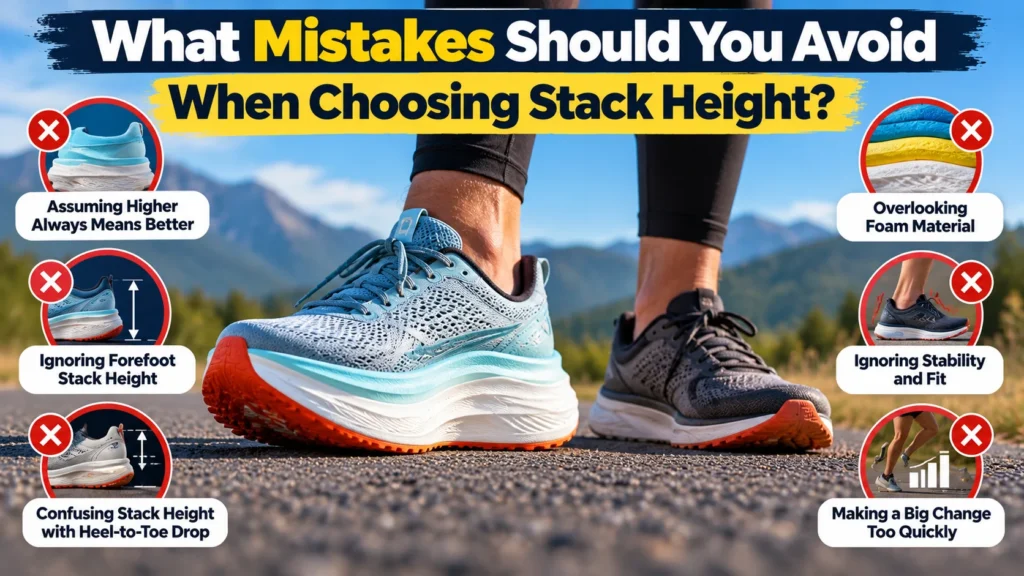
The biggest mistake is treating stack height as a complete measurement of running shoe quality. It is useful information, but only one part of the design.
- Assuming higher means better: Extra sole thickness doesn’t guarantee greater comfort or injury prevention.
- Confusing stack with drop: A thick shoe can still have zero or low drop.
- Ignoring foam composition: Two shoes with identical stack heights may feel completely different.
- Overlooking stability: Platform width, upper fit, and sidewalls influence security.
- Comparing inconsistent measurements: Manufacturer and retailer figures may use different methods.
- Changing footwear abruptly: Large geometry changes may require gradual adaptation.
- Ignoring fit: Cushioning can’t compensate for poor sizing or uncomfortable pressure.
When comparing two shoes, I first narrow the choices by comfort and intended use. Then I use stack height to understand why their underfoot experiences might differ.
Which Running Shoes Are Worth Comparing for Stack Height?
If you’re ready to compare real models, these three shoes provide useful examples of different running-shoe geometries. They’re starting points for evaluation, not universal recommendations.
Affiliate disclosure: Some links below are Amazon affiliate search links, which may earn a commission at no additional cost to you. The ratings are editorial assessments of suitability for the stated use cases, not customer ratings or claims of hands-on testing.
⚡ Lower-Profile Training
Saucony Kinvara 16
★★★★☆ 4.0/5 — Editorial fit
The Kinvara 16 features a 28 mm heel, 24 mm forefoot, and 4 mm drop, with lightweight PWRRUN cushioning. I’d shortlist it for runners who prefer a flexible, relatively close-to-ground experience during faster training.
🏃 Balanced Daily Training
Brooks Ghost 17
★★★★½ 4.5/5 — Editorial fit
The Ghost 17 uses DNA LOFT v3 cushioning and a 10 mm drop, with retailer-measured stack heights of 36 mm at the heel and 26 mm at the forefoot. I’d consider it a versatile reference point for comfortable daily road training.
☁️ Maximum Cushioning
HOKA Bondi 9
★★★★☆ 4.0/5 — Editorial fit
The Bondi 9 has a 43 mm heel stack, 5 mm drop, and supercritical EVA cushioning. I’d compare it for easy runs and walking when substantial underfoot padding is the priority, while checking whether its tall geometry feels comfortable.
Frequently Asked Questions About Running Shoe Stack Height
Is a 40 mm stack height considered high?
Yes, a 40 mm heel stack is relatively tall compared with many traditional running shoes. However, the overall category depends on whether you’re comparing heel or forefoot measurements. A shoe with a 40 mm heel and 30 mm forefoot has a different underfoot profile from one with 40 mm beneath both areas.
Is higher stack height better for your knees?
Higher stack height isn’t automatically better for knee health. Cushioning changes how the shoe responds to landing, but the body’s overall mechanics also depend on running form, foam properties, speed, and individual characteristics. No single stack height guarantees reduced knee pain or injury prevention.
Can zero-drop running shoes have high stack heights?
Yes. Zero drop means the heel and forefoot sit at the same height, not that the sole is thin. A running shoe with 30 mm beneath both the heel and forefoot has a 30 mm stack in both locations and a 0 mm drop.
What stack height is best for beginner runners?
Beginners often benefit from starting with a comfortable, stable-feeling daily trainer rather than choosing an extreme sole height. Medium or moderately high cushioning may be useful starting points. Fit, comfort at an easy pace, and familiar shoe geometry matter more than targeting one exact measurement.
Does a higher stack height make running shoes faster?
Not necessarily. More stack height creates room for responsive cushioning and other performance features, but foam composition, shoe weight, rocker shape, and individual running mechanics also matter. A tall shoe isn’t automatically more efficient, and a low-stack shoe isn’t automatically faster.
Final Takeaway: How Much Stack Height Do You Need?
Stack height tells you how much material separates your foot from the ground. It’s a useful starting point for predicting ground feel, cushioning capacity, and the overall geometry of a running shoe.
For everyday running, I recommend beginning with comfort, fit, and the type of training you do most. Use heel and forefoot stack measurements to compare promising shoes rather than treating the biggest number as the best.
Before your next shoe purchase, compare two or three models at your normal running pace. The right stack height is the one that works comfortably with the rest of the shoe’s design and your running needs.