

Quick Answer
Your running shoes may be too small if your toes hit the front, feel cramped, or develop blisters, numbness, or bruised toenails. A properly fitted pair usually leaves roughly half an inch (about 12–13 mm) beyond your longest toe while holding your heel securely. Check our running shoe toe room guide for a closer look at front clearance.
Six Warning Signs
- Toe pressure: Your longest toe touches or strikes the front.
- Persistent numbness: Your toes tingle or lose sensation.
- Repeated blisters: Friction develops around or between your toes.
- Nail discomfort: Toenails become painful, bruised, or discolored.
- Side compression: Your forefoot feels squeezed or pinched.
- Increasing tightness: Shoes become uncomfortable during longer runs.
Quick Confirmation Test
- Stand and check: Lace your shoes normally and press above your longest toe to estimate the remaining front clearance.
- Move and assess: Walk briskly or jog briefly; your toes shouldn’t repeatedly touch the front.
Running shoes can feel comfortable when you first put them on, then become painfully tight halfway through a run. I’ve found that the most useful starting point is separating a short shoe from a narrow one.
Those problems need different solutions. This guide explains the warning signs, simple home tests, and what to change before your next run.
What Are the Signs That Running Shoes Are Too Small?
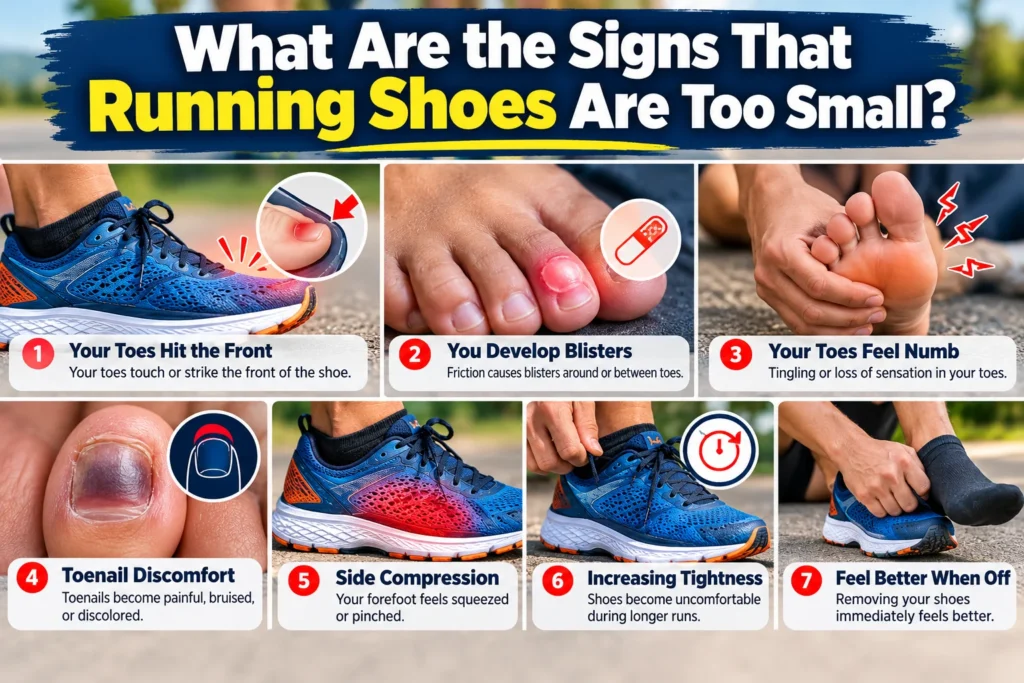
The strongest signs are repeated toe contact, uncomfortable pressure, and irritation that follows the same pattern during runs. One symptom alone doesn’t prove a sizing problem, but several together make poor fit more likely.
1. Your Toes Hit the Front of Your Shoes
Your longest toe shouldn’t repeatedly strike the front during normal running. Contact often becomes more noticeable downhill, when your foot moves forward inside the shoe.
Check your second toe, too. For some runners, it extends beyond the big toe and needs the most clearance.
2. You Develop Blisters Around Your Toes
Blisters on toe tips, between toes, or over toe joints may indicate excessive friction and compression. Short or narrow shoes can contribute to both problems.
However, socks, moisture, and movement inside overly loose shoes can also cause blisters. Examine where the irritation occurs before deciding to change sizes.
3. Your Toes Feel Numb or Tingly
Numbness can happen when footwear places excessive pressure across your forefoot or the top of your foot. Tight lacing, narrow uppers, and insufficient shoe volume are possible explanations.
Don’t ignore recurring symptoms. Stop and reassess the fit rather than continuing through uncomfortable tingling.
4. Your Toenails Become Bruised or Painful
Repeated impacts against the front can injure your toenails. Some runners notice tenderness, dark discoloration, or pressure beneath a nail after longer runs.
These symptoms can have other causes, including direct injury. Severe pain or a painful darkened nail deserves medical assessment.
5. Your Feet Feel Squeezed Along the Sides
Pressure around your little toe or the widest part of your forefoot often suggests insufficient width. Your toes should spread naturally without pushing painfully against the upper.
According to the American Academy of Orthopaedic Surgeons’ athletic shoe guidance, the toe box should provide enough room to move your toes comfortably.
6. Your Shoes Become Tight as You Run
Feet can increase in volume during prolonged activity and throughout the day. A shoe that feels borderline tight at home may become uncomfortable during exercise.
This is why fitting shoes later in the day, while wearing your regular running socks, makes sense.
7. Removing Your Shoes Immediately Feels Better
Relief after removing shoes suggests that footwear pressure may be contributing to discomfort. Notice whether the pressure disappears quickly or remains afterward.
Persistent pain isn’t simply a sign to buy larger shoes. A clinician can assess symptoms that continue even without footwear.
How Much Room Should Running Shoes Have?
Many running shoe fitting guides recommend about a thumb’s width between your longest toe and the shoe’s front. This is approximately half an inch, although thumb sizes differ.
Your heel and midfoot should remain comfortably secure. The front should allow toe movement without excessive sliding.
The Three-Zone Running Shoe Fit Check
- Toe box: Allow comfortable toe movement and roughly 12–13 mm of front clearance.
- Midfoot: Aim for a secure hold without uncomfortable pressure over your instep.
- Heel: Keep movement minimal without rubbing or painfully gripping the heel.
The REI running shoe fit guide also recommends checking toe clearance alongside heel and midfoot security.
Don’t judge fit entirely by how much space you can see. Your foot shape, the shoe’s construction, and its behavior during movement matter just as much.
How Can You Check Whether Running Shoes Are Too Small at Home?
You can perform a useful fit assessment without specialized equipment. Test both shoes while standing and wearing the socks you normally use for running.
Step-by-Step Running Shoe Fit Test
- Wear your usual running socks. Thick and thin socks occupy different amounts of space.
- Put on both shoes. Your feet may differ slightly in length and width.
- Set your heel back. Gently position your heel in the rear of the shoe before tightening the laces.
- Stand naturally. Your feet spread under body weight, giving a more realistic fit than sitting.
- Check your longest toe. Press gently above it and estimate the gap to the shoe’s front.
- Spread your toes. Make sure they can move without painful compression.
- Walk and jog briefly. Notice front contact, rubbing, pressure, and heel movement.
Repeat the test later in the day if the shoes feel different during actual runs. Check the larger foot carefully before making a sizing decision.
Does the Removable Insole Test Work?
Removing the original insole can provide an additional clue about foot shape and shoe width. Stand on the insole and see whether your forefoot significantly overhangs its sides.
Overhang can suggest a narrow shoe, but the test isn’t definitive. Some insoles don’t match the shoe’s full internal shape.
Are Your Running Shoes Too Short, Too Narrow, or Too Tight?
These problems are easy to confuse because each can create pressure. The location of discomfort and results of simple fit checks help distinguish them.
| Fit Problem | Common Clue | Useful Check | Likely Solution |
|---|---|---|---|
| Too short | Toes hit the front | Less than the intended toe clearance | Try additional length |
| Too narrow | Little-toe or forefoot pressure | Side compression despite adequate length | Try a wider width or toe box |
| Low volume | Pressure above the foot | Tight instep or upper | Try more upper volume |
| Overtight lacing | Pressure under the laces | Relief after loosening | Adjust the lacing pattern |
| Too large | Excessive sliding or heel movement | Poor hold during movement | Try a different length, width, or heel shape |
The exact solution depends on your foot and the shoe model. A wider shoe won’t necessarily correct inadequate length.
Why Do Running Shoes Feel Too Small After a Few Miles?
A snug shoe can feel increasingly restrictive as the run continues. Exercise duration, temperature, socks, and terrain can influence comfort.
Common Reasons Fit Changes During Running
- Foot swelling: Activity and prolonged standing can increase foot volume.
- Warm conditions: Hot weather may contribute to swelling and discomfort.
- Downhill movement: Your foot can shift toward the front on descents.
- Sock thickness: Cushioned socks occupy more internal space.
- Fatigue: Changes in movement later in a run can reveal fit issues.
For example, a shoe might pass a short indoor walking test but cause repeated toe contact on downhill trails. That suggests the initial test didn’t capture the demands of the intended activity.
My practical rule is to judge running shoes by how they behave during realistic movement, not only during the first minute of wear.
Should You Go Half a Size Bigger in Running Shoes?
Going up half a size may help when a shoe lacks enough length. However, automatically buying every running shoe half a size larger than your usual footwear isn’t a reliable rule.
Brands use different sizing systems and shoe shapes. The correct choice depends on your measurements and actual fit.
When a Half-Size Increase Makes Sense
- Your longest toe repeatedly touches the front.
- You cannot achieve adequate front clearance while standing.
- The next half size improves comfort without excessive heel movement.
- Your usual size becomes uncomfortably short during running.
When a Wider Shoe Makes More Sense
Choose width rather than extra length when toe clearance is sufficient but the sides feel compressed. Buying a longer shoe solely for width can create a sloppy heel fit.
Our running shoe width guide explains width labels and how different toe-box shapes affect comfort.
Could You Need a Different Shoe Model Instead?
Yes. Two shoes labeled with the same size can feel completely different because their internal shapes vary.
Trying another model may solve problems that neither a longer nor a wider version fixes. Prioritize the overall fit rather than a particular size number.
How Do You Measure Your Feet Before Buying Running Shoes?
Measuring both feet provides a useful starting point before comparing shoes. Measure while standing, preferably later in the day.
Simple Home Measurement Method
- Place a sheet of paper on a firm floor against a wall.
- Stand with your heel gently touching the wall.
- Mark the position of your longest toe.
- Measure from the paper’s wall edge to that mark.
- Repeat the process for your other foot.
- Compare the longer measurement with the manufacturer’s size chart.
- Try the suggested size and verify comfort while moving.
Remember that foot length isn’t the same as ideal shoe interior length. Running shoes need additional room ahead of the toes.
A professional foot-measuring device can also assess length, arch length, and width. The Brannock Device fitting instructions explain why measuring the heel-to-ball distance matters.
Can You Break In Running Shoes That Feel Too Small?
Breaking in a running shoe won’t reliably fix inadequate length or major width problems. The upper may soften slightly, but you shouldn’t expect the shoe’s overall shape to change enough to eliminate serious pressure.
The AAOS guidance on tight shoes recommends choosing footwear that fits from the beginning rather than relying on a break-in period.
Adjustments Worth Trying Before Replacing Shoes
- Relace the upper: Reduce excessive pressure across the instep.
- Try your intended socks: Check whether extra sock bulk is contributing.
- Check insole thickness: An additional insert can reduce available internal space.
- Reseat your heel: Make sure your foot starts in the correct position.
These adjustments may help minor fit issues, but they cannot make a genuinely short shoe long enough. Don’t use unusually thin socks to justify continuing in a painfully tight pair.
What Happens If You Keep Running in Shoes That Are Too Small?
Continuing to run in restrictive footwear can worsen pressure and friction. Possible problems include blisters, damaged toenails, irritated skin, and increased forefoot discomfort.
Problems Worth Watching For
- Recurring toe blisters or painful rubbing
- Bruised or darkened toenails
- Corns and calluses around pressure points
- Increasing discomfort around existing bunions
- Tingling, burning, or numbness during runs
- Persistent forefoot pain
These symptoms don’t establish a specific diagnosis. Footwear may contribute, but injuries and medical conditions can produce similar problems.
Seek medical care for persistent numbness, significant swelling, severe pain, or recurring symptoms despite properly fitted shoes. People with diabetes, impaired circulation, or reduced foot sensation should address pressure injuries promptly.
What Common Mistakes Make Running Shoes Feel Too Small?
Some sizing mistakes happen before your first run. Others become obvious only after several workouts.
Six Mistakes to Avoid
- Buying by your usual size alone: Shoe sizing varies among manufacturers and models.
- Trying shoes only while sitting: Standing changes your foot’s shape and dimensions.
- Ignoring the longest toe: Your second toe may extend farther than your big toe.
- Choosing length to solve width: A longer shoe may still squeeze your forefoot.
- Testing with unsuitable socks: Your actual running socks affect fit.
- Expecting a break-in miracle: Painful pressure isn’t a normal requirement of new running shoes.
I also recommend checking shoe fit before spending money on specialized inserts. Additional footbeds take up space and can make an already tight upper more restrictive.
If you are considering inserts for support, our running shoe arch support guide explains when extra support may be useful.
What Should You Do If Your Current Running Shoes Are Too Small?
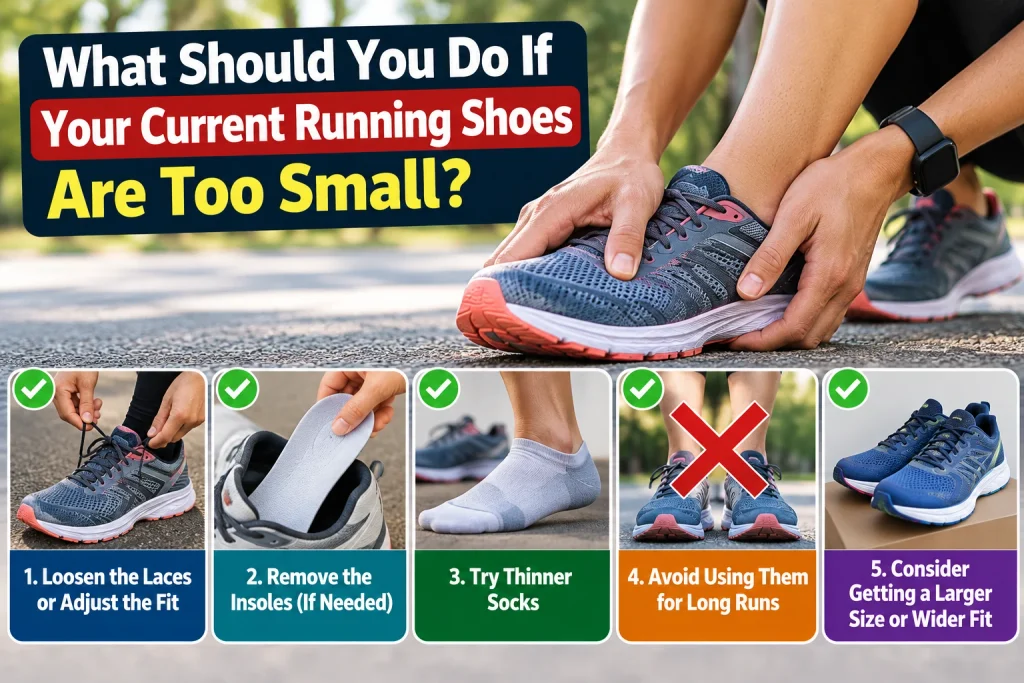
Stop using a pair that repeatedly causes pain, numbness, or toe injury. Then identify whether the problem involves length, width, internal volume, or lacing.
A Practical Fix Checklist
- Check front clearance: Determine whether your longest toe has sufficient room.
- Locate the pressure: Identify whether discomfort occurs at the toe tips, sides, or instep.
- Adjust lacing: Test a comfortable, secure fit without overtightening.
- Compare another size: Try a half size larger if the shoe is genuinely too short.
- Compare widths: Try a wider option when the forefoot feels compressed.
- Test movement: Walk and jog in the alternative pair before committing.
- Review return options: Exchange a new pair when possible rather than forcing it to fit.
Keep comfort as the deciding factor. A shoe that fits naturally usually needs fewer adjustments than one that constantly requires workarounds.
Which Products Can Help You Check Running Shoe Fit?
Basic measuring tools and suitable running socks can make fit testing easier. None of these products can repair a shoe that’s genuinely too short.
Here are three options I would consider for measuring and comparing fit. The scores below are editorial usefulness estimates, not customer-review averages or claims of hands-on testing.
Affiliate disclosure: Purchases made through qualifying shopping links may earn a commission at no additional cost to you.
🏆 Best for Measuring
Genuine Brannock Combination Foot-Measuring Device
★★★★★ 4.8/5
The Brannock measuring system assesses foot length, arch length, and width. I’d choose a combination model for frequent shoe fitting, although occasional shoppers may find professional in-store measuring more economical.
☁️ Best for Plush Comfort
Balega Hidden Comfort No Show Socks
★★★★☆ 4.5/5
These socks provide plush full-length cushioning, moisture-wicking yarn, and a secure heel pocket. I’d consider them when comparing comfort with cushioned socks, but their additional thickness must be included in shoe fitting.
⚡ Best for Light Cushioning
Feetures Elite Light Cushion No Show Tab Socks
★★★★☆ 4.6/5
These running socks combine light cushioning, an anatomical fit, and a seamless toe design. I’d compare them with thicker socks when evaluating internal space, while remembering that thin socks cannot correct insufficient shoe length.
Frequently Asked Questions
Should your toes touch the front of running shoes?
Your toes shouldn’t repeatedly hit the front while running. Most fit guidance recommends approximately half an inch of space beyond the longest toe when standing. This gives your toes room to move while the heel and midfoot remain secure. If contact continues during normal movement, reassess the shoe’s length and heel hold.
Can running shoes be too small even if they don’t hurt?
Yes. Some shoes feel acceptable during brief wear but become uncomfortable during longer runs. Check toe clearance, forefoot width, and how the shoes behave during movement. A pair that causes recurring pressure or rubbing may be unsuitable even if it feels comfortable during the first few minutes.
Should running shoes feel tight when new?
New running shoes should feel secure, not painfully tight. A snug midfoot can be appropriate, but your toes need room to move naturally. Don’t rely on the shoe stretching enough to correct cramped toes or inadequate front clearance. Try another size or model when the initial fit is uncomfortable.
How do you know if running shoes are too small or too narrow?
Too-short shoes often cause the longest toe to contact the front. Too-narrow shoes usually squeeze the sides of your forefoot or compress your smaller toes. Check front clearance first, then assess side pressure. Both problems can occur together, so a different model may provide a better overall fit.
Can wearing running shoes that are too small damage your feet?
Repeated pressure and rubbing can contribute to blisters, painful toenails, skin irritation, and aggravation of existing foot problems. Continued compression may also worsen discomfort. Replace or stop using shoes that repeatedly cause symptoms, and seek medical advice for persistent pain, numbness, or significant nail injuries.
Final Takeaway: Don’t Ignore Running Shoes That Feel Too Small
The easiest way to identify undersized running shoes is to check toe clearance, width, and comfort during movement. Your toes need room, while your heel and midfoot should remain securely supported.
If your toes keep striking the front, try a longer fit. If your forefoot feels squeezed despite adequate length, compare wider or differently shaped models.
Before your next run, try the standing toe-room test. A few minutes spent checking fit may help prevent recurring discomfort and unnecessary shoe purchases.


