
Quick Answer
Yes, rotating running shoes can help each pair last longer in calendar time because you distribute your running mileage between multiple pairs. Rotation also allows shoes to dry between workouts. However, there is limited evidence that resting midsoles increases their total mileage lifespan. Knowing how running shoes should fit remains important regardless of how many pairs you own.
How to Make Shoe Rotation Work
- Start with two pairs: Alternate comfortable running shoes between workouts.
- Track each pair: Record mileage separately to monitor accumulated wear.
- Allow drying time: Air-dry damp footwear before wearing it again.
- Match your workouts: Choose appropriate shoes for roads, trails, and faster sessions.
- Inspect regularly: Replace shoes when cushioning, traction, or fit deteriorates.
Does rotating shoes extend lifespan, or does buying a second pair simply spread the same wear over more footwear? It’s a useful question for runners who want comfortable shoes without overspending.
I’ve put together this guide to separate practical rotation benefits from claims that lack strong evidence. You’ll learn how rotation works, when it’s worthwhile, and how to organize your shoes.
What Does Rotating Running Shoes Actually Mean?
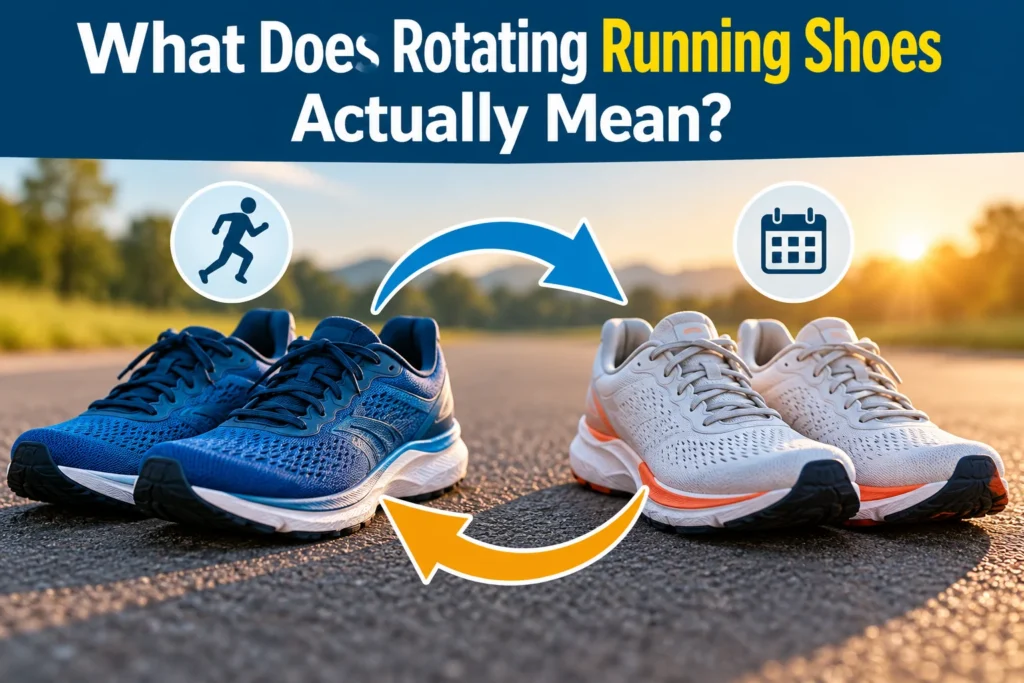
Running shoe rotation means alternating between two or more pairs instead of wearing the same shoes for every run. Each pair accumulates mileage according to how often you use it.
For example, you might wear one pair on Monday and another on Wednesday. Both remain available for future sessions.
Rotation can involve identical models or different shoes designed for particular workouts.
Why Do Runners Rotate Their Shoes?
Runners generally rotate shoes for three practical reasons:
- Distribute mileage: Running distance accumulates more slowly on each individual pair.
- Manage moisture: Shoes can dry between sweaty or rainy workouts.
- Match activities: Different models can suit easy runs, speed sessions, or trails.
These benefits matter more as weekly running frequency increases. Someone who runs twice weekly may not need additional footwear.
Does Rotating Shoes Really Make Them Last Longer?
Rotating shoes generally extends the calendar lifespan of each pair because each receives less frequent use. It does not automatically increase the total miles that each pair can withstand.
That distinction matters when deciding whether a second pair represents genuine savings.
Calendar Lifespan vs. Mileage Lifespan
Calendar lifespan describes how many weeks or months you can keep using your shoes. Mileage lifespan describes the running distance accumulated before replacement becomes necessary.
Consider a runner covering 20 miles weekly.
- One-pair rotation: One pair accumulates all 20 weekly miles.
- Two-pair rotation: Each pair averages 10 weekly miles when usage is divided equally.
- Three-pair rotation: Each pair accumulates approximately 6.7 weekly miles when usage is equal.
The total distance remains unchanged. Additional pairs divide that distance instead of eliminating wear.
How Much Longer Can Rotated Shoes Last?
Imagine two identical pairs that each provide 400 usable running miles. This is an illustrative assumption, not a guaranteed shoe lifespan.
At 20 miles weekly, a single pair reaches 400 miles after approximately 20 weeks. Two equally rotated pairs reach that individual mileage after about 40 weeks.
| Rotation | Miles Per Pair Weekly | Weeks to 400 Miles Per Pair |
|---|---|---|
| One pair | 20 | 20 |
| Two pairs | 10 | 40 |
| Three pairs | 6.7 approximately | 60 approximately |
Important: This calculation assumes equal mileage distribution and a fixed 400-mile replacement point. Real durability varies by model, running surface, and individual wear.
Rotation makes each pair reach its mileage limit later. It does not prove that those shoes will survive more total miles.
Does Running Shoe Foam Need 24 to 48 Hours to Recover?
Running shoe foam deforms under repeated impact, but the claim that it needs 24–48 hours between runs remains scientifically uncertain. Research has not demonstrated a universal recovery period that increases total shoe longevity.
The midsole is the cushioning layer between the insole and the outer rubber sole. Materials such as EVA, TPU, and PEBA have different mechanical properties.
What Does Research Say About Midsole Recovery?
A commonly cited 1985 study examined running shoe shock absorption and recovery. Allowing shoes to rest for 24 or 48 hours produced little meaningful recovery in the measured properties.
You can find an explanation of that research in this CTS running shoe replacement guide.
A 2026 scientific review also explains that repeated loading changes running shoe mechanical properties. However, foam degradation depends on the material and conditions rather than a proven universal resting schedule.
Read the research overview through PubMed.
Is Resting Shoes Still Beneficial?
Yes, resting shoes can be useful for moisture management. Damp footwear may need time to dry after running in rain or humid conditions.
That is a practical care benefit, not proof that dry foam gains additional lifetime mileage.
- Remove wet shoes promptly after running.
- Loosen the laces and open the tongue for airflow.
- Remove insoles when appropriate to help trapped moisture escape.
- Avoid direct heaters, high heat, and tumble dryers unless the manufacturer permits them.
What Are the Biggest Benefits of Rotating Running Shoes?
The strongest practical arguments for rotation involve flexibility, moisture control, and distributing accumulated wear. Potential injury-related benefits are less certain and depend on the runner.
1. Slower Mileage Accumulation Per Pair
Two shoes sharing your weekly running distance accumulate fewer miles individually. This makes it easier to keep a usable pair available while the other approaches replacement.
However, buying two pairs also means making a larger initial investment.
2. More Time for Shoes to Dry
Alternating between pairs is especially convenient during wet weather. A second pair allows you to run without putting on damp footwear.
Drying also helps manage moisture-related discomfort and unpleasant odors.
3. Footwear for Different Running Surfaces
Road running and technical trail running place different demands on footwear. A dedicated trail shoe can provide more suitable outsole traction on loose terrain.
Using activity-appropriate shoes also avoids relying on one design for every condition.
4. Different Running Experiences
Running shoes vary in cushioning, flexibility, heel-to-toe drop, and stability. Alternating between suitable models can change how running loads are distributed.
Observational research has associated multiple-shoe use with lower running injury risk. However, this does not establish that rotation alone prevents injuries.
A broader discussion appears in this peer-reviewed running footwear review.
5. Backup Footwear When Needed
An additional pair becomes valuable when your usual shoes are wet, damaged, or unexpectedly uncomfortable. You can also retire a worn pair without interrupting your routine.
How Many Pairs of Running Shoes Should You Rotate?
Two pairs are a reasonable starting point for runners who train frequently. Three pairs may make sense when different workouts require specialized footwear.
You do not need a large shoe collection to benefit from rotation.
| Running Routine | Suggested Pairs | Reason |
|---|---|---|
| 1–2 runs weekly | 1 | Usually enough drying time |
| 3–4 runs weekly | 1–2 | Convenient alternation |
| 5–6 runs weekly | 2–3 | Workout flexibility |
| Specialized training | 2–3 or more | Terrain and workout needs |
These are practical suggestions rather than medical requirements. Training needs, comfort, and budget should determine your final choice.
How Do You Rotate Running Shoes Properly?
Start with two comfortable pairs and alternate them consistently. A simple schedule is easier to manage than a complicated collection.
Step 1: Choose Two Suitable Pairs
Begin with a familiar daily trainer and another shoe that fits comfortably. Similar models may simplify the transition if you’re new to rotation.
If you’re choosing a second model, review running shoe width and fit before purchasing.
Step 2: Introduce the Second Pair Gradually
Use the new shoes for short, easy runs first. Observe any changes in comfort, pressure, or muscle soreness.
Avoid simultaneously changing footwear, training distance, and running intensity.
Step 3: Alternate Based on Your Schedule
Here is an example rotation for someone running four times weekly:
- Monday: Pair A for an easy run.
- Wednesday: Pair B for another easy run.
- Friday: Pair A for a steady run.
- Sunday: Pair B for a longer run.
This is an organizational example, not a required rest interval. Choose shoes according to your actual workout needs.
Step 4: Track Mileage Separately
Record each pair’s mileage in a running app, spreadsheet, or notebook. Include the purchase date and the first running date.
For example, one pair may accumulate 180 miles while another reaches 260 miles. Tracking prevents you from treating both shoes as equally worn.
Step 5: Inspect the Shoes Regularly
Check the outsole, midsole, heel counter, upper, and overall fit. Compare how older shoes feel against a comfortable newer pair.
Replace footwear when its condition no longer supports comfortable, safe use.
What Mistakes Should You Avoid When Rotating Shoes?
Rotation works best when you manage every pair individually. These mistakes can reduce its usefulness.
- Ignoring mileage: A shoe may be old in distance even if it looks clean.
- Buying uncomfortable shoes: Rotation cannot correct improper sizing or pressure points.
- Changing shoe geometry abruptly: Sudden changes in heel drop or cushioning can create unfamiliar loading.
- Using road shoes on technical trails: Inadequate traction may create safety problems.
- Storing shoes while wet: Poor drying encourages lingering moisture and odors.
- Expecting guaranteed savings: Extra pairs do not automatically deliver additional lifetime mileage.
- Rotating already worn shoes: Switching between damaged pairs does not restore cushioning or grip.
I would prioritize proper fit and sensible replacement decisions before expanding a shoe collection. Those fundamentals matter more than following an exact rotation schedule.
Does Rotating Running Shoes Save Money?
Rotating shoes may make purchasing more convenient, but it does not guarantee lower long-term costs. Financial savings depend on purchase price and actual lifetime mileage.
Consider this simple example.
| Cost Factor | One Pair | Two Pairs |
|---|---|---|
| Price per pair | $120 | $120 |
| Upfront spending | $120 | $240 |
| Total usable miles | 400 | 800 combined |
| Cost per running mile | $0.30 | $0.30 |
These hypothetical numbers show why doubling the number of shoes doesn’t automatically reduce the cost per mile. You still purchase the same amount of total usable footwear.
Discounts, different shoe prices, or demonstrably longer usable mileage could change the calculation.
When Should You Replace Running Shoes Instead of Rotating Them?
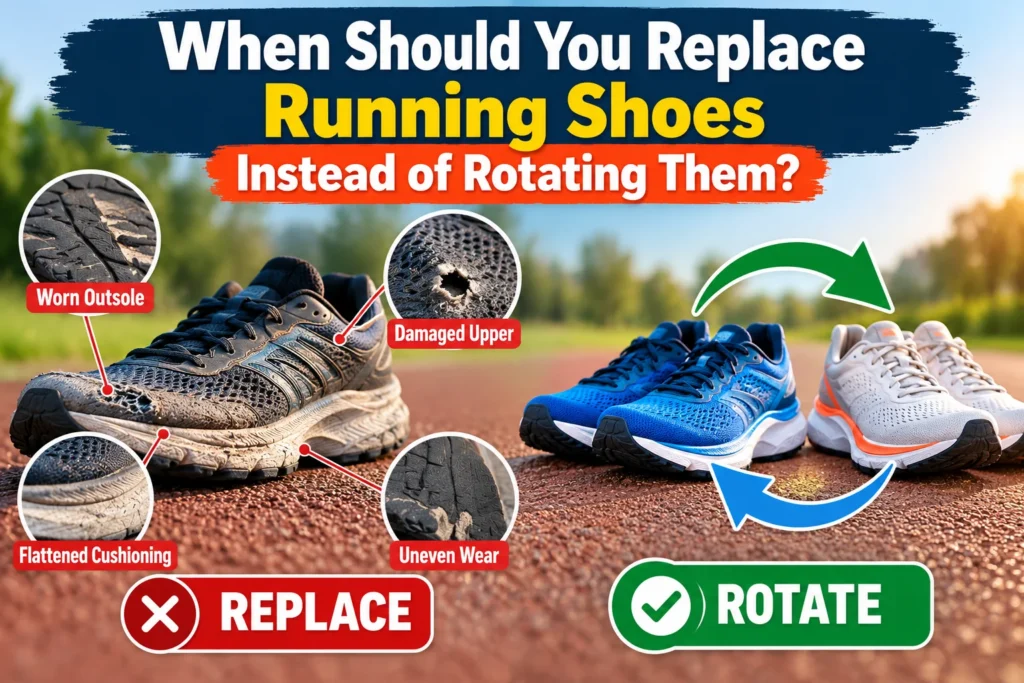
Replace running shoes when significant wear affects their comfort, traction, structural integrity, or suitability for running. Rotation cannot reverse permanent material damage.
Many conventional running shoes are commonly assessed around 300–500 miles, although this range is not a universal replacement deadline.
Signs Your Running Shoes May Need Replacement
- Worn outsole: Tread has become unusually smooth or worn through.
- Changed cushioning: The shoe feels substantially different from its original condition.
- Uneven wear: One side shows significant deterioration or instability.
- Damaged upper: Tears interfere with secure foot placement.
- Persistent discomfort: Previously comfortable footwear now creates unusual pressure or irritation.
- Structural damage: Separation, cracks, or deformation compromise normal use.
New aches alone do not prove that your shoes are responsible. Training changes and other factors may also contribute.
For specific replacement decisions, compare your footwear condition with its mileage and your current comfort.
Which Running Shoes Are Worth Considering for Rotation?
For many runners, I would start with a comfortable neutral daily trainer rather than buying specialized racing footwear. The following established models offer different cushioning characteristics worth comparing.
These are product shortlisting recommendations based on published specifications, not claims of personal wear-testing. The model versions below may remain available through selected retailers.
🏆 Balanced Daily Trainer
Brooks Ghost 17
★★★★☆
The Ghost 17 features DNA LOFT v3 cushioning, a 10 mm heel-to-toe drop, and a neutral road-running design. I’d shortlist it for runners seeking a traditional daily training shoe with balanced cushioning.
☁️ Soft Cushioning Option
ASICS GEL-Cumulus 27
★★★★☆
The GEL-Cumulus 27 combines FF BLAST PLUS cushioning with PureGEL technology and an 8 mm drop. I’d consider it when comparing softer-feeling neutral road trainers.
⚡ Versatile Training Option
Saucony Ride 18
★★★★☆
The Ride 18 uses PWRRUN+ foam and an 8 mm drop. I’d shortlist it for runners wanting a versatile neutral trainer for everyday miles and varied paces.
Affiliate disclosure: As an Amazon Associate, we earn from qualifying purchases. The stars above are editorial suitability indicators, not verified customer ratings. Product availability and pricing may change.
Frequently Asked Questions
Does alternating shoes every day extend their lifespan?
Alternating shoes every day reduces how quickly each pair accumulates mileage. It also provides time for damp footwear to dry. However, research does not establish that alternating daily increases a shoe’s total usable running distance. Replacement should still depend on actual wear, comfort, and condition.
Should you rotate two identical pairs of running shoes?
Yes, rotating two identical pairs can be convenient if you already know the model fits comfortably. Both pairs can share weekly mileage while offering a consistent running experience. However, identical models will not provide the different mechanical characteristics associated with rotating genuinely different shoe designs.
How long should running shoes rest between runs?
There is no scientifically established rest period required to extend running shoe mileage. Some runners allow 24–48 hours between uses, especially when shoes are wet. What matters most is allowing damp footwear to dry properly and replacing shoes when their functional condition deteriorates.
Can rotating shoes prevent running injuries?
Some observational research has associated using multiple pairs with reduced running injury risk. However, this does not prove that rotation itself prevents injuries. Training volume, recovery, running experience, shoe fit, and individual biomechanics also matter. Introduce substantially different shoes gradually.
Is buying two pairs of running shoes worth it?
Two pairs may be worthwhile if you run frequently, encounter wet weather, or need different footwear for separate workouts. Occasional runners can often manage comfortably with one good pair. Rotation doesn’t guarantee lower costs, so prioritize fit, actual training needs, and budget.
Final Verdict: Does Rotating Shoes Extend Lifespan?
Yes, rotating running shoes can extend how long each pair lasts on the calendar because mileage is shared across your collection. It also provides useful flexibility for weather, workouts, and footwear maintenance.
However, there’s insufficient evidence that foam rest periods produce a guaranteed increase in lifetime mileage.
For most regular runners, two comfortable pairs are a sensible starting point. Track their mileage, check their condition, and replace them when necessary.
My recommendation: Buy a second pair when it solves a real training or maintenance problem, not because of an unsupported promise that it will double your shoes’ durability.