

Quick Answer
To lace running shoes for wide feet, loosen the laces completely, skip or bypass eyelets where your foot feels squeezed, and use gentle crisscross lacing above the pressure area. For a wide forefoot, run the laces vertically through the first few eyelets before crossing them higher up. If the shoe remains uncomfortable, check whether your running shoes are wide enough instead of tightening or loosening them repeatedly.
5 Quick Steps for Wide Feet
- Loosen every eyelet: Release existing lace tension before putting your foot into the shoe.
- Identify the pressure: Check whether the forefoot, midfoot, or entire upper feels tight.
- Change the lace path: Run laces vertically or skip selected eyelets where more room is needed.
- Secure the upper section: Resume comfortable crisscross lacing toward your ankle.
- Test while moving: Walk and jog briefly to check toe freedom, pressure, and heel stability.
Important Fit Rule
- Lacing changes pressure, not shoe width. A genuinely narrow toe box still requires a better-fitting shoe.
Wide feet can make otherwise comfortable running shoes feel painfully tight, particularly around the ball of the foot and little toe. Fortunately, changing how the laces cross your shoes may relieve that pressure without sacrificing heel security.
I prefer starting with a small lacing adjustment before considering new accessories. This guide explains five practical techniques, how to choose between them, and when a wider shoe is the better solution.
What Does Wide-Feet Running Shoe Lacing Mean?
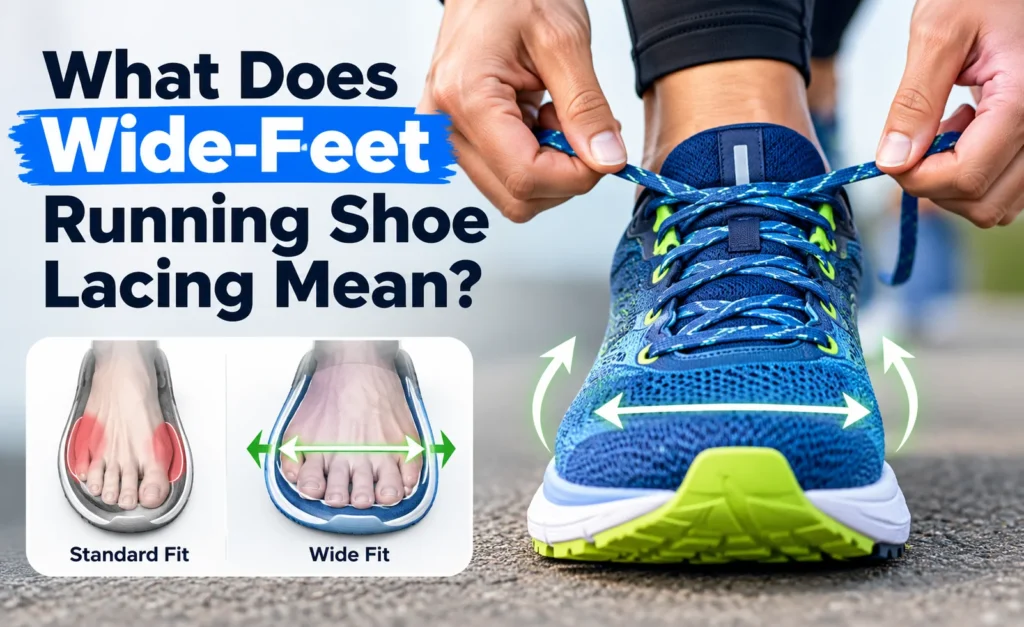
Wide-feet lacing means arranging shoelaces to reduce pressure over the broadest or highest-volume areas of your foot. It changes how tightly the shoe’s upper wraps around your foot without changing the actual sole width.
Traditional crisscross lacing pulls both sides of the upper toward the center. That pressure can become uncomfortable when your forefoot spreads or your midfoot occupies more space.
How Does Lacing Affect Running Shoe Fit?
Running shoes have eyelets, which are the reinforced holes used to hold shoelaces. Moving the laces through different eyelets changes where the upper applies pressure.
- Forefoot pressure: Vertical lacing near the toes reduces lace tension over the front of the shoe.
- Midfoot tightness: Skipping a crossing can relieve pressure over the top of the foot.
- Overall tightness: Using alternate eyelets may reduce compression across a broader section.
- Heel slipping: A runner’s loop can improve heel hold without excessively tightening the forefoot.
These adjustments work best when the shoe already has enough physical room for your foot. They cannot expand a narrow midsole platform or create significant extra toe-box width.
Which Lacing Technique Is Best for Wide Feet?
The best technique depends on where the shoe feels tight. Runners with broad toes need a different adjustment from runners experiencing pressure across the top of the midfoot.
- Wide forefoot: Use side-threaded or forefoot-relief lacing.
- Overall wide foot: Try alternate-eyelet wide-foot lacing.
- High instep: Try window or box lacing.
- Pressure across several eyelets: Consider straight-bar lacing.
- Wide forefoot with heel slipping: Combine forefoot-relief lacing with a gentle runner’s loop.
The ASICS running shoe lacing guide describes separate approaches for wide forefeet, generally wide feet, and high midfoot pressure. Choosing the right pattern matters more than making every lace uniformly loose.
How Do You Lace Running Shoes for a Wide Forefoot?
Wide-forefoot lacing gives the front of the shoe more flexibility by avoiding traditional crossings over the lower eyelets. The laces travel upward along each side before crisscrossing around the midfoot.
This is the first method I’d consider when a shoe fits reasonably well at the heel but feels tight near the ball of the foot.
Step-by-Step Wide-Forefoot Lacing
- Remove the existing tension. Loosen your shoelaces completely or remove them if the current pattern is difficult to follow.
- Start at the lowest eyelets. Thread one lace through the bottom pair, creating a straight horizontal section and leaving equal lace lengths.
- Thread upward along each side. Move each lace end into the next eyelet on its own side instead of crossing the tongue.
- Continue through the lower section. Use this vertical pattern for roughly two or three eyelet levels, depending on where your forefoot needs relief.
- Resume crisscross lacing. Once you reach the midfoot, cross each lace into the opposite eyelet.
- Finish with gentle tension. Tie a secure knot and test the fit while standing and walking.
Different shoes have different eyelet layouts. Adjust the number of uncrossed sections to match your own pressure points.
Practical tip: Avoid pulling the lower laces tightly after creating the extra space. Doing so may cancel the pressure relief you wanted.
How Can You Tell If Wide-Forefoot Lacing Worked?
Your forefoot should feel less compressed while the middle and back of the shoe remain secure. Your toes should move naturally without pressing against the shoe’s sides.
- Stand with your full weight on both feet.
- Spread and wiggle your toes inside the shoes.
- Walk for a few minutes on a clean indoor surface.
- Jog gently and check for rubbing or instability.
- Compare the new fit with your original lacing pattern.
If the outer edge of your foot still presses firmly against the shoe, the problem may be its width rather than the lacing.
How Do You Lace Running Shoes When Your Entire Foot Is Wide?
For generally wide feet, alternate-eyelet lacing can reduce compression across a larger portion of the upper. Instead of using every eyelet, the laces cross between selected eyelet pairs.
This pattern can help when ordinary crisscross lacing feels restrictive from the forefoot into the midfoot.
Step-by-Step Alternate-Eyelet Lacing
- Loosen the shoelaces and position your heel fully inside the shoe.
- Start with a normal crisscross through the lowest pair of eyelets.
- Cross each lace toward a higher eyelet, bypassing one intermediate pair.
- Continue using alternate eyelets where the shoe feels restrictive.
- Use the remaining upper eyelets as needed for adequate heel security.
- Tie the shoe comfortably and check whether your foot moves excessively.
Skipping eyelets reduces the number of points pulling the upper tightly across your foot. However, it can also reduce security when too many eyelets are bypassed.
I recommend changing one section at a time. That makes it easier to identify which adjustment improves comfort without allowing the foot to slide.
How Do You Use Window Lacing for a Wide Midfoot?
Window lacing, also called box lacing, removes the diagonal lace crossing over a specific pressure point. It is particularly useful when the top of your foot hurts beneath one or two rows of laces.
It works best for localized pressure rather than a shoe that is uniformly too narrow.
Step-by-Step Window Lacing
- Identify the uncomfortable spot on top of your foot.
- Unlace the shoe until you reach the pair of eyelets immediately below that spot.
- Thread each lace straight upward through the next eyelet on the same side.
- Leave the area between those eyelet rows free of a diagonal crossing.
- Resume ordinary crisscross lacing above the pressure point.
- Tie the shoe and check whether the localized discomfort has improved.
The result is an open rectangular space between the lace crossings. This reduces direct lace pressure without requiring you to loosen the entire shoe.
The REI guide to lacing running shoes explains window lacing as a way to relieve pressure on the top of the foot.
Should You Use Window Lacing for High Arches?
Window lacing may help if a high instep creates pressure under the laces. However, arch height and instep height are not identical, so identify the actual uncomfortable area first.
If the shoe’s upper presses firmly against your foot even with loose laces, consider a higher-volume shoe design. Changing the lacing pattern may provide only limited relief.
Can Straight-Bar Lacing Help Wide Running Shoes?
Straight-bar lacing replaces visible diagonal crossings with horizontal lace sections. It can distribute lace contact differently and reduce pressure caused by crisscrossing over the top of the foot.
This technique may be worth trying when several crossings feel uncomfortable rather than one isolated spot.
How to Try Straight-Bar Lacing
- Remove the existing laces and begin with a straight bar across the lowest eyelets.
- Feed the lace ends upward inside the shoe toward unused eyelets.
- Bring one lace horizontally across the tongue to form the next visible bar.
- Repeat with the other lace, alternating sides as you move upward.
- Keep the visible bars flat without twisting the shoelaces.
- Tie the laces and adjust the tension gradually.
Eyelet count affects the exact threading pattern, so some shoes require a small adjustment near the top. Choose a configuration that leaves two usable ends for a secure knot.
Straight-bar lacing is not automatically better for running. Test heel hold and sideways movement before deciding whether it suits your shoes.
What Is the Difference Between Wide-Foot Lacing Methods?
These techniques solve different fitting problems. The following comparison shows where each method changes lace pressure and its main limitation.
| Lacing Method | Best For | Main Adjustment | Possible Drawback |
|---|---|---|---|
| Wide forefoot | Pressure near the ball of the foot | Vertical threading through lower eyelets | Less lower-foot hold |
| Alternate eyelets | Overall upper tightness | Skips selected eyelet pairs | May reduce stability |
| Window lacing | One midfoot pressure point | Bypasses one diagonal crossing | Limited targeted relief |
| Straight-bar | Broad lace pressure across the instep | Horizontal bars instead of diagonal crossings | May feel less secure |
| Runner’s loop | Heel slipping with a roomy forefoot | Uses extra upper eyelets to secure the heel | Can tighten the ankle area too much |
My preferred starting point: Match the lacing pattern to the location of pressure, then make only one adjustment before testing again.
How Can You Keep Your Heel Secure Without Squeezing Wide Feet?
A runner’s loop, sometimes called heel-lock lacing, helps limit excessive heel movement. It can be combined with forefoot-relief lacing when the front of your foot needs room but your heel needs more support.
The key is applying controlled tension near the upper eyelets instead of overtightening every crossing.
How to Make a Runner’s Loop
- Use your preferred comfortable lacing pattern through the lower shoe.
- Stop at the second-to-last eyelet on each side.
- Pass each lace into the final eyelet directly above it on the same side, forming a small loop.
- Cross each lace end through the loop on the opposite side.
- Pull gently to secure the heel, then tie a normal knot.
- Walk and jog briefly to confirm the heel stays seated without ankle pressure.
A runner’s loop should not create pain around your ankle. If the shoe still slips despite comfortable tension, its heel shape may not suit your foot.
For additional troubleshooting, see how to tell if running shoes are too big. Excessive foot movement can indicate a sizing or shoe-volume problem.
How Tight Should You Tie Running Shoes for Wide Feet?
Running shoes should feel comfortably secure through the heel and midfoot while allowing the forefoot to move naturally. Your laces should not create painful pressure, tingling, or numbness.
Getting the correct tension requires checking the shoe while standing, not merely judging how it feels when sitting.
Three Checks for Proper Lace Tension
- Toe movement: Your toes can wiggle without pressing painfully against the upper.
- Midfoot comfort: The shoe holds your foot without creating a tight band across the top.
- Heel security: Your heel remains reasonably stable during walking and gentle jogging.
Make small changes to the pressure at individual eyelets rather than pulling both lace ends harder. A smooth transition from relaxed forefoot tension to secure upper tension usually feels more natural.
For a deeper explanation of this balance, read how tight running shoes should be.
What Mistakes Should You Avoid When Lacing Wide Running Shoes?
Even a suitable lacing pattern can become uncomfortable when applied incorrectly. Most problems involve uneven tension, excessive looseness, or trying to compensate for poor shoe fit.
- Tightening every eyelet equally: This can recreate pressure over the widest part of your foot.
- Skipping too many eyelets: Excessive skipping may allow unwanted movement inside the shoe.
- Ignoring the heel: A loose forefoot should not require accepting repeated heel slipping.
- Leaving laces twisted: Twisted sections can create concentrated pressure instead of lying flat.
- Changing several patterns at once: Multiple changes make it difficult to identify what actually helped.
- Overtightening a runner’s loop: Excessive upper tension can create ankle discomfort.
- Ignoring persistent numbness: Continuing to run through symptoms may worsen irritation.
- Expecting laces to stretch a narrow shoe: The shoe’s physical width and shape remain unchanged.
My preferred troubleshooting method is to change one lace section and repeat the same short indoor walk. This gives a clearer comparison than completely rebuilding the pattern after every attempt.
When Is Lacing Not Enough for Wide Feet?
Lacing adjustments are insufficient when the actual shoe is too narrow, short, or shallow for your foot. A different width or shoe model may be necessary if pressure continues with comfortably loose laces.
According to FootCareMD’s athletic shoe fitting guidance, your toes should move freely and your heel should remain reasonably secure. Shoes should feel comfortable from the beginning rather than requiring a painful break-in period.
Signs You May Need a Wider Shoe
- Your little toe presses against the side of the shoe.
- The forefoot feels squeezed even with loose laces.
- Your feet develop recurring side-pressure marks or blisters.
- You experience persistent tingling or numbness during running.
- The shoe’s upper bulges noticeably beyond the midsole platform.
- Your foot cannot spread naturally while standing.
An insole check may help identify a width mismatch. Remove the sockliner, stand on it, and compare your forefoot with its edges.
However, the sockliner is only a fitting clue, not a definitive measurement. Some shoes have different upper shapes and sole constructions.
Which Running Shoe Width Should You Choose?
US running shoes commonly use letter codes for width. The meaning depends on whether the shoe uses men’s or women’s sizing.
| Width Category | Men’s US | Women’s US |
|---|---|---|
| Standard | D | B |
| Wide | 2E | D |
| Extra wide | 4E | 2E |
These standard categories match the Brooks shoe-width explanation. Actual fit can still differ between manufacturers and models.
Measure both feet while standing and use the larger foot when choosing a size. Our guide on how to find your running shoe size explains the fitting process.
How Much Toe Room Should Wide Running Shoes Have?
Many runners benefit from approximately 10–15 mm of space beyond their longest toe, roughly a thumb’s width. Your forefoot also needs sufficient sideways room without excessive sliding.
Length and width are separate measurements. Buying a longer shoe to compensate for insufficient width can create unwanted heel movement.
- Correct length: Your longest toe has comfortable forward clearance.
- Correct width: The sides of your forefoot are not painfully compressed.
- Correct volume: The upper accommodates your instep without excessive pressure.
- Correct hold: Your heel stays reasonably secure during movement.
For more detailed examples, see how much space to leave at the toe of running shoes.
Should You Change Shoelaces or Buy Wide Running Shoes?

Changing shoelaces can improve tension control, but it cannot correct a substantial width mismatch. Choose new laces for minor adjustment problems and wider shoes when the foot itself lacks room.
- Flat standard laces: Useful for traditional patterns and controlled, section-by-section adjustments.
- Elastic laces: Stretch with movement and offer convenient adjustment, but may not provide the same hold as ordinary laces.
- Wide-width running shoes: Better for persistent forefoot compression caused by an unsuitable shoe shape.
Elastic laces are not automatically better for every runner. Their stretch may feel comfortable but can also permit unwanted movement if adjusted too loosely.
If you experience continuing foot pain, numbness, or recurrent irritation, stop the activity and seek suitable medical advice. The Mayo Clinic Health System shoe-fitting guidance also recommends professional advice for ongoing foot-health concerns.
Useful Products for Wide-Foot Running Shoe Comfort
If your shoes remain restrictive after sensible lacing adjustments, consider products designed for extra width or easier tension control. These options address different needs rather than offering one universal solution.
The star scores below are editorial suitability estimates for these use cases, not verified customer ratings or personal wear-test results.
👟 Best for wide daily training
Brooks Ghost 18 Wide
★★★★☆ 4/5
The Ghost 18 uses nitrogen-infused DNA LOFT v3 cushioning and is offered in wide-width options, including men’s 2E and 4E. I’d shortlist it for everyday road running when a secure heel and suitable forefoot width matter more than changing the laces alone.
☁️ Best for plush cushioning
New Balance 1080v15 Wide
★★★★☆ 4/5
The 1080v15 features Infinion cushioning, a breathable mesh upper, and multiple width options. I’d consider it for runners prioritizing a soft daily-training feel, provided the selected width genuinely accommodates their feet.
🔒 Best for adjustable tension
Lock Laces Original No-Tie Elastic Shoelaces
★★★☆☆ 3/5
These elastic shoelaces use a locking mechanism to adjust tension without tying traditional knots. I’d consider them for convenience and minor fit adjustments, but not for correcting a genuinely narrow running shoe.
Shopping reminder: Confirm the exact width, available size, and seller listing before purchasing. Wide and extra-wide availability can differ by shoe model, color, and retailer.
Frequently Asked Questions
1. What is the best way to lace running shoes for wide feet?
The best approach is to reduce lace pressure where your foot needs extra room. For a wide forefoot, run the laces vertically through the lower eyelets before crisscrossing higher up. For overall tightness, try alternate eyelets, but maintain enough heel security for comfortable running.
2. Can changing the lacing make running shoes wider?
Changing the lacing can create more usable space beneath the upper by reducing compression. However, it does not increase the shoe’s actual sole width or reshape its toe box. If your forefoot remains painfully squeezed, choosing a wider shoe is usually more effective.
3. Should people with wide feet skip shoelace eyelets?
Skipping selected eyelets can help people with wide feet by reducing pressure over tight areas. However, skipping too many may weaken the shoe’s hold and allow excessive foot movement. Start with one section, test the result, and keep the upper portion secure.
4. Can wide-foot lacing help prevent toe numbness?
It may relieve numbness caused by excessive lace pressure, but numbness has several possible causes. Shoes that are too narrow or short can also compress the foot. Stop running if numbness occurs, reassess the fit, and seek medical evaluation if symptoms persist or return.
5. Can you combine wide-foot lacing with a runner’s loop?
Yes. You can reduce compression near the forefoot using vertical or skipped-eyelet lacing, then add a runner’s loop near the ankle. This combination may improve heel hold without making the forefoot tighter. Adjust both sections gently and test stability before running longer distances.
Final Takeaway: How Should You Lace Running Shoes for Wide Feet?
The most useful wide-foot lacing technique is the one that relieves pressure without allowing excessive movement. Side-threaded forefoot lacing, alternate-eyelet lacing, and window lacing each address different fit problems.
Start by identifying the uncomfortable area, then change one section of the lacing and check the result. Keep your toes comfortable, your midfoot supported, and your heel secure.
Most importantly, remember that lacing is a fitting adjustment, not a replacement for adequate shoe width. If discomfort continues, try a properly fitted wide or extra-wide running shoe before your next long run.


Steven is a former sportsperson and now a full-time businessman and research writer. He is the mastermind of this site, and he created this site to help people who need specialized shoes for different activities. When he was a sportsperson, he was very passionate about different types of shoes for his sports purpose. The passion he had for shoes at that time now turned into his profession. Besides his shoe business, he loves sharing his knowledge and experience with people and helping them maintain healthy feet.
More Posts
