
Quick Answer
To find the correct running shoe size for wide feet, measure both foot length and forefoot width while standing. Most men with wide feet should start by trying 2E shoes, while women can start with D-width models. Keep your normal running-shoe length if it already provides enough toe clearance. For more detail, see how wide running shoes should be.
Find your wide running shoe size in five steps
- Measure both feet: Record length and forefoot width while standing in running socks.
- Choose your length: Allow approximately one thumb-width beyond your longest toe.
- Select a width: Start with men’s 2E or women’s D when standard shoes feel narrow.
- Check the shape: Your forefoot needs room without excessive heel movement.
- Test the fit: Walk and jog briefly before deciding.
Important sizing rule
- Width is not length: Don’t automatically purchase a longer shoe just because your forefoot feels tight.
- Prioritize comfort: A wide-width label does not guarantee the shoe will match your foot shape.
Finding the right running shoe size for wide feet can feel confusing. Your usual shoe length might fit perfectly while the sides squeeze your toes.
I recommend treating length, width, and foot shape as three separate fitting decisions. This guide explains how to measure correctly, understand width labels, and choose shoes that feel comfortable while running.
What Does Running Shoe Size for Wide Feet Mean?
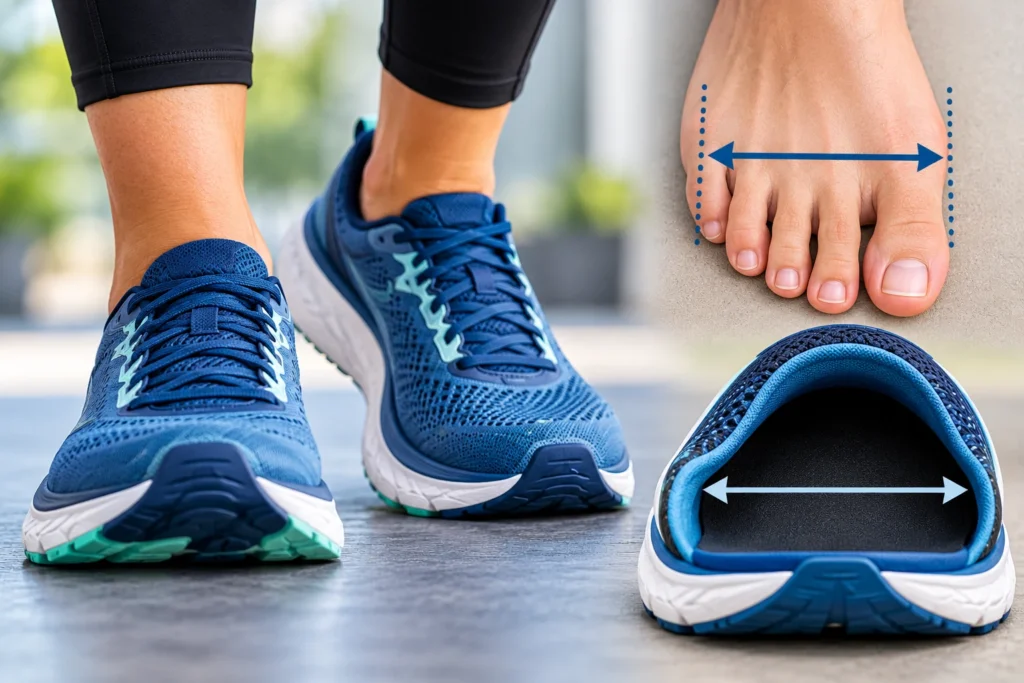
Running shoe size for wide feet means selecting footwear that accommodates your foot’s length and greater-than-standard width. A suitable shoe provides enough room around the forefoot without becoming loose around the heel.
Running shoes have three important fit dimensions:
- Length: The distance from your heel to your longest toe.
- Width: The space across the widest part of your forefoot.
- Volume: The internal space surrounding your foot, including the area above your arch.
Two shoes marked US size 10 can fit very differently. One may have a narrow toe box, while another offers additional space across the forefoot.
The shape used to construct a shoe is called its last. Different lasts explain why equal size labels do not always produce equal comfort.
How Can You Tell Whether Your Feet Are Wide?
Your feet may need wide running shoes if standard-width models repeatedly squeeze the sides of your forefoot. However, pressure alone does not confirm your exact width category.
Look for these common fitting clues:
- Your little toe presses firmly against the upper.
- The sides of your feet feel compressed when standing.
- You experience repeated rubbing near the ball of your foot.
- Your forefoot appears wider than the shoe’s supporting platform.
- Wider shoes feel more comfortable without requiring extra length.
- You need to loosen the laces excessively to reduce pressure.
These signs justify checking your width measurement. They do not replace trying on different shoe shapes.
What Running Shoe Width Should You Choose?
Most men’s running shoes use D as standard width and 2E as wide. Women’s running shoes commonly use B as standard width and D as wide.
Some manufacturers also offer extra-wide options. The following table shows commonly used US running-shoe width labels.
| Width category | Men’s width | Women’s width |
|---|---|---|
| Narrow | B | 2A |
| Standard | D | B |
| Wide | 2E | D |
| Extra-wide | 4E | 2E |
These designations are commonly used by Brooks and New Balance. The Brooks shoe-width guide explains the categories and their relationship to shoe fit.
What Is the Difference Between 2E and 4E Running Shoes?
Men’s 2E running shoes generally offer a wide fit, while 4E indicates extra-wide. The difference may involve upper volume, forefoot space, and the shoe’s platform construction.
Do not assume every brand increases width by an identical measurement. The actual internal shape varies between manufacturers and models.
Does the Width Measurement Change With Shoe Size?
Yes. Shoe-width categories correspond to different measurements as shoe length increases.
For example, New Balance publishes these reference foot-width measurements for a men’s US size 10:
| Width label | Reference width |
|---|---|
| B – Narrow | 10.2 cm |
| D – Standard | 10.6 cm |
| 2E – Wide | 10.9 cm |
| 4E – Extra-wide | 11.3 cm |
These are brand-specific sizing references, not exact measurements of the shoe’s interior. They should not be applied automatically to other brands.
Always compare your measurements with the relevant manufacturer’s chart and confirm the physical fit.
How Do You Measure Running Shoe Size for Wide Feet at Home?
Measure your feet while standing, preferably later in the day. Weight-bearing measurements help capture your foot’s natural spread.
You need a ruler, paper, a pencil, and your usual running socks.
Step 1: Measure Your Foot Length
- Place paper on a hard floor against a wall.
- Put on the socks you normally wear for running.
- Stand with your heel gently touching the wall.
- Keep your weight evenly distributed.
- Mark the end of your longest toe.
- Measure from the wall edge to the mark.
- Repeat the process for your other foot.
Record both measurements in centimeters. Use the longer foot as your starting point when consulting size charts.
Step 2: Measure Your Forefoot Width
- Stand naturally on a clean sheet of paper.
- Mark the outer edges around your widest forefoot area.
- Measure the distance between those marks.
- Repeat the measurement on your other foot.
- Compare the results with the brand’s width chart.
Keep your pencil upright to reduce tracing errors. Avoid squeezing your toes together during measurement.
Home tracing offers an estimate, not a precise professional fitting. A specialist can also check arch length and foot volume.
Step 3: Check Your Arch Length
Arch length is the distance from your heel to the ball of your foot. It helps determine where a shoe should bend during walking and running.
Two feet with the same overall length can have different arch lengths. The Brannock Device fitting instructions explain how professional measurement includes both lengths and width.
Step 4: Compare Your Measurements With a Brand Chart
Find the manufacturer’s size chart and identify the correct sizing system. US, UK, and EU labels are not interchangeable.
Check these details before selecting a shoe:
- Foot length in centimeters or millimeters.
- Men’s, women’s, or unisex sizing designation.
- Available width categories.
- Any model-specific fit recommendations.
- Whether your foot shape requires extra toe-box depth.
I recommend keeping your measurements in your phone. They provide a useful reference whenever you switch brands.
Should You Size Up Running Shoes If You Have Wide Feet?
Not automatically. If your running shoes already have sufficient length but squeeze the sides, try a wider version first.
Increasing shoe length can create unnecessary space in front of your toes. That may allow your feet to slide inside the shoes.
When Should You Choose a Wider Shoe?
Choose a wider model when your toes have adequate forward clearance but the forefoot feels compressed.
- Correct length, tight sides: Try the same length in a wider width.
- Correct length, tight upper: Consider more internal volume.
- Wide forefoot, narrow heel: Compare models with different heel shapes.
When Should You Choose a Longer Shoe?
Consider additional length when your longest toe approaches or contacts the front of the shoe. Check the fit while standing and moving.
The American Academy of Orthopaedic Surgeons’ shoe-fitting guidance recommends approximately half an inch of space beyond the longest toe.
Do not automatically increase every running shoe by half a size. Your measured foot length and the individual model’s fit matter more.
How Should Wide Running Shoes Fit?
Wide running shoes should feel comfortable across your forefoot while keeping your heel reasonably secure. Your toes should move without rubbing against the upper.
Length and width work together. For additional guidance, read our running shoe toe-room guide.
Check the Toe Box
The toe box is the front section surrounding your toes. It should accommodate their natural position without forcing them together.
- Your longest toe has adequate forward clearance.
- Your little toe does not feel pinched.
- Your toes can move without strong side pressure.
- The upper does not press uncomfortably against your toenails.
Check the Midfoot and Heel
A wider forefoot should not require an excessively loose heel. The middle of your shoe should feel supported without uncomfortable compression.
If your heel slides significantly, compare another model or try a runner’s-loop lacing technique. Avoid tightening the laces so much that your foot becomes numb.
Perform a Five-Minute Fit Test
- Wear both shoes with your running socks.
- Stand and check toe clearance.
- Shift your weight from one foot to the other.
- Walk around and notice side pressure.
- Jog lightly if the store permits.
- Check whether your heel slips or toes rub.
- Remove the shoes and look for unusual pressure marks.
The REI running-shoe fit guide also recommends testing shoes with your usual socks and checking the larger foot.
Do Wide Feet Always Need a Wide Toe Box?
Wide feet often benefit from a roomy toe box, but the shoe’s full shape matters. A naturally broad toe box and a labeled wide-width shoe are not necessarily identical.
Some shoes create additional toe room without greatly widening the middle or heel. Others provide extra space throughout the upper.
Wide Toe Box vs. Wide-Width Running Shoe
- Wide toe box: More room around the front of the foot.
- Wide-width version: A designated width option that may change several fit dimensions.
- High-volume fit: More internal room above the foot and around the upper.
If your toes feel cramped but your midfoot fits well, compare toe-box shapes. If the entire shoe feels narrow, a wider overall model may work better.
Do Men and Women Need Different Wide Running Shoe Sizes?
Men’s and women’s running shoes commonly use different standard-width codes. A men’s D is generally standard, while a women’s D is typically wide.
However, matching width letters does not guarantee identical shoe shapes. The heel, arch, and overall construction can differ.
For US length conversions, our women’s-to-men’s running shoe size chart explains the brand-specific differences.
Can Women With Wide Feet Wear Men’s Running Shoes?
Yes, when the converted length and complete fit are appropriate. Some women find suitable options among men’s standard-width models.
For brands using a 1.5-size US conversion, a women’s size 9 corresponds approximately to a men’s size 7.5 in length. Check the manufacturer’s current chart before ordering.
Can Men With Wide Feet Wear Extra-Wide Shoes?
Yes. Men’s 4E models are worth trying when 2E shoes still squeeze the forefoot.
Choose the smallest width category that fits comfortably without pressure. Excessive width can create unwanted foot movement.
How Do You Choose Wide Running Shoes Online?
Start with your foot measurements and a manufacturer’s size chart. Then compare width availability, shoe shape, and the retailer’s return policy.
Our complete guide on how to choose running shoes explains other features worth checking before purchasing.
Online Buying Checklist for Wide Feet
- Confirm the correct men’s or women’s size chart.
- Check that the selected width is actually available.
- Read the manufacturer’s model-specific fit notes.
- Look for comments about forefoot and toe-box comfort.
- Compare the fit with a shoe you already own.
- Check whether the retailer accepts indoor try-on returns.
- Review any return-shipping fees or conditions.
A good return policy matters because two similarly labeled shoes can fit differently. Try new shoes indoors before using them outside.
What Are the Most Common Wide Running Shoe Sizing Mistakes?
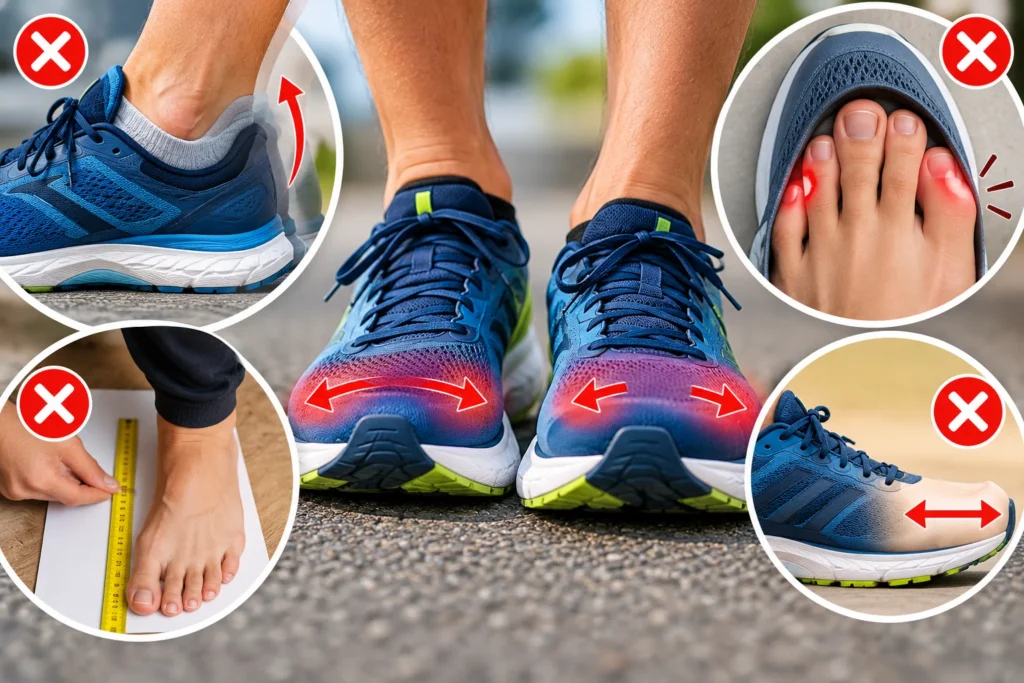
The biggest mistake is choosing extra length to compensate for inadequate width. A longer shoe may still squeeze your forefoot while allowing excessive movement.
Avoid these common problems:
- Ignoring width labels: Check B, D, 2E, and 4E rather than selecting length alone.
- Measuring while sitting: Stand naturally for a more useful measurement.
- Shopping too early: Fit later in the day when possible.
- Assuming all wide shoes are equal: Compare shapes between brands.
- Ignoring the larger foot: Fit the foot requiring more space.
- Expecting major stretching: Choose comfortable shoes from the start.
- Overlooking heel security: More forefoot room should not create excessive slipping.
- Buying by reviews alone: Another runner’s perfect fit may not suit your feet.
My preferred approach is to compare two widths in the same model before changing length. That helps isolate which dimension causes discomfort.
Which Running Shoes Are Worth Considering for Wide Feet in 2026?
New Balance, Brooks, and ASICS offer running shoes with designated wide-width options. The models below provide different approaches to cushioning, support, and width availability.
For more help selecting everyday footwear, see our daily training running shoe guide.
These are feature-based recommendations, not claims of personal wear testing. The star scores are editorial assessments of their suitability as wide-fit options, not verified customer-review averages.
🏆 Best for Width Selection
New Balance Fresh Foam X 880v15
★★★★★ 5/5 editorial fit score
This neutral daily trainer features Fresh Foam X cushioning and a 6 mm heel-to-toe drop. Men’s versions have been offered in standard, 2E, and 4E widths, making it a practical starting point for comparing fit.
I would shortlist this model when selecting an appropriate width is the main priority. Confirm available sizes and colors before purchasing.
👟 Best Neutral Alternative
Brooks Ghost 17
★★★★☆ 4/5 editorial fit score
The Ghost 17 uses DNA LOFT v3 cushioning and an engineered air-mesh upper. Brooks has offered men’s 2E and 4E widths and women’s wide-width choices.
I recommend comparing this neutral trainer with the New Balance option if you prefer a different upper or heel shape. Width availability varies by color.
🛡️ Best Stability Option
ASICS GEL-KAYANO 32
★★★★☆ 4/5 editorial fit score
The GEL-KAYANO 32 combines FF BLAST PLUS cushioning with ASICS’ 4D Guidance System. Designated wide and extra-wide versions have been offered in selected markets.
I would consider this model for runners who prefer structured stability features alongside wider sizing. Wide feet alone do not mean stability shoes are necessary.
Affiliate disclosure: Qualifying purchases through these Amazon links may earn a commission at no additional cost to you. Product availability and widths can change.
Frequently Asked Questions About Running Shoe Size for Wide Feet
Should I Buy Half a Size Bigger for Wide Feet?
Not necessarily. If your current running shoes provide enough toe clearance but squeeze your forefoot, choose a wider version before increasing length. Consider a longer shoe only when the existing size is too short or the manufacturer’s fitting guidance indicates a different length.
Is 2E Wide Enough for Running Shoes?
Men’s 2E is a common wide-width option and works for some runners with broader feet. Others may need 4E or a differently shaped shoe. Women’s 2E is commonly labeled extra-wide, so always check the sizing category used for your intended model.
Are Wide Running Shoes Better for Bunions?
A roomy toe box may reduce pressure around a bunion compared with a narrow shoe. However, adequate depth and the location of seams also matter. Persistent pain, swelling, or difficulty finding comfortable footwear deserves assessment by a qualified foot-care professional.
Can I Wear Regular Running Shoes With Wide Feet?
Yes, if the particular shoe comfortably accommodates your foot shape. Some regular-width models have a naturally spacious forefoot. Check for rubbing, pressure, and excessive movement rather than assuming a labeled wide shoe is always necessary.
How Often Should I Measure My Feet?
Measure your feet whenever your usual shoe size or fit seems different, particularly before changing brands. Foot dimensions can change with age and other factors. An updated measurement is more useful than relying on an old shoe label.
Final Takeaway: Find Your Best Running Shoe Size for Wide Feet
The right running shoe size for wide feet balances length, forefoot space, and heel security. Start with accurate measurements instead of automatically buying a bigger shoe.
Compare men’s 2E or women’s D models when standard widths feel restrictive. Move to extra-wide options when needed, but remember that every model has its own shape.
My final recommendation is simple: measure both feet, compare appropriate widths, and test the actual fit before committing. Comfortable running shoes should feel right from the beginning.