
Quick Answer
Max cushion running shoes generally use taller midsoles to provide a plush, protective underfoot experience. Standard cushion running shoes typically emphasize balanced comfort, versatility, and a more connected feel. Neither type is automatically safer or better for every runner. Your best choice depends on fit, running conditions, and personal comfort. Cushioning is also different from the support features explained in our neutral vs stability running shoes guide.
Key Differences
- Cushioning depth: Max cushion shoes generally place more midsole material beneath your feet.
- Underfoot feel: Max cushion models often feel plush, while standard shoes usually provide balanced cushioning.
- Ground awareness: Standard cushion shoes may provide a more direct connection with the running surface.
- Running purpose: Max cushion shoes often suit relaxed miles, while standard trainers provide everyday versatility.
- Stability: Platform width, foam firmness, and geometry matter more than cushioning labels alone.
Which Should You Choose?
- Choose max cushioning: If plush comfort and relaxed running are your priorities.
- Choose standard cushioning: If you prefer balanced comfort, ground awareness, and one versatile daily trainer.
- Best approach: Try both styles during a short run before buying.
Choosing between max cushion vs standard cushion running shoes isn’t as simple as picking the thickest sole. A shoe can look incredibly comfortable but still feel awkward during your normal stride.
I prefer comparing how footwear feels during actual movement rather than trusting cushioning labels. This guide explains the differences, research, real shoe specifications, and practical buying decisions for 2026.
What Are Max Cushion and Standard Cushion Running Shoes?
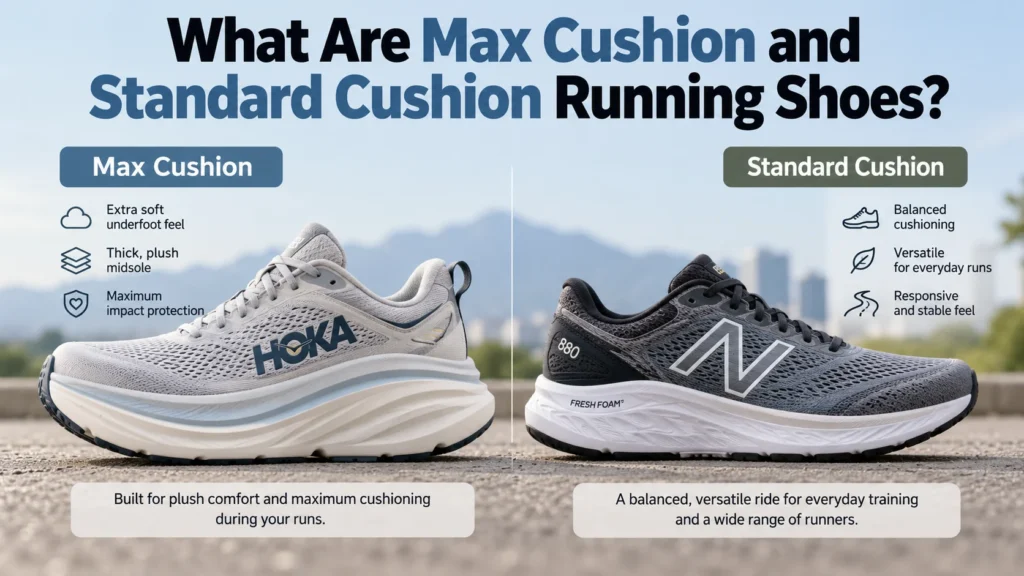
Both categories use midsole materials to manage underfoot forces and provide comfort. Their main difference is the amount and arrangement of cushioning, although brands define these categories differently.
What Are Max Cushion Running Shoes?
Max cushion running shoes are footwear designed with substantial underfoot cushioning, usually achieved through a relatively thick midsole. They often prioritize comfort during easy runs, recovery sessions, and longer outings.
However, thicker cushioning doesn’t always feel softer. Foam density, compression behavior, and sole geometry determine the actual running experience.
- High midsole stack: More material separates the foot from the ground.
- Plush cushioning: Many designs prioritize soft, comfortable landings.
- Rocker geometry: Some use curved soles to encourage smooth forward transitions.
- Variable stability: Wide platforms can improve stability, but very soft foam may feel less controlled.
- Typical purpose: Easy running, recovery miles, and comfort-focused training.
The HOKA Bondi 9 and ASICS GEL-NIMBUS 28 illustrate two approaches to maximum cushioning. Both emphasize comfort, although their foam formulations and running sensations differ.
What Are Standard Cushion Running Shoes?
Standard cushion running shoes offer cushioning intended to balance comfort, flexibility, support, and everyday performance. Their midsoles are often less exaggerated than those found in maximum-cushion models.
These shoes aren’t necessarily thin or firm. Modern standard trainers can contain substantial foam while maintaining a more conventional running feel.
- Balanced cushioning: Combines impact comfort with predictable movement.
- Everyday versatility: Often suitable for routine training and walking.
- Ground awareness: May feel less elevated than maximum-cushion alternatives.
- Natural transitions: Many allow a conventional heel-to-toe rolling motion.
- Typical purpose: Regular training across different comfortable paces.
The Brooks Ghost 18 is a useful example. Its nitrogen-infused DNA LOFT v3 midsole provides cushioning without positioning the shoe primarily as a maximalist model.
Max Cushion vs Standard Cushion Running Shoes: Side-by-Side Comparison
The table summarizes common design tendencies rather than strict technical rules. Individual shoes can overlap considerably, so avoid assuming that every max cushion model shares identical characteristics.
| Feature | Max Cushion | Standard Cushion |
|---|---|---|
| Midsole profile | Generally taller | Usually moderate or balanced |
| Underfoot feel | Often plush or highly cushioned | Balanced, sometimes firmer |
| Ground awareness | Generally reduced | Often more noticeable |
| Weight | Varies; not always heavier | Varies by construction |
| Stability | Depends on base width and geometry | Depends on the same features |
| Common use | Easy and recovery runs | Versatile daily training |
| Example for 2026 | ASICS GEL-NIMBUS 28 | Brooks Ghost 18 |
Important: There is no universally accepted stack-height cutoff separating standard and maximum cushioning. Manufacturer classifications and actual shoe construction should guide your comparison.
Does Max Cushioning Make Running Shoes More Comfortable?
Maximum cushioning can feel more comfortable, particularly if you enjoy soft landings and a substantial layer of foam. However, extra cushioning doesn’t guarantee a better experience for every runner.
Comfort depends on individual preferences and the interaction between your foot and the shoe. Two models with similar sole thickness may feel completely different.
Why Do Some Runners Prefer Thick Cushioning?
A well-designed cushioned midsole can deform underfoot and create a softer landing sensation. This may feel appealing during repetitive running on paved surfaces.
- Soft landings: Foam compression may reduce the harsh sensation some runners experience.
- Long-run comfort: Substantial cushioning can feel pleasant as fatigue builds.
- Smoother transitions: Rockered midsoles can encourage a rolling forward sensation.
- Underfoot coverage: Thick cushioning may protect against the feeling of firm pavement.
I wouldn’t judge comfort by pressing the foam with my thumb. That simple test tells you little about how the shoe behaves while running.
Why Might Standard Cushioning Feel Better?
Some runners prefer a shoe that feels more predictable and connected to the ground. A moderately cushioned midsole can provide enough comfort without an unusually tall platform.
- Direct response: The landing and push-off may feel easier to judge.
- Less elevated feel: Some runners dislike standing high above the surface.
- Familiar movement: Traditional sole shapes may suit established running habits.
- Balanced versatility: One comfortable model may handle several training activities.
Neither sensation is objectively superior. The most useful comfort comparison happens during movement at your normal running pace.
Do Max Cushion Running Shoes Reduce Impact and Prevent Injuries?
Maximum cushioning can change how forces are distributed beneath your feet, but research does not establish that it prevents running injuries. Impact comfort and injury prevention are different outcomes.
A 2025 study comparing maximal and traditional running shoes examined 20 recreationally active adults. Researchers observed lower peak forefoot pressure in the maximal shoe, without significant differences in several measured ground reaction forces.
Those findings suggest footwear can influence localized loading. They do not prove that maximum cushioning reduces overall injury risk.
What Does Research Say About Thicker Soles?
A 2026 systematic review of shoe sole thickness included 14 studies. Thicker soles generally showed lower ground reaction force loading rates, but results across other measurements were inconsistent.
The researchers rated the certainty of the available evidence as low to very low. This limits how confidently anyone can recommend a particular stack height for injury prevention.
What Should You Consider Beyond Cushioning?
- Training load: Increase running distance and intensity at a manageable rate.
- Comfortable fit: Avoid concentrated pressure and excessive internal movement.
- Running technique: Your movement pattern influences where forces occur.
- Recovery: Adjust training when discomfort or fatigue becomes persistent.
- Individual symptoms: Seek professional assessment for recurring pain.
A 2026 review of running shoes and injury considerations also emphasizes individualized footwear choices. Current evidence does not justify treating cushioning alone as reliable injury protection.
Which Cushioning Is Better for Long Runs, Easy Runs, and Faster Training?
The ideal cushioning depends on the session and your personal running preferences. A maximum-cushion model may excel at relaxed training without being the best choice for every workout.
For Easy Runs and Recovery Days
Max cushion running shoes are worth considering when relaxed comfort is your primary goal. Thick, compliant foam and smooth rocker geometry can create a pleasant experience at easy speeds.
However, comfortable standard trainers also work well for recovery running. You don’t need an unusually thick sole to run slowly.
For Long-Distance Running
Both styles can work for long-distance training. What matters is whether the shoe remains comfortable and predictable as your legs become tired.
- Consider max cushioning: When you enjoy plush underfoot comfort over extended distances.
- Consider standard cushioning: When you prefer balanced transitions throughout longer efforts.
- Check stability: Make sure your feet feel controlled later in the run.
- Check fit: Allow enough space for natural foot movement.
A long run is a useful opportunity to assess footwear, but introduce unfamiliar shoes gradually. Avoid making a race your first extended test.
For Tempo Runs and Faster Workouts
Neither category automatically produces faster running. Foam resilience, geometry, weight, and individual biomechanics all contribute to performance.
A thick, lightweight, responsive shoe may outperform a firmer standard trainer for some runners. Conversely, a plush recovery shoe may feel less suitable for rapid pace changes.
Don’t confuse maximum cushioning with a carbon-plated racing shoe. Advanced racing footwear uses additional design features that influence performance independently of stack height.
Are Max Cushion Running Shoes Better for Beginners?
Beginners can succeed with either cushioning style. A comfortable, stable-feeling daily trainer is usually a more useful starting point than choosing the thickest available sole.
New runners often benefit from a predictable shoe while developing consistent training habits. Extra softness isn’t a substitute for comfortable fit or appropriate training progression.
What Should Beginners Look For?
- Secure heel: Your foot should stay in place without painful pressure.
- Toe clearance: Leave enough length for comfortable forward movement.
- Forefoot width: Your toes should spread without squeezing.
- Comfortable cushioning: The midsole should feel natural during walking and jogging.
- Stable transitions: Avoid shoes that make you feel unsteady.
Our guide explaining how much toe room running shoes need can help you evaluate length. A comfortable shoe should fit your actual foot rather than a marketing category.
Does Stack Height, Heel Drop, or Shoe Weight Matter More?
All three specifications affect the overall design, but none determines comfort alone. Understanding their differences makes product comparisons more meaningful.
Stack Height
Stack height measures the vertical distance between the foot and the ground at a specified location. Manufacturers and independent testing laboratories may use different measurement methods.
Greater stack height typically means more material underfoot. It doesn’t automatically indicate softer cushioning, better support, or improved injury protection.
Heel-to-Toe Drop
Heel-to-toe drop is the height difference between the heel and forefoot. A 10 mm drop means the heel platform sits 10 mm higher than the forefoot.
Drop is different from total stack height. Maximum-cushion shoes may have low, moderate, or high drop measurements.
Running Shoe Weight
A taller shoe isn’t necessarily heavier than a standard trainer. Lightweight foams and selective outsole rubber can reduce weight despite substantial cushioning.
For example, manufacturer-listed men’s weights are approximately 281 g for the GEL-NIMBUS 28 and 289.2 g for the Ghost 18. Weight also varies with size and construction.
How Do You Know Which Cushioning Feels Right for Your Feet?
Comparing the shoes during running is more useful than relying on technical labels alone. I suggest testing models designed for similar surfaces and training purposes.
Six Steps to Compare Running Shoe Cushioning
- Choose comparable models. Select one maximum-cushion shoe and one standard daily trainer.
- Check the fit. Confirm that both shoes provide comfortable toe room and heel security.
- Walk naturally. Notice whether either shoe feels awkward, excessively soft, or unstable.
- Jog at an easy pace. Compare landing comfort and heel-to-toe transitions.
- Try a controlled pace change. Notice how each shoe responds without forcing your movement.
- Evaluate overall comfort. Prefer the design that feels predictable and comfortable rather than simply soft.
Here’s a useful example: imagine that one shoe feels wonderfully plush while standing but unstable during turns. A slightly firmer model might be the better everyday choice for that runner.
This is an illustrative comparison, not a personal product test. Your response may differ, which is why an appropriate running trial matters.
Are Max Cushion Shoes Good for Running on Concrete and Pavement?
Max cushion shoes can be comfortable on concrete and other paved surfaces. Their thick midsoles may soften the sensation of repeated landings, although that doesn’t guarantee reduced injury risk.
Standard cushion shoes can also perform well on hard ground. Outsole durability, suitable traction, and comfortable fit remain important.
- Road running: Look for durable outsoles and predictable cushioning.
- Sidewalks: Prioritize comfortable transitions and secure footing.
- Long paved routes: Check how comfort changes as fatigue develops.
- Wet pavement: Evaluate actual outsole grip instead of cushioning thickness.
For more buying considerations, read our guide to the best running shoes for concrete floors. Surface conditions should influence your choice alongside cushioning preferences.
Which Running Shoes Show the Cushioning Differences in 2026?
Real product specifications demonstrate why cushioning labels alone aren’t enough. The following models represent different approaches to underfoot comfort.
Figures below use published manufacturer specifications for men’s models. Weight and fit can vary by size, width, and market.
| Running Shoe | Cushioning Style | Drop | Men’s Weight |
|---|---|---|---|
| Brooks Ghost 18 | Balanced daily cushioning | 10 mm | 289.2 g |
| ASICS GEL-NIMBUS 28 | Maximum cushioning | 8 mm | 281 g |
| HOKA Bondi 9 | Maximum cushioning | 5 mm | 297 g |
These numbers show that a max cushion shoe can weigh less than a conventional daily trainer. Design efficiency and individual model construction matter.
The GEL-NIMBUS 28 uses FF BLAST PLUS cushioning and PureGEL technology. Brooks uses DNA LOFT v3 in the Ghost 18, while HOKA uses a premium foam midsole and rocker geometry in the Bondi 9.
What Mistakes Should You Avoid When Choosing Running Shoe Cushioning?
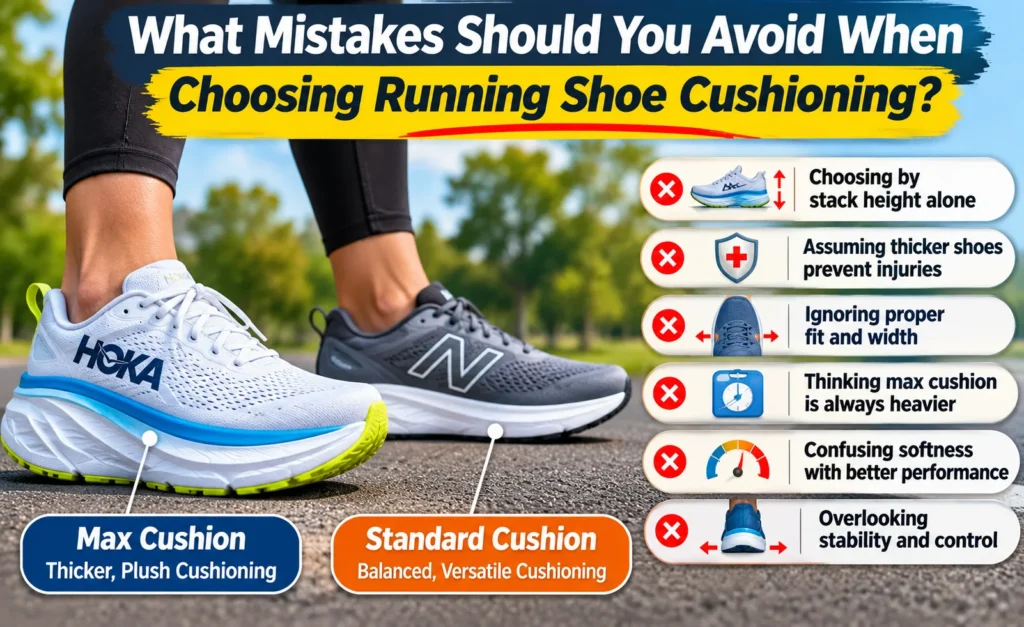
The biggest mistake is assuming more foam automatically means more comfort, stability, or protection. Choosing suitable running shoes requires evaluating the complete design.
- Choosing by stack height alone: Tall soles can feel firm, soft, responsive, or unstable depending on construction.
- Assuming thicker shoes prevent injuries: Current evidence doesn’t support that universal claim.
- Ignoring fit: Even excellent cushioning cannot compensate for uncomfortable sizing.
- Assuming max cushioning is always heavier: Modern foam technology creates substantial weight differences between models.
- Confusing softness with energy return: A soft shoe isn’t necessarily faster or more responsive.
- Overlooking stability: Very soft midsoles may not suit runners who prefer a controlled platform.
- Changing footwear abruptly: Introduce significantly different shoes gradually.
Fit deserves particular attention when comparing brands. Our guide on how wide running shoes should be explains why forefoot space and secure positioning matter.
Recommended Max Cushion and Standard Cushion Running Shoes for 2026
If you’re deciding between real shoes, these three models provide useful starting points. I’ve selected them for their verified design characteristics and distinct running purposes, not unverified personal wear testing.
The ratings below represent editorial suitability for each stated use case. They aren’t Amazon customer ratings, laboratory scores, or claims that every runner will prefer the model.
🏆 Best Balanced Daily Trainer
Brooks Ghost 18
★★★★☆ 4.0/5
The Ghost 18 features nitrogen-infused DNA LOFT v3 cushioning, a 10 mm drop, and a secure everyday design. I’d shortlist it for runners who prefer balanced cushioning and predictable daily comfort. Its cushioning may feel less protective under the forefoot than plush maximalist alternatives.
☁️ Best Plush Cushioning
ASICS GEL-NIMBUS 28
★★★★½ 4.5/5
The GEL-NIMBUS 28 combines FF BLAST PLUS cushioning, rearfoot PureGEL technology, and an 8 mm drop. I’d consider it for easy runs, recovery training, and runners who prioritize substantial impact comfort. Its plush design is less focused on fast, aggressive running.
🚶 Best Rockered Comfort
HOKA Bondi 9
★★★★☆ 4.0/5
The Bondi 9 features a thick premium foam midsole, a 5 mm drop, and HOKA’s MetaRocker geometry. I’d compare it when soft landings and smooth rolling transitions matter most. Its elevated platform and pronounced rocker may not suit runners seeking a conventional ground feel.
Affiliate disclosure: As an Amazon Associate, we may earn from qualifying purchases. Product prices, sizes, and availability can change. Confirm the exact model and seller before ordering.
Frequently Asked Questions
Are Max Cushion Running Shoes Better for Your Knees?
Not necessarily. Maximum cushioning can change running biomechanics and underfoot force distribution, but current evidence does not establish that thicker shoes consistently reduce knee pain or prevent knee injuries. Comfort and loading patterns differ between runners, so persistent knee symptoms deserve appropriate professional assessment.
Can You Run Fast in Max Cushion Shoes?
Yes, you can run fast in maximum-cushion shoes, but performance depends on foam responsiveness, weight, geometry, and overall design. Some high-stack models are built for speed, while plush recovery trainers prioritize comfort. Maximum cushioning alone does not indicate racing performance.
Are Standard Cushion Running Shoes Good for Long Distances?
Yes. Standard cushion running shoes can work well for long distances when they provide comfortable fit, suitable support, and consistent cushioning. Maximum cushioning isn’t required for marathon training, although some runners prefer the plush feeling of thicker midsoles over extended runs.
Do Max Cushion Running Shoes Wear Out Faster?
Not automatically. Running shoe lifespan depends on midsole materials, construction, mileage, running mechanics, storage, and usage conditions. Thick foam doesn’t guarantee longer durability, while thinner cushioning doesn’t necessarily wear out sooner. Watch for changes in comfort, compression, and outsole wear.
Should Heavy Runners Choose Maximum Cushioning?
Maximum cushioning may feel comfortable for runners who want additional underfoot material, but body weight alone doesn’t determine the best shoe. Foam firmness, platform stability, fit, and individual comfort remain important. Some heavier runners prefer supportive, balanced cushioning instead of extremely soft midsoles.
Final Verdict: Max Cushion vs Standard Cushion Running Shoes
Choose max cushion running shoes when substantial underfoot comfort, soft landings, and relaxed training are your main priorities. Choose standard cushion running shoes when you prefer balanced comfort and a familiar, versatile running feel.
Neither style guarantees improved running performance or fewer injuries. Fit, midsole design, stability, and your individual movement preferences matter more than marketing categories.
My recommendation is to compare both styles at your usual running pace. The right shoe is the one that feels consistently comfortable and supports the type of running you actually do.
Ready to choose? Start by identifying your typical running distance, preferred underfoot sensation, and fit requirements. Then compare suitable models rather than buying solely because a shoe has more cushioning.


Steven is a former sportsperson and now a full-time businessman and research writer. He is the mastermind of this site, and he created this site to help people who need specialized shoes for different activities. When he was a sportsperson, he was very passionate about different types of shoes for his sports purpose. The passion he had for shoes at that time now turned into his profession. Besides his shoe business, he loves sharing his knowledge and experience with people and helping them maintain healthy feet.
More Posts