
Quick Answer
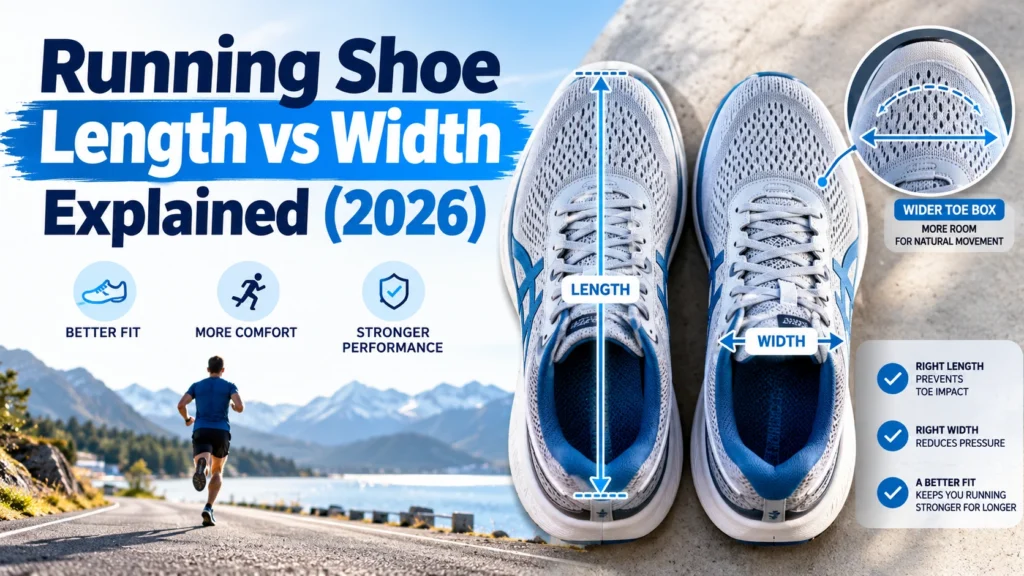
Running shoe length measures the distance from your heel to the front of the shoe, while width describes the space across your forefoot. Length determines toe clearance; width determines whether your foot feels squeezed or slides sideways. You need both measurements for a comfortable fit, not just a numerical shoe size. Start by learning how to find your running shoe size.
Five key differences to remember:
- Length measurement: Runs from the back of your heel to the end of your longest toe.
- Width measurement: Runs across the widest part of your forefoot.
- Length sizing: Usually appears as a number, such as US 9, 10, or 10.5.
- Width sizing: Usually uses letters such as B, D, 2E, and 4E.
- Correct fit: Provides approximately a thumb’s width of toe clearance with comfortable forefoot space and a secure heel.
Quick fitting tip:
- Measure both dimensions: Check both feet while standing, then compare your measurements with the manufacturer’s size and width chart.
Finding running shoes that fit shouldn’t feel like guesswork. Yet many runners know their shoe size without knowing whether their feet need extra length or width.
I prefer checking these measurements separately because a shoe can have perfect toe clearance and still squeeze your forefoot. This 2026 guide explains the differences, sizing labels, measurements, and practical fitting decisions.
What Do Running Shoe Length and Width Actually Mean?

Running shoe length and width describe two different dimensions of footwear fit. Both affect how your feet move and feel during running.
Neither measurement tells the entire story. Shoe shape, depth, and heel construction also influence comfort.
What Is Running Shoe Length?
Running shoe length describes the front-to-back dimension of the shoe. Its main purpose is to provide enough room for your foot and toes.
Your foot length is measured from the back of your heel to your longest toe. Your longest toe isn’t necessarily your big toe.
- Foot length: Your actual heel-to-longest-toe measurement.
- Shoe length: The internal space available inside the shoe.
- Toe clearance: The extra room between your longest toe and the front of the shoe.
- Length size: The manufacturer’s numerical size designation.
These values aren’t identical. Running shoes need some additional internal space beyond your standing foot length.
What Is Running Shoe Width?
Running shoe width describes how much room a shoe provides across your foot. The widest part of your forefoot is especially important.
This area is commonly called the ball of the foot. It’s near the joints at the bases of your toes.
- Narrow width: Designed for feet needing less side-to-side space.
- Standard width: Intended for a typical width range within a particular sizing system.
- Wide width: Provides additional space for a broader foot.
- Extra-wide width: Accommodates feet needing substantially more room.
A shoe can match your length perfectly and still feel painfully narrow. That’s why I never treat length alone as proof of a proper fit.
Running Shoe Length vs Width: What Is the Main Difference?
The main difference is where each measurement affects fit. Length controls front-to-back space, while width controls side-to-side accommodation.
Here’s how they compare in practical terms.
| Feature | Shoe Length | Shoe Width |
|---|---|---|
| Direction | Heel to toe | Across the forefoot |
| Common label | US 9, 10, 10.5 | B, D, 2E, 4E |
| Main purpose | Allows toe clearance | Accommodates foot breadth |
| Too small | Toes hit the front | Sides squeeze the foot |
| Too large | Excessive toe space or sliding | Unwanted sideways movement |
| Typical adjustment | Change numerical size | Change width option |
Consider a men’s US size 10 D and a size 10 2E. Both share the same labeled length, but the 2E version is designed for a wider foot.
Now compare a size 10 D with a size 10.5 D. The second size is longer, but it isn’t necessarily the correct solution for a width problem.
How Do You Measure Running Shoe Length and Width at Home?
You can measure both dimensions with paper, a pencil, and a ruler. Standing measurements provide a useful starting point because your feet carry body weight.
For greater precision, a footwear specialist can use a Brannock-style measuring device. This may also help assess arch length.
Step 1: Prepare Your Measuring Area
Place a sheet of paper against a wall on a hard, level floor. Wear the socks you normally use for running.
Measure later in the day when possible. Feet can become slightly larger after hours of standing or activity.
Step 2: Measure Your Foot Length
- Stand with your heel gently against the wall.
- Keep your weight evenly distributed while standing.
- Mark the position of your longest toe.
- Measure from the heel reference point to that mark.
- Record the measurement in millimeters or centimeters.
- Repeat the process for your other foot.
Use the longer foot as your starting point for length selection. Then confirm that both shoes fit comfortably.
Step 3: Measure Your Foot Width
- Keep your foot flat on the measuring paper.
- Locate the widest part of your forefoot.
- Mark the two outermost points at that location.
- Measure the straight-line distance between those points.
- Write down the width in millimeters.
- Repeat the measurement for your other foot.
Measure gently without squeezing your foot. Pressing the sides together can produce an inaccurate result.
Step 4: Compare Your Measurements With a Brand Chart
Look for a size chart that includes foot length and width. Don’t assume every manufacturer uses identical measurements.
Pay attention to whether the chart describes foot dimensions or internal shoe dimensions. They’re not interchangeable.
For example, a chart based on foot length may already account for appropriate fit allowance. Don’t automatically add another centimeter to its recommended size.
The REI running shoe fitting guide also recommends checking the larger foot, toe room, and heel security.
How Do Running Shoe Length and Width Size Charts Work?
Most running shoe brands use numerical labels for length and letters for width. However, the meaning of standard width differs between men’s and women’s sizing.
What Do B, D, 2E, and 4E Mean?
These letters identify width categories within a sizing system. They aren’t fixed measurements that mean the same number of centimeters at every length.
| Width Category | Men’s US | Women’s US |
|---|---|---|
| Narrow | B | 2A |
| Standard | D | B |
| Wide | 2E | D |
| Extra wide | 4E | 2E |
This chart follows the common width system explained in the Brooks shoe width guide. Individual brands may offer different combinations.
Does Width Change When Shoe Length Changes?
Yes. Width measurements generally increase as shoe length increases, even within the same width category.
For a concrete example, New Balance publishes the following foot measurements in its men’s sizing chart.
| US Size | Foot Length | D Width | 2E Width | 4E Width |
|---|---|---|---|---|
| 9 | 27 cm | 10.4 cm | 10.7 cm | 11.0 cm |
| 10 | 28 cm | 10.6 cm | 10.9 cm | 11.3 cm |
Source: New Balance men’s size and width guide. These are published fitting-chart values, not measured internal shoe dimensions or universal standards.
Notice how width changes at the same numerical size. That’s why I recommend finding the correct length first, then comparing width options.
How Much Extra Length Should Running Shoes Have?
Most running shoes should leave approximately a thumb’s width of room beyond your longest toe. Around 10–15 mm is a useful starting point, though individual needs vary.
Running places repeated loads on your feet. Your forefoot also spreads under pressure, making some additional space important.
Signs Your Running Shoes Are Too Short
- Your longest toe repeatedly touches the front of the shoe.
- Your toenails feel pressured during downhill running.
- Your toes curl because there isn’t enough space.
- You experience persistent pressure at the front of the shoe.
- Your toes cannot move comfortably while standing.
A longer size may solve these problems if the shoe already fits well across the forefoot. Recheck heel security after sizing up.
Signs Your Running Shoes Are Too Long
- Your heel repeatedly slips while walking or jogging.
- Your feet slide forward inside the shoes.
- You have excessive space beyond the longest toe.
- You must overtighten the laces for basic stability.
- Your foot moves noticeably despite normal lacing.
These signs can also reflect excessive width or an unsuitable heel shape. Read the complete guide to telling whether running shoes are too big before changing sizes.
How Can You Tell If Running Shoes Are Too Narrow or Too Wide?
Width problems usually appear around the sides of your forefoot. They can cause discomfort even when your longest toe has sufficient clearance.
Signs Your Running Shoes Are Too Narrow
- Side pressure: Your forefoot feels squeezed near the toe joints.
- Toe crowding: Your toes press against one another.
- Upper bulging: The shoe fabric stretches tightly around the forefoot.
- Persistent rubbing: Hot spots appear along the outside or inside of your foot.
- Tingling or numbness: Uncomfortable pressure affects your toes during activity.
Don’t ignore numbness or pain. Stop running and reassess the fit if symptoms develop.
Signs Your Running Shoes Are Too Wide
- Your foot slides sideways inside the shoe.
- The upper folds excessively when you tighten the laces.
- Your midfoot feels loose despite appropriate toe clearance.
- Your foot shifts noticeably during turns or uneven movement.
- You struggle to secure the shoe without uncomfortable lace tension.
A wide shoe isn’t automatically better for comfort. Excessive internal movement can create friction and make running feel less stable.
Should You Buy Longer or Wider Running Shoes?
Choose longer running shoes when toe clearance is insufficient. Choose wider running shoes when the length is correct but your foot feels squeezed across the sides.
The distinction matters because sizing up often adds both length and some width. That may create a new fit problem.
When Should You Go Up Half a Size?
Try a longer size when your toes press against the front, especially during descents. Keep the width unchanged initially if the forefoot already feels comfortable.
For example, a runner wearing men’s US 10 D might compare a 10.5 D. The goal is additional toe clearance without sacrificing heel security.
When Should You Choose a Wide Version?
Try a wider version when toe space is already appropriate but the sides pinch. A men’s 10 2E may work better than a 10.5 D for this situation.
I would compare those two options directly instead of assuming a longer shoe solves every tight fit. The result often becomes obvious once you stand and walk.
What If Both Length and Width Feel Wrong?
Measure both feet again and compare the manufacturer’s sizing options. You may need a different length and width combination.
Sometimes neither adjustment solves the issue. A differently shaped shoe may match your foot better.
Is Toe Box Width the Same as Overall Running Shoe Width?
No. Toe box width refers to the space around your toes, while overall shoe width concerns the broader shape of the shoe.
A shoe can have a roomy toe box and a narrow midfoot. Another model may have a broad forefoot and a similarly broad heel.
What About Shoe Volume?
Shoe volume is the three-dimensional space available inside the upper. It includes room above your foot, not just length or width.
Footwear specialists sometimes describe this as accommodating high-volume or low-volume feet. Instep height can influence which shoe feels secure.
- Wide forefoot: Look for sufficient space across the ball of your foot.
- High instep: Check for pressure from the tongue and laces.
- Narrow heel: Look for secure heel construction without excessive movement.
- Wide toes, narrow midfoot: Consider models with a roomier toe box and more fitted midfoot.
Foot shape matters as much as the size label. The right combination should feel comfortable without requiring painful adjustments.
How Do You Test Running Shoe Length and Width Before Buying?
The best fitting test combines standing measurements with movement. A shoe that feels comfortable while sitting may behave differently when you run.
Follow these checks before deciding.
- Wear your running socks: Use the same thickness you wear during training.
- Try both shoes: Check each foot rather than relying on one fitting.
- Check toe clearance: Stand and feel for roughly a thumb’s width beyond your longest toe.
- Check forefoot width: Spread your toes naturally and notice any pressure.
- Check the midfoot: Lace the shoe until it feels secure without squeezing.
- Test the heel: Walk and notice repeated lifting or rubbing.
- Jog briefly: Test movement on a safe indoor surface when appropriate.
- Compare sizes: Try the next width or length if the fit remains uncomfortable.
The ASICS running shoe fit guidance also emphasizes toe clearance and a secure heel.
Try shoes later in the day when possible. If you’re buying online, check return conditions before testing them outdoors.
What Mistakes Should You Avoid When Choosing Running Shoe Length and Width?
The most common mistake is choosing a bigger numerical size whenever a shoe feels tight. Tightness doesn’t always mean insufficient length.
These errors are worth avoiding.
- Ignoring width: Buying longer shoes to relieve pressure across the forefoot.
- Trusting old sizes: Assuming your feet haven’t changed since your last fitting.
- Ignoring brand differences: Expecting every model with the same label to fit identically.
- Checking only one foot: Missing a difference between your left and right measurements.
- Forgetting sock thickness: Testing shoes with socks unlike your running pair.
- Accepting pinching: Hoping uncomfortable shoes will stretch enough to become suitable.
- Overtightening laces: Using excessive tension to compensate for poor fit.
- Ignoring heel hold: Choosing toe comfort while allowing excessive heel movement.
New running shoes should feel comfortable from the beginning. Don’t depend on an extended break-in period to correct painful pressure.
For a closer look at balanced fit, see how tight running shoes should be.
When Should You Exchange Running Shoes for Another Size or Width?

Consider an exchange when ordinary lacing adjustments cannot provide a comfortable, secure fit. Persistent squeezing, sliding, or toe contact suggests a mismatch.
Choose your next step based on the problem.
- Toes hit the front: Compare a longer size.
- Forefoot feels squeezed: Compare a wider option.
- Foot slides sideways: Try a narrower option or differently shaped model.
- Heel slips repeatedly: Check lacing, heel shape, and overall volume.
- Upper presses downward: Consider a model with more instep room.
- Several areas feel wrong: Get professionally fitted or try another shoe design.
Persistent numbness, significant pain, or repeated injury symptoms deserve professional assessment. Shoe sizing advice cannot diagnose a medical problem.
Useful Running Shoes and Tools for Finding the Right Fit
If you’re comparing shoe dimensions, I recommend starting with models that offer multiple width choices. A measuring device can also help establish a consistent starting size.
The ratings below are editorial estimates of usefulness for fit selection, not verified customer ratings or hands-on performance test scores. Width availability depends on size, color, market, and retailer.
🏆 Best for width selection
New Balance Fresh Foam X 880v15
★★★★☆ 4/5
This neutral everyday running shoe uses Fresh Foam X cushioning and a structured mesh upper. Men’s versions have been offered in B, D, 2E, and 4E widths. I especially like having several labeled widths to compare without automatically changing length.
👟 Best for everyday running
Brooks Ghost 18 Running Shoes
★★★★☆ 4/5
The Ghost 18 is a cushioned road-running shoe designed for daily training. Men’s selections include narrow, standard, wide, and extra-wide options in participating sizes and colors. I’d consider it a useful comparison model when checking forefoot room and heel security.
📏 Best for measuring
Genuine Brannock Device Adult Foot Measuring Device
★★★☆☆ 3/5
This professional-style device measures heel-to-toe length, arch length, and foot width. I see it as useful for repeated fitting checks, although a knowledgeable running shoe store may be more economical for occasional measurements.
Shopping tip: Check the selected width before ordering. A product listing may default to standard width even when the same model offers wider versions.
Frequently Asked Questions
Is running shoe length more important than width?
Neither measurement is universally more important. Length provides essential toe clearance, while width prevents uncomfortable squeezing or excessive sideways movement. A shoe needs to accommodate both dimensions, alongside heel shape and internal volume, to fit comfortably during running.
Does a bigger running shoe size automatically mean more width?
Increasing numerical shoe size usually increases length and may also increase width. However, sizing up doesn’t provide the same fit as choosing a dedicated wide option. If your toes already have enough clearance, comparing widths at your current length may be more effective.
How much room should running shoes have around the toes?
Approximately 10–15 mm, or around a thumb’s width, beyond your longest toe is a useful starting point. Your toes should move freely without repeated contact with the front or sides. The heel and midfoot should remain comfortably secure.
Can I wear wide running shoes if my feet are not wide?
You can, provided the shoes fit securely and don’t create excessive movement. Some models have different shapes through the forefoot and midfoot. However, unnecessarily wide shoes may cause slipping or friction, so compare them with standard-width versions before buying.
Should I measure running shoe width with or without socks?
Wear your normal running socks during practical shoe fitting. For measurements at home, follow the manufacturer’s specific measurement instructions. Sock thickness can affect the fit, so test the finished shoe-and-sock combination while standing and moving.
Final Verdict: How Should You Choose Running Shoe Length and Width?
Running shoe length determines how much front-to-back room your foot has. Width determines how comfortably your forefoot fits across the shoe.
The best fit provides adequate toe clearance, natural forefoot movement, a secure heel, and comfortable midfoot support. A numerical size alone cannot guarantee all four.
My recommendation is simple: measure both feet, choose a suitable length, and then compare widths. If neither fits comfortably, try another shoe shape rather than forcing the wrong size to work.
Ready to find a better fit? Use your measurements to compare two or three running shoes in the correct length and width, then test each pair before committing.


Steven is a former sportsperson and now a full-time businessman and research writer. He is the mastermind of this site, and he created this site to help people who need specialized shoes for different activities. When he was a sportsperson, he was very passionate about different types of shoes for his sports purpose. The passion he had for shoes at that time now turned into his profession. Besides his shoe business, he loves sharing his knowledge and experience with people and helping them maintain healthy feet.
More Posts
