Quick Answer
To build a running shoe rotation, start with one comfortable daily trainer, then add a second pair that serves a different purpose. Assign each shoe to suitable workouts, alternate pairs throughout the week, and track mileage separately. For most recreational runners, two pairs are a practical starting point, while three can support more specialized training. For additional guidance, see Saucony’s shoe rotation guide.
Six steps to build your rotation
- 1. Review your training: Identify your easy runs, long runs, workouts, and running surfaces.
- 2. Choose a daily trainer: Prioritize comfortable fit and dependable cushioning.
- 3. Add another shoe: Select a complementary model for faster sessions, trails, or recovery runs.
- 4. Assign shoe roles: Match footwear to training demands rather than choosing randomly.
- 5. Alternate gradually: Introduce unfamiliar shoes with shorter, comfortable sessions.
- 6. Monitor wear: Record mileage and replace shoes when their performance deteriorates.
Beginner tip
- Start small: You don’t need expensive racing shoes or three new pairs to create a useful rotation.
Learning how to build a running shoe rotation can make your training more organized without making it complicated. I prefer starting with the runs you already do, then choosing footwear that supports those sessions.
In this guide, I’ll explain how many shoes you need, which types make sense, and how to create a practical weekly rotation. We’ll also cover costs, replacement timing, and common mistakes.
What Is a Running Shoe Rotation?
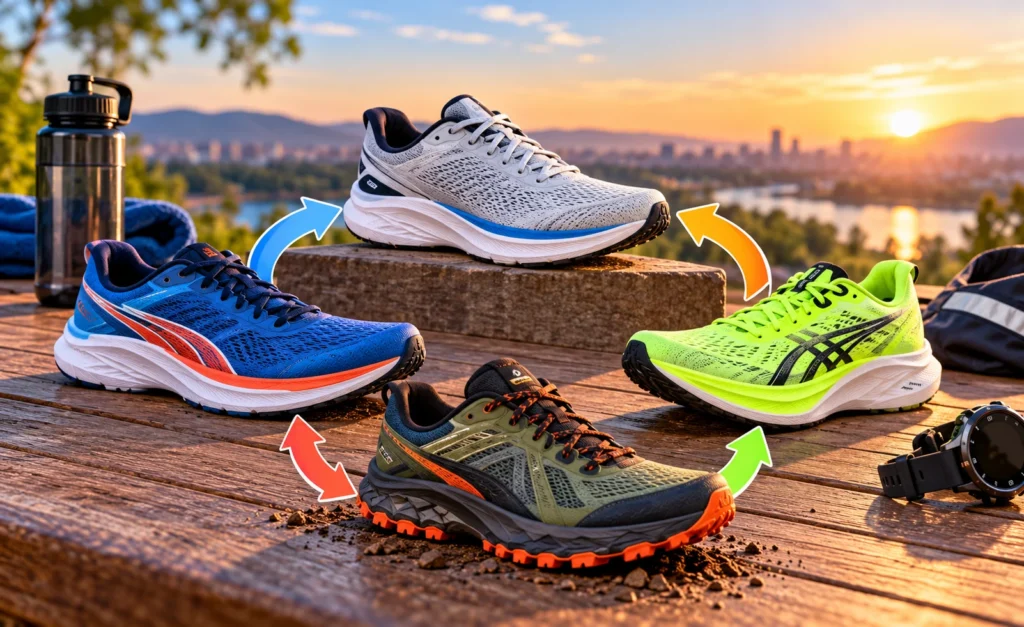
A running shoe rotation is a system of using two or more pairs of running shoes across your training schedule. Each pair may serve a different purpose, such as everyday mileage, speed training, or trail running.
Instead of wearing the same pair for every workout, you select footwear according to the session’s demands. You can also alternate similar daily trainers to distribute wear.
How Does Running Shoe Rotation Work?
Imagine you run four times weekly. You could wear your everyday trainers for three sessions and a lighter pair for a faster workout.
That creates a simple two-shoe rotation. Your shoes have defined roles, and both contribute to your weekly training.
- Daily trainer: Easy runs, steady runs, and general mileage.
- Recovery shoe: Relaxed sessions where comfort is the priority.
- Speed trainer: Tempo workouts, intervals, and faster efforts.
- Long-run shoe: Extended sessions requiring dependable comfort.
- Trail shoe: Off-road routes requiring appropriate grip and protection.
- Racing shoe: Competition and selected race-specific workouts.
Not every runner needs all six categories. A versatile daily trainer can cover several roles.
Why Should You Rotate Running Shoes?
Rotating running shoes gives you more footwear options for different workouts and spreads mileage across multiple pairs. It may also change the loading patterns your body experiences during training.
These advantages are worth considering, but rotation isn’t a guaranteed injury-prevention strategy. Training load, recovery, fit, and running history remain important.
Can Rotating Running Shoes Reduce Injury Risk?
Some research suggests that using multiple shoe models may be associated with fewer running injuries. However, the existing evidence doesn’t establish that adding another pair directly prevents injuries.
A study published in the Scandinavian Journal of Medicine & Science in Sports followed 264 recreational runners for 22 weeks. Researchers found that participants using multiple running shoes had a lower observed injury risk.
You can review the running shoe rotation research on PubMed.
Because the study was observational, other differences between runners may have influenced the findings. I wouldn’t treat a second pair as a substitute for sensible training.
Does Shoe Rotation Make Running Shoes Last Longer?
Rotation distributes mileage between pairs, so each individual shoe accumulates distance more slowly. That can extend the calendar time before a particular pair needs replacement.
It doesn’t necessarily reduce your total footwear costs. Two pairs still experience wear across the combined miles you run.
- Distributed mileage: Each pair handles fewer weekly miles.
- Drying time: Alternating allows damp shoes more time to dry.
- Workout matching: You avoid using specialized shoes unnecessarily.
- Condition monitoring: Comparing pairs can help reveal changes in comfort.
Airflow and proper drying are useful, especially after wet or muddy workouts. However, an exact 24- or 48-hour foam recovery period isn’t a proven universal requirement.
How Many Running Shoes Do You Need in a Rotation?
Most casual runners can start with one or two pairs, while runners doing varied workouts may benefit from two or three. The right number depends on training volume, terrain, budget, and goals.
More pairs aren’t automatically better. Each shoe should have a reason to be in your rotation.
| Runner type | Pairs | Suggested setup |
|---|---|---|
| Beginner running 1–3 days weekly | 1–2 | Daily trainer; optional second comfortable pair |
| Regular runner doing 3–5 sessions | 2 | Daily trainer and complementary workout shoe |
| Half-marathon or marathon trainee | 2–3 | Daily trainer, workout shoe, optional racing shoe |
| Road and technical trail runner | 2+ | Road trainer and terrain-specific trail shoe |
These are practical planning examples, not mandatory rules. A runner with a versatile shoe and consistent training needs may be perfectly happy with one pair.
Is a Two-Shoe Rotation Enough?
Yes, a two-shoe rotation is enough for many recreational runners. One shoe can handle everyday mileage while the other covers a distinct training need.
For example, pair a comfortable daily trainer with a responsive workout shoe. If you don’t do speed sessions, two comfortable trainers may work better.
Do Marathon Runners Need Three Pairs?
Marathon runners don’t strictly need three pairs, but a three-shoe rotation offers useful flexibility. A daily trainer, faster workout shoe, and race-day shoe can cover different demands.
Choose the third pair only when your training justifies it. A good two-shoe setup is more useful than three poorly fitting shoes.
How Do You Build a Running Shoe Rotation Step by Step?
Build your rotation around your current weekly schedule, not a collection of popular shoe models. The goal is to fill meaningful gaps while keeping your footwear comfortable.
Step 1: Review Your Weekly Running Routine
Write down the sessions you complete during a typical week. Include distance, effort, terrain, and whether you run on consecutive days.
- Easy runs: Relaxed sessions at a conversational effort.
- Long runs: Your longest continuous weekly session.
- Tempo runs: Sustained efforts at a comfortably hard pace.
- Intervals: Repeated faster efforts with recovery periods.
- Trail runs: Off-road running over dirt, rocks, or uneven ground.
If nearly all your miles are easy road runs, prioritize an everyday trainer. Specialized shoes become more useful as your workouts diversify.
Step 2: Choose Your Main Daily Trainer
Your first shoe should comfortably handle the majority of your weekly running. It should fit securely without squeezing your toes or causing rubbing.
Daily trainers typically emphasize repeatable comfort rather than race-day speed. A versatile model can also handle occasional faster efforts.
- Fit: Comfortable forefoot space and a secure heel.
- Cushioning: Enough comfort for your normal distances.
- Stability: A predictable ride that suits your movement.
- Outsole: Suitable traction for your usual surfaces.
- Durability: Construction appropriate for regular training.
I would prioritize fit over marketing claims about foam technology. An impressive shoe isn’t useful if it feels uncomfortable during your runs.
Step 3: Add a Second Shoe With a Different Purpose
Choose your second pair based on a specific need your daily trainer doesn’t fully address. This makes the rotation more practical.
- Speed workouts: Consider a lighter or more responsive trainer.
- Long easy runs: Consider a comfortable, well-cushioned alternative.
- Technical trails: Choose trail-appropriate grip and protection.
- Wet conditions: Keep an alternative pair available while shoes dry.
- Simple daily rotation: Choose a second comfortable trainer, possibly with a different ride.
A second shoe doesn’t have to be dramatically different. It simply needs to contribute something useful.
Step 4: Introduce New Shoes Gradually
Start unfamiliar footwear with a short, easy run rather than your hardest workout. Pay attention to your calves, arches, toes, and overall comfort.
Changes in heel-to-toe drop, rocker shape, cushioning, or stiffness may feel unfamiliar. Give yourself time to assess the difference.
- Begin with a comfortable, relatively short session.
- Check for rubbing, pressure, or unusual discomfort afterward.
- Increase use gradually if the shoes continue feeling comfortable.
- Stop using the pair if it repeatedly causes pain.
There isn’t one mandatory adaptation schedule for every runner. Adjust according to your training experience and response.
Step 5: Match Each Pair to Your Workouts
Assign a primary purpose to every pair. You can still use a versatile shoe across several workout types.
For example, reserve your responsive trainer for tempo sessions and occasional faster runs. Let your everyday pair handle most relaxed mileage.
Step 6: Track Mileage and Shoe Condition
Record the distance completed in each pair using a running app, spreadsheet, or training journal. Check fit, cushioning, traction, and visible wear regularly.
Tracking doesn’t need to be complicated. A shoe name and running-distance total are usually enough to begin.
What Is a Good Weekly Running Shoe Rotation Schedule?
A useful rotation schedule matches shoes to workouts without forcing unnecessary footwear changes. The following example suits someone running four days weekly.
| Day | Workout | Shoe |
|---|---|---|
| Monday | Easy 3 miles | Daily trainer |
| Tuesday | Rest or cross-training | No running shoes required |
| Wednesday | 4-mile workout | Responsive trainer |
| Thursday | Rest | No running shoes required |
| Friday | Easy 3 miles | Daily trainer |
| Saturday | Rest | No running shoes required |
| Sunday | Long run of 7 miles | Daily trainer |
This example totals 17 miles, with 13 miles assigned to the daily trainer. The responsive shoe handles the remaining four miles.
These distances illustrate rotation planning, not a recommended training load. Keep your actual schedule appropriate for your fitness and recovery.
How Should You Rotate Three Pairs of Running Shoes?
With three pairs, assign one to daily miles, another to faster training, and a third to a specific need. That third role might be racing, long-run comfort, or off-road terrain.
- Pair A: Everyday training and relaxed mileage.
- Pair B: Tempo work, intervals, or progression runs.
- Pair C: Racing, longer efforts, or terrain-specific sessions.
You don’t need equal mileage across all three. Your daily trainer may still account for most of your running.
Should You Rotate Different Running Shoe Brands?
You can rotate different brands, but it isn’t necessary. What matters more is whether each pair fits comfortably and serves your intended workouts.
Different brands may offer distinct fits, cushioning systems, and ride characteristics. Two models from the same brand can also feel very different.
Should Your Running Shoes Have Different Heel Drops?
Different heel-to-toe drops can be part of a rotation, but deliberately varying drop isn’t essential. Heel-to-toe drop describes the height difference between the heel and forefoot.
Large changes can alter how a shoe feels and how your lower legs are loaded. Introduce unfamiliar designs carefully, especially if you’re sensitive to changes in footwear.
Can You Mix Stability and Neutral Running Shoes?
Some runners comfortably use both stability and neutral models. However, switching support categories isn’t automatically beneficial.
Choose footwear based on comfort, running demands, and individual needs. If you have recurring pain or a complicated injury history, consider advice from a qualified clinician.
A review of running footwear and injury research highlights why shoe selection should consider the individual runner rather than rely on one universal rule.
How Long Do Running Shoes Last When Rotated?
Many performance running shoes have an approximate working life of 300–500 miles, although individual results vary. Running mechanics, surfaces, construction, and use all influence wear.
Brooks discusses these ranges in its running shoe replacement guidance.
How Do You Calculate Shoe Replacement Timing?
Divide each pair’s remaining usable mileage by the weekly distance assigned to that shoe. This gives an approximate number of weeks before reaching your planning threshold.
For example, suppose one pair accumulates 15 miles weekly and you use 400 miles as a tracking milestone.
- Weekly distance: 15 miles.
- Tracking milestone: 400 miles.
- Estimated time: 400 ÷ 15 = approximately 26.7 weeks.
This calculation isn’t a replacement deadline. Inspect the shoe regularly, because some pairs wear out sooner while others remain usable longer.
What Signs Show a Running Shoe Needs Replacing?
- Worn outsole: Important tread areas appear smooth or heavily abraded.
- Compressed cushioning: The midsole feels noticeably flatter or less supportive.
- Damaged upper: Tears, worn lining, or structural damage affect fit.
- Unusual discomfort: A previously comfortable shoe begins feeling consistently different.
- Reduced traction: The shoe slips more easily on its intended surface.
Never rely on mileage alone. A shoe’s condition and how it performs matter more than one universal number.
How Do You Build a Running Shoe Rotation on a Budget?
The simplest budget approach is to keep using a suitable daily trainer and add another pair only when needed. Avoid buying specialized footwear before your training calls for it.
Can You Build a Rotation With Two Affordable Shoes?
Yes. Two comfortable, appropriately fitted trainers can provide a useful rotation without expensive performance features.
You might use one pair for everyday mileage and another for occasional faster runs. You could also alternate similar shoes during regular training.
- Start with what works: Don’t replace a comfortable shoe just to create a rotation.
- Buy for a purpose: Choose features that support your actual training.
- Compare previous models: Older versions may offer better value when available.
- Prioritize fit: A discount is unhelpful if the shoe causes discomfort.
- Track mileage: Avoid unnecessary replacement based on calendar age alone.
A two-shoe rotation may require more money upfront than owning one pair. It doesn’t guarantee lower lifetime footwear spending.
What Running Shoe Rotation Mistakes Should You Avoid?
The biggest mistake is buying more shoes without identifying why you need them. A useful rotation should support training, not create unnecessary complexity.
- Buying too many pairs: Additional shoes aren’t automatically better.
- Ignoring fit: A popular model may not suit your foot.
- Changing everything at once: Unfamiliar designs deserve gradual introduction.
- Using race shoes everywhere: Specialized performance footwear may be unnecessary for ordinary runs.
- Ignoring terrain: Road shoes may lack grip on technical trails.
- Skipping mileage tracking: You may overlook wear when multiple pairs share your training.
- Expecting guaranteed injury prevention: Rotation cannot replace appropriate training and recovery.
Should You Alternate Shoes Every Single Run?
No. There isn’t a universal rule requiring a different shoe for every consecutive run. Choose footwear according to your workout and shoe condition.
If your schedule includes several easy sessions, using the same comfortable daily trainer more than once is reasonable. Rotate when another pair offers a useful advantage.
Which Running Shoes Are Worth Considering for a Rotation in 2026?

If you’re ready to select complementary shoes, these established models illustrate three different training priorities. The options below aren’t personal wear-test results or a claim that one design suits everyone.
I’ve rated their suitability for the stated roles rather than presenting the stars as verified customer-review averages. Always check fit, current model availability, and retailer details before buying.
🏆 Daily training pick
Brooks Ghost 17
★★★★☆ 4/5 suitability
A neutral road-running shoe designed for consistent daily miles, with balanced cushioning and a traditional training feel. I’d shortlist it for the everyday role rather than expecting it to replace a dedicated racing shoe.
⚡ Responsive training pick
ASICS Novablast 5
★★★★★ 5/5 suitability
A neutral trainer featuring FF BLAST MAX cushioning and a lively ride. I’d consider it a versatile option for everyday miles and quicker efforts, particularly when paired with a more traditional trainer.
💰 Versatile alternative
Saucony Ride 18
★★★★☆ 4/5 suitability
A neutral everyday trainer with PWRRUN+ cushioning, suitable for general road mileage. I’d compare its current price and fit against newer versions when building a practical rotation on a budget.
Affiliate disclosure: As an Amazon Associate, this website may earn from qualifying purchases. Product suitability scores above are editorial judgments, not customer ratings or laboratory performance scores.
Frequently Asked Questions About Running Shoe Rotation
How many running shoes should beginners rotate?
Beginners can start with one comfortable daily trainer and add a second pair when their schedule or training needs justify it. A two-shoe rotation is convenient but not mandatory. Prioritize fit, gradual training progress, and reliable comfort before investing in specialized running footwear.
Is it better to rotate two pairs of the same running shoe?
Rotating two identical models can distribute mileage and provide a spare pair when one becomes wet. However, identical shoes offer less variation in ride characteristics than different models. Choose the approach that best matches your comfort, budget, and training requirements.
Do running shoes need 24 hours to recover between runs?
There isn’t a universally established rule that running shoe foam requires exactly 24 hours to recover. Alternating shoes can provide useful drying time after sweaty or wet sessions. Focus on shoe condition, comfort, and proper storage rather than treating a fixed recovery interval as essential.
Can you rotate running shoes with different cushioning levels?
Yes, you can use shoes with different cushioning levels if both fit well and feel comfortable. For example, a balanced daily trainer and a softer long-run shoe can serve complementary roles. Introduce major differences gradually and monitor how your body responds.
Does running shoe rotation save money?
Shoe rotation can extend the calendar life of each individual pair by sharing your weekly mileage. However, it doesn’t automatically reduce total spending because you’re purchasing additional shoes. Buying only useful models and replacing footwear based on condition are better ways to manage your budget.
Final Thoughts: Start With a Simple Running Shoe Rotation
Learning how to build a running shoe rotation doesn’t require an expensive collection. Start with a comfortable everyday trainer, identify one genuine training need, and add a complementary shoe when appropriate.
Assign each pair a purpose, introduce new footwear gradually, and monitor mileage and comfort. Your rotation should support your training routine rather than complicate it.
My recommendation: Begin with one or two suitable pairs and expand only when your workouts justify another. A thoughtful, manageable rotation is more useful than an oversized collection.





Steven is a former sportsperson and now a full-time businessman and research writer. He is the mastermind of this site, and he created this site to help people who need specialized shoes for different activities. When he was a sportsperson, he was very passionate about different types of shoes for his sports purpose. The passion he had for shoes at that time now turned into his profession. Besides his shoe business, he loves sharing his knowledge and experience with people and helping them maintain healthy feet.
More Posts