Quick Answer
The best time of day to try running shoes is late afternoon or evening, when your feet have expanded from everyday movement and standing. Shopping later helps you choose shoes that remain comfortable during activity. Aim for the end of your usual active day rather than a specific clock time. See this running shoe fitting guide for additional expert advice.
Six Quick Fitting Steps
- Choose your time: Visit the store after several hours of normal daily activity.
- Wear running socks: Bring the socks you regularly use during training.
- Measure both feet: Check length and width while standing.
- Check toe clearance: Leave approximately one thumb-width beyond your longest toe.
- Test heel security: Make sure your heel stays reasonably secure without painful pressure.
- Walk and jog: Test the shoes in motion before deciding.
The time you shop for running shoes can affect how they fit. A comfortable morning fit might feel restrictive after a long day on your feet.
I recommend considering both foot size and the timing of your fitting session. This guide explains why timing matters, how to test shoes, and which fitting mistakes to avoid in 2026.
What Is the Best Time of Day to Try Running Shoes?
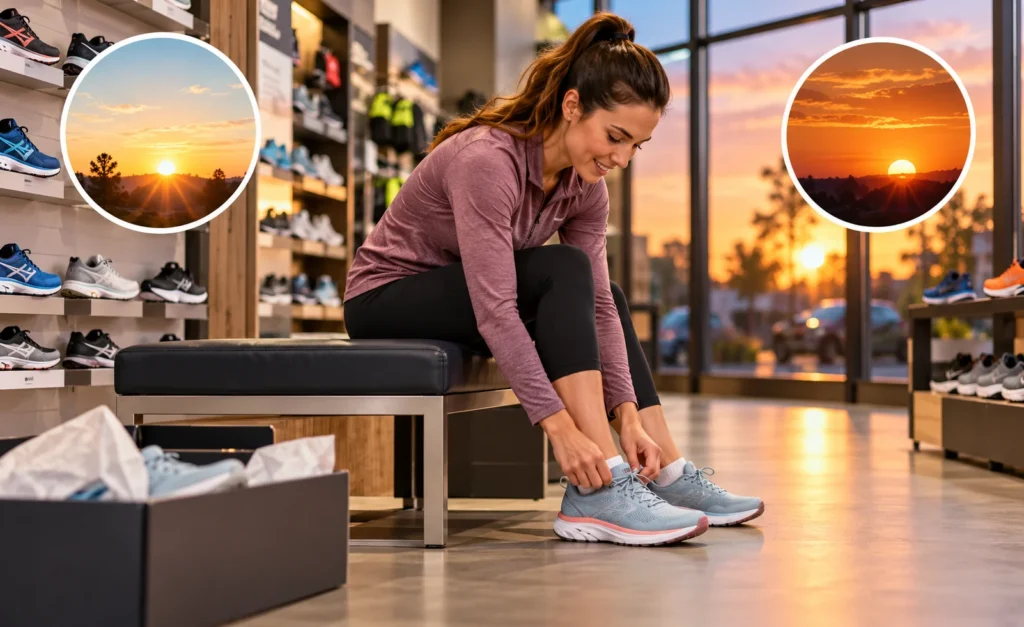
Late afternoon or evening is generally the best time to try running shoes. Feet often become slightly larger during the day because of fluid accumulation and prolonged activity.
The important factor is your foot’s condition, not the number on the clock. Someone who works overnight might need a different fitting schedule from someone who works standard daytime hours.
Why Is Late Afternoon a Good Choice?
Normal walking, standing, and daily activity can increase foot volume. Trying shoes after these activities may reveal tightness that you wouldn’t notice earlier.
This matters because a shoe’s upper and toe box have limited space. Even a small change in foot volume can alter how the shoe feels.
- Length: A little extra room helps prevent toes from pressing against the front.
- Width: Increased forefoot volume can reveal shoes that feel narrow.
- Midfoot: Laces may feel tighter as your feet expand.
- Comfort: Later fitting can expose pressure points before you buy.
Mayo Clinic Health System recommends shopping late in the day or evening because feet commonly swell throughout the day.
You can read its expert running shoe fitting advice for more guidance.
Is Evening Better Than Afternoon?
Evening can be particularly useful if your feet become noticeably fuller after a long day. However, late afternoon is often sufficient for runners who have already been active.
There is no universal best hour for everyone. Your goal is to test shoes when your feet resemble their typical size during running.
Why Do Your Feet Change Size Throughout the Day?
Your feet can change volume because of gravity, fluid movement, temperature, and physical activity. This daily change is one reason shoe sizing should account for more than foot length alone.
Foot swelling is not identical for everyone. Your schedule, activity level, and individual health can influence how much your feet change.
How Does Standing and Walking Affect Shoe Fit?
Spending hours upright can contribute to fluid accumulation in your feet and ankles. The extra volume may make tight footwear feel more restrictive.
I suggest checking the widest part of your forefoot during fitting. That area is often where an otherwise comfortable shoe begins to feel too snug.
Does Running Make Your Feet Swell?
Running can temporarily change foot volume because of exercise-related circulation, movement, and prolonged loading. The amount varies with the individual and the workout.
Long-distance runners may notice that shoes feel different near the end of a run. That’s why a brief fitting test should consider your typical training conditions.
- Workout duration: Longer activity gives fit issues more time to become noticeable.
- Weather: Warm conditions may increase the feeling of tightness.
- Footwear: Socks and insoles affect available shoe volume.
- Lacing: Tight laces can create extra pressure across the midfoot.
The American Orthopaedic Foot & Ankle Society’s athletic shoe selection guide recommends trying shoes after exercise or later in the day.
Morning vs. Afternoon vs. Evening: Which Is Best?
All three times can work, but they represent different fitting conditions. Late-day shopping generally offers the best opportunity to detect shoes that become uncomfortable as your feet expand.
| Time of Day | Typical Foot Condition | Fitting Benefit | Recommendation |
|---|---|---|---|
| Morning, 7–11 a.m. | Often less accumulated swelling | Useful baseline measurement | Acceptable with careful fit testing |
| Afternoon, 12–5 p.m. | May reflect several hours of activity | Can reveal developing tightness | Good choice |
| Evening, 5–9 p.m. | May reflect greater daily foot volume | Helps identify pressure points | Usually preferred |
These clock ranges are illustrative, not scientifically established fitting windows. The best schedule depends on when you wake, work, and exercise.
If you normally run before sunrise, a morning fitting can still be useful. Just make sure the shoes leave enough room for movement and possible later swelling.
How Should You Try Running Shoes for the Best Fit?
A reliable fitting session checks length, width, heel security, and comfort while moving. Standing still in front of a mirror cannot tell you everything about running shoe fit.
Use the following process whenever you visit a running store.
Step 1: Choose the Right Fitting Time
Visit after a normal active part of your day. If possible, avoid choosing shoes immediately after waking when your feet may be less swollen.
Don’t deliberately exhaust yourself or force swelling before shopping. Ordinary daily activity is enough for a useful fitting session.
Step 2: Bring Your Regular Running Socks
Sock thickness changes the space available inside a shoe. Thin socks and thick cushioned socks can produce noticeably different fits.
Wear the socks you use during normal training. Bring your usual insoles or orthotics if you rely on them.
Step 3: Measure Both Feet While Standing
Both feet should be measured for length and width. Many people have one foot that is slightly larger than the other.
Use the larger foot as your main fitting reference. A store employee can help you compare sizes if necessary.
- Stand with weight on both feet during measurement.
- Measure from your heel to your longest toe.
- Check the widest part of each forefoot.
- Compare the results with the brand’s current size chart.
- Try the actual shoe rather than relying only on the printed size.
For additional advice, read our complete running shoe buying guide.
Step 4: Check the Space Around Your Toes
A common starting point is approximately one thumb-width between your longest toe and the front of the shoe. Your toes should also spread without pressing painfully against the upper.
Check this clearance while standing. Remember that your second toe might be longer than your big toe.
- Too little space: Toes touch or strike the front.
- Suitable space: Toes move freely without excessive sliding.
- Too much space: Your foot may move forward inside the shoe.
- Incorrect width: The shoe squeezes your forefoot despite sufficient length.
Our running shoe toe room guide explains how to check front clearance in more detail.
Step 5: Test Heel and Midfoot Security
Your heel should remain reasonably secure when you walk or jog. A little movement may occur, but repeated slipping or rubbing is a warning sign.
The middle of the shoe should feel comfortably held. Avoid tightening your laces so aggressively that they create numbness or pressure.
Step 6: Walk and Jog Before Buying
A short movement test can expose issues that standing still doesn’t reveal. Walk naturally, turn, and jog briefly if the retailer provides a suitable test area.
Pay attention to how your toes, arches, and heels feel. Don’t ignore discomfort simply because a shoe looks attractive.
- Walk for a minute or two.
- Jog at a comfortable pace when permitted.
- Notice any slipping around the heel.
- Check whether your toes hit the front.
- Look for rubbing around seams or the collar.
- Compare another size or width if needed.
Comfort should be present during the initial fitting. Don’t depend on an uncomfortable shoe becoming suitable after several weeks.
Should You Try Running Shoes Before or After a Workout?
Trying running shoes after a normal workout can be useful because your feet may better reflect their exercise-related volume. However, you should still check fit carefully and avoid judging it solely by temporary fatigue.
The right choice depends on your schedule and the workout’s intensity.
Benefits of Trying Shoes After Running
A post-run fitting may help identify tightness across the toes and forefoot. This can be useful for runners preparing for longer training sessions.
- Your feet may resemble their condition during exercise.
- Tight shoe uppers may become easier to identify.
- You can assess room for normal foot expansion.
- You may notice whether your current socks affect the fit.
When Should You Avoid a Post-Workout Fitting?
A demanding workout can produce temporary soreness, irritation, or unusual swelling. These conditions may make it harder to judge everyday comfort.
If your feet are painful or unusually swollen, choose another day. Persistent or unexplained swelling deserves assessment by a healthcare professional rather than a larger shoe size alone.
How Much Extra Room Do Running Shoes Need?
Running shoes generally need enough front clearance for your toes to move during exercise. A thumb-width is a practical starting point, but the ideal fit also depends on width and heel security.
Buying a larger numerical size is not always the answer. Some runners need a wider version of the same length instead.
Should Running Shoes Be Half a Size Bigger?
Some runners wear a half-size larger in running shoes than in casual footwear. However, this is not a universal rule.
Start with your measured foot length and the brand’s sizing chart. Compare neighboring sizes in person instead of automatically sizing up.
Why Does Running Shoe Width Matter?
A shoe can have adequate toe clearance and still squeeze the sides of your feet. That means the width or shape may be wrong.
Try a wide-width option when your forefoot feels compressed. Learn more in our running shoe width guide.
Can You Try Running Shoes in the Morning?
Yes. Morning fittings can work when you evaluate toe room, width, and the way the shoes feel during movement.
The disadvantage is that your feet may be less swollen than they become later in the day. That could make a slightly tight pair seem comfortable initially.
How to Make Morning Shoe Shopping More Accurate
- Measure both feet while standing.
- Wear your normal running socks.
- Allow appropriate toe clearance.
- Avoid buying shoes that already feel tight.
- Test both shoes while walking and jogging.
- Check the retailer’s exchange or return policy.
If you’re between two sizes, compare both carefully. Choose based on the full fit rather than the assumption that bigger always means better.
What Mistakes Should You Avoid When Trying Running Shoes?
The biggest fitting mistakes involve ignoring width, choosing shoes that feel tight, and relying entirely on size labels. The time of day matters, but these mistakes can still ruin an evening fitting.
Seven Common Shoe Fitting Mistakes
- Shopping only by size: Different brands and models can fit differently.
- Ignoring foot swelling: A shoe that feels snug early may become uncomfortable later.
- Wearing unfamiliar socks: Your fitting should resemble your normal running setup.
- Skipping the larger foot: Always check both shoes.
- Ignoring shoe width: Extra length cannot reliably fix a narrow toe box.
- Expecting shoes to stretch: Significant pressure is a reason to try another fit.
- Skipping the movement test: Walk or jog before making the final decision.
Should You Buy Running Shoes That Feel Tight?
No. Running shoes should feel comfortable from the beginning without painful pressure, numbness, or restricted toes.
Materials may soften slightly with use, but a poor initial fit is unlikely to become reliably comfortable. Try another width, size, or shoe shape.
The Johns Hopkins Medicine shoe fitting and lacing guide provides further advice about toe room and heel fit.
How Do You Choose the Right Time When Buying Running Shoes Online?
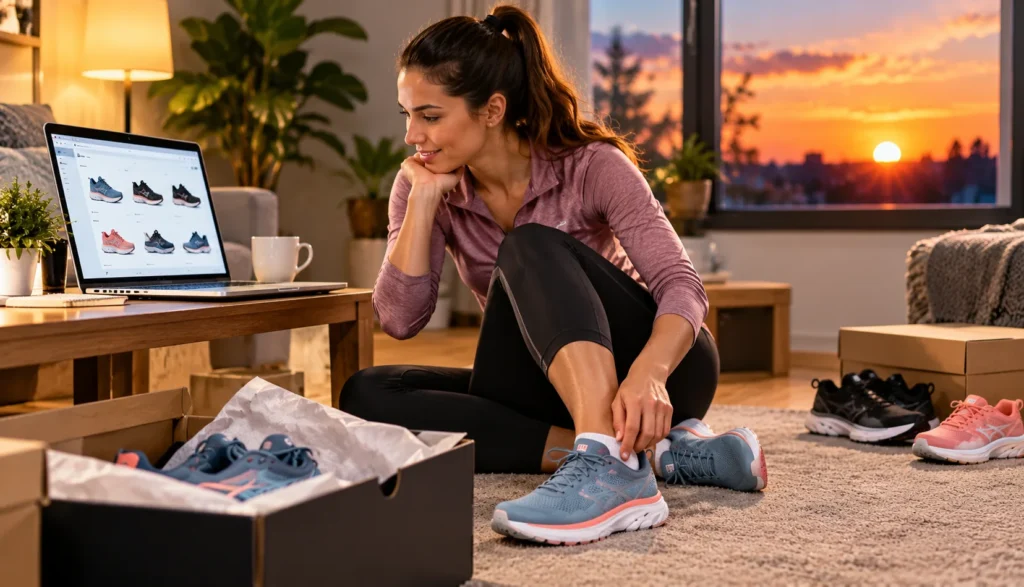
You can apply the same late-day fitting principle at home. Try delivered shoes during a typical active period and test them indoors before removing labels or using them outside.
Always follow the retailer’s specific return conditions.
Online Running Shoe Fitting Checklist
- Measure both feet later in your active day.
- Compare measurements against the manufacturer’s size chart.
- Read the model’s width and fit information.
- Order from a retailer with clear return terms.
- Try both shoes while wearing running socks.
- Walk on a clean indoor surface.
- Reject the pair if you notice pinching or excessive slipping.
I recommend checking the shoe’s actual fit before committing to it. Measurements and reviews help narrow your options, but they cannot replace a fitting test.
Which Running Shoes Are Worth Considering for a Better Fit?
When comparing running shoes, I would prioritize models available in different widths and shapes. Two useful examples are the Brooks Ghost 17 and Brooks Ghost Max 3.
These are shopping candidates, not a substitute for trying shoes on your own feet. The fit assessments below are editorial considerations rather than hands-on test scores.
🏆 Everyday Training
Brooks Ghost 17
Editorial fit consideration: 4.5/5
A neutral road-running shoe with DNA LOFT v3 cushioning and a 10 mm heel-to-toe drop. I would shortlist it for everyday training, especially when comparing standard and wide fits.
👟 Cushioned Alternative
Brooks Ghost Max 3
Editorial fit consideration: 4.3/5
A cushioned road-running option with a broad platform and rocker-style geometry. I would compare it with conventional daily trainers to see which underfoot feel and upper shape work better.
Affiliate disclosure: As an Amazon Associate, this website may earn from qualifying purchases. The editorial scores describe suitability for comparison, not verified customer ratings or independent wear-test results. Prices and availability vary.
Frequently Asked Questions
Is it better to buy running shoes in the morning or evening?
Evening is generally better because your feet may be larger after daily activity. This makes it easier to identify shoes that become too tight.
Morning shopping can still work if you check toe clearance, width, and heel security carefully.
What time should I try on running shoes?
Late afternoon or evening is a useful starting point, especially after several hours of activity. There isn’t a medically established best clock hour.
Choose the time when your feet most closely reflect their typical condition during running.
Should I try running shoes after a long run?
Trying shoes after a normal run can help you assess fit when your feet have expanded. However, an exhausting workout may cause temporary soreness or unusual swelling.
If your feet feel irritated or painful, postpone the fitting until they recover.
How tight should running shoes feel when trying them on?
Running shoes should hold the heel and midfoot securely without squeezing. Your toes should move freely, with approximately a thumb-width of clearance beyond the longest toe.
Persistent pressure, numbness, or significant heel slipping suggests that you should try another size or model.
Can the time of day change your running shoe size?
The time of day can change your foot volume and how shoes fit, but it doesn’t always require a different numbered size. Some people notice little difference, while others experience more noticeable swelling.
Measure both feet, compare widths, and judge the actual fit rather than assuming a fixed size increase.
Final Takeaway: When Should You Shop for Running Shoes?
The best time of day to try running shoes is usually late afternoon or evening. By then, your feet may better reflect the volume they reach during regular activity.
Still, timing is only one part of a reliable fitting process. Proper length, comfortable width, secure heels, and a movement test matter just as much.
Before purchasing your next pair, wear your regular running socks, measure both feet, and compare different fits. Choose the shoe that feels comfortable while moving, not simply the one with the most appealing design.


Steven is a former sportsperson and now a full-time businessman and research writer. He is the mastermind of this site, and he created this site to help people who need specialized shoes for different activities. When he was a sportsperson, he was very passionate about different types of shoes for his sports purpose. The passion he had for shoes at that time now turned into his profession. Besides his shoe business, he loves sharing his knowledge and experience with people and helping them maintain healthy feet.
More Posts