Quick Answer
A running shoe fitting checklist helps you confirm that new shoes have enough toe space, a comfortable width, and a secure heel before buying. Start with both feet measured, allow roughly one thumb-width beyond your longest toe, and use our running shoe toe room guide to check the front fit correctly.
Six essential fitting steps
- Measure both feet: Use the larger foot when selecting a size.
- Check toe clearance: Leave approximately 12–15 mm of space at the front.
- Test forefoot width: Your toes should spread without painful pressure.
- Secure the heel: Check for excessive lifting while walking or jogging.
- Assess midfoot comfort: The shoe should hold your foot without squeezing.
- Move before buying: Walk, jog, and check for rubbing or unusual pressure.
Before making your decision
- Use running socks: Wear the same type you plan to train in.
- Check immediate comfort: Do not depend on a break-in period to fix painful pressure.
Finding the right running shoes involves more than choosing your usual size. A shoe can look perfect and still pinch your toes or allow your heel to slip.
I recommend checking fit systematically instead of trusting size labels alone. This guide explains twelve practical checks, common fitting mistakes, and how to test shoes before committing.
What Is a Running Shoe Fitting Checklist?
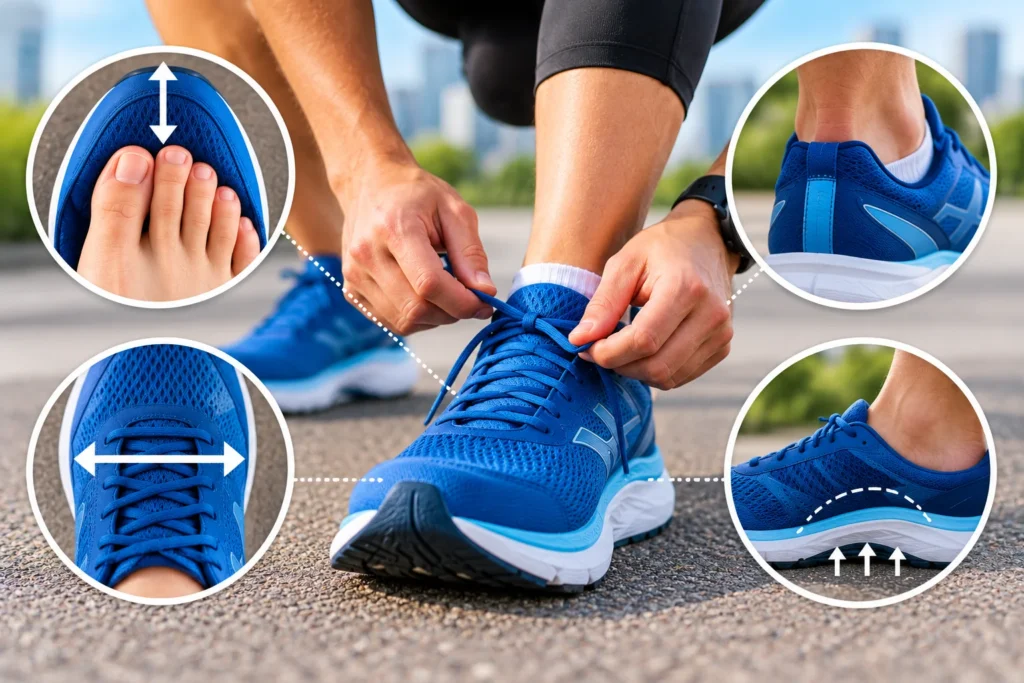
A running shoe fitting checklist is a step-by-step method for evaluating shoe length, width, heel security, support, and comfort. It helps you identify fit problems before they become frustrating during regular runs.
Running shoes must accommodate repeated movement and changes in foot volume. That makes the correct fit different from simply finding shoes that feel comfortable while sitting.
What Should a Proper Running Shoe Fit Feel Like?
A correctly fitted running shoe should hold your foot securely without restricting natural movement. Your toes need room, while your heel and midfoot should feel supported.
- Length: Your longest toe has room to move forward without hitting the shoe.
- Width: Your forefoot fits without uncomfortable squeezing.
- Heel: The rear of your foot remains reasonably secure.
- Midfoot: The upper holds your foot without excessive lace pressure.
- Comfort: Walking and jogging do not create immediate pain or rubbing.
The REI running shoe fitting guide also emphasizes proper toe space and a secure heel.
What Should You Do Before Fitting Running Shoes?
Prepare for the fitting session before you start comparing shoe models. Small changes in socks, foot measurements, and timing can affect your final decision.
Measure Both Feet While Standing
Measure your feet with your weight evenly distributed. Standing measurements better represent your foot dimensions under load than measurements taken while sitting.
- Place a sheet of paper against a wall on a firm floor.
- Stand with your heel lightly touching the wall.
- Mark the position of your longest toe.
- Measure the distance from the wall to the mark.
- Repeat the process for your other foot.
- Compare the longer measurement with the brand’s official size chart.
If your feet differ in length, start with the larger foot. Then check that the smaller foot remains secure inside its shoe.
Bring Your Running Socks and Orthotics
Wear the socks you use for regular training. Sock thickness can change the space available around your toes and midfoot.
Bring your regular orthotic inserts if you wear them while running. Their shape and thickness can influence shoe volume and heel position.
Try Shoes Later in the Day
Feet can become larger after hours of standing or physical activity. Trying shoes later in the day may provide a more realistic fit assessment.
The American Academy of Orthopaedic Surgeons recommends fitting athletic shoes near the end of the day or after exercise.
What Is the Complete 12-Point Running Shoe Fitting Checklist?
Use these twelve checks when trying on running shoes in a store or evaluating a new pair at home. Work through every step before deciding whether the shoes fit.
- Confirm your measured size. Start with the size suggested by the manufacturer’s foot-length chart, not your casual shoe label.
- Fit your larger foot. Check that neither shoe feels cramped, even when your feet differ slightly in size.
- Check your longest toe. Leave approximately one thumb-width between that toe and the front of the shoe.
- Wiggle every toe. Make sure your toes can move without pressing painfully against the upper.
- Inspect forefoot width. Look for squeezing near the little toe or the ball of your foot.
- Check upper volume. Confirm that the material above your foot does not create excessive downward pressure.
- Secure your heel. Walk and check whether your heel lifts excessively.
- Assess midfoot hold. Your foot should stay centered without requiring unusually tight laces.
- Notice arch pressure. Avoid pronounced discomfort from the insole or support structure.
- Walk naturally. Take several steps and notice any rubbing, awkward movement, or pressure points.
- Jog briefly. If permitted and safe, test the shoes at your normal running pace.
- Recheck comfort. Remove the shoes and consider whether either foot developed irritation or pressure.
My practical rule is simple: a shoe needs to pass the complete fitting test. One impressive feature cannot compensate for an uncomfortable shape.
How Much Toe Room Should Running Shoes Have?
Most runners should aim for approximately one thumb-width of space beyond their longest toe. This is commonly around 12–15 mm, although individual thumb widths vary.
Measure from whichever toe extends farthest forward. For some people, the second toe is longer than the big toe.
How Can You Check Toe Clearance?
- Put on both shoes and tighten the laces normally.
- Stand upright with your weight distributed naturally.
- Locate your longest toe inside the shoe.
- Gently press the upper to estimate the space ahead of it.
- Walk forward and check whether your toes contact the front.
Toe clearance matters during longer runs and downhill sections, when your foot can move forward. Repeated contact may lead to painful toenails or other irritation.
The NHS athletic footwear guidance also recommends approximately one thumb-width of front clearance.
How Should Running Shoes Fit Around the Width and Heel?
The correct length does not guarantee the correct width. A shoe may leave plenty of toe space while squeezing the sides of your forefoot.
Running Shoe Width
Your forefoot should rest comfortably inside the shoe without painful pressure. The upper should accommodate your foot rather than forcing it into a narrower shape.
Common adult US width labels vary between men’s and women’s sizing. The following table shows standard width categories.
| Width Category | Men’s US | Women’s US |
|---|---|---|
| Narrow | B | 2A |
| Standard | D | B |
| Wide | 2E | D |
| Extra Wide | 4E | 2E |
These labels describe width categories, not identical measurements across brands. The Brooks width guide explains the common sizing system.
If you’re comparing footwear across categories, our women’s to men’s running shoe size chart explains the length and width differences.
Heel and Midfoot Fit
Your heel should feel secure without painful pressure around the back of your ankle. Some minor movement can occur, but repeated slipping is a warning sign.
The midfoot should feel gently supported. You should not need to pull the laces extremely tight to stop your foot from sliding.
- Good heel fit: Minimal unwanted lifting during normal movement.
- Poor heel fit: Repeated rubbing, excessive lifting, or a loose rearfoot.
- Good midfoot fit: Comfortable hold without numbness or pinching.
- Poor midfoot fit: Excessive pressure from the upper or laces.
How Is Running Shoe Fit Different From Casual Shoe Fit?
Running shoes must accommodate repetitive movement and varying foot volume. Casual footwear may not experience the same repeated forward motion.
| Fit Factor | Running Shoes | Casual Shoes |
|---|---|---|
| Toe clearance | About one thumb-width | Depends on shoe design |
| Heel security | Important during repeated strides | Depends on activity and style |
| Width | Must allow comfortable forefoot movement | Should also avoid squeezing |
| Testing | Walk and jog if possible | Usually assessed through walking |
This does not mean running shoes always require a larger numerical size. Choose the size that meets the actual fitting criteria instead.
How Do You Test Running Shoes Before Buying?
A short movement test can reveal problems that remain hidden while standing still. You should assess the shoes using movements similar to your normal training.
Try This Five-Minute Fitting Routine
- Minute 1: Stand naturally and check toe space, width, and upper pressure.
- Minute 2: Walk at a normal pace and notice heel movement.
- Minute 3: Walk more quickly and assess midfoot security.
- Minute 4: Jog briefly if the store and surroundings allow it.
- Minute 5: Stand again and reassess discomfort, rubbing, or slipping.
Five minutes is a useful screening routine, not a guarantee of long-run comfort. Follow the seller’s return policy and test new footwear indoors before outdoor use when appropriate.
Should You Test Shoes on an Incline?
A gentle incline can help reveal forward sliding and heel movement. Use a safe surface and stop if the shoes feel unstable.
Downhill-oriented testing is particularly relevant for trail runners. Your toes should not repeatedly collide with the front of the shoe.
What Are the Signs That Running Shoes Do Not Fit?
Persistent pinching, rubbing, or unwanted movement suggests that a shoe may not match your foot. Avoid assuming discomfort will disappear after repeated use.
Common Fit Problems and Their First Checks
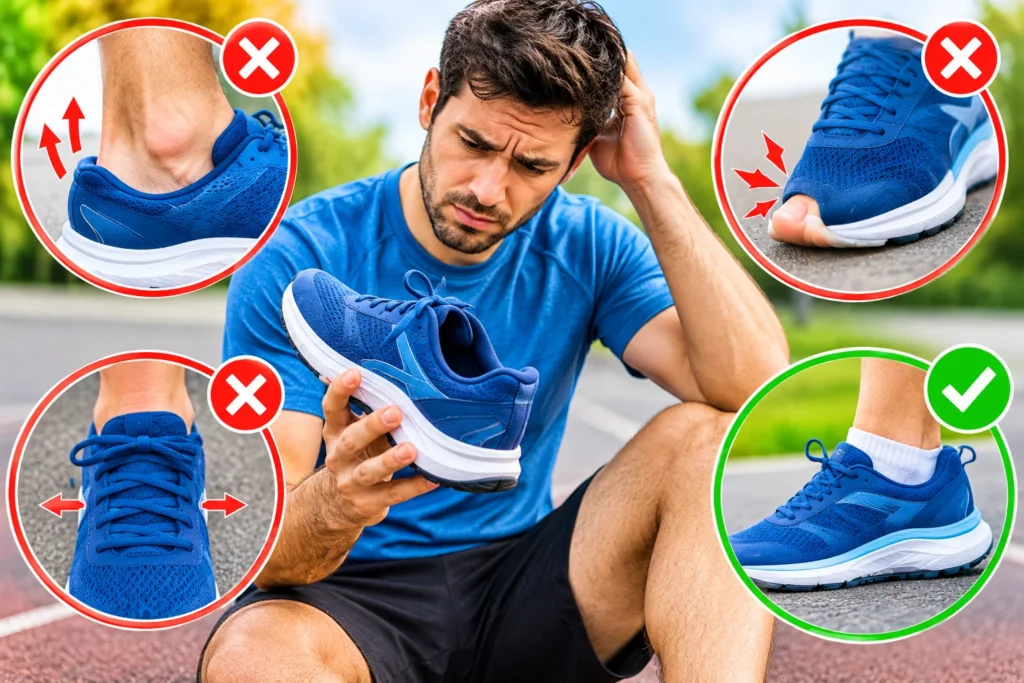
- Toes hit the front: Recheck length and front clearance.
- Little toe feels squeezed: Consider a wider or differently shaped toe box.
- Heel keeps slipping: Check lacing and heel-cup shape.
- Top of foot feels tight: Assess shoe volume and lace pressure.
- Arch feels painfully pressed: Try a different insole or shoe design.
- Feet slide sideways: Check whether the shoe is too wide or loose.
- Toes become numb: Stop and investigate tightness or pressure.
The Northwestern Medicine fitting advice recommends shoes that feel comfortable immediately, with sufficient front clearance and a secure heel.
Persistent pain, numbness, or recurring foot problems deserve assessment by a qualified healthcare professional. Shoe fitting alone cannot diagnose the underlying cause.
Can Different Lacing Techniques Improve Running Shoe Fit?
Yes, lacing changes can improve fit when a shoe is already close to the correct shape. However, lacing cannot reliably correct insufficient length or a fundamentally narrow toe box.
Which Lacing Method Should You Try?
- Runner’s loop: Uses the upper eyelets to improve heel hold.
- Window lacing: Reduces lace pressure over a sensitive area on top of the foot.
- Looser forefoot lacing: May ease mild pressure across the front of the upper.
- Even crisscross lacing: Provides a straightforward starting point for consistent midfoot hold.
After adjusting the laces, repeat the walking and jogging tests. Stop tightening when pressure becomes uncomfortable.
Should You Choose Neutral or Stability Running Shoes?
Both neutral and stability running shoes can fit comfortably when their shape suits your foot. Their main difference involves how the shoe guides or accommodates movement.
Neutral shoes generally avoid dedicated motion-control features. Stability shoes include structures intended to provide additional movement guidance.
- Choose by comfort: Compare how different shoes feel during movement.
- Check arch pressure: Added support should not create painful contact.
- Assess control: Notice whether the shoe feels secure during your normal stride.
- Avoid assumptions: Arch height alone does not identify one guaranteed best shoe.
For a more detailed breakdown, read our neutral vs stability running shoes comparison.
How Do You Fit Running Shoes When Shopping Online?
Online buying makes accurate measurements and return policies especially important. A correct size label still cannot guarantee that the shoe’s shape matches your foot.
Online Running Shoe Fitting Checklist
- Measure both feet and record the longer measurement.
- Read the manufacturer’s size chart for the specific model.
- Check whether narrow, standard, or wide options are available.
- Read model-specific feedback about toe-box shape and heel hold.
- Review the seller’s return and exchange conditions.
- Try the shoes indoors before removing tags or wearing them outside.
For example, imagine one foot measures 26.4 cm and the other measures 26.7 cm. Start by comparing 26.7 cm with the brand’s foot-length guide, then test the actual fit.
I would not buy an unfamiliar model solely because another shoe from the same brand fits well. Different models can use different shapes and upper constructions.
What Running Shoe Fitting Mistakes Should You Avoid?
The biggest fitting mistakes often involve relying too heavily on shoe size or appearance. A better approach is to evaluate the complete fit before considering color or price.
- Buying only by size: Different brands can fit differently despite identical labels.
- Ignoring width: A longer shoe is not always the solution to forefoot squeezing.
- Testing only one foot: Your feet may differ in length or shape.
- Skipping movement tests: Standing comfort does not reveal every running issue.
- Overtightening laces: Excessive pressure can create numbness or discomfort.
- Expecting major stretching: Do not depend on future material changes to correct an unsuitable fit.
- Prioritizing appearance: Attractive shoes are still unsuitable when they cause pain.
- Ignoring running purpose: Choose footwear suited to your usual training surface.
If you’re still deciding what type of shoe to buy, our complete running shoe buying guide explains the main selection criteria.
Which Running Shoes Are Worth Considering for a Good Fit in 2026?
The following models provide useful starting points for comparing different types of fit and support. None is guaranteed to suit every runner.
I would shortlist them based on their construction, available widths, and intended use. The stars below are editorial shortlist assessments, not personal wear-test results or aggregated customer ratings.
🏆 Best all-around fit starting point
Brooks Ghost 18
★★★★☆ Editorial shortlist: 4/5
A neutral daily trainer with balanced cushioning and multiple width options. I consider it a useful first model to compare when looking for a dependable road-running fit, provided the heel and toe box suit your feet.
👟 Best alternative daily trainer
ASICS Gel-Cumulus 28
★★★★☆ Editorial shortlist: 4/5
A neutral road-running shoe with cushioned construction and standard or wider fit options in selected markets. I would compare its upper volume and forefoot shape against the Ghost before choosing.
🛡️ Best for structured support
Brooks Adrenaline GTS 26
★★★★☆ Editorial shortlist: 4/5
This support-focused daily trainer uses Brooks GuideRails technology and offers several width categories. I would compare it with neutral options when additional guidance feels more comfortable, while checking availability in your size.
Affiliate disclosure: As an Amazon Associate, we earn from qualifying purchases at no additional cost to you.
Frequently Asked Questions About Running Shoe Fitting
How tight should running shoes feel?
Running shoes should feel comfortably secure around your heel and midfoot without squeezing your feet. Your toes should have enough room to move naturally. Excessive tightness, numbness, or painful pressure suggests that the shoe may not fit correctly.
Should running shoes be half a size bigger?
Not necessarily. Some runners choose a half-size larger than their casual shoes, but this is not a universal rule. Check your measured foot length, toe clearance, width, and heel security before changing sizes.
How do I know if my running shoes are too wide?
Running shoes may be too wide when your feet slide sideways, the upper feels excessively loose, or your heels repeatedly lift. Try adjusting the laces and comparing a narrower option. Length and width should be assessed separately.
Can I buy running shoes without trying them on?
Yes, but buying without a fitting session increases uncertainty. Measure your feet, check the brand’s size chart, review width options, and choose a seller with a suitable return policy. Test the shoes indoors before wearing them for regular running.
Should running shoes feel comfortable immediately?
Yes. Running shoes should feel comfortable during the first fitting session, without painful pinching or significant rubbing. Small changes in familiarity can occur, but you should not expect a break-in period to correct an unsuitable shoe shape.
Final Takeaway: Use the Checklist Before Every Purchase
The best running shoe fit combines comfortable toe clearance, appropriate width, secure heel positioning, and natural movement. No single size number or brand can guarantee those qualities.
I recommend repeating the checklist whenever you change shoe models or notice that your current footwear no longer fits properly. Small fitting checks can prevent costly buying mistakes.
Once you identify a comfortable fit, explore our guide to choosing running shoes for daily training to match your footwear with your regular workouts.


Steven is a former sportsperson and now a full-time businessman and research writer. He is the mastermind of this site, and he created this site to help people who need specialized shoes for different activities. When he was a sportsperson, he was very passionate about different types of shoes for his sports purpose. The passion he had for shoes at that time now turned into his profession. Besides his shoe business, he loves sharing his knowledge and experience with people and helping them maintain healthy feet.
More Posts