

Quick Answer
The Brooks Caldera 8 is the better new purchase for long trail runs when fit matters most. Its updated upper adds a more refined hold, while the Caldera 7 offers nearly the same cushioning and grip for less. Keep a well-fitting Caldera 7; choose the Caldera 8 for a fresh pair.
What really changed between the Caldera 8 and Caldera 7?
- Both models have a stated 6 mm drop and 10.6 oz men’s weight.
- The Caldera 8 has revised quick-dry mesh and an updated lacing layout.
- The Caldera 7 remains the better deal when its fit works for you.
Quick Verdict: Brooks Caldera 8 vs 7
BROOKS CALDERA 8
Editorial choice for a new pair
$119.95
Observed Brooks US listing; Amazon price varies
Best for: Trail runners wanting revised upper comfort and secure long-run fit.
BROOKS CALDERA 7
Best value if your size is available
$99.95
Observed Brooks US listing; Amazon price varies
Best for: Budget-conscious runners who already like the Caldera 7 fit.
| Category | Caldera 8 | Caldera 7 |
|---|---|---|
| Overall new-pair pick | 🏆 | — |
| Best sale value | — | ✅ |
| Updated upper | ✅ | — |
| Underfoot cushioning | ✅ | ✅ |
| Versatile trail grip | ✅ | ✅ |
Bottom line: Choose the Caldera 8 when buying new for its improved upper; pick the Caldera 7 when the fit is right and the discount is meaningful.
- Caldera 8 gets the nod for its revised quick-drying mesh and fit updates.
- Observed Brooks listings showed a $20 gap: $119.95 versus $99.95.
- Both models suit long, steady trail runs and extended time on your feet.
- Caldera 7 gives budget buyers the same stated 6 mm drop and 10.6 oz weight.
- Underfoot changes are small; choosing the right upper fit matters more.
Buying a trail shoe for long runs can feel harder than it should. You want soft landings, steady footing, and enough room for tired feet. The Brooks Caldera 8 promises all three. But its older sibling, the Brooks Caldera 7, looks almost the same beneath the foot.
I’m Steven Tyler, writing for FootwearHiker. I compare published shoe specifications with independent lab tests and trail reviews. This review does not claim that I personally ran in either pair. Instead, it shows what the available evidence means for your next purchase.
The main question is simple: does the new upper earn its price? We’ll look at cushioning, grip, fit, stability, durability, and the small details that matter late in a run. We’ll also cover wet trails, cold mornings, long hikes, and what happens when a shoe feels good in the store but rubs after ten miles.
If you already own the Caldera 7, there is no need to replace a sound pair just to get a new model number. If you’re shopping for your first Caldera, fit and current pricing should guide the decision.
What Is the Brooks Caldera 8 Designed to Do?
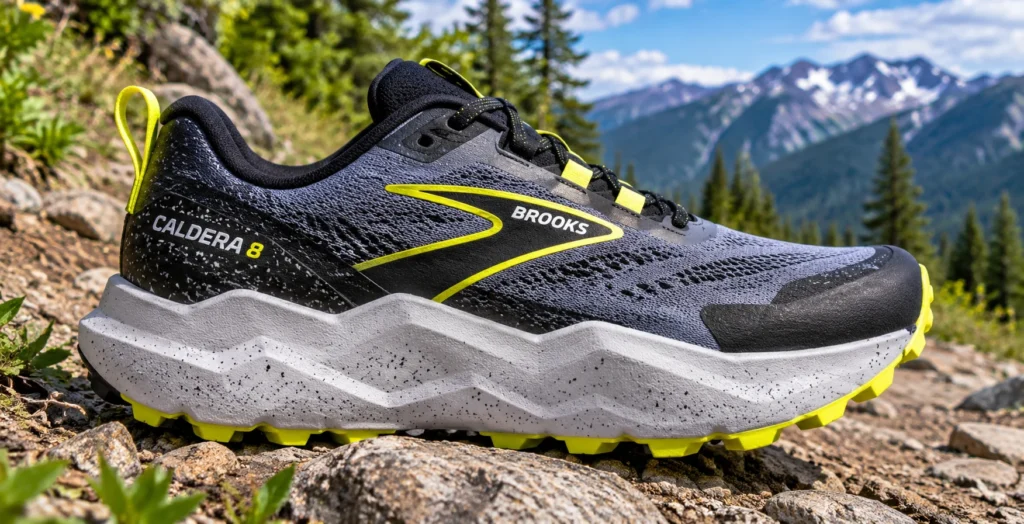
In short, the Brooks Caldera 8 is built for long trail runs, not speed sessions. It pairs a large dose of nitrogen-infused DNA LOFT v3 foam with a broad, stable base. Brooks lists it for ultra-distance outings, including trail events of 50 kilometers or more. The result is a protective ride made for steady effort.
Its raised midsole sidewalls help cradle the foot. Grooves under the shoe let the platform adapt to uneven ground. A quick-dry upper aims to hold the foot without trapping as much water after a stream crossing. Those features suit long dirt paths, rocky park loops, and hiking days.
Quick verdict: The Caldera 8 is a comfort-first trail shoe. Buy it for time on your feet, not race-day speed.
What are the Caldera 8’s main strengths and weaknesses?
Main strengths: Stable landings, long-run cushioning, a protective shape, and a revised upper. The outsole works across many firm trail surfaces. Independent testers also report an easy, rolling stride at moderate speed.
Main weaknesses: The shoe feels bulky beside lighter trail racers. Its short lugs limit deep-mud bite. Some wear-testers reported toe-guard rub or difficulty getting the laces just right. The generous outer shape does not guarantee a roomy inner fit.
Pros
- Comfortable protection for long outings
- Stable and wide underfoot platform
- Durable TrailTack Green grip
- Revised upper dries quickly
Cons
- Not a light race shoe
- Limited grip in deep mud
- Possible toe-cap irritation
- Lacing can require adjustment
Brooks Men’s Caldera 8 Ultra Trail Running Shoe
Original US list price: $150. One observed Brooks colorway was $119.95. Amazon price, sizes, and seller terms must be checked at checkout.
What Does the Brooks Caldera 7 Still Offer?
Essentially, the Caldera 7 delivers the same kind of long-distance trail comfort. It uses nitrogen-infused DNA LOFT v3 cushioning, a broad base, and durable TrailTack Green rubber. Brooks lists a 6 mm drop and a men’s weight of 10.6 oz. The Caldera 8 matches those published figures.
The Caldera 7 has a breathable upper and an external midfoot cage. Its cushioning and outsole remain strong reasons to buy it. For runners whose feet already like this shape, the older pair can be a smart choice. A low sale price matters more when the new model changes only small details.
However, old stock brings a practical risk. Popular sizes and widths disappear first. Check the exact color, size, condition, and return terms before ordering. A cheap shoe becomes poor value when it pinches your toes or slips at the heel.
Where does the Caldera 7 win and lose?
It wins on value when discounted. It also offers familiar cushioning for Caldera fans. Independent comparisons say the new version changes the upper more than the ride, so many runners will feel at home in either model.
It loses on updated fit details. The newer quick-dry mesh and revised lacing are absent. That is a real difference for runners bothered by upper shape, heat, or wet fabric. It is not a reason to switch if the Caldera 7 already fits you well.
Pros
- Strong clearance value
- Long-run cushioning
- Steady platform on trails
- Familiar secure midfoot cage
Cons
- Less refined upper than version 8
- Remaining sizes may be limited
- Still heavy for fast racing
- Not suited to deep mud
Brooks Men’s Caldera 7 Trail Running Shoe
Original US list price: $150. One observed Brooks colorway was $99.95. Check Amazon for the current price and your exact size.
How Do the Brooks Caldera 8 and 7 Specs Compare?
The core specifications are close to identical. Both shoes use DNA LOFT v3 foam, TrailTack Green rubber, a 6 mm stated drop, and a 10.6 oz published men’s weight. The clearest change is the Caldera 8 upper. Brooks also lists a higher share of recycled content in that upper.
One caution matters here. Manufacturer figures are not the same as independent lab measurements. For example, RunRepeat measured the Caldera 8 at 309 grams, slightly above Brooks’ stated 300.5 grams. Those numbers use different samples and methods, so they should not be treated as a design error.
| Specification | Caldera 8 | Caldera 7 | Edge |
|---|---|---|---|
| Use | Ultra-distance trail | Long-distance trail | Tie |
| Midsole | DNA LOFT v3 | DNA LOFT v3 | Tie |
| Stated drop | 6 mm | 6 mm | Tie |
| Stated men’s weight | 10.6 oz / 300.5 g | 10.6 oz / 300.5 g | Tie |
| Outsole | TrailTack Green | TrailTack Green | Tie |
| Upper | Revised quick-dry mesh | Breathable mesh and cage | Caldera 8 |
| Lacing | Updated offset layout | More conventional layout | Fit-dependent |
| Recycled upper materials | 52.9% by weight | 42.1% by weight | Caldera 8 |
| Original US list price | $150 | $150 | Tie |
| Observed Brooks sale price | $119.95 | $99.95 | Caldera 7 |
Sources: Brooks Caldera 8 specifications, Brooks Caldera 7 specifications, and independent Caldera 8 lab tests.
Which Caldera Has Better Cushioning for Long Runs?
Neither model has a major cushioning advantage. Both shoes use Brooks’ nitrogen-infused DNA LOFT v3 foam and a similar tall platform. The Caldera 8 keeps the broad, cradled ride that made the Caldera 7 popular. This matters at mile 20, when steady support can feel more useful than a quick burst of speed.
RunRepeat’s Caldera 8 lab test measured a 36.7 mm heel stack and 27.9 mm forefoot stack. These are lab measurements, not the brand’s claimed figures. It also recorded 129 units of heel shock absorption and 56.9% heel energy return. Those findings suggest decent impact protection without the springy feel of a plated racing shoe.
One useful surprise: more visible foam does not always mean softer landings. Foam mix, geometry, and your body weight change how a shoe feels. The Caldera 8 can feel firm to some runners despite its thick midsole. Try it on the type of trail where you plan to use it.
Does the Caldera 8 feel faster than the Caldera 7?
No clear speed gain is supported by the published design. The foam and platform remain similar. The Caldera 8’s revised upper can feel more secure when cornering, but that is different from a lighter or more responsive ride. Choose either Caldera for endurance comfort, not interval pace.
A runner tackling smooth forest loops for two hours will value a stable landing. Someone chasing a personal best on a short mountain race should compare lighter trail models. The Caldera’s strength lies in how calmly it handles repeated steps over a long day.
Which Has Better Grip on Wet, Rocky, or Muddy Trails?
The Caldera 8 and 7 are effectively tied on outsole design. Both use TrailTack Green rubber with multi-directional lugs. That setup grips packed dirt, gravel, and many rocky surfaces. The Caldera 8 does not bring a new aggressive tread that would transform performance in deep mud.
RunRepeat measured the Caldera 8 lugs at 3.6 mm. This is a practical depth for mixed trails. It does not match the bite of shoes built with taller, more widely spaced mud lugs. Independent field testers also praised the outsole on ordinary wet trails while noting trouble in the muddiest conditions.
Think about the ground under your feet. On damp gravel or dry woodland paths, both models make sense. On steep wet grass, thick clay, or deep slush, neither is the strongest tool. Tire-like tread matters more than a small difference in upper fabric.
Can you use Caldera 8 shoes for hiking?
Yes, the Caldera 8 suits long walks and day hikes on moderate trails. Its cushioned platform can feel welcome on packed paths. The raised sidewalls add a steady sensation when your pace slows. For exposed scrambling or a heavy pack, a more protective hiking shoe can be better.
Our guide to hiking in running shoes explains where trail runners make sense. Match footwear to the route, weather, and load rather than the distance alone. Good cushioning cannot replace sure footing on steep, slippery ground.
Does the Caldera 8 Fit More Securely Than the Caldera 7?
The Caldera 8 is the more refined design, but fit is still personal. Brooks revised the upper with quick-drying mesh and changed the lacing path. These changes aim to improve midfoot hold and comfort. Still, more fabric and extra structure can create pressure for some feet, especially near the toe guard.
Believe in the Run testers liked the updated upper overall. Yet some reported tricky lace tension, a loose-feeling heel, or rubbing at the front. These accounts do not mean every pair fits badly. They show why upper fit deserves more attention than the matching weight and drop figures.
Measure both feet late in the day. Try your normal trail socks, and check for a thumb’s width in front of the longest toe. Walk down an incline if the shop has one. Your toes should not strike the front, and your heel should stay secure without painful lace pressure.
Is the Caldera 8 a good choice for wide feet?
It can work for some broad feet, but do not assume the toe box is wide. The shoe has a wide-looking base, which improves stability. Internal space is a different measurement. RunRepeat describes its fit as medium, and buyer experiences range from roomy to pinching.
Use a running shoe fitting checklist before buying online. Pay attention to the little toe and forefoot. If your foot rubs a hard edge indoors, extra trail miles will not make that pressure more comfortable.
Fit warning: Do not choose a longer size just to solve width pressure. Check a suitable width or another shoe shape first.
Which Caldera Is Better for Stability and Durability?
Both models offer strong platform stability, while the Caldera 8 improves upper materials. A broad midsole can help the foot feel planted on rolling terrain. The raised sidewalls also reduce the sense of sitting high above the shoe. Neither feature guarantees freedom from ankle twists on uneven ground.
For the Caldera 8, RunRepeat measured a 116.6 mm forefoot platform and a 104 mm heel platform. Its lab also found 1.0 mm of outsole wear after a standard abrasion test. That result supports useful rubber durability, not an exact lifespan. Trail rock, walking gait, and runner weight all change wear rates.
Brooks reports that recycled materials make up 52.9% of the Caldera 8 upper by weight. The listed figure for the Caldera 7 is 42.1%. This is a real material difference. It does not prove that either upper will last longer in rocky brush.
Will the Caldera 8 last longer than the Caldera 7?
There is not enough matched long-term evidence to promise a longer lifespan. Both share a similar rubber layout. Inspect the toe fabric, heel lining, midsole feel, and lugs rather than relying on a fixed mileage number. Some runners will wear down an outsole before the foam feels tired; others will do the reverse.
Alternating pairs can also help each shoe dry between wet runs. Our running shoe rotation tips explain how to keep training simple without buying footwear you do not need.
Which Caldera Wins in Real-World Trail Scenarios?
The winner changes with the route and the price, not just the model number. Caldera 8 has the advantage when a new upper fits your foot better. Caldera 7 wins when it delivers the same comfort at a useful discount. Neither shoe is designed for every type of terrain.
For a long, easy trail race, both models can manage steady miles. The quick-dry fabric of the Caldera 8 adds an edge after stream crossings. On a cold gravel loop, the same cushioning and rubber make the Caldera 7 a fair choice. On deep, wet mud, look beyond the Caldera line.
| Use case | Better choice | Why |
|---|---|---|
| 50K trail run on mixed ground | Caldera 8 | Updated fit features for long wear |
| Budget trail training | Caldera 7 | Similar core ride at a lower observed price |
| Repeated stream crossings | Caldera 8 | Revised quick-dry upper |
| Cold, firm winter trails | Fit-dependent tie | Neither is an ice-specific shoe |
| Trail guide’s daily walking routes | Caldera 7 on sale | Comfort and replacement cost matter |
| Deep mud and steep wet grass | Neither | Shorter lugs are not ideal |
Cold-weather runs require one more check. Rubber grip on packed snow does not mean safe traction on ice. If the trail freezes overnight, choose conditions and traction tools appropriate to that route. Do not treat a regular trail shoe as a winter safety device.
Is the Caldera 8 Worth Paying More For?
The Caldera 8 is worth a small premium when its upper fits better. At the time of this review, an observed Brooks US listing showed $119.95 for Caldera 8. Another showed $99.95 for Caldera 7. That $20 difference applies to those listings, not every size or retailer.
Both models launched at a US list price of $150. That makes the Caldera 7’s remaining stock an attractive option when the color and fit work. But a closeout deal without your size is not a bargain. The wrong fit can end a planned run early.
Price also changes quickly on Amazon. Seller choice, width, size, and color can produce different amounts. Check the exact product title, total at checkout, and return rules. For more help, use this running shoe discount guide to compare actual savings.
Here is the practical cutoff: for a modest $20 gap, I favor the new upper if it feels better. For a much larger discount, the Caldera 7 is harder to pass up. Neither option is worth buying when the toe guard rubs or the heel slips.
Who Should Buy the Caldera 8, the Caldera 7, or Neither?
Buy the Caldera 8 if you need a new long-distance trail shoe and like its fit. Its strongest case is comfort on long routes with mixed ground. Buy Caldera 7 if you want much the same base ride for less money. Skip both when you want a light, fast shoe or deep-mud grip.
Buy Caldera 8 if you:
- Run long distances on mixed trails
- Want the revised quick-dry upper
- Prefer comfort over race weight
- Can test the toe and heel fit
Buy Caldera 7 if you:
- Find a real discount in your size
- Already know this upper works
- Want a cushioned training shoe
- Do not need the new lacing layout
Don’t buy either if your usual runs involve deep sticky mud, exposed scrambling, or fast technical racing. A more aggressive trail outsole or a lighter performance shoe may suit that use better. If you need structured ankle protection for heavy backpacking, look at hiking footwear instead.
What Do Real Buyers and Independent Testers Say?
Buyer feedback is positive on comfort, but fit complaints matter. A retailer page carrying Amazon-sourced reviews describes a Caldera 8 buyer who found the shoe roomy and comfortable for daily wear. Another buyer praised traction on wet dirt and leaves yet reported forefoot pinching after two nine-mile trail runs.
Those accounts point to a common lesson. Two runners can wear the same listed size and get opposite results. One foot may settle comfortably into the broad platform while another meets pressure near the toes. Customer reviews do not replace a personal try-on.
Independent reviewers add helpful context. Believe in the Run praised the Caldera 8’s long-trail ride and updated upper. Its testers also noted awkward lace tension, toe-guard rubbing, and bulk. RunRepeat’s lab found medium breathability and a measured 3.6 mm lug depth. These are more useful details than a star rating alone.
Buyer feedback at a glance
- Most useful praise: Comfortable cushioning on walks and long trails.
- Most useful concern: Forefoot pressure or lace fit on certain feet.
- Lab finding: 3.6 mm lugs and 3/5 breathability for Caldera 8.
- Buying lesson: Check fit and traction needs before comparing price.
Sources: Believe in the Run’s field review, RunRepeat’s laboratory review, and retailer-hosted buyer review excerpts. Individual reviews reflect their authors’ experiences, not a verified overall rating.
How Should You Care for Brooks Caldera Trail Shoes?
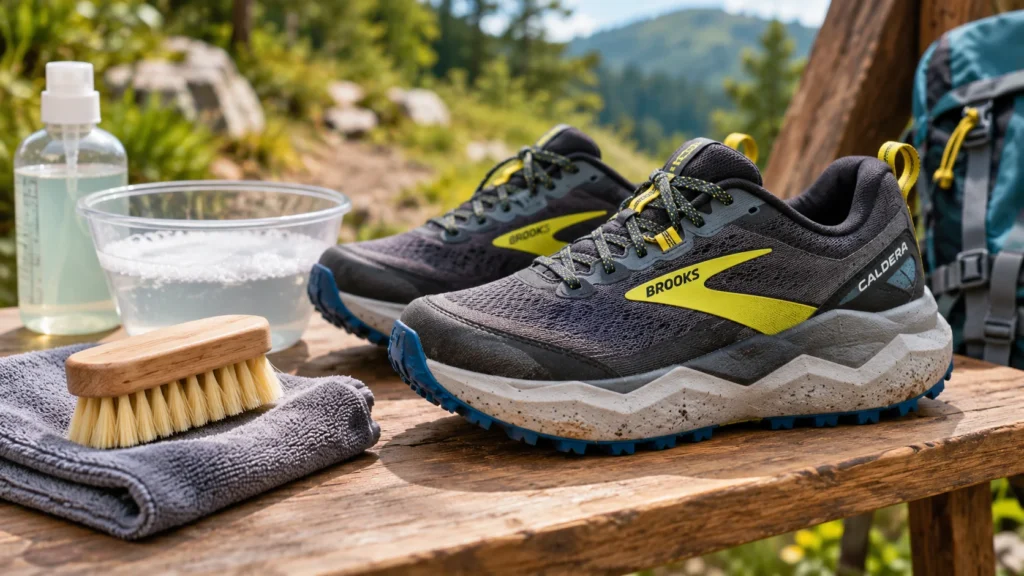
Clean gently, dry slowly, and inspect wear before each long outing. Dirt can pack between the outsole lugs and reduce grip. Brush away loose mud once it dries. For stubborn grime, use cool water and mild soap. Avoid machine washing or harsh detergents that can affect fabric and adhesives.
Remove the insoles and loosen the laces after wet runs. Let the shoes air dry at room temperature. Do not put them beside direct heat or in a tumble dryer. Heat can damage glue, foam, and upper materials. Stuffing the shoes with paper can help absorb some moisture.
Check the toe guard for lifting, especially after repeated contact with rocks. Look for worn heel fabric and flattened lugs. If the shoe starts feeling unstable on a familiar route, inspect it before your next long run. Our guide to replace worn running shoes covers the warning signs in more detail.
How can you make the Caldera 8 last longer?
Use the shoe mainly on trails it was built to handle. Occasional pavement is fine, but regular road miles can wear tread faster than dirt paths. Rotate a second pair if you run often and one pair stays wet. Store the shoes in a cool, dry place out of strong sunlight.
Do not set a strict replacement day based on a number alone. Compare tread depth, upper condition, and underfoot comfort. If a pair no longer feels safe or comfortable, the reduced risk is worth more than squeezing out another week of use.
Final Verdict: Should You Upgrade to the Brooks Caldera 8?
Buy the Brooks Caldera 8 for a new pair, but do not rush to replace a good Caldera 7. The updated upper provides the most useful change. The core foam, stated drop, weight, and outsole design remain close. That makes the Caldera 8 a measured improvement rather than a different kind of shoe.
The Caldera 7 still wins on value when discounted. Both shoes suit steady trail runs, mixed routes, and long walks. Neither is the best tool for steep mud or short, fast racing. More than any chart, your foot’s fit inside the upper should decide the purchase.
My final advice is to compare the exact prices and try on the same size in both models. Walk downhill, check the toe guard, and tighten the laces as you would on a run. A shoe that feels right after that test offers more value than a new name alone.
Frequently Asked Questions
Is the Brooks Caldera 8 worth buying for long trail runs?
Yes. The Brooks Caldera 8 is well suited to long, steady runs on mixed trails. It uses nitrogen-infused DNA LOFT v3 cushioning, a broad base, and a revised upper. It is less suitable for deep mud and fast racing. Check the toe-guard fit before buying.
What is the difference between Brooks Caldera 8 and 7?
The main change is the upper. Brooks gave the Caldera 8 revised quick-dry mesh and an updated lacing layout. Both models retain similar cushioning, rubber, stated weight, and drop. Expect a familiar underfoot feel rather than a major performance jump. Fit is the main reason to switch.
Which is better, Brooks Caldera 8 or Caldera 7?
The Brooks Caldera 8 is my pick for a new pair when both fit well and prices are close. Its updated upper adds useful refinement. The Caldera 7 wins when you can save more and already like its fit. Neither has a clear advantage in core cushioning or outsole design.
Are Brooks Caldera 8 shoes good for walking and hiking?
Yes. The Brooks Caldera 8 can handle long walks and moderate day hikes, especially on dirt, gravel, and mixed paths. Its broad base and cushioned feel suit time on your feet. For heavy packs, slick rock, or steep mud, choose footwear made for those demands.
Does the Brooks Caldera 8 run true to size?
Independent testing describes the Caldera 8 as generally true to size, but foot shape still matters. Some buyers find it roomy, while others report toe pressure. Measure both feet, wear your normal trail socks, and check heel hold. Do not guess based on your road shoe size alone.
Affiliate Disclosure: As an Amazon Associate, I earn from qualifying purchases. If you click a link on this page and make a purchase, I may receive a small commission — at no extra cost to you. I only recommend products I genuinely believe will help you. This helps keep the site free and running. Thank you for your support.


