
Quick Answer
Yes, the Puma Deviate Nitro Elite 3 is a strong race shoe for neutral runners who value speed. Its carbon plate and 204 g lab weight make it agile. At $230, its grip and bounce impress. However, the tapered toe box and narrow heel make it a poor choice for some runners.
Is the Deviate Nitro Elite 3 worth buying?
- Best for fast road races and key workouts.
- Strong grip on wet pavement.
- Less suited to wide feet and runners needing support.
🏆 Our pick: Wet-road racing
Overall*
5K/10K*
Value (editorial)
Stability*
*Overall: RunRepeat 84/100. Other scores: RTINGS, converted to a five-point scale.
Best for: Neutral runners chasing a personal best.
Not ideal for: Wide feet or runners who need a broad heel base.
Price: $230 PUMA list price; Amazon price unverified.
Affiliate link: I may earn a commission on qualifying purchases.
RTINGS test scores on a ten-point scale, not Amazon ratings.
Fast shoes should fit your feet as well as your pace.
I’m Steven Tyler, and this Puma Deviate Nitro Elite 3 review draws on independent lab tests and published road tests. No personal wear testing was performed.
What Is the Puma Deviate Nitro Elite 3 and Who Is It For?
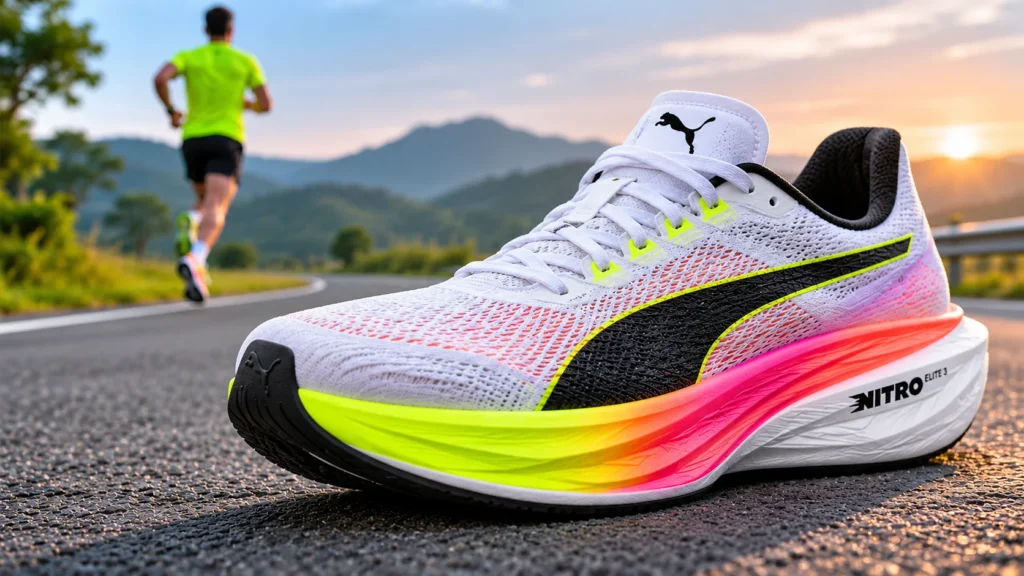
The Deviate Nitro Elite 3 is PUMA’s neutral, carbon-plated road racer. It pairs NITROFOAM ELITE with a PWRPLATE to create a quick ride.
Our guide to carbon-plated running shoes explains the design.
- Prefer quick road races.
- Have neutral foot mechanics.
- Want strong wet-road traction.
- Need a roomy toe box.
- Want a daily mileage shoe.
- Require extra rearfoot stability.
Puma Deviate Nitro Elite 3 Review: Pros and Cons
Speed and traction stand out most. The biggest drawbacks are limited side-to-side support and a thin, vulnerable upper.
- Low 204 g lab weight helps keep strides quick.
- Energy return exceeds the tested category average by 14.8 points.
- Grip coefficient of 0.67 suits damp road race conditions.
- Heel padding earned the maximum lab durability rating of 5/5.
- Stability score of 5.9/10 reveals limited support under fatigue.
- Big-toe width of 69.5 mm can restrict toe spread.
- Toe mesh earned just 1/5 in lab abrasion testing.
- Rubber wear of 1.6 mm exceeds the tested average.
Puma Deviate Nitro Elite 3 Review: Key Features
How much bounce does NITROFOAM ELITE provide?
The foam gives the Elite 3 a lively ride at race pace. RunRepeat’s displayed energy return result is 76.3%, against a 61.5% test average.
RunRepeat dataset, 420 running shoes; bar length represents measured energy return, not a review score.
Takeaway: The foam returns more energy than the average shoe in that lab’s dataset.
The foam uses expanded TPU instead of PEBA. Lab energy return does not predict race time.
Try the foam during a fast finish to a long run.
Does the carbon plate help you run faster?
The curved PWRPLATE gives the Elite 3 a brisk toe-off. RunRepeat measured 18.1 N in its 30-degree bend test.
Takeaway: The plate and foam work together, but neither guarantees a personal best.
Use it for fast intervals rather than slow recovery runs.
Is the PUMAGRIP outsole good in the rain?
Yes. Its 0.67 traction result beats the lab average of 0.53.
RunRepeat dataset, 413 shoes. Bar lengths use the observed maximum of 1.05.
Takeaway: The rubber holds well on wet roads, though it can wear quickly.
Take corners carefully even with good grip.
Is the fit comfortable for long races?
It feels best on slim to average feet. The lab measured 69.5 mm near the big toe, versus a 73.2 mm average.
Takeaway: True-to-size length does not mean the front is wide.
Leave room for toe swelling.
How stable is the heel?
The heel offers less support than runners who need stability may want. RTINGS gave stability 5.9/10.
Takeaway: More foam underfoot does not always mean more support.
Try Saucony if the narrow rearfoot feels unstable.
How long does the upper and outsole last?
Durability is a compromise. The upper scored 1/5 in RunRepeat’s toe abrasion test.
Takeaway: Save the Elite 3 for races and select speed sessions.
Lab abrasion cannot predict exact mileage.
How Does the Puma Deviate Nitro Elite 3 Perform in Real Tests?
The data favors racing over routine training.
See the original RTINGS test results and RunRepeat lab data for test methods.
Puma Deviate Nitro Elite 3 Full Specifications
These specs separate manufacturer claims from independent measurements.
| Specification | Details |
|---|---|
| Design | |
| Category | Road racing |
| Support | Neutral |
| Style code | 309809_07 |
| Upper | ULTRAWEAVE |
| Midsole | NITROFOAM ELITE |
| Carbon plate | ✓ Yes |
| Outsole | PUMAGRIP rubber |
| Dimensions | |
| Listed weight | 194 g (UK 8) |
| Lab weight | 204 g |
| Listed stack | 40/32 mm |
| Listed drop | 8 mm |
| Lab drop | 10.6 mm |
| Removable insole | ✓ Yes |
The measured drop differs from the listed drop. See the official PUMA specifications for the advertised figures.
How Does the Puma Deviate Nitro Elite 3 Compare to Competitors?
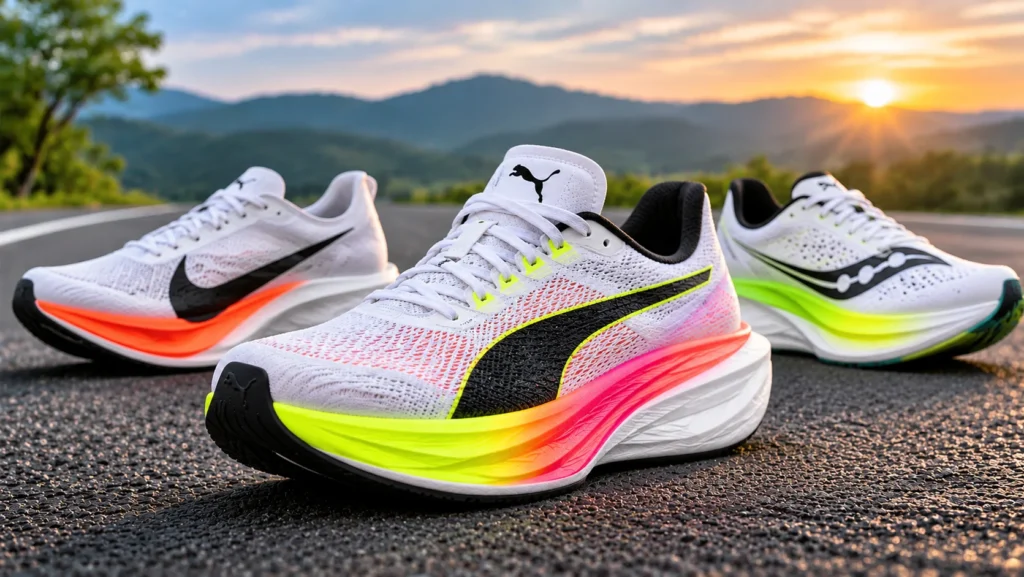
The PUMA offers a strong mix of bounce and grip. Nike is lighter, while Saucony provides a more accommodating ride.
Puma Deviate Nitro Elite 3 vs Nike Vaporfly 4
Choose the Vaporfly 4 if low weight matters most. It weighs 166 g in RunRepeat’s lab, but the PUMA costs less at list price.
Puma Deviate Nitro Elite 3 vs Saucony Endorphin Pro 4
Choose the Saucony for a more forgiving fit around the arch. The PUMA weighs less and feels more race-focused.
See our Saucony Endorphin Pro 4 review.
Compare launch list prices and measurements from the same lab below.
| Feature | PUMA Elite 3 | Vaporfly 4 | Endorphin Pro 4 |
|---|---|---|---|
| List price | $230 | $260 | $225 |
| RunRepeat score | 84/100 | 93/100 | 90/100 |
| Lab weight | 204 g | 166 g | 220 g |
| Listed drop | 8 mm | 6 mm | 8 mm |
| Plate | Carbon | Carbon | Carbon |
| Best use | Fast road races | Shorter races | Longer races |
Choose fit over scores. For more training versatility, see our Nike Zoom Fly 6 review.
Puma Deviate Nitro Elite 3 Pricing: Is It Worth the Price?
Yes, at a meaningful discount. PUMA lists the shoe at $230, while the newer Elite 4 carries a $250 list price.
Running Warehouse previously listed one men’s size at $184.88, not a confirmed record low.
Current and historical low Amazon US prices: unavailable.
PUMA Deviate Nitro Elite 3 Carbon Plate Racing Shoes
Who Should Buy the Puma Deviate Nitro Elite 3?
Buy it for racing if you like snug shoes.
- Neutral runners aiming for faster times on paved roads.
- Racers seeking good traction when the weather turns wet.
- Experienced runners adding a shoe to their race rotation.
- Your toes need extra space during longer road races.
- You want one durable shoe for all weekly mileage.
Bottom line: New runners should check whether carbon-plated shoes suit beginners.
What Are Real Buyers Saying About the Puma Deviate Nitro Elite 3?
PUMA-site feedback is mixed. Amazon ratings remain unverified.
3.3/5 — 7 PUMA-site ratings, not Amazon.
- Light feel that makes quick road runs more enjoyable.
- Good grip for fast workouts on paved surfaces.
- Secure fit for feet that suit its race shape.
- The pointed toe shape leaves less room for spreading.
- Some runners need special lacing for secure heel hold.
These small samples cannot establish buyer consensus.
Final Verdict — Is the Puma Deviate Nitro Elite 3 Worth Buying?
The Elite 3 suits runners seeking speed and wet-road grip.
The slim heel and tapered toe box are the strongest reasons to skip it. Those limits matter more as race fatigue builds.
Seek a discount if the fit works; otherwise, choose a wider or more stable racer.
PUMA Deviate Nitro Elite 3 Lightweight Road Racing Shoes
Frequently Asked Questions
Does the Puma Deviate Nitro Elite 3 fit true to size?
Yes, most sizing votes on RunRepeat indicate true-to-size length. However, its 69.5 mm big-toe width creates a pointed fit that may squeeze wider toes. Try your normal size with race socks before deciding whether you need a different size or model.
Is the Puma Deviate Nitro Elite 3 good for a marathon?
Yes, if you have neutral mechanics and feel comfortable in this shoe during long runs. RTINGS scored its marathon racing ability 7.9/10, but its narrow heel can challenge tired runners. Test how it feels near the end of a long workout before race day.
Can you use the Elite 3 for daily training?
You can, but it is not the best tool for easy mileage. RTINGS gave daily training 6.2/10, and the upper has limited abrasion resistance. Rotate it with a more stable daily trainer so you can reserve the premium foam for key sessions and races.
What is the difference between Deviate Nitro 3 and Elite 3?
The Elite 3 uses a lighter, more race-focused construction and full-length premium foam. The standard Deviate Nitro 3 is better suited to regular training and tempo workouts. PUMA lists an 8 mm drop for the Elite 3, but its plate shape differs from the trainer.
Is the Elite 3 breathable in hot weather?
Yes, its thin upper earned 4/5 in RunRepeat’s smoke test. That makes it a reasonable choice for warm road races when the fit works for you. The trade-off is a mesh that offers little resistance when it rubs against rough surfaces.
Should I buy the Elite 3 or the newer Elite 4?
Buy the Elite 3 when the discount is large and you like its fit. The Elite 4 has a $250 list price, versus $230 for the older model. At similar sale prices, compare the newer shoe first rather than assuming the older one offers better value.
Affiliate Disclosure: As an Amazon Associate, I earn from qualifying purchases. Links on this page may earn me a small commission at no extra cost to you.