

Quick Answer
Yes, the Puma Deviate Nitro 3 is worth buying if you want a plated trainer with strong road grip. This Puma Deviate Nitro 3 review finds a wet-grip score of 0.65 and useful heel cushioning.
Its narrow fit limits comfort for wide feet. Discounts make it a better deal than paying full price.
Why consider the Deviate Nitro 3?
- Carbon plate for steady and faster training runs.
- Above-average traction on wet roads.
- Best suited to neutral runners with narrow feet.
🏆 Standout Wet-Road Grip
Overall*
Grip
Value
Comfort
*RunRepeat score converted to five stars. Other ratings: Running Shoes Guru, converted from ten points.
The badge is an editorial distinction.
✅ Best for: Mixed road training and wet-weather runs.
❌ Not ideal for: Wide feet or runners needing extra stability.
💰 Original price: $160 USD. Recent tracked Amazon offer: from $79.95.
Category Scores — Running Shoes Guru
9/10
8/10
9/10
9/10
8/10
One reviewer’s ratings, not category rankings.
Finding a fast shoe that feels good on long runs takes care. You want enough cushioning without losing the ability to pick up your pace.
I’m Steven Tyler. This review uses published tests, not personal wear testing.
Tom’s Guide ran 30 miles; RunRepeat examined the cut shoe. Both offer useful insights for runners considering this model.
Fit matters more than the plate. Here’s what you need to know before buying.
What Is the Puma Deviate Nitro 3 and Who Is It For?
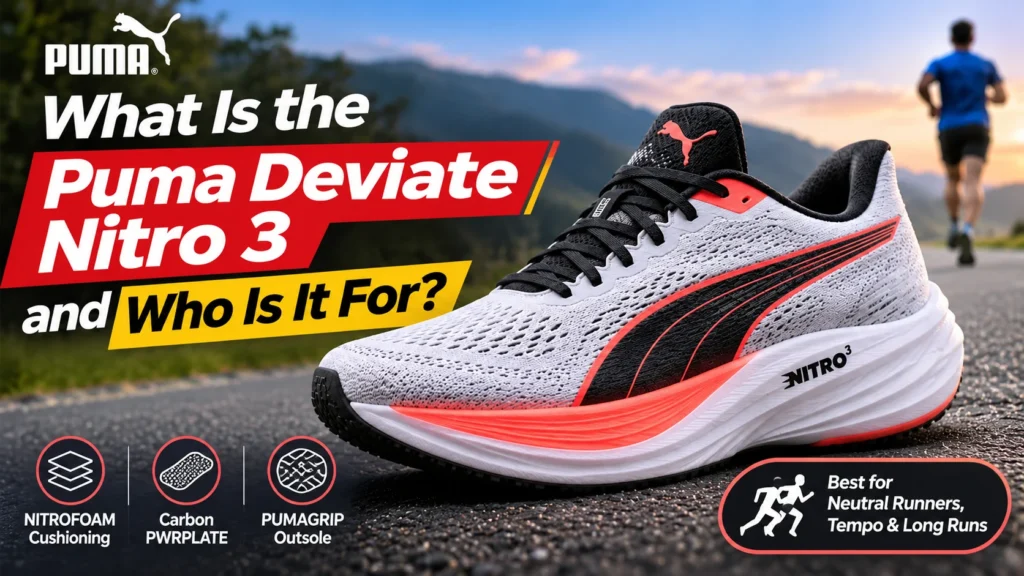
The Puma Deviate Nitro 3 is a neutral road shoe for runners who mix steady mileage with faster sessions.
Dual foam layers surround a full-length carbon PWRPLATE. PUMAGRIP rubber adds grip across paved surfaces.
Compared with the Puma Deviate Nitro 2, it has a higher stated stack and drop.
✅ Buy if you…
- Run tempo sessions and long road workouts.
- Need reliable grip on damp paved surfaces.
- Prefer a secure, close fit around your foot.
❌ Consider alternatives if…
- You need a roomy toe box.
- You want flexible recovery shoes.
- You need a broad, stable heel platform.
Puma Deviate Nitro 3 Review: Pros and Cons
Road grip is the biggest strength. The close fit is the main drawback across independent reviews.
✅ Pros
- Wet traction reaches 0.65 in controlled forefoot grip tests.
- Dual foam layers provide useful cushioning for steady mileage.
- Full-length carbon plate supports transitions during faster training runs.
- Rubber measures 3.2 mm thick for added outsole coverage.
❌ Cons
- Narrow toe box measures just 69.7 mm in testing.
- Lab weight of 268 g exceeds the tested average.
- Breathability earns only three out of five in testing.
- Narrow heel base offers limited support for unstable runners.
- Outsole abrasion reaches 1.5 mm, above the tested average.
Puma Deviate Nitro 3 Review: Key Features and Test Results
Grip stands out; fit and rebound lag behind. These features explain how the shoe performs across different types of runs.
1. How Good Is the NITROFOAM Cushioning?
The foam provides a cushioned heel without leading the field in impact protection. RunRepeat measured heel shock absorption at 132 SA against an average of 131 SA.
Takeaway: Extra foam does not always mean extra shock absorption.
OutdoorGearLab found the forefoot firmer than the heel. This balance can suit runners who want cushioning without a soft, unstable feel.
For recovery runs, consider a flexible trainer.
2. Does the Carbon PWRPLATE Improve Speed?
The plate helps guide the shoe through each step, but it cannot promise faster times. RunRepeat recorded 63.4% forefoot energy return.
Forefoot Energy Return — Lab Comparison
83.0%
63.4%
61.5%
38.0%
RunRepeat lab dataset, 419 shoes. Bars represent actual energy return percentages.
Takeaway: Rebound beats the average, but not leading race shoes.
Its 20.6 N bend test shows above-average stiffness. A lighter race option is the New Balance FuelCell SuperComp Elite v4.
3. How Well Does PUMAGRIP Work on Wet Roads?
PUMAGRIP is a clear reason to choose this shoe. The grip test returned 0.65, compared with a sample average of 0.53.
Forefoot Traction — Lab Comparison
1.05
0.65
0.53
0.11
RunRepeat lab dataset, 412 shoes. Bars scale to the highest tested value.
Takeaway: Grip is a stronger selling point than speed alone.
The sole cutout can trap gravel; stick to paved routes.
Slow down on slick paint, metal covers, and ice even with a grippy outsole.
4. Is the Fit Too Narrow?
Yes, the standard fit is narrow compared with many road shoes. Lab measurements put the widest internal fit at 91.5 mm versus a 95.2 mm average.
Takeaway: Foot shape matters more than your normal shoe size.
Running Shoes Guru reported toe pressure; OutdoorGearLab found a low-volume fit.
Try the wide version if available, or compare your usual size with a half size larger.
Extra length cannot always solve width issues.
5. Is the Outsole Durable Enough for Daily Training?
It has substantial rubber coverage, but the lab abrasion result is less impressive. RunRepeat found a 1.5 mm wear mark versus a 1.1 mm sample average.
Takeaway: Excellent grip does not automatically mean excellent wear resistance.
Running Shoes Guru rated durability highly despite lab wear results.
Check grip regularly, especially on rough paths.
How Does the Puma Deviate Nitro 3 Perform in Real Tests?
Grip stands out in these lab tests. Energy return is above average, while heel cushioning sits close to the tested average.
Measured Performance
Excellent
0.65 — above the tested average of 0.53.
Good
63.4% forefoot energy return.
Average
132 SA heel shock absorption.
Below Average
82.7 mm heel platform width.
Average
3/5 in laboratory airflow testing.
Measurements: RunRepeat lab review. Performance labels reflect editorial interpretation.
Puma Deviate Nitro 3 Full Specifications
The following table lists official and laboratory specifications for the men’s standard model.
| Specification | Details |
|---|---|
| General Specifications | |
| Brand / Model | PUMA / 309707 |
| Category | Neutral road trainer |
| Original Retail Price | $160 |
| Official Weight | 250 g (UK 8) |
| Lab Weight | 268 g |
| Midsole and Outsole | |
| Midsole Foam | NITRO and NITRO Elite |
| Carbon PWRPLATE | ✓ Yes |
| Official Stack Height | 39 / 29 mm |
| Lab Stack Height | 37.4 / 27.3 mm |
| Heel-to-Toe Drop | 10 mm |
| Outsole | PUMAGRIP rubber |
| Upper and Fit | |
| Upper Material | Engineered textile mesh |
| Width Options | Standard and wide |
| Removable Insole | ✓ Yes |
| Dedicated Stability Design | ✗ No |
See the official PUMA product listing for size-specific details.
How Does the Puma Deviate Nitro 3 Compare to Competitors?
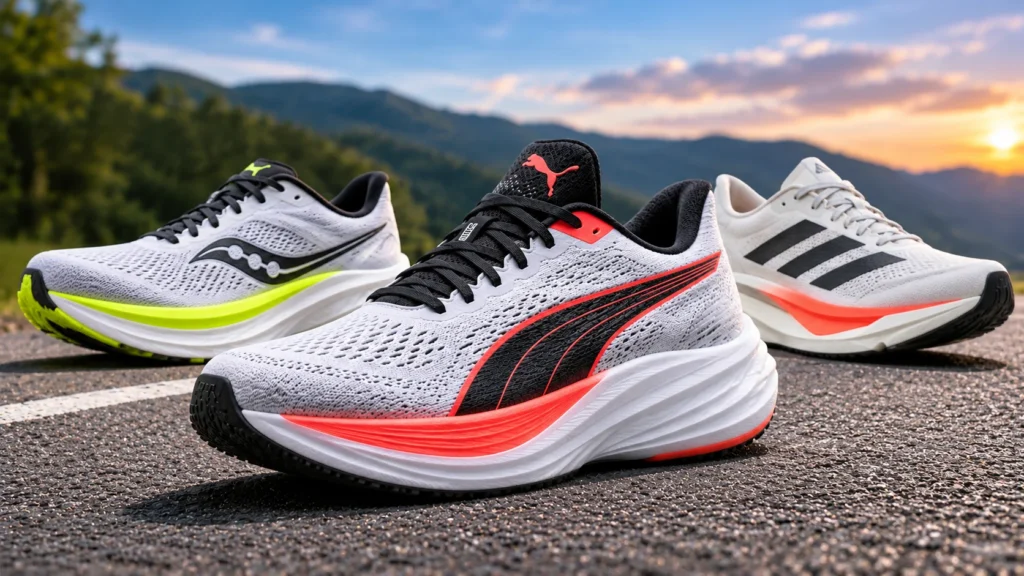
Rivals offer lighter builds or wider platforms. The Deviate Nitro 3 stands out for its strong wet-road grip.
Puma Deviate Nitro 3 vs Saucony Endorphin Speed 4
The Saucony Endorphin Speed 4 weighs 237 g in lab tests and uses a nylon plate. Choose Saucony for quicker workouts or more room.
Puma Deviate Nitro 3 vs Adidas Adizero Boston 12
The Adidas Adizero Boston 12 has a wider platform and uses EnergyRods. It suits runners who like a firmer ride.
| Feature | Deviate Nitro 3 | Endorphin Speed 4 | Boston 12 |
|---|---|---|---|
| Retail Price | $160 | $170 | $160 |
| Lab Weight | 268 g | 237 g | 261 g |
| Official Drop | 10 mm | 8 mm | 6.5 mm |
| Stiffening System | Carbon plate | Nylon plate | EnergyRods |
| Best Use | Mixed road runs | Tempo work | Fast long runs |
Choose based on fit and training style.
Puma Deviate Nitro 3 Pricing — Is It Worth the Price?
It offers better value at a discount than at the original $160 retail price. Newer models make full retail less attractive.
- Original MSRP: $160.
- Recent Amazon offer: From $79.95, via Running Shoes Guru.
- Tracked retailer low: $64.95 at Shoebacca, via Deal.ai.
- Amazon historical low: Not verified.
My buying target: below $100, subject to size and stock.
PUMA Deviate NITRO 3 Men’s Carbon-Plated Road Running Shoes
Check the latest price and availability for your preferred size and width.
Who Should Buy the Puma Deviate Nitro 3?
Buy it for mixed road sessions if it fits. Its plate and grippy outsole make it useful for varied training plans.
✅ Best-Fit Runners
- Neutral runners with narrow or low-volume feet.
- Runners who train on wet pavement.
- Marathon runners mixing easy and faster miles.
- Buyers seeking discounted carbon-plated trainers.
❌ Consider Skipping If
- You need wide toe space or extra support.
- You prefer flexible, soft recovery shoes.
- You want a lightweight race specialist.
What Are Real Buyers Saying About the Puma Deviate Nitro 3?
Owners praise grip and cushioning but flag narrow fit. Comfort depends heavily on foot shape and size selection.
27 ratings on PUMA’s US product listing (retrieved snapshot).
Amazon rating and review count: not verified.
What Owners Praise
- Secure grip during regular training sessions on paved roads.
- Comfortable cushioning with enough response for mixed training paces.
- Useful versatility across steady runs and faster road workouts.
Recurring Concerns
- Tight midfoot and toe space for runners needing width.
- Some runners need another size to find comfortable fit.
Buyer takeaway: The shoe’s fit is the key condition behind positive experiences.
Final Verdict — Is the Puma Deviate Nitro 3 Worth Buying?
Yes, I recommend it for neutral runners seeking a grippy plated trainer, especially at a discount.
Its narrow fit, limited stability, extra weight, and modest airflow remain important drawbacks.
Test the fit before committing to long runs. Choose an alternative if you need more toe space or extra stability.
Final Recommendation
PUMA Deviate NITRO 3 Men’s Carbon-Plated Road Running Shoes
A useful training option if the narrow fit suits you.
Frequently Asked Questions
Is the Puma Deviate Nitro 3 good for daily running?
Yes, it works for daily runs if you enjoy a structured ride. Its official 10 mm drop and carbon plate suit steady mileage with faster sections.
For relaxed recovery runs, a more flexible shoe can feel easier to move in.
Is the Deviate Nitro 3 suitable for marathons?
Yes, it can serve as a marathon training shoe or a budget race option. Its 39 mm stated heel stack provides useful cushioning for longer efforts.
Test it during long workouts first, since foot swelling can make its narrow fit uncomfortable.
Does the Puma Deviate Nitro 3 run small?
Some testers found it slightly small, while others reported normal length. The measured toe box is 69.7 mm wide, so width is a more consistent concern.
Try your normal size and a half size up to compare comfort and heel security.
Does the Deviate Nitro 3 have a carbon plate?
Yes, it uses a full-length carbon fiber PWRPLATE between NITRO foam layers. RunRepeat measured 20.6 N of force in its bend test.
That makes it stiffer than the tested average, but a plate does not guarantee better running times.
How long does the Puma Deviate Nitro 3 last?
No fixed mileage applies to every runner. The outsole has 3.2 mm of rubber, but wear depends on your running form, body weight, and road surface.
Check for uneven wear or fading grip. Replace the shoe when its condition affects comfort.
Is the Deviate Nitro 3 better than the Deviate Nitro 4?
Not for everyone. The newer model weighs 247 g in RunRepeat’s lab, compared with 268 g for the third version.
Choose the newer model if you prioritize a lighter, faster feel. The older shoe remains worth comparing when discounts are substantial.
Affiliate Disclosure: As an Amazon Associate, I earn from qualifying purchases. Links may earn me a small commission at no extra cost to you.