Quick Answer
Running shoe sizing between brands is not perfectly consistent. A US size 10 in Nike, adidas, Brooks, or New Balance may feel different because each manufacturer uses different shoe shapes, internal dimensions, and fitting standards. Start with your measured foot length, consult the brand’s official sizing chart, and check width, toe room, and heel security before buying.
Five Rules for Comparing Running Shoe Sizes
- Measure both feet: Use the longer foot when selecting your starting size.
- Compare official charts: Check each brand’s US, UK, EU, and centimeter references.
- Check toe clearance: Aim for approximately one thumb-width beyond your longest toe.
- Consider shoe width: A longer shoe cannot always solve a narrow toe box.
- Test the actual model: Two shoes from the same brand may fit differently.
Best Starting Point
- Switching brands: Begin with your current running shoe size, then verify measurements and fit.
- Between sizes: Compare both sizes when possible rather than automatically increasing your size.
Running shoe sizes can be confusing when switching brands. I’ve found that comparing the numbers on shoe boxes alone rarely gives the complete picture.
One company’s size 10 may feel comfortable, while another squeezes your toes or allows unwanted heel movement. This guide explains how brand sizing works and how to choose a better fit in 2026.
What Is Running Shoe Sizing Between Brands?
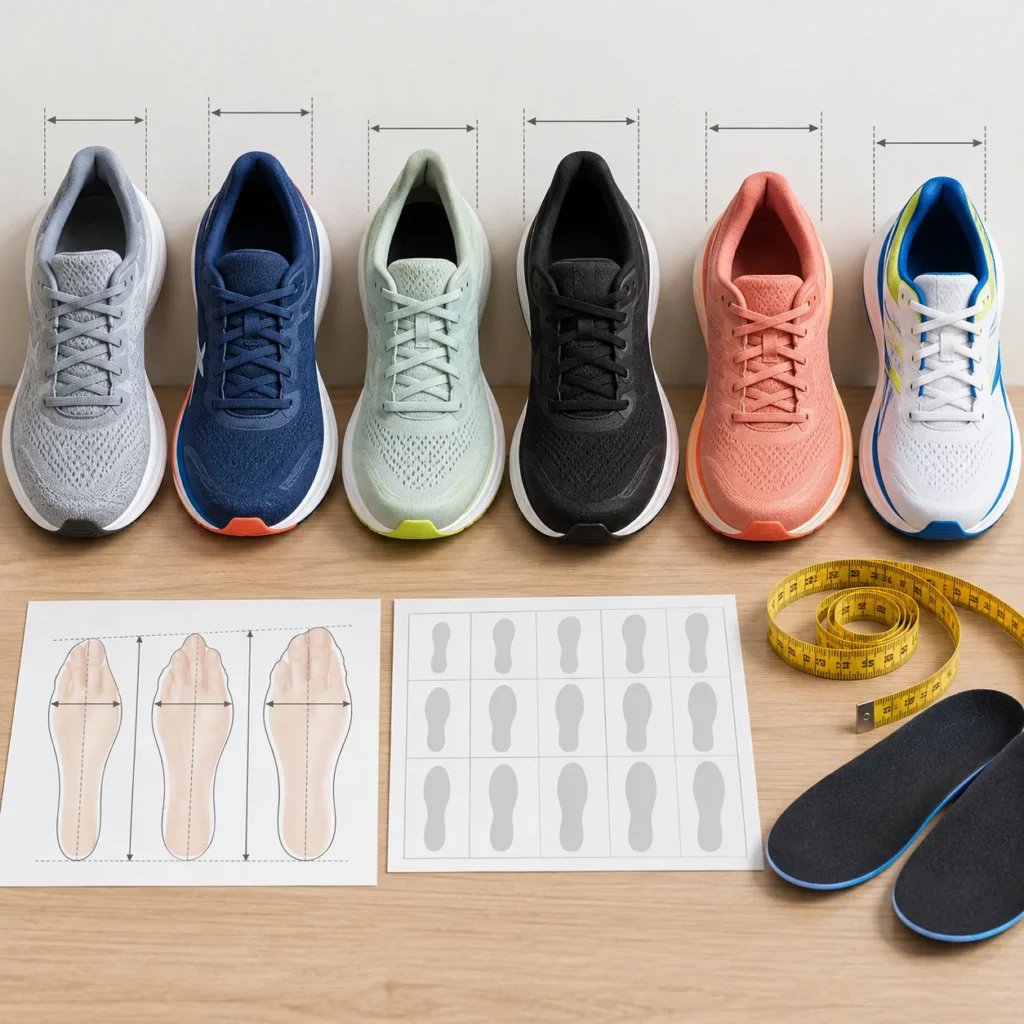
Running shoe sizing between brands describes differences in shoe measurements, size conversions, and actual fit across footwear manufacturers. These differences mean an identical size label does not guarantee an identical fit.
Brands build footwear using their own design standards and foot-shaped molds called lasts. The last influences a shoe’s overall shape and how it accommodates different feet.
Why do running shoe brands fit differently?
Several design features can affect fit, even when two shoes carry the same US size.
- Last shape: The three-dimensional form used to construct the shoe.
- Toe-box design: The space surrounding the toes.
- Heel construction: The shape and firmness around the back of the foot.
- Upper materials: The flexibility and structure of the fabric surrounding your foot.
- Foot volume: The interior space available above and around the foot.
- Width options: Available narrow, standard, wide, and extra-wide versions.
These differences explain why numerical sizing is only a starting point. The final decision should depend on comfort during movement.
For a broader shopping checklist, see my guide on how to compare running shoe specifications.
Do Nike, adidas, Brooks, ASICS, and New Balance Run the Same Size?
No. These major running shoe brands use published size charts, but their conversion systems and shoe shapes are not identical.
It is especially important to distinguish between a company’s numerical conversions and how a particular shoe model fits.
Nike running shoe sizing
Nike publishes US, UK, EU, and foot-length measurements. Its official guidance explains that the centimeter size printed on a shoe label differs from the foot-length measurement shown in its chart.
When comparing Nike shoes with another brand, I would start with measured foot length. I would then examine the individual model’s fit rather than assuming every Nike shoe feels the same.
adidas running shoe sizing
adidas uses its own conversion chart, including EU sizes with third-size increments. For example, a men’s US 9 corresponds to UK 8.5 and EU 42 2/3.
The official adidas size chart provides heel-to-toe measurements. These measurements are more useful than simply copying a European size from another brand.
Brooks running shoe sizing
Brooks specifically advises that its running shoes often fit slightly shorter than casual footwear. The company suggests considering approximately half a size to one full size above casual or dress shoe sizing.
That recommendation is not a universal conversion from other running brands. Check the company’s shoe sizing guidance and try the actual model whenever possible.
ASICS running shoe sizing
ASICS publishes separate US, UK, EU, and centimeter measurements. Its shoes also differ in shape and construction across daily trainers, stability models, and racing designs.
I recommend checking the exact ASICS model and available widths. A comfortable fit in one series does not automatically establish your size in another.
New Balance running shoe sizing
New Balance states that its shoes generally follow standard industry sizing. It also provides model-specific fit guidance when a style runs differently.
One advantage is its extensive range of width options. The company’s official size and width guide helps narrow the choices.
Running Shoe Size Comparison Chart: Nike vs adidas vs ASICS vs New Balance
The table below compares published men’s shoe size conversions from official brand charts available in 2026. It shows how equivalent US size labels can have different UK or EU conversions.
| Brand | US 9 / UK | US 9 / EU | US 10 / UK | US 10 / EU |
|---|---|---|---|---|
| Nike | 8 | 42.5 | 9 | 44 |
| adidas | 8.5 | 42 2/3 | 9.5 | 44 |
| ASICS | 8 | 42.5 | 9 | 44 |
| New Balance | 8.5 | 42.5 | 9.5 | 44 |
Important: These figures are manufacturer-published label conversions, not measurements of a shoe’s internal length. They do not establish which brand runs larger or smaller.
For example, a Nike men’s US 10 converts to UK 9, while an adidas men’s US 10 converts to UK 9.5. Both are labeled EU 44, yet that does not guarantee identical physical fit.
How Do You Find Your Running Shoe Size When Switching Brands?
Start by measuring your feet instead of relying entirely on your existing shoe size. Then use the measurements to identify a starting size in the new brand.
Step 1: Measure both feet while standing
Stand on a firm surface and use a sheet of paper, pencil, and ruler. Measuring later in the day can provide a better reference for running when feet may be slightly larger.
- Place the paper against a wall on a flat floor.
- Stand with your heel against the wall.
- Mark the end of your longest toe.
- Measure the distance from the wall to that mark.
- Repeat the measurement with your other foot.
- Record the longer measurement in centimeters.
Wear thin socks or follow the manufacturer’s specified measuring instructions. Keep your weight distributed naturally while measuring.
Step 2: Record your foot width
Foot length alone cannot describe the entire fit. Measure the widest part of the forefoot and note whether your toes need additional space.
Also consider whether your foot feels tall under the laces. Some runners need more interior volume rather than a longer shoe.
Step 3: Find the matching size chart
Use the chart for the exact brand, region, and footwear category. Confirm whether the centimeter measurement represents actual foot length or a shoe-label conversion.
That distinction matters when switching between brands. A centimeter marking on one shoe box may not represent the same measurement method used by another manufacturer.
Step 4: Check toe space and heel security
Once you’ve selected a starting size, check the space beyond your longest toe. Approximately one thumb-width is a practical guideline for many runners.
Your toes should move freely without sliding excessively inside the shoe. Read my guide on how much toe room running shoes need for additional fit checks.
Step 5: Walk and jog before deciding
Stand, walk, and jog in both shoes if the retailer permits testing. Pay attention to changes in heel movement, toe pressure, and midfoot comfort.
- Too short: Toes touch the front during movement.
- Too narrow: The forefoot feels compressed.
- Too loose: Your foot slides or your heel lifts excessively.
- Too shallow: The upper presses uncomfortably over your foot.
I would record the model, size, width, and fit notes before comparing another brand. A simple record makes future shoe shopping easier.
Should You Size Up or Down When Switching Running Shoe Brands?
Not automatically. A half-size adjustment may improve one model’s fit, but there is no reliable universal sizing formula between running shoe brands.
Your current shoe’s fit provides a useful starting point. The main question is whether your existing shoe is already comfortable.
When should you consider a half-size larger?
- Your longest toe presses against the front of the shoe.
- You have insufficient clearance during downhill running.
- The manufacturer’s measurements place you between two sizes.
- The exact model has reliable guidance indicating a shorter fit.
A larger size should solve a genuine length problem without introducing excessive movement. Check your heel again after changing sizes.
When should you consider a smaller size?
- Your heel slips significantly despite appropriate lacing.
- Your foot moves forward and backward excessively.
- The shoe provides noticeably more length than you need.
- The model’s fit guidance indicates a particularly roomy construction.
Don’t size down simply to make a loose forefoot feel tighter. A narrower width or differently shaped model may offer a better solution.
How Does Running Shoe Width Sizing Compare Between Brands?
Running shoe width describes how much room a shoe provides across the foot. Width labels can help, but the actual internal shape still varies between brands and models.
The following codes are widely used for adult running footwear.
| Width | Men’s Code | Women’s Code |
|---|---|---|
| Narrow | B | 2A |
| Standard | D | B |
| Wide | 2E | D |
| Extra-wide | 4E | 2E |
These are conventional US width designations, not guaranteed measurements in millimeters. Availability depends on the manufacturer and individual shoe model.
If your current running shoes squeeze your forefoot, consider a wider version before changing length. Learn more in my running shoe width guide.
Are Men’s and Women’s Running Shoe Sizes Different Across Brands?
Yes. Men’s and women’s US sizing systems often use different numerical conversions and standard widths.
For Nike, Brooks, and New Balance, the published US charts commonly show a 1.5-size difference. For example, men’s US 8.5 corresponds to women’s US 10.
adidas uses a different conversion relationship in its published chart. Its men’s US 9 corresponds to women’s US 10.
What should you check before converting sizes?
- Brand chart: Use the manufacturer’s own conversion.
- Shoe width: Compare standard and specialty width options.
- Foot shape: Check toe-box, heel, and midfoot fit.
- Model availability: Some styles use unisex sizing labels.
Men’s and women’s shoes can also differ in construction. A numerical conversion should never replace an actual fit check.
For detailed examples, use my women’s to men’s running shoe size chart.
Why Can Two Running Shoes From the Same Brand Fit Differently?
Shoe models serve different running purposes, so manufacturers may vary their materials and construction. Consequently, a comfortable size in one model might feel different in another.
Daily trainers versus racing shoes
Daily trainers generally focus on accommodating regular workouts and comfortable mileage. Racing models may prioritize a secure fit and efficient performance-oriented construction.
Those design priorities can change the feeling around the midfoot and toes. Do not assume a racing shoe should automatically use the same size as your daily trainer.
Road shoes versus trail shoes
Trail running involves uneven surfaces and frequent changes in foot position. Some trail shoes use protective structures or secure uppers that affect available interior space.
Check fit while walking downhill or across uneven ground when testing is permitted. Your toes should not repeatedly strike the front.
Older versions versus newer versions
Manufacturers sometimes redesign uppers, heel structures, and toe boxes between model generations. Even familiar product families can feel different after an update.
I recommend treating every replacement version as a new fitting decision. Start with your previous size, but confirm the new shoe independently.
What Running Shoe Sizing Mistakes Should You Avoid?
The biggest mistake is treating a size number as proof that a shoe fits. A comfortable fit depends on length, width, volume, and how the shoe behaves during movement.
- Copying EU sizes blindly: European size conversions are not identical across every manufacturer.
- Ignoring centimeter definitions: A printed CM label may differ from measured foot length.
- Automatically sizing up: Extra length can create heel movement and rubbing.
- Ignoring width: A larger shoe may still have the wrong forefoot shape.
- Measuring one foot: The other foot may be longer or wider.
- Testing without running socks: Different sock thickness can change fit.
- Trusting old measurements: Feet can change over time.
- Expecting a painful break-in: Running shoes should feel comfortable from the beginning.
The REI running shoe fitting guide also emphasizes measuring both feet, checking toe space, and testing shoes later in the day.
How Should You Compare Running Shoe Sizes When Buying Online?
Online shopping requires more attention to sizing because you cannot immediately test the shoes. A structured comparison reduces guesswork.
- Measure your current foot length and width.
- Identify the exact brand and model you’re considering.
- Read the official manufacturer sizing chart.
- Compare the recommended size with your current running shoes.
- Review model-specific width and fit information.
- Check recent reviews for recurring fit concerns.
- Confirm the retailer’s return and exchange policy.
- Try the new shoes indoors before using them outside.
If practical, order two neighboring sizes from a retailer offering convenient returns. Test them under the same conditions before making your decision.
Once you’ve confirmed your fit, explore my guide on how to choose running shoes for cushioning, support, and terrain considerations.
Which Running Shoes Are Worth Comparing for Sizing in 2026?
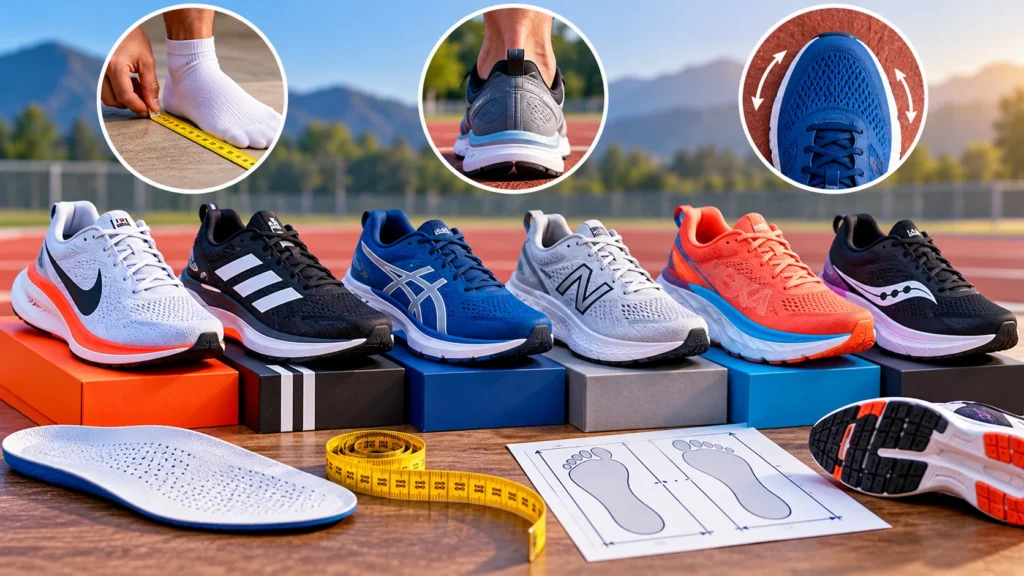
These three established running shoe models offer useful starting points for comparing fit and width options. I would shortlist them based on their published specifications, then test the correct size before purchasing.
Affiliate disclosure: The following Amazon search links may earn a commission from qualifying purchases at no additional cost to you. Ratings are editorial shortlist assessments, not customer review averages or claims of personal wear testing.
🏆 Multiple Width Options
Brooks Ghost 18
★★★★☆ 4.3/5 Editorial Assessment
The Ghost 18 is a daily road-running shoe with multiple width options, including men’s narrow, medium, wide, and extra-wide versions. I would consider it when testing how different widths change fit within one established shoe family.
📏 Wide Fit Selection
New Balance Fresh Foam X 880v15
★★★★☆ 4.4/5 Editorial Assessment
The 880v15 uses Fresh Foam X cushioning and offers men’s narrow B, standard D, wide 2E, and extra-wide 4E options. I would shortlist it when forefoot width and shoe volume matter as much as length.
👟 Neutral Daily Trainer
ASICS GEL-CUMULUS 28
★★★★☆ 4.2/5 Editorial Assessment
The GEL-CUMULUS 28 features an 8 mm heel-to-toe drop and FF BLAST MAX cushioning. With standard and specialty widths available in selected versions, I would include it when comparing neutral daily-training fit.
Frequently Asked Questions About Running Shoe Sizing Between Brands
Are running shoe sizes the same across all brands?
No. Running shoe sizes are not perfectly consistent across brands because manufacturers use different size conversions, construction methods, and shoe shapes. Start with your measured foot length, consult the specific brand’s chart, and check width and comfort before assuming your usual size will fit.
Should I go half a size up when switching running shoe brands?
Only when the measurements and actual fit support that adjustment. A half-size increase can help if a shoe is too short, but it may also create heel slipping. Compare both sizes when possible, and check whether a wider model would solve the problem better.
Do Nike and adidas running shoes fit the same?
Not necessarily. Nike and adidas have different published conversion charts, and their individual running shoes may have different interior shapes. Compare each brand’s foot-length guidance and test the models rather than assuming their US, UK, or EU labels represent identical physical dimensions.
Are running shoe sizes different from everyday shoe sizes?
They can be. Running shoes often need enough front clearance to accommodate foot movement during exercise, while casual shoes may have different fitting expectations. Rather than relying on a fixed size increase, measure your feet and check the actual shoe’s length, width, and heel security.
What is the most accurate way to compare running shoe sizes?
Measure both feet while standing, record length and width, and consult each manufacturer’s official size chart. Then test the selected shoes with your normal running socks. A qualified footwear fitter can also help assess foot shape, arch length, and shoe volume.
Final Thoughts: How to Choose the Right Running Shoe Size Between Brands
Understanding running shoe sizing between brands helps you make better buying decisions. The important lesson is that a familiar size label does not guarantee the same comfort across different manufacturers.
Measure your feet, compare official charts, and check the fit of each model. Pay particular attention to toe clearance, available width, and heel security.
I recommend keeping a simple record of the running shoes that fit you best. Include the brand, model, size, width, and any pressure points you notice.
That information can make switching brands much easier. Before purchasing your next pair, compare two or three suitable models and choose the one that fits comfortably during movement.


Steven is a former sportsperson and now a full-time businessman and research writer. He is the mastermind of this site, and he created this site to help people who need specialized shoes for different activities. When he was a sportsperson, he was very passionate about different types of shoes for his sports purpose. The passion he had for shoes at that time now turned into his profession. Besides his shoe business, he loves sharing his knowledge and experience with people and helping them maintain healthy feet.
More Posts