

Quick Answer
To test fit running shoes at home, wear your usual running socks, check for roughly 10–15 mm of toe clearance, and confirm that your heel stays secure when walking or jogging. Test both feet while standing, and use our running shoe size measurement guide if you are unsure where to start.
Six quick steps to check running shoe fit:
- Prepare your feet: Test later in the day with your normal running socks.
- Check toe clearance: Leave approximately one thumb-width beyond your longest toe.
- Check forefoot width: Make sure your toes can spread without rubbing.
- Secure your heel: Lace comfortably and watch for repeated heel slipping.
- Walk and jog: Test movement on a safe, clean indoor surface.
- Check discomfort: Notice pressure, numbness, rubbing, or unwanted foot movement.
The final decision:
- Good fit: Roomy toes, comfortable midfoot, and a secure heel.
- Poor fit: Persistent slipping, pinching, painful pressure, or toes hitting the front.
Buying running shoes online is convenient, but knowing whether they fit correctly can be challenging. A shoe might feel comfortable while sitting and become uncomfortable after several minutes of movement.
I recommend checking three things before keeping any pair: toe room, midfoot comfort, and heel security. This guide explains how to test each area at home without expensive equipment.
What Does Testing Running Shoe Fit at Home Mean?
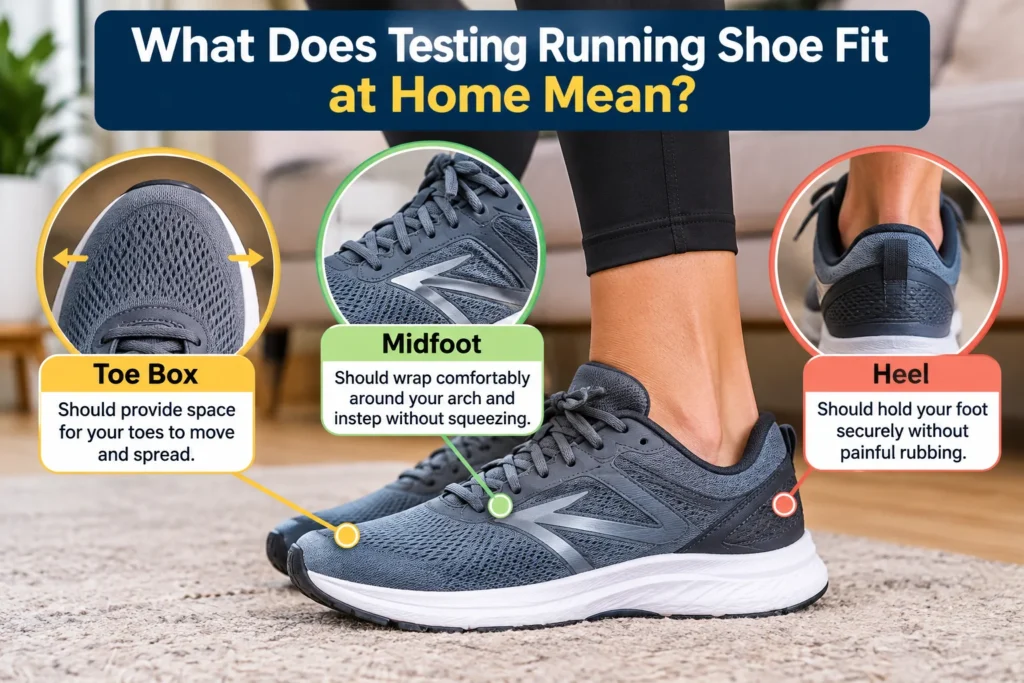
Testing running shoe fit at home means checking whether a shoe’s length, width, internal volume, and shape match your feet. The goal is to identify pressure or unwanted movement before committing to regular running.
A proper fit is not simply about matching a number on a shoe label. Different brands and models can fit differently, even when they share the same printed size.
The Three Main Areas of Running Shoe Fit
- Toe box: The front section should provide space for your toes to move and spread.
- Midfoot: The shoe should wrap comfortably around your arch and instep without squeezing.
- Heel: The rear section should hold your foot securely without painful rubbing.
The REI running shoe fit guide also emphasizes adequate toe clearance and a comfortably secure heel and midfoot.
My preferred approach is to assess these areas separately. A shoe can pass the toe-space test and still fail because its heel shape does not suit your foot.
What Do You Need to Test Running Shoes at Home?
You can test running shoe fit using simple items already available at home. Specialized fitting machines are not essential for an initial assessment.
Prepare These Items
- Your running shoes: Test both shoes, not just one.
- Normal running socks: Use the thickness you intend to wear during training.
- Paper and pencil: Useful for tracing your feet before measuring.
- Ruler or measuring tape: Helps estimate foot length and width.
- Clean indoor space: Allows walking and gentle jogging without damaging returnable shoes.
- Your usual insoles: Include orthotics or replacement insoles if you normally run with them.
Try the shoes later in the day because feet can become larger after prolonged standing or activity. The American Academy of Orthopaedic Surgeons’ athletic shoe guidance recommends this approach.
Check the retailer’s return conditions before testing outdoors. Indoor testing gives you an opportunity to discover fit problems while keeping the shoes clean.
How Do You Measure Your Feet Before Testing Running Shoes?
Measure both feet while standing because body weight affects foot shape. Use the larger foot as your starting point when choosing a shoe size.
A paper-and-ruler measurement gives you a useful estimate. However, you should still compare that measurement with the manufacturer’s current sizing chart.
Five Steps to Measure Foot Length at Home
- Step 1: Place a sheet of paper on a hard, level floor against a wall.
- Step 2: Stand on the paper with your heel gently touching the wall.
- Step 3: Mark the position of your longest toe while standing upright.
- Step 4: Measure from the wall-side paper edge to the toe mark.
- Step 5: Repeat with your other foot and record both measurements in millimeters.
For example, suppose one foot measures 266 mm and the other measures 270 mm. Use 270 mm when comparing your measurements with the brand’s sizing chart.
How Do You Measure Foot Width?
Trace around your standing foot and measure its widest forefoot section. Compare that figure with the manufacturer’s width guidance when available.
Remember that shoe width labels vary by category and brand. A standard-width shoe in one model might feel different from another model carrying the same label.
How to Test Running Shoe Fit at Home Step by Step
The best home fitting routine combines standing measurements with movement. Follow these eight tests in order to identify different fit problems.
Step 1: Put On Your Regular Running Socks
Start with the socks you normally wear while running. Sock thickness changes the available space inside your shoes.
Thin socks may make a shoe feel loose, while thick socks can create pressure. Avoid switching sock thickness just to disguise an obvious sizing problem.
Step 2: Seat Your Heels and Lace Both Shoes
Put on both shoes and gently settle your heels against the back. Tighten the laces until your midfoot feels comfortably secure.
You should not need to pull the laces painfully tight. The shoe should provide security without compressing the top of your foot.
Step 3: Check the Space Beyond Your Longest Toe
Stand upright with your weight distributed normally. Locate your longest toe and gently press the upper to estimate the available front clearance.
- Target: Approximately 10–15 mm of room.
- Too short: Your toes touch or press into the front.
- Potentially too long: Excessive space appears alongside sliding or instability.
Your second toe may be longer than your big toe. Always check the longest toe rather than assuming the big toe determines the required length.
Step 4: Wiggle Your Toes and Check Forefoot Width
Spread and wiggle your toes while standing. They should move comfortably without being forced together.
Pay attention to the little-toe side and the ball of your foot. Persistent pressure against the upper suggests that the shoe may be too narrow.
Step 5: Check the Midfoot and Instep
The midfoot should feel secure but not restricted. The instep is the upper part of your foot beneath the shoelaces.
- Good fit: Comfortable contact across the midfoot.
- Too tight: Pressure, tingling, or discomfort beneath the laces.
- Too loose: Noticeable foot movement despite normal lacing.
Some upper material naturally wrinkles during movement. However, excessive bunching combined with poor foot security may indicate too much internal volume.
Step 6: Walk Around Your Home
Walk normally across a clean, level indoor surface. Notice whether the shoe feels natural as your foot rolls forward.
Focus on heel movement, toe pressure, and side rubbing. A shoe that feels uncomfortable during ordinary walking may become more troublesome during running.
Step 7: Perform a Short, Gentle Jog Test
If space and safety allow, jog gently indoors for several moments. You can also jog lightly in place.
Your heel should stay reasonably secure, and your toes should not repeatedly strike the front. Stop if you experience pain, instability, or concerning pressure.
Step 8: Repeat the Checks on Both Feet
Do not assume your feet have identical dimensions or shapes. One shoe may feel comfortable while the other reveals pressure or slipping.
Repeat the standing and movement tests for both feet. The final pair should accommodate the larger foot without leaving the smaller foot excessively loose.
How Much Toe Room Should Running Shoes Have?
Running shoes generally need approximately 10–15 mm of clearance beyond your longest toe. This is roughly equivalent to the width of an adult thumb.
That space helps accommodate natural foot movement and changes in foot volume. It is a fitting guideline rather than a universal measurement for every foot.
How to Check Toe Room Correctly
- Stand upright: Avoid checking toe clearance only while sitting.
- Find your longest toe: It may be your second toe.
- Press gently: Locate the toe through the upper without pushing it backward.
- Check movement: Your toes should stay clear of the front during gentle jogging.
For additional measurements and examples, read our guide to how much space to leave at the toe of running shoes.
A generous toe box should not make the entire shoe unstable. Heel and midfoot security remain important even when the front feels spacious.
How Can You Tell If Running Shoes Are the Right Width?
Running shoes have the correct width when your forefoot feels comfortable without being squeezed or sliding excessively. Your toes should spread naturally while your midfoot remains secure.
Width and length are separate measurements. Buying a longer shoe to solve a width problem can create unwanted heel movement.
Four Practical Width Checks
- Little-toe test: Look for pressure along the outside edge of your foot.
- Toe-spread test: Confirm that your toes can separate comfortably.
- Insole test: Stand on the removable insole and inspect whether your forefoot extends beyond its edges.
- Side-movement test: Walk and check whether your foot slides noticeably inside the shoe.
The insole test is only a rough screening tool. Insoles do not represent every internal dimension of a running shoe.
If your forefoot feels restricted, consult our running shoe width and sizing guide before changing shoe length.
How Do You Test Heel Security in Running Shoes?
A properly fitted running shoe should hold your heel without repeated slipping or uncomfortable friction. Some small movement may occur depending on shoe construction.
The important warning sign is persistent movement that continues after comfortable lacing. Heel shape, internal volume, and lacing technique can all affect security.
Try a Simple Heel-Lock Lacing Test
- Lace the shoe normally until you reach the upper eyelets.
- Use the extra top eyelets, if available, to create small loops on each side.
- Pass each lace end through the loop on the opposite side.
- Pull gently, tie the laces, and walk again to check heel security.
This technique is commonly called a runner’s loop or heel-lock lacing. It can improve rearfoot hold without requiring excessive tension across the entire shoe.
If the heel continues slipping, consider a different heel shape or shoe volume. Our guide to recognizing running shoes that are too big explains related warning signs.
What Is the Difference Between a Good Fit, Tight Fit, and Loose Fit?
A comfortable shoe should feel secure without squeezing or allowing excessive movement. Use the following comparison to evaluate each part of the shoe.
| Fit Area | Good Fit | Too Tight | Too Loose |
|---|---|---|---|
| Toe clearance | About 10–15 mm | Toes touch the front | Excess length with sliding |
| Forefoot width | Toes spread comfortably | Side pressure or pinching | Excess side movement |
| Midfoot | Comfortably secure | Lace pressure or tingling | Foot shifts inside |
| Heel | Stable without rubbing | Painful pressure | Repeated slipping |
| Walking and jogging | Comfortable movement | Pinching or numbness | Unwanted sliding |
These observations are practical fitting indicators, not exact medical thresholds. Shoe design, foot anatomy, and running preferences can influence the best fit.
Can You Test Running Shoes by Walking or Jogging Indoors?
Yes, indoor movement testing can reveal problems that are difficult to notice while standing. Walking and gentle jogging help you evaluate how the shoe holds your foot.
The Fleet Feet running shoe fitting guide recommends assessing shoes while standing and moving.
Try These Simple Movement Checks
- Normal walking: Notice heel movement and forefoot comfort.
- Walking on tiptoes: Check flexibility and pressure around the forefoot.
- Gentle jogging: Watch for toe contact, slipping, or instability.
- Controlled direction changes: Check whether your foot shifts sideways.
Choose a clear, non-slippery surface and keep movements controlled. Avoid strenuous indoor testing or activities that could damage the shoes.
A short home test cannot perfectly reproduce a long training run. However, it can help eliminate obvious fit problems before outdoor use.
What Should You Do If Your Running Shoes Fail the Fit Test?
First, identify which part of the shoe causes the problem. Changing shoe length will not necessarily fix poor width, heel shape, or internal volume.
Match the Problem to the Right Solution
- Toes hit the front: Try a longer size and repeat the fit tests.
- Forefoot feels squeezed: Consider a wider version or a different toe-box shape.
- Heel slips slightly: Test comfortable heel-lock lacing before changing shoes.
- Midfoot feels painfully tight: Adjust lacing tension or consider a higher-volume design.
- Foot slides excessively: Try another size, width, or model.
- One foot fits differently: Choose a size that accommodates the larger foot, then assess security on the smaller foot.
I prefer changing the underlying shoe fit rather than immediately adding accessories. Socks and lacing can fine-tune a good fit, but they cannot reliably correct a major sizing mismatch.
For more detail about secure lacing and comfortable pressure, read how tight running shoes should be.
What Mistakes Should You Avoid When Testing Running Shoes at Home?
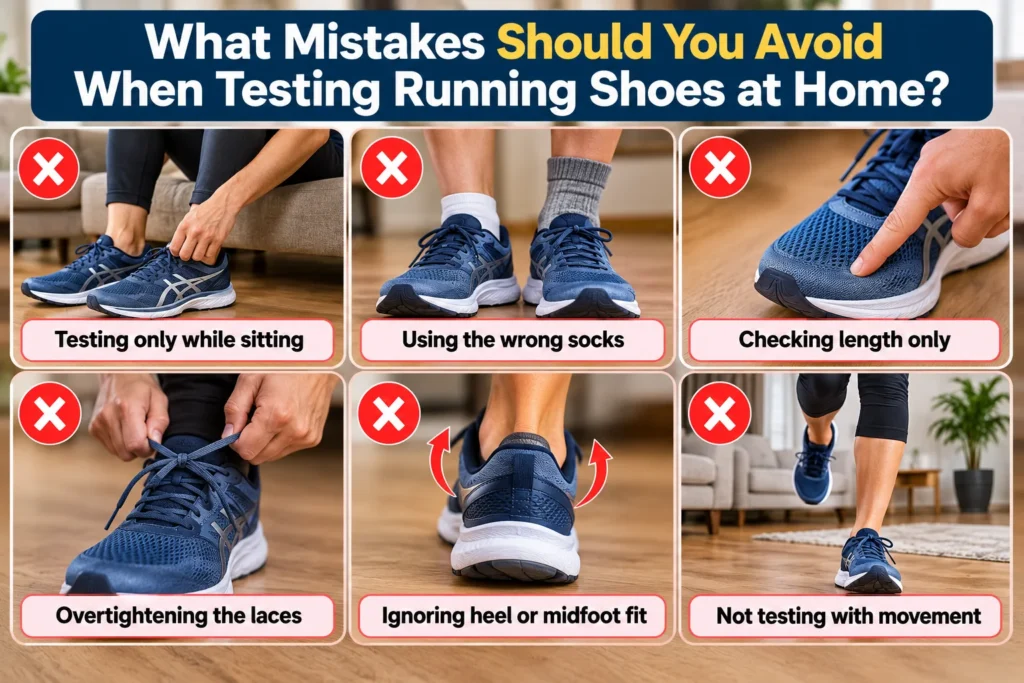
The most common fitting mistakes involve testing shoes under unrealistic conditions. A shoe should work with your normal socks, foot shape, and running movement.
Six Running Shoe Fitting Mistakes
- Testing only while sitting: Standing changes the shape and dimensions of your feet.
- Ignoring the second foot: Your feet may differ in length or width.
- Using unfamiliar socks: Different cushioning levels can alter the fit.
- Checking length alone: Width, volume, and heel shape are equally important.
- Overtightening the laces: Excessive tension can conceal looseness while causing pressure.
- Expecting a painful shoe to break in: A shoe that pinches significantly may need replacement rather than more wear.
The ASICS running shoe selection guide also recommends testing both shoes, wearing running socks, and assessing comfort through movement.
When Is a Home Running Shoe Fit Test Not Enough?
A home test is useful for basic sizing and comfort decisions, but it does not replace a professional assessment. Persistent pain or repeated fitting problems may need additional attention.
Consider Professional Help If:
- You experience recurring numbness, significant pain, or persistent foot symptoms.
- Several sizes or models produce the same uncomfortable pressure.
- You need to accommodate prescribed orthotics or a specific foot condition.
- You cannot achieve both toe comfort and reliable heel security.
A specialist running store can help compare different shoe shapes and widths. For persistent or worsening symptoms, seek advice from an appropriately qualified healthcare professional.
Helpful Products for Testing and Adjusting Running Shoe Fit
You do not need to buy equipment to perform these tests. However, the following accessories may help when evaluating shoes or fine-tuning an otherwise suitable fit.
Editorial note: The ratings below reflect usefulness for these specific tasks, not verified customer-review averages or personal laboratory testing.
🏆 Best for Running Sock Fit
Balega Hidden Comfort No Show Socks
★★★★☆ 4/5 Editorial Utility
These running socks feature plush cushioning, moisture-wicking fibers, and a secure heel pocket. I would consider them for runners who prefer cushioned socks, but the best fitting test still uses the socks you will actually run in.
🔒 Best for Adjustable Lacing
Lock Laces Original Elastic No-Tie Shoelaces
★★★☆☆ 3/5 Editorial Utility
These elastic laces include adjustable locking hardware and can replace ordinary shoelaces. I would consider them for convenient tension adjustment after confirming a shoe fits properly with its original laces.
Affiliate disclosure: As an Amazon Associate, we may earn from qualifying purchases. Product availability, pricing, and retailer listings can change.
Frequently Asked Questions
How Can I Tell If My Running Shoes Fit Properly at Home?
Wear your usual running socks, lace both shoes comfortably, and stand to check toe room. You should have roughly 10–15 mm beyond your longest toe, with a secure heel and comfortable forefoot. Walk and jog gently to check for slipping, pressure, or rubbing.
Should Running Shoes Feel Tight When You First Buy Them?
Running shoes should feel comfortably secure, not painfully tight. Your midfoot and heel need enough hold to prevent excessive movement, while your toes need room to spread. Do not rely on an uncomfortable shoe stretching enough to become suitable.
Can I Test Running Shoe Fit Without a Measuring Device?
Yes. You can use paper, a ruler, your normal socks, and simple movement tests. A thumb-width check provides a useful estimate of toe clearance, while walking and gentle jogging reveal possible heel or midfoot problems. Professional measurement can help when sizing remains uncertain.
Is It Better to Test Running Shoes in the Morning or Evening?
Late afternoon or evening is generally a useful time to test running shoes because feet may expand during the day. You can also test after ordinary activity to assess comfort. Always use your normal running socks and check both feet while standing.
Should You Buy Running Shoes Half a Size Bigger?
Some runners need a larger running shoe than their everyday footwear, but increasing by half a size is not a universal rule. Shoe sizing varies between models and brands. Choose the size that provides suitable toe clearance, width, and heel security rather than relying on the label alone.
Final Takeaway: How to Know Your Running Shoes Fit Correctly
Testing running shoes at home requires more than checking the size label. The most useful approach combines standing toe measurements, width checks, comfortable lacing, and gentle movement tests.
My final recommendation is to prioritize a secure heel, comfortable midfoot, and enough room for your toes. If a shoe repeatedly causes pressure or unwanted movement, try another size, width, or model before committing to it.
Before your next run: Give both shoes a complete indoor fitting check. A few careful observations can help you make a more informed footwear choice.


