
Quick Answer
A stability running shoe is a running shoe designed to guide foot movement and provide additional support during your stride. It typically uses wider soles, supportive sidewalls, or specialized midsole technology to manage excessive inward rolling, called overpronation. Stability shoes may suit runners who prefer a more controlled feel, but they aren’t necessary for everyone. See our neutral vs stability running shoes comparison to understand the main differences.
Five things to know about stability running shoes
- Extra guidance: Support features help manage foot movement during running.
- Overpronation support: Some runners who roll inward excessively prefer these shoes.
- Modern designs: Wider platforms and guidance systems can replace traditional rigid support posts.
- Individual fit: Arch height alone cannot determine whether stability footwear is appropriate.
- No injury guarantee: Research hasn’t established that stability shoes prevent injuries for every runner.
Quick fit check
- Compare comfort: Try neutral and stability shoes during a short walk or easy jog.
- Check pressure: Avoid shoes that create uncomfortable arch pressure, rubbing, or numbness.
- Consider symptoms: Seek professional advice for persistent foot, ankle, or knee pain.
Stability running shoes can sound complicated, especially when brands advertise different support technologies. The good news is that understanding their purpose doesn’t require advanced knowledge of running biomechanics.
I’ll explain how these shoes work, who might benefit, and how to compare real models available in 2026. My focus is choosing comfortable footwear rather than assuming more support is always better.
What Is a Stability Running Shoe?
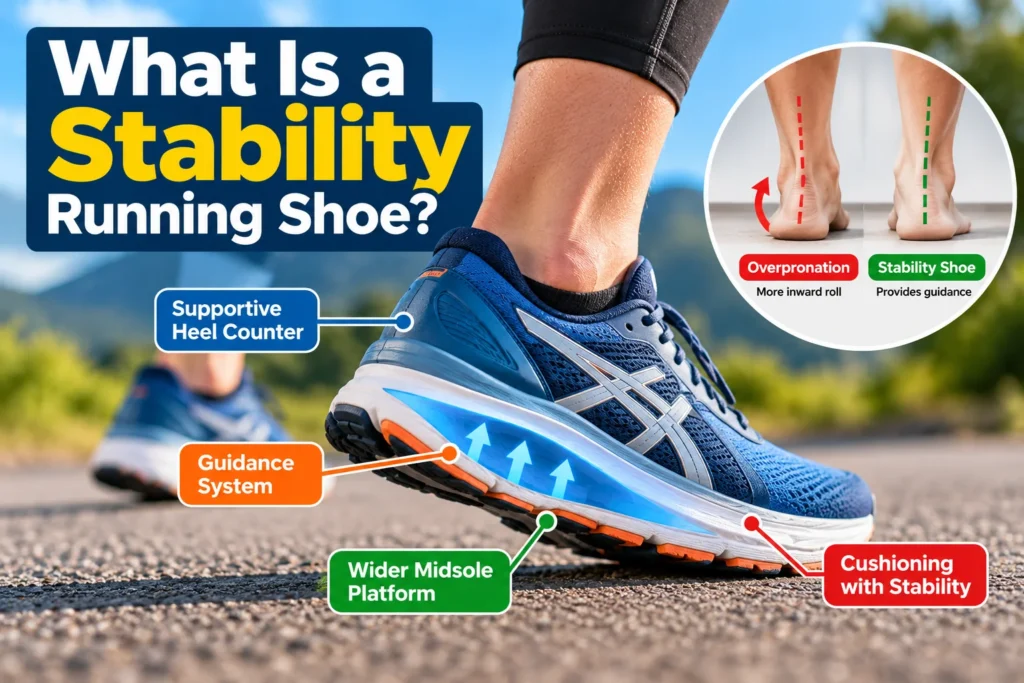
A stability running shoe is footwear designed to provide additional guidance against excessive foot movement while running. It combines cushioning with structural features that can influence how your foot travels from landing to toe-off.
Stability refers to the shoe’s ability to provide a supportive, controlled platform. It doesn’t mean your foot should stop moving naturally.
Simple definition: A stability running shoe is a cushioned running shoe with design features intended to guide excessive foot motion while allowing a comfortable running stride.
Traditional stability shoes often used firmer foam beneath the inner arch. Modern designs may provide guidance through the shape and width of the entire midsole.
The support system matters, but comfort remains essential. A shoe that feels intrusive or painful isn’t automatically better because it offers more structure.
How Do Stability Running Shoes Work?
Stability running shoes use specialized construction to influence how your foot moves under load. Different brands accomplish this through cushioning, geometry, and supporting structures.
Four design features are especially important.
1. Medial Support
A medial post is a firmer section traditionally placed along the inner side of a shoe’s midsole. It aims to resist excessive inward compression and movement.
Not every modern stability shoe contains a medial post. Many manufacturers now favor guidance systems that feel less restrictive.
2. Wider Midsole Platforms
A wide sole creates a larger surface beneath your foot. This can make the shoe feel more planted when landing and pushing forward.
Platform width is particularly important in highly cushioned footwear. Soft foam may feel less stable when paired with a narrow base.
3. Sidewalls and Guide Rails
Supportive sidewalls extend upward around parts of the foot. They help guide movement without necessarily creating a hard arch-shaped structure.
Brooks uses its GuideRails system in selected support shoes. Saucony’s CenterPath design also uses sidewalls and platform geometry for guidance.
4. Supportive Heel Construction
A structured heel counter helps hold the rearfoot within the shoe. It works alongside the upper and lacing system to improve fit.
However, heel security depends on the complete shoe design. A stiff heel counter alone doesn’t establish how much stability a shoe provides.
What Is Overpronation, and Why Does It Matter?
Overpronation describes greater-than-expected inward rolling of the foot during movement. Stability shoes are commonly marketed toward runners with this movement pattern.
Pronation itself is normal. Your feet naturally move inward to help adapt to the ground and manage loading.
Normal Pronation vs. Overpronation
- Normal pronation: The foot rolls inward as part of its natural movement cycle.
- Overpronation: Inward movement is greater than expected, although there is no single universally accepted cutoff.
- Underpronation: The foot rolls inward relatively little, often leaving more load toward its outer edge.
Visible inward movement doesn’t automatically mean something is wrong. Some runners with noticeable pronation remain comfortable and injury-free.
For a deeper explanation, read our guide to what overpronation means in running.
Can Stability Shoes Correct Overpronation?
Stability shoes can influence foot movement, but they don’t permanently correct your natural biomechanics. Their effects also vary between runners and shoe designs.
I wouldn’t judge a shoe only by how straight someone’s ankle looks in a video. Comfort, running history, and symptoms provide important additional context.
Stability vs. Neutral vs. Motion Control Running Shoes: What’s Different?
The main difference is how much movement guidance each shoe is designed to provide. However, these categories aren’t governed by one universal support rating.
| Feature | Neutral | Stability | Motion Control |
|---|---|---|---|
| Primary purpose | General running comfort | Additional movement guidance | More restrictive motion guidance |
| Support features | General platform geometry | Sidewalls, posts, or guidance systems | Traditionally firmer, more controlling structures |
| Typical feel | Less structured | Guided and supportive | More structured |
| Who might consider it? | Runners comfortable without dedicated support | Runners preferring added guidance | Runners with specific higher-support needs |
These categories overlap more than their labels suggest. Some neutral shoes feel exceptionally stable because of their wide, firm platforms.
Likewise, some modern stability shoes feel flexible and comfortable rather than rigid. Trying both categories is often more useful than relying on labels.
Who Should Wear Stability Running Shoes?
Stability running shoes may suit runners who feel more comfortable with additional structural guidance. They are worth comparing when neutral footwear feels unstable or unsupportive.
The American Podiatric Medical Association’s running shoe guidance identifies supportive footwear as a potential option for low-arched feet. Individual comfort and symptoms still deserve consideration.
Do Runners With Flat Feet Need Stability Shoes?
No, flat feet don’t automatically require stability shoes. Many people with low arches run comfortably in neutral footwear.
Arch height describes foot shape, not the complete movement pattern. A flat-footed runner may still have comfortable, well-controlled movement.
Our guide on whether running shoes need arch support explains when extra structure may help.
Can Beginners Wear Stability Running Shoes?
Yes, beginners can wear stability running shoes if they feel comfortable and fit correctly. You don’t need years of running experience to consider supportive footwear.
However, beginners shouldn’t assume stability shoes prevent injuries caused by increasing training too quickly. Comfortable footwear and sensible training progression serve different purposes.
Can Neutral Runners Wear Stability Shoes?
Yes, neutral runners can wear stability shoes when the design feels natural and comfortable. Additional support isn’t inherently harmful, but it may be unnecessary.
Some runners dislike pronounced guidance along the arch or heel. Others appreciate the broader platform even without excessive pronation.
How Can You Tell If You Need Stability Running Shoes?
There isn’t one reliable at-home test that determines your ideal stability level. Comparing properly fitted shoes while moving provides a more useful starting point.
I recommend approaching the decision as a comfort comparison rather than a diagnosis.
Five Practical Checks
- Review your current shoes: Notice recurring discomfort, slipping, or an unstable feeling during familiar runs.
- Inspect wear patterns: Uneven wear can offer clues, but cannot diagnose overpronation.
- Compare shoe categories: Try a neutral trainer and a stability trainer with similar cushioning.
- Test natural movement: Walk and jog while noticing pressure, heel security, and overall comfort.
- Monitor your response: Choose the option that remains comfortable during activity and afterward.
A specialist running store may offer gait observation to help compare designs. A brief video isn’t sufficient to predict which shoe will prevent injury.
Persistent pain, repeated ankle problems, or worsening symptoms deserve assessment by a qualified healthcare professional.
What Features Should You Look for in a Stability Running Shoe?
Start with the fit, then evaluate support and cushioning. A supportive shoe is only useful when it accommodates your foot comfortably.
Midsole Support and Cushioning
Consider how the midsole feels when you land and move forward. Cushioning can range from relatively firm to highly protective and soft.
A softer shoe isn’t automatically less stable. Platform width, foam distribution, and sidewall design also influence the overall feel.
Heel-to-Toe Drop
Heel-to-toe drop is the height difference between the heel and forefoot. For example, a shoe with a 36 mm heel and 26 mm forefoot has a 10 mm drop.
Different drops change the shoe’s geometry and may affect how running loads are distributed. No single drop works best for everyone.
Proper Width and Toe Space
Your heel should remain secure while your toes have space to move. A supportive midsole cannot compensate for a narrow or poorly fitting upper.
Our running shoe width guide explains how to recognize an appropriate fit.
Allow roughly a thumb’s width of space in front of your longest toe as an initial sizing check. See our running shoe toe-room guide for more detail.
Removable Insoles and Orthotic Compatibility
If you use orthotics, check whether the shoe has a removable footbed. Your insert should fit securely without crowding your toes or lifting your heel.
Don’t assume that combining a strong stability system with an orthotic is always better. Follow the advice of the clinician who prescribed your device.
Do Stability Running Shoes Prevent Running Injuries?
Research hasn’t established that stability running shoes prevent injuries more effectively than neutral shoes for all runners. The available evidence is limited and depends on the comparisons studied.
A Cochrane review of running shoes and injury prevention found very low-certainty evidence when comparing stability shoes with neutral shoes.
The review also found that selecting footwear based on static foot posture probably makes little or no difference to injury risk. This challenges the idea that every low-arched runner needs a specific corrective shoe.
What Matters Beyond Your Running Shoes?
- Training progression: Increase running demands at a manageable rate.
- Strength and conditioning: Build capacity for the movements involved in running.
- Recovery: Allow adequate time between demanding sessions.
- Comfort: Avoid persistent rubbing, pressure, and painful footwear.
- Early assessment: Address recurring symptoms instead of relying on a shoe change alone.
A comfortable stability shoe can be a sensible equipment choice. It shouldn’t be treated as a medical treatment or guaranteed injury-prevention tool.
Are Stability Running Shoes Heavy or Slow?
Some stability shoes are heavier than lightweight neutral trainers because of their cushioning and support structures. However, modern designs vary considerably.
Weight alone doesn’t determine whether a shoe works well for daily training. Comfort, responsiveness, and the intended running distance also matter.
Can You Run Long Distances in Stability Shoes?
Yes, many stability running shoes are designed for regular training and longer distances. Their cushioning and guidance systems can support a comfortable running experience.
Look for models that remain comfortable as your feet warm up and expand. Avoid assuming that maximum cushioning always provides the best fit.
Can You Use Stability Running Shoes for Walking?
Yes, stability running shoes can also work for everyday walking. A secure fit and comfortable platform are useful during both activities.
However, running and walking create different movement demands. Test the shoe during whichever activity you perform most often.
How Do You Choose the Right Stability Running Shoe?
Choose stability running shoes through a combination of fit, support preference, and intended use. Your running experience matters more than a marketing category alone.
The England Athletics running shoe guide also emphasizes appropriate fit, foot characteristics, and running activity.
A Six-Step Buying Process
- Identify your activity: Decide whether you need shoes for daily runs, long distances, or walking.
- Measure your feet: Check both length and width while wearing your usual running socks.
- Choose your cushioning: Compare balanced cushioning with softer, higher-stack options.
- Evaluate the guidance: Notice whether the arch, heel, and midfoot feel naturally supported.
- Test movement: Walk and perform a short, easy jog where permitted.
- Confirm the fit: Reject shoes that create painful pressure, slipping, or numbness.
My preferred comparison method is to change one major feature at a time. Comparing two shoes with similar cushioning makes their support differences easier to recognize.
Don’t buy a shoe solely because its support technology sounds advanced. The right model should feel comfortable without forcing your foot into an uncomfortable position.
What Mistakes Should You Avoid When Buying Stability Running Shoes?
The biggest mistake is assuming that more stability always means better footwear. Different runners need different amounts of structure.
Six Common Mistakes
- Buying based only on flat feet: Low arches don’t automatically prove that stability footwear is necessary.
- Ignoring toe-box width: A narrow forefoot can create discomfort regardless of support technology.
- Choosing maximum support immediately: Strong guidance may feel unnecessary or restrictive.
- Relying on shoe wear alone: Outsole patterns cannot reliably identify all aspects of running mechanics.
- Ignoring persistent pain: Shoes cannot diagnose or treat every running-related condition.
- Changing everything together: Switching shoes, running distance, and training intensity simultaneously makes problems harder to identify.
Another mistake is expecting stability technology to compensate for a poor fit. Even an excellent support system cannot make an uncomfortable shoe suitable for your feet.
Which Stability Running Shoes Are Worth Considering in 2026?
Several established running shoe brands offer modern stability designs. The following models demonstrate three different approaches to supportive daily training.
These specifications come from published manufacturer information. They describe product features rather than guaranteeing an individual fit or running experience.
| Running Shoe | Support System | Listed Drop | Useful Starting Point |
|---|---|---|---|
| ASICS GEL-KAYANO 33 | FluidSupport | 8 mm | Maximum cushioning with adaptive guidance |
| Brooks Adrenaline GTS 25 | GuideRails | 10 mm | Structured daily-training support |
| Saucony Guide 19 | CenterPath | 6 mm | Wide-platform guidance and daily comfort |
Listed drops are manufacturer specifications, not independent laboratory measurements. Different models and sizes may produce different measured results.
ASICS uses dual-layer cushioning in the GEL-KAYANO 33, while Brooks emphasizes structured GuideRails support. Saucony relies heavily on platform geometry and supportive sidewalls.
Three Stability Running Shoes to Compare
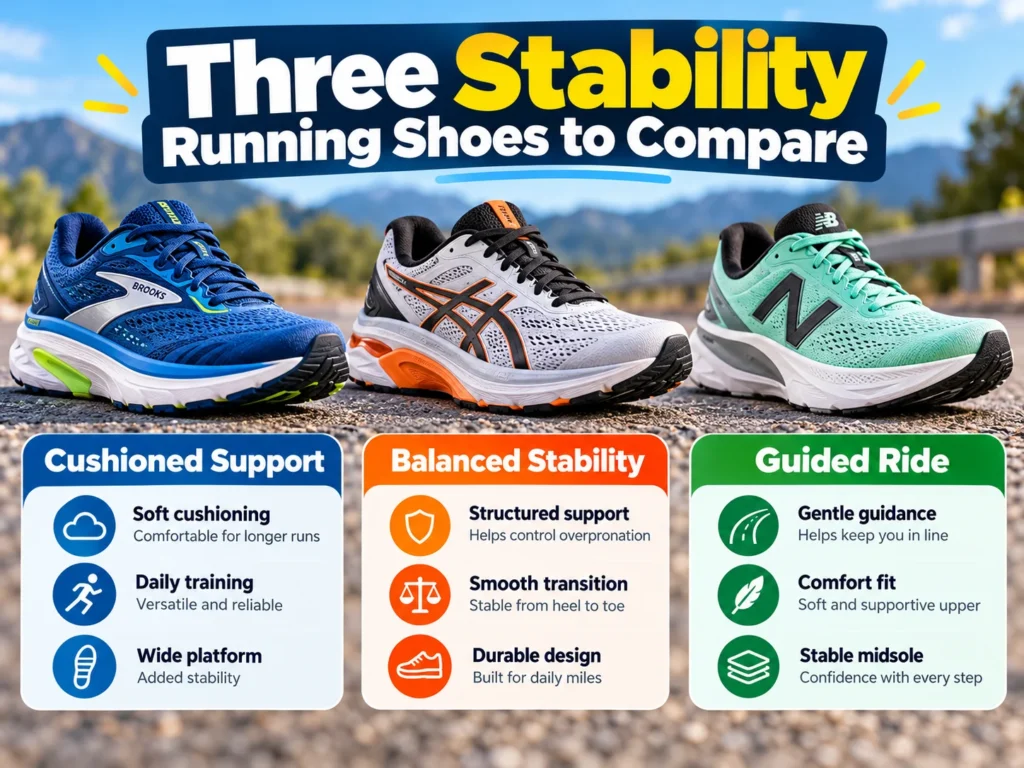
If you’re ready to compare specific models, these three options provide useful starting points. I would choose between them based on cushioning preference, support feel, and fit rather than ranking one as universally best.
The scores below are feature-based editorial assessments out of five, not Amazon customer ratings or firsthand performance-test results.
🏆 Cushioned Support Pick
ASICS GEL-KAYANO 33
★★★★½ 4.5/5 editorial score
Features FluidSupport technology, FF BLAST MAX and FF BLAST PLUS cushioning, and an 8 mm drop. I’d shortlist it for runners who prioritize substantial cushioning alongside dedicated stability features. Its maximum-cushion construction may not suit runners seeking minimal bulk.
👟 Structured Daily Support
Brooks Adrenaline GTS 25
★★★★☆ 4.0/5 editorial score
Combines GuideRails support with DNA LOFT v3 cushioning and a 10 mm drop. I consider it a strong comparison option for runners who want noticeable structure during everyday training. Its guided feel and higher drop won’t match every running preference.
🚶 Geometry-Based Guidance
Saucony Guide 19
★★★★☆ 4.0/5 editorial score
Uses CenterPath sidewalls, PWRRUN cushioning, and a 6 mm drop to create a guided running platform. I’d compare it with traditional support shoes if a less intrusive, geometry-led design sounds appealing. Its shape and rocker still require an individual fit check.
Frequently Asked Questions About Stability Running Shoes
Are Stability Running Shoes Better Than Neutral Shoes?
Neither category is universally better. Stability shoes provide extra structural guidance, while neutral shoes generally allow a less directed ride. Some runners prefer the supported feeling of stability footwear, while others find neutral models more comfortable. Fit and individual response should guide the decision.
Do Stability Running Shoes Help With Flat Feet?
Stability shoes may improve comfort for some runners with flat feet, particularly those who prefer additional guidance. However, low arches alone don’t prove that stability footwear is necessary. Many flat-footed runners use neutral shoes comfortably, and recurring pain should receive an individualized assessment.
Are Stability Running Shoes Good for Beginners?
Yes, beginners can use stability shoes for walking, jogging, and everyday training. The most important considerations are comfort, proper fit, and appropriate cushioning. Beginners don’t need corrective footwear automatically, and stability technology cannot replace gradual training progression or adequate recovery.
Can Stability Running Shoes Cause Foot Pain?
Yes, any poorly fitted running shoe can cause discomfort. A stability shoe may create unwanted arch pressure, rubbing, or restricted movement when its design doesn’t suit your foot. Stop using shoes that cause persistent pain or numbness, and seek professional advice if symptoms continue.
Do You Need Stability Running Shoes if You Overpronate?
Not necessarily. Overpronation describes a movement pattern, but it doesn’t automatically indicate injury or require corrective footwear. Stability shoes may feel better for some runners with pronounced inward movement. Comparing comfort and assessing any recurring symptoms is more useful than choosing shoes from pronation alone.
Final Verdict: Are Stability Running Shoes Right for You?
Stability running shoes provide additional guidance through supportive midsoles, wider platforms, and specialized design features. They can be a practical option for runners who appreciate a more controlled running experience.
However, extra support doesn’t guarantee comfort or injury prevention. Your preferred fit, cushioning, and natural movement should guide the choice.
My recommendation: Start by comparing a comfortable neutral shoe with a modern stability model. Choose the one that feels secure without creating unwanted pressure.
If discomfort continues despite appropriate footwear, seek an individualized assessment rather than relying on increasingly supportive shoes.
Ready to choose? Compare the models above, check the correct size and width, and prioritize comfort throughout your stride.


Steven is a former sportsperson and now a full-time businessman and research writer. He is the mastermind of this site, and he created this site to help people who need specialized shoes for different activities. When he was a sportsperson, he was very passionate about different types of shoes for his sports purpose. The passion he had for shoes at that time now turned into his profession. Besides his shoe business, he loves sharing his knowledge and experience with people and helping them maintain healthy feet.
More Posts